
GADGETS
INIU SnapGo Air Turns Thin iPhones Into a Two-Piece Kit
INIU’s SnapGo Air is the $54.99 Qi2.2 magnet thin iPhones now assume you carry, while 25W and 45W are peaks the spec sheet cuts to 15W.

INIU’s SnapGo Air is a 10,000mAh magnetic pack that sells Qi2.2 25W charging for $54.99. The P781 is 0.5 in (1.37 cm) thick and 6.9 oz (195.4 g), with a 12 cm USB-C GoCord that also refills the bank.
The product that matters is not another slim brick. Thin 2026 phones, led by iPhone Air, left spare capacity on the desk, and this magnet is the cell they no longer carry inside the handset.
Thin Phones Outsourced the Extra Cell
INIU’s own wireless lab list leads with iPhone Air at about 2.0 full charges from one cycle, then iPhone 17 at about 1.8 and AirPods Pro 2 at about 13.4. That order is the tell. The Air is the phone this category now orbits, because Apple cut wireless speed on it and then sold a matching battery that only fits that model.
THE THIN-PHONE CHARGE MATH
- Air wireless cap: iPhone Air takes up to 20W on Qi2, not the 25W Qi2.2 peak the SnapGo Air advertises for later Pro models.
- Apple’s own pack: the iPhone Air MagSafe Battery adds up to 65 percent extra charge and tops out at 12W on the go.
- SnapGo Air cell: 10,000mAh in a 1.37 cm magnet, with INIU quoting about two wireless cycles into an Air.
- US price: $54.99 on INIU’s shop, with a subscribe price of $46.75.
A 20W phone with a first-party 12W add-on is a two-piece product whether Apple says so or not. Third-party 10,000mAh magnets exist to finish that job for people who also own an older MagSafe iPhone, a Pixel, or a pair of AirPods.
INIU was founded in 2014 and says it serves more than 40 million users in 174 countries, with more than 100 patents. TinyCell is the cell recipe behind the slim stack, 15% lighter and 25% smaller than a standard cell, and HyperStack is the inductor layout INIU describes as NVIDIA-grade hot-pressed parts in a smaller footprint. Those two claims are how a 10,000mAh pack lands at 1.37 cm without becoming a 5,000mAh novelty.
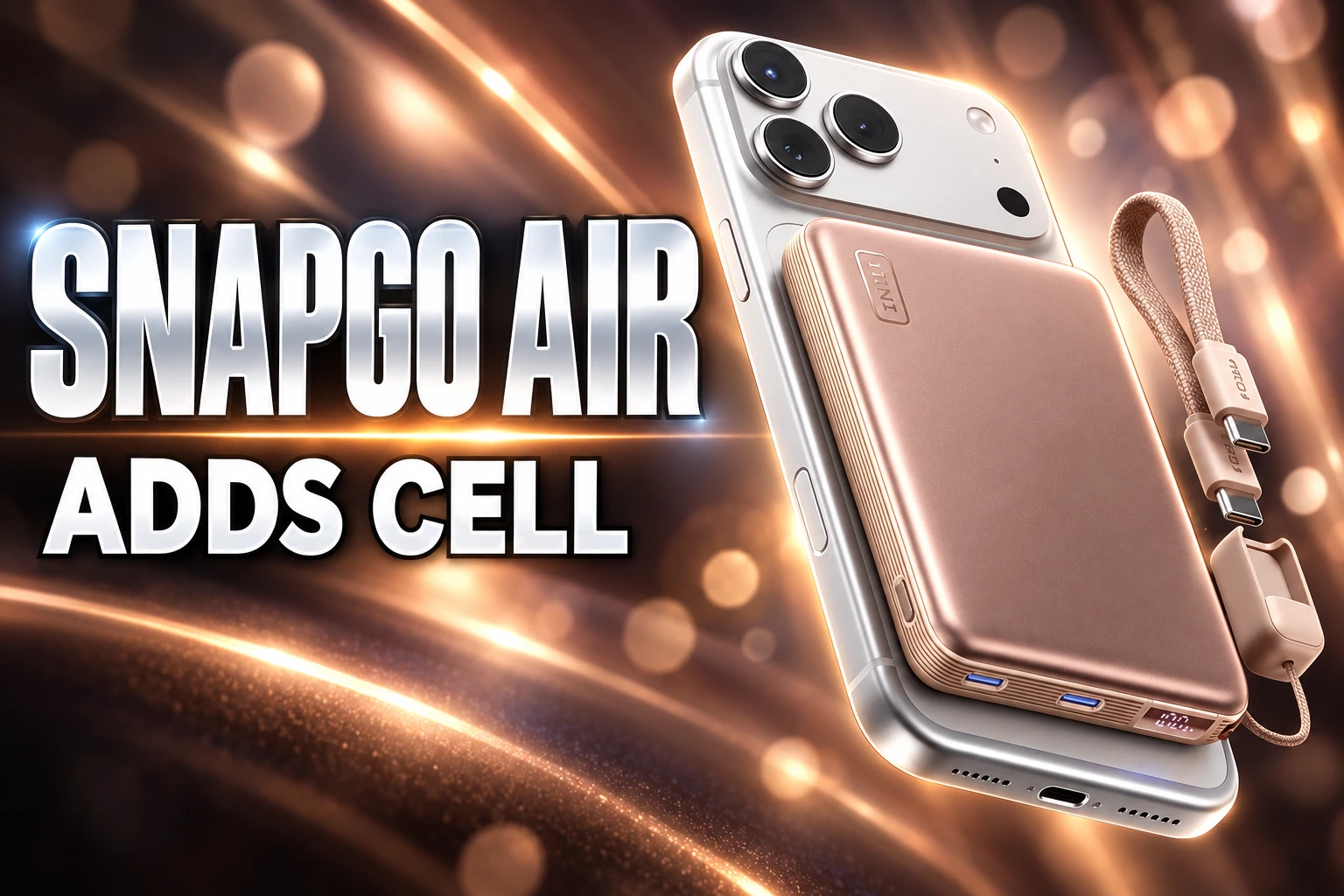
Dual Charging Drops the Pack to 15W
The box talk is 25W wireless and 45W wired. The official SnapGo Air spec sheet is blunter once two ports work at once. Any mix of the two USB-C ports, or one port plus the magnet, is capped at 15W. The same 15W ceiling applies if you try all three outputs together. INIU even tells you to press a button to turn wireless on during a wired session, which is the opposite of an always-on everyday magnet.
THE OUTPUT MODES ON PAPER
| Mode | Rated output | What that is for |
|---|---|---|
| Wireless only | 25W Qi2.2 (also 15W / 10W / 7.5W / 5W) | One phone on the magnet |
| One USB-C port | 45W max | A phone, tablet, or light laptop on the GoCord |
| Both USB-C ports | 15W max | Two wired gadgets at once |
| USB-C plus wireless | 15W max | Phone on the back and a second device on a cable |
| All three outputs | 15W max | The “charge 3 devices” pitch |
| Input | 27W max | Refilling the pack itself |
That 15W combined figure is why the dual-device story and the 25W story cannot be true in the same minute. Use the magnet alone if you want the headline speed. Plug in a second device and you are back in old Qi territory, sharing a small pool of watts. Input is 27W, so the pack cannot refill as fast as it can empty a phone on the 45W port.
The GoCord is a 0.4 ft (12 cm) 60W USB-C lead that ships on the body as a loop. INIU times an iPhone 17 Pro from about 20% to 78% in 25 minutes on that cable, and it quotes a full self-recharge in about 1.8 hours through the same lead. Those numbers are INIU lab results, not a second-clock on a desk.
What Qi2.2 25W Does on an iPhone 17
Qi2.2 is the Wireless Power Consortium step also sold as the Qi2 25W charging standard, and it is the reason this pack exists as a 2026 product rather than another 15W MagSafe clone. Qi2 itself tops out at 15W with magnetic alignment. Qi2 25W raises that to 25W, stays an open standard, and, in Belkin’s account of the test load, runs 691 test cases before a charger may carry the mark. MagSafe can also hit 25W on newer iPhones, but it stays inside Apple’s closed accessory program.
INIU’s lab comparison for an iPhone 17 Pro is 50% in 33 minutes at 25W versus 63 minutes at 7.5W Qi, a 30-minute gap. That 25W only shows up when both ends of the link support it. Older MagSafe phones still snap on. They just do not get the new ceiling.
THE IPHONE WATTAGE SPLIT
- Up to 25W: iPhone 17, 17 Pro, and 17 Pro Max natively; iPhone 16 Plus, 16 Pro, and 16 Pro Max with iOS 26 or later.
- Up to 20W: iPhone Air, which Belkin lists as a 20W Qi2 phone even on a 25W charger.
- Up to 15W: iPhone 12 through 15 series on Qi2, plus 17e-class models that stay on the older magnetic cap.
- Cases and buds: MagSafe-style cases up to 4 mm thick, plus AirPods 3, AirPods Pro 2, and AirPods Pro 3 on the magnet.
Google Pixel 10 Pro XL is the Android phone Belkin names at 25W with built-in magnets. Pixel 10, 10 Pro, and 10 Pro Fold stay at 15W. Galaxy S26 Ultra can take 25W, but Samsung still wants a magnetic case for alignment. INIU’s wireless list is still an iPhone list from 12 through 18 and Air; Pixel 6 and later and Galaxy S21 and later show up on the wired side.
A Qi2.2 logo on a listing is not the same as a pass in the WPC Qi product database. “Qi2 compatible” and “supports 25W” are marketing lines. The model number is the check, and P781 is the number to look up for this pack.
Apple’s Air Pack Stops at 12W
Apple already admitted the thin-phone problem. In 2025 it shipped a MagSafe Battery that only fits iPhone Air, after it pulled the old Lightning MagSafe Battery Pack in September 2023. The new pack is the official extra cell, and it is slower and narrower than the SnapGo Air on paper.
The iPhone Air MagSafe Battery was created exclusively for iPhone Air. Designed to slip into your pocket, it feels great in your hand and adds up to 65 percent additional charge to iPhone Air, extending battery life further than that of any other iPhone.
Apple Support, iPhone Air MagSafe Battery tech specs
The same iPhone Air MagSafe Battery specs cap on-the-go wireless at 12W. Faster charging needs the pack on the phone and a 20W or higher adapter at the same time. Retail listings still hang a $99 tag on that accessory. It will not snap to an iPhone 17 Pro. It will not feed a Pixel. USB-C on it is for smaller accessories, not a 45W laptop bump.
THREE MAGNETS, THREE JOBS
| Pack | Wireless | Capacity story | Wired | Price |
|---|---|---|---|---|
| INIU SnapGo Air (P781) | 25W Qi2.2 | 10,000mAh; about 2.0 Air charges (INIU lab) | 45W peak, 15W shared | $54.99 |
| Apple iPhone Air MagSafe Battery | 12W on the go | Up to 65% extra on Air only | USB-C for smaller accessories | $99 in retail listings |
| INIU SnapGo P73 | 15W Qi2 | 10,000mAh, same family, older radio | 45W wired | $39.99 |
UGREEN lists its MagFlow 10,000mAh Qi2 pack at $89.99. Anker’s MagGo 10K Slim stays on 15W Qi2 at a $79.99 RRP in deal copy. The SnapGo Air’s job in that spread is obvious: certified 25W and a built-in cable, for less than Apple’s Air-only 12W slab. People who only own an Air and want Apple’s charge logic still have a reason to pay for the first-party magnet. Everyone else is being sold a generic extra cell, and INIU priced that cell like a cable.
Heat Trims the 45W Wired Peak
Temp Guard 3.0 is INIU’s name for the thermal loop. The company says it samples temperature 9,000 times per second in wireless use and holds the pack surface under 104°F (40°C), which it calls 14°F (8°C) cooler than a common industry mark. Eighteen SmartProtect layers sit under that, covering USB-C and USB-A overcharge, output short-circuit, overcurrent, over-temperature, and IC overheat shutdown. Those are the claims on the product page, not a lab log from a second party.
Hands-on use keeps running into the same limit those protections imply. Wireless charging warms the stack, and the pack then eases off, so a 25W session does not stay at 25W for a full tank. One overnight wireless fill on a large iPhone ran past five hours. A timed USB-C test held 45W for only 5 to 15 minutes before the output fell near 30W, and a desk thermometer on one unit peaked at 105°F, a tick over INIU’s 104°F surface line. Compact 10,000mAh magnets have less area to dump heat than thicker Qi2.2 banks, so summer desks and pockets make that fade show up sooner.
The 13N magnet is the part testers do not argue with. The pack stays on during a commute. The side LCD shows a percentage without a front window. Our hands-on SnapGo Air charging notes walk through that daily snap-on use in more depth. The short version is that the magnet and the GoCord are the features you actually touch; the wattage on the box is the feature heat edits.
The $54.99 Price Sits Under the Usual MagSafe Premium
INIU’s June 5 launch announcement set US MSRP at $54.99, with £49.99 in the UK and €54.99 in Europe, on iniushop.com and Amazon. The shop’s subscribe-and-save line is $46.75, which is 15% off the $54.99 tag. Dimensions are 4.1 × 2.8 × 0.5 in (10.5 × 7.1 × 1.37 cm). Colors are Space Gray, Lunar Silver, Metallic Mocha, Soft Lilac, Sunset Orange, and Midnight Navy, in anodized aluminum with a soft-touch finish.
The warranty is three years, with INIU promising a new unit if quality fails in that window. Magnetic charging is listed for iPhone 12 through 18 and the Air series, which is INIU writing the next handset onto a pack that already has to live on this year’s thin phones. Wired charging covers iPhone 8 and later (Lightning iPhones need a cable INIU does not put in the box), iPad, MacBook Air, Pixel 6 and later, and Galaxy S22-class phones in the launch copy, with the shop list stretching Galaxy back to S21.
Read the 15W combined cap before you buy the three-device pitch. Read the 20W Air cap before you buy it as a 25W Air kit. What you get for $54.99 is a 10,000mAh magnet that is fast on a supported iPhone 17 when it is the only thing drawing power, and slow in the exact everyday case of a phone plus buds. That is the extra cell thin phones now assume you will carry, sold at cable money, with a 12 cm lead already on the body so you do not have to remember the rest.
Frequently Asked Questions
Is the INIU SnapGo Air Airline-Approved?
INIU labels the P781 airline-approved. A 10,000mAh pack sits well under the usual 100Wh carry-on limit for spare lithium batteries, so it is meant for a cabin bag rather than checked luggage, though each airline can still set its own handling rules at the gate.
What Comes in the SnapGo Air Box?
The box holds the 10,000mAh pack, the 0.4 ft (12 cm) USB-C GoCord already attached, a user manual, and INIU’s three-year replacement promise plus lifetime technical support. Orders of $59.99 or more on INIU’s shop also trigger a separate starter kit INIU values at $30, a 6.6 ft 100W USB-C cable and a travel pouch, which is not part of the $54.99 pack itself.
Will a MagSafe Case Block SnapGo Air Charging?
INIU rates magnetic charging through cases up to 4 mm thick. Thicker wallets, rings, and metal plates can weaken the 13N grip or cut the wireless rate even if the pack still snaps on, so a slim MagSafe or Qi2 case is the setup that matches the 25W claim on a supported phone.
How Do You Confirm SnapGo Air Is Qi2.2 Certified?
Look up model P781 in the Wireless Power Consortium’s certified-product database rather than trusting a listing that says “Qi2 compatible” or “25W MagSafe.” Only packs that passed an authorized lab test may show the Qi2 mark, and that database entry is the record that separates a certified P781 from a magnet with a 25W sticker.
INIU already printed iPhone 18 series on the SnapGo Air magnet list, which is how this accessory class now works. The phone gets thinner, the spare cell lives on the back, and the number to read on the spec sheet is still that 15W shared cap.

Instagram Plus Tests a Read-Only Mode That Cuts Stories

Altman Asks the Public to Accept Some AI Harm

Google Freezes OSS VRP Product Reports After AI Flood

AI Agents Make Payment Rails the Scarce Prize

Turkey’s Crypto Boom Now Runs Through Three Banks

Fable 5 Came Back Under a Commerce On-Off Switch

Google’s SpaceX GPU Lease Has a Sept. 30 Deadline

Plasma One’s XPL Locks Face a 1.81 Billion Cliff

DGO’s Rs 549 World Cup Pass Cost Fans Sleep and Data

Moonshot AI’s $30 Billion Ask Became a $35 Billion Close
-
 AI4 months ago
Fable 5 Came Back Under a Commerce On-Off Switch
-
 AI4 months ago
Google’s SpaceX GPU Lease Has a Sept. 30 Deadline
-
 CRYPTO4 months ago
Plasma One’s XPL Locks Face a 1.81 Billion Cliff
-
 APPS4 months ago
DGO’s Rs 549 World Cup Pass Cost Fans Sleep and Data
-
 AI4 months ago
Moonshot AI’s $30 Billion Ask Became a $35 Billion Close
-
 NEWS4 months ago
ColorOS 17 Device List Spans Oppo, OnePlus and Realme
-

 GAMING4 months ago
Xbox Cuts 3,200 Jobs After Five Years of Thin Returns
-

 GAMING4 months ago
The RTX 4050 Under Rs 70,000 Hides a Wattage Gap