
COMPUTERS
Nvidia and Intel Split the Computex 2026 Chip Fight
Computex 2026 handed Nvidia the Windows laptop CPU and Intel the handheld chip, with Spark PCs due in October and AMD left answering both.

Nvidia’s first Windows CPU and Intel’s first handheld chip split Computex 2026, and AMD left Taipei with answers due on both. The 15-product floor list led with Nvidia’s first CPU winning best in show, then stacked an Intel handheld, a $699 XPS, and a 5K gaming panel behind it.
The first RTX Spark laptops and compact desktops are due in October, four months after Nvidia’s May 31 unveil at GTC Taipei. Until those machines land, the scoreboard is still a claim. The handheld result is already in shops.
Nvidia Walked Off With the Laptop CPU
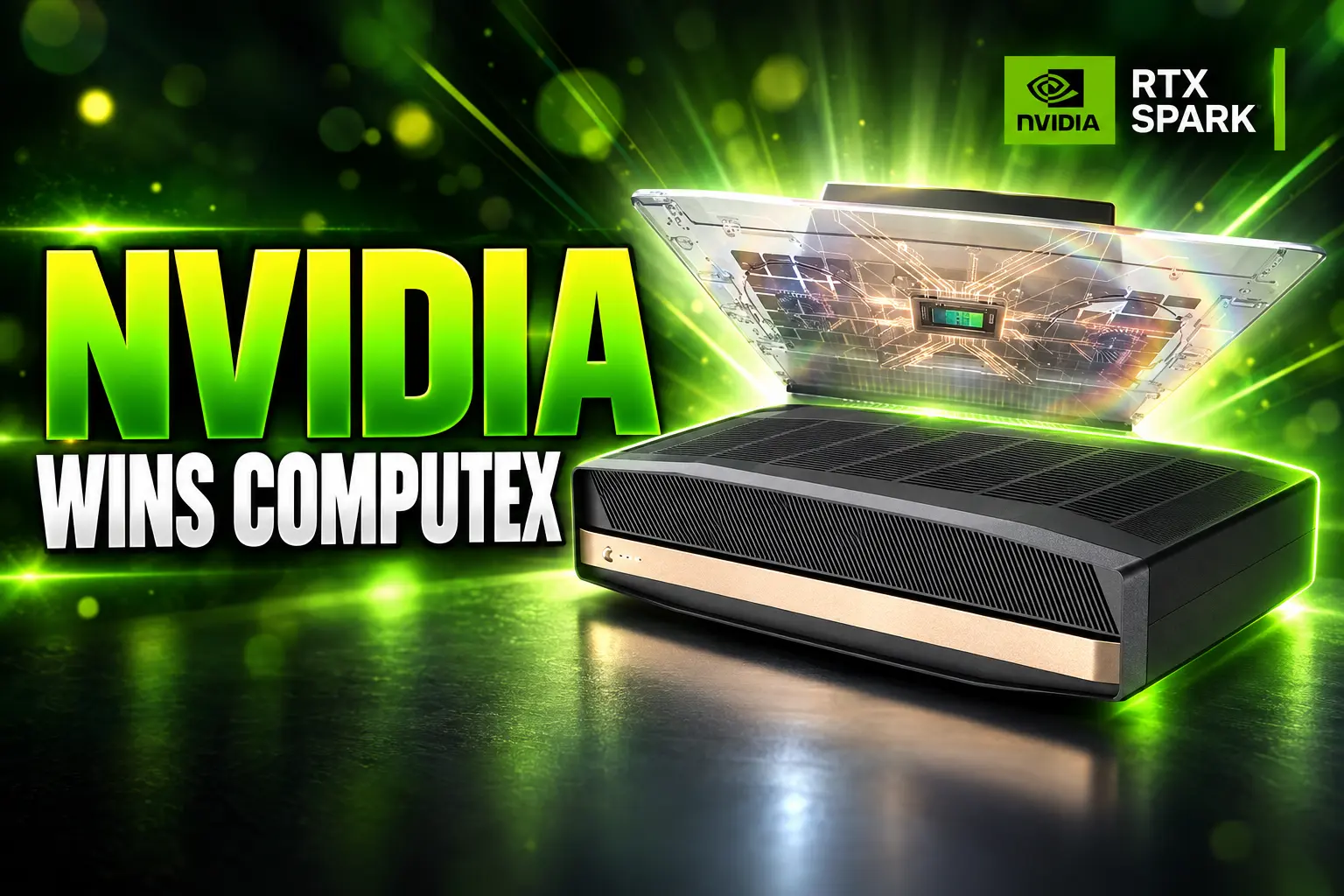
On May 31, Nvidia put a 20-core Grace CPU and a Blackwell GPU on one Arm package built for Windows laptops and small desktops. MediaTek worked on the custom CPU, which mixes 10 Cortex-X925 cores with 10 Cortex-A725 cores. The top SKU pairs that CPU with a 6,144-core Blackwell RTX GPU, the same CUDA count as a desktop RTX 5070, and up to 128 GB of unified LPDDR5X that the CPU and GPU share.
Nvidia’s newsroom rates the chip at 1 petaflop of AI performance in FP4, enough, it says, to run 120-billion-parameter models locally with up to 1 million tokens of context. The same brief says a Spark machine can render 3D scenes larger than 90 GB, edit 12K 4:2:2 video, and play AAA games at 1440p over 100 frames per second with ray tracing, DLSS, and Reflex. Adobe is rebuilding Photoshop and Premiere for the chip and says those tools should see up to 2x faster AI, editing, color, and effects when Spark systems arrive.
RTX SPARK ON PAPER
- Top SKU: 20-core Grace CPU, 6,144 CUDA cores, up to 128 GB unified LPDDR5X, 45-80 W in laptops.
- Cut SKU: 18-core Grace CPU, 5,120 CUDA cores, up to 64 GB unified memory, laptops only, same 45-80 W band.
- Desktop N1X: The full 20-core, 6,144-core chip at 140 W for compact towers that can leave an agent running all day.
- Chassis claim: Laptops as slim as 14 mm and as light as 3 pounds, in 14- and 16-inch sizes with tandem OLED panels and G-SYNC.
Jensen Huang, Nvidia’s founder and CEO, sold that package as a change in how a PC is used, not only in how fast it draws a frame.
The PC is being reinvented. For forty years, you launched apps. Click. Type. With RTX Spark and Microsoft Windows, you ask, and the PC does the work. RTX Spark brings everything NVIDIA has built, CUDA, RTX, our AI platform, into a single superchip. Local agents. Frontier models. Creative workflows. RTX games. All on a laptop. This is the new PC. The personal AI computer.
Jensen Huang, founder and CEO, NVIDIA newsroom, May 31, 2026
Satya Nadella, Microsoft’s chairman and CEO, called it a step toward “unmetered intelligence to every home and every desk with Windows.” Asus, Dell, HP, Lenovo, Microsoft Surface, and MSI are in the first wave, with Acer and Gigabyte to follow. CUDA, TensorRT, DLSS, Reflex, and G-SYNC ride along, which is the part Intel, AMD, and Qualcomm cannot photocopy in a season.
The Handheld AMD No Longer Owns
Intel’s prize sat in a different aisle. Arc G3 Extreme is the company’s first chip built for gaming handhelds, a 14-core Panther Lake part (2 performance cores, 8 efficient cores, 4 low-power cores) with an Arc B390 GPU on 12 Xe3 cores. MSI put it in the Claw 8 EX AI+, an 8-inch machine floor demos ran through Forza Horizon 6 and Hogwarts Legacy at 60 fps with high settings. Acer’s Predator Atlas 8 used the same silicon.
Independent tests later locked both the Claw and an Asus ROG Xbox Ally X at 35 watts, 1080p, and no upscaling. The Intel chip’s overall rating was 98.6 against 69.9 for AMD’s Ryzen Z2 Extreme, a 41% gap. AMD still won one title in that suite. The rest of the sheet did not look like a contest.
ARC G3 EXTREME VS RYZEN Z2 EXTREME AT 35W
| Title (1080p, no upscaling) | Arc G3 Extreme | Ryzen Z2 Extreme |
|---|---|---|
| Overall rating | 98.6 | 69.9 |
| Cyberpunk 2077 | 46.7 fps | 28 fps |
| Baldur’s Gate 3 | 49.5 fps | 32.5 fps |
| F1 24 | 36.5 fps | 17.7 fps |
| X-Plane 11.11 | 38.3 fps | 43 fps |
MSI lists the Claw 8 EX AI+ at $1,799. The Ally X that took the beating sells at $999. That is the other half of the handheld scoreboard: Intel took the frames, and AMD still owns the price that most people will pay. Nvidia did not put Spark in a handheld at the show, so the gap Intel walked through was empty. People who want that Intel silicon without Windows already have a side door in Intel handhelds on SteamOS.
Why Microsoft Put Spark in Surface
Microsoft’s answer to a 16-inch MacBook Pro is no longer a Qualcomm story. The Surface Laptop Ultra is a 15-inch clamshell on RTX Spark, with a mini-LED PixelSense Ultra panel at 2880 x 1920 (262 ppi) that hits 2,000 nits in HDR. The chassis stays under 18 mm and under 4.5 pounds (2 kg). Microsoft says thermal headroom is 2.5 times that of the 15-inch Surface Laptop 7.
Ports are HDMI, USB-C, USB-A, a full-size SD reader, and a 3.5 mm jack, and the SSD is user-replaceable. Platinum and Nightfall are the colors. Surface boss Andrew Hill called it the most powerful thing the group has ever made. Brett Ostrum, corporate vice president of Surface, said the machine is for creators, developers, and engineers who need serious performance in a portable Windows PC. Microsoft still has not posted a price.
Introducing Surface Laptop Ultra.
Built for world makers. Designed for what's next.
The most powerful Surface laptop ever. Coming Fall 2026.
Sign up to learn more: https://t.co/k8aEX2pTAy pic.twitter.com/bY1NdzNnie
— Microsoft Surface (@surface) June 1, 2026
The official post calls it the most powerful Surface laptop ever and points to a fall arrival. The first replies were not about CUDA counts. They were about Windows bloat, and about whether Apple’s M5 still wins once the demos stop. That is the sales job Spark laptops actually have. The die can look like a 5070. The buyer still has to want Windows on Arm, haptic trackpads, and local agents more than a MacBook Pro.
A $699 XPS and a 5K Gaming Panel
Dell aimed the new XPS 13 at Apple’s MacBook Neo and launched it at $699, or $599 for students in the back-to-school window. It is 12.7 mm thick and 2.2 pounds, with a 13.4-inch 2560 x 1600 touch panel that ramps from 30 Hz to 120 Hz and a claimed 17 hours of video. The base chip is Intel’s Core 5 320, with Core Ultra 7 355 configs later. On September 10, Dell moved the $699 box to 8 GB of RAM and 256 GB of storage, and asked $799 for the 512 GB config that used to sit at $699.
Gigabyte’s Aorus Elite FM275K16P did a quieter kind of damage. 5K was an Apple Studio Display habit. The 27-inch panel runs 5120 x 2880 at 218 ppi, then drops to 4K at 220 Hz or QHD at 330 Hz, with 2,304 local-dimming zones behind a glossy sheet. Floor awards also liked Asus’s ROG Xbox Ally X20, a 7.4-inch OLED handheld at 1,400-nit HDR with Gulikit TMR sticks and a pair of glasses that throw a 171-inch virtual image. Asus later priced a standalone OLED Ally with AR glasses at $1,300, $300 above the LCD Ally X, with shipments on October 15.
WHO LEFT WITH WHAT
- Laptop CPU: Nvidia RTX Spark, best in show, first Windows machines due in October.
- Handheld chip: Intel Arc G3 Extreme in the $1,799 MSI Claw 8 EX AI+ and Acer’s Predator Atlas 8.
- Budget clamshell: Dell XPS 13 at $699, now with less storage in that slot after the September 10 hike.
- 5K gaming panel: Gigabyte FM275K16P, tri-mode 165 / 220 / 330 Hz on 27 inches.
- OLED handheld: Asus ROG Xbox Ally X20 at $1,300, shipping October 15, still on AMD silicon.
The rest of the floor was garnish that still sells. Asus asked $259 for the ROG Harpe II Extreme Edition 20 mouse and $699 for the Azoth Extreme Edition 20 keyboard. Corsair showed a dual-dongle HS35 v3 headset and a Warthog case with carry-handle feet and a rear I/O lamp. MSI put a hologram of its dragon, Lucky, in a desktop front panel. Those products did not move the CPU map. They filled bags.
Windows on Arm Is No Longer Qualcomm’s Story
For two years, a fast Windows-on-Arm laptop meant Snapdragon X. Microsoft’s own flagship now boots Nvidia, and Qualcomm no longer has that slot to itself. Spark is the second major Arm supplier for Windows, and it arrives with CUDA, which Snapdragon never had. That is why Dell, HP, Lenovo, Asus, and MSI stood on Huang’s stage instead of waiting for another Oryon cycle.
Qualcomm is not exiting. It still sells the chips that already shipped in Copilot+ PCs, and those machines do not need a 45-80 W envelope or a 128 GB memory bet. What it lost in Taipei is the exclusive claim that Windows on Arm is its house. Microsoft just put its most expensive clamshell on a GPU company’s die. OEMs that spent a year tuning Snapdragon SKUs now have to keep two Arm stacks alive, or pick one and watch the other show take the creator budget.
The Model Has to Share the 128 GB
The 128 GB figure is the number people quote. It is also the number that misleads. Spark’s memory is one pool. Windows, Chrome, Premiere, and a local model all draw from the same LPDDR5X, so a 120-billion-parameter model at 4-bit can eat on the order of 60 GB before the rest of the laptop has sat down. Mixture-of-experts models with a small active set fit that envelope. Dense 200-billion-parameter runs turn into a stunt that needs other apps closed.
No third-party 120B tokens-per-second figure exists yet, because retail Spark laptops are still weeks out. Nvidia’s own claims (local agents, 1 million tokens, 1440p over 100 fps) are still vendor slides. Native Arm builds remain scarce, so a lot of the Windows library will live on translation until more publishers follow the Gamescom list that now includes Electronic Arts, Ubisoft, Embark, KRAFTON, NetEase, Riot, and Xbox. The hardware can look like a 5070 in a 14 mm shell. The software still has to show up.
That is why the Surface replies landed on Windows instead of CUDA. A Mac buyer is not waiting for Prism-class translation or for Premiere’s Spark build. A Claw buyer is staring at $1,799 next to a $999 Ally X that already plays the same Steam library. Nvidia won the laptop CPU argument on paper. Intel won the handheld fps argument in a lab. Neither win is a receipt until the October boxes, and the June Claw, are the machines people keep.
Spark Laptops Start Shipping in October
On September 3 at IFA, Nvidia said the first RTX Spark Windows PCs arrive in October, and Lenovo and Acer added designs to the six OEMs already on the list. Acer showed a compact Spark desktop. Lenovo showed a Yoga Pro 9n and a Yoga 9n 2-in-1. The N1X branding is now official for both the 20-core / 6,144-core chip and the 18-core / 5,120-core laptop SKU.
THE SWAP, BY DATE
- May 31, 2026: Nvidia unveils RTX Spark at GTC Taipei during Computex, with Microsoft on stage for Windows agents.
- June 1, 2026: Microsoft posts Surface Laptop Ultra, a 15-inch Spark clamshell due in the fall, still without a price.
- June 2026: MSI’s Claw 8 EX AI+ with Arc G3 Extreme begins shipping, putting Intel’s handheld chip in stores.
- July 2, 2026: Matched 35 W tests put Arc G3 Extreme 41% ahead of Ryzen Z2 Extreme, with AMD winning only X-Plane in that set.
- September 3, 2026: Nvidia confirms October shipments for Spark laptops and compact desktops, and names the two N1X configs.
- September 10, 2026: Dell’s $699 XPS 13 base becomes 8 GB and 256 GB; the 512 GB config moves to $799.
- October 2026: First Spark PCs due from Asus, Dell, HP, Lenovo, Microsoft, and MSI. Ally X20 ships October 15 at $1,300.
Asus, Dell, HP, Lenovo, Microsoft, and MSI are supposed to put Spark machines on sale in October, with Acer and Gigabyte behind them. Intel’s handheld already has a price and a review sheet. Nvidia’s laptop CPU still does not. The next scoreboard is a street date, not a booth.

Instagram Plus Tests a Read-Only Mode That Cuts Stories

Altman Asks the Public to Accept Some AI Harm

Google Freezes OSS VRP Product Reports After AI Flood

AI Agents Make Payment Rails the Scarce Prize

Turkey’s Crypto Boom Now Runs Through Three Banks

Fable 5 Came Back Under a Commerce On-Off Switch

Google’s SpaceX GPU Lease Has a Sept. 30 Deadline

Plasma One’s XPL Locks Face a 1.81 Billion Cliff

DGO’s Rs 549 World Cup Pass Cost Fans Sleep and Data

Moonshot AI’s $30 Billion Ask Became a $35 Billion Close
-
 AI4 months ago
Fable 5 Came Back Under a Commerce On-Off Switch
-
 AI4 months ago
Google’s SpaceX GPU Lease Has a Sept. 30 Deadline
-
 CRYPTO4 months ago
Plasma One’s XPL Locks Face a 1.81 Billion Cliff
-
 APPS4 months ago
DGO’s Rs 549 World Cup Pass Cost Fans Sleep and Data
-
 AI4 months ago
Moonshot AI’s $30 Billion Ask Became a $35 Billion Close
-

 NEWS4 months ago
ColorOS 17 Device List Spans Oppo, OnePlus and Realme
-

 GAMING4 months ago
Xbox Cuts 3,200 Jobs After Five Years of Thin Returns
-
 GAMING4 months ago
The RTX 4050 Under Rs 70,000 Hides a Wattage Gap