
APPS
Focus Apps Must Host the Feeds They Were Built to Kill
UBC interviews with 27 neurodivergent students show Forest, Freedom and Screen Time punish the YouTube ritual that often starts their work.

UBC interviews with 27 neurodivergent students show focus apps that kill a session for opening YouTube also kill the ritual that starts their work. Forest, Freedom and Apple Screen Time still treat that clip as a leak to plug.
The finding, published for CHI 2026 and spelled out by the authors on June 3, 2026, is not only that timers feel harsh. It is that the next honest blocker has to hold a short, known feed inside the session, then put the lock back. None of the three tools the students actually used is built as that product.
Twenty-Seven Students Named the Same Three Apps
Marvel Chrismatheo Hariadi, Kevin Chow and Joanna McGrenere, computer science researchers at the University of British Columbia, sat down with 27 college and university students in Canada and the United States. Every student had ADHD, autism spectrum disorder, generalized anxiety disorder, or more than one of those, and every one of them already used a digital distraction blocker.
The CHI 2026 interviews with 27 students are not a bake-off of which app saves the most minutes. They map how people whose attention does not switch like a tap actually live with locks sold as self-control.
On June 3, 2026, the same authors wrote that neurodivergent people make up an estimated 10 to 20 per cent of the Canadian population, and that the share on campus is likely higher because fewer than half disclose. Consumer blockers are, in practice, unofficial classroom kit for students who never file a disability form.
WHICH BLOCKERS THE 27 STUDENTS ALREADY USED
| App | Students using it | What it gates |
|---|---|---|
| Apple Screen Time | 16 of 27 | Clock windows and app-category limits |
| Forest | 9 of 27 | A virtual tree that dies if you leave |
| Freedom | 5 of 27 | Chosen sites and apps across devices |
Those counts overlap on purpose. The paper says more than half of the group ran more than one blocker at once. Apple’s switch is the default, not the novelty tree. That is the install base any redesign has to move.
Forest Still Sells the Dead Tree
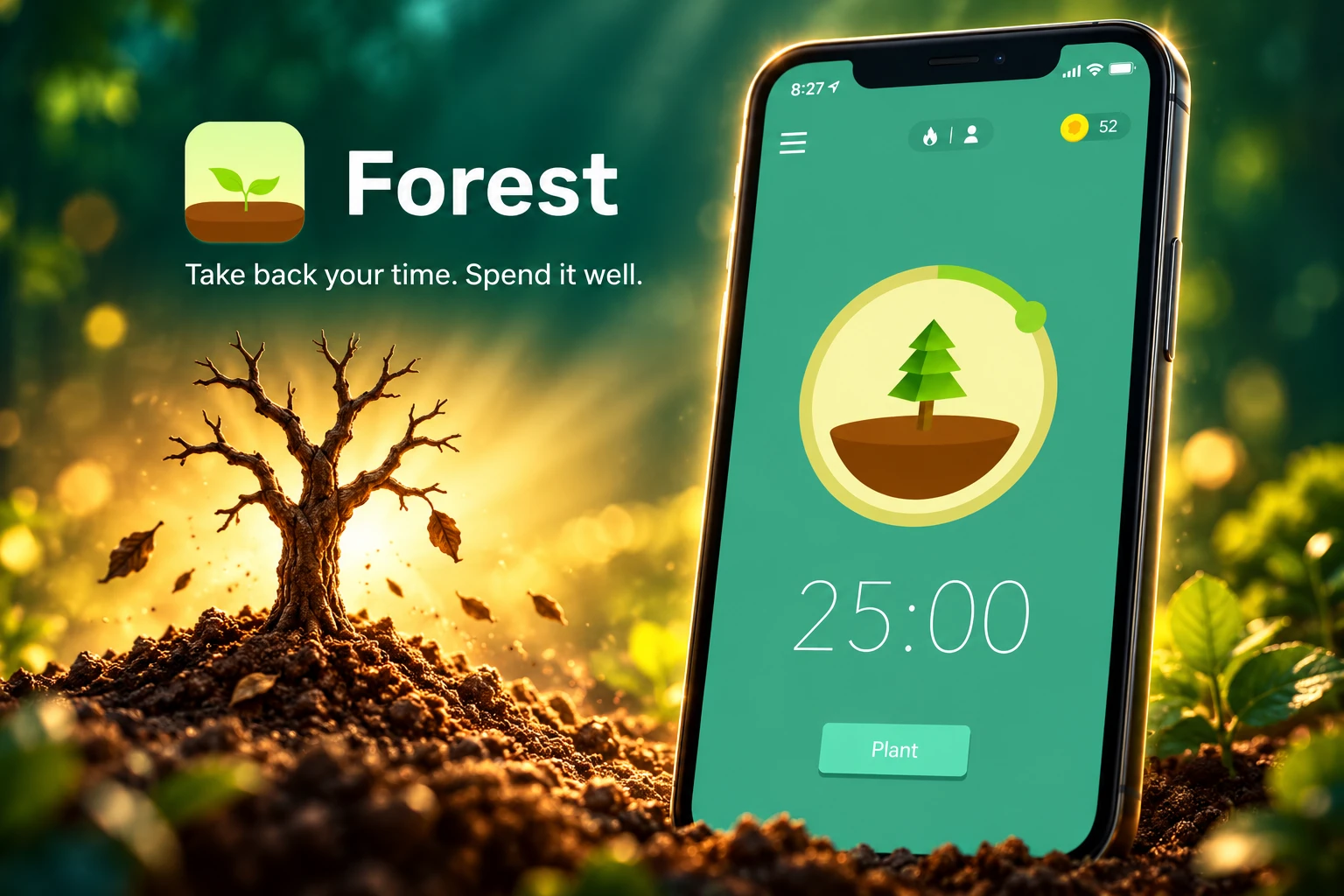
Seekrtech’s Forest, first shipped in 2014, still describes itself as a pomodoro-style timer with a twist. You pick a focus length and a tree species. The seedling grows while you stay in the session. Leave, and the tree is gone.
Use other apps and your tree dies.
Seekrtech, Forest product site
The company is not shy about the feeling that creates. “That small sense of loss is intentional,” the same page says. Deep Focus blocks chosen apps during a session. Time Guard extends the lock across the day. Finish the block, and the tree joins a forest you keep.
Forest also plants living trees. Its site counted 2,102,946 on the ground through a partnership with Trees for the Future, paid from app revenue. Since 2014, Seekrtech says, more than 60 million people have used Forest. It lists a 4.8 App Store rating, more than 1 million ratings across stores, and a top productivity ranking in 157 countries.
The store copy still courts the same users the CHI paper interviewed. Forest’s Google Play listing frames the product as a Pomodoro study timer to beat phone addiction, manage ADHD and stay focused. The product site goes further: “Loved by students, remote workers, and ADHD focusers.”
A withered tree is a sharp cue if the only problem is a wandering thumb. It is a public fail state if the thing you opened was the clip that lets you start the essay. Forest’s allow list can keep a few tools alive during a session, but the session is still a clock, and leaving it still kills the tree.
Why Pomodoro’s 25 Minutes Clash With ADHD
Most blockers still borrow Francesco Cirillo’s late-1980s kitchen-timer method: work in a sealed 25-minute block, then take a short break. Cirillo treated a pomodoro as indivisible. If you break it, you throw it out. Forest, Apple’s timers and a long tail of copycats still sell that unit as the respectable way to work.
McGrenere, Chow and Hariadi write that focus, for the students they interviewed, does not work like a faucet. Starting can stall on executive dysfunction, on time blindness, or on a room that is already too loud. Some students with ADHD described hyperfocus that takes longer than 25 minutes to reach. A few with anxiety said the timer itself raised stress.
One student, tagged P12 in the paper, even used Forest’s clock as a dare rather than a wall, setting “30 minutes,” aiming a little under, and seeing how far a task would run. That is a cue. It is not the product Forest puts on the home screen, which still grows a tree for a fixed span and withers it if you leave.
FROM A TOMATO TIMER TO A CHI PAPER
- Late 1980s: Francesco Cirillo, then a university student, sets a tomato-shaped kitchen timer for 25 minutes and treats the block as indivisible.
- 2014: Seekrtech launches Forest, wrapping that block in a tree that dies if you switch apps.
- April 13, 2026: CHI publishes the UBC interviews from Barcelona’s 2026 conference.
- June 3, 2026: Hariadi, Chow and McGrenere tell a general audience that the lock should give way to stimming windows, task rules and less shame.
Indies are still shipping the same 25-minute object. The CHI paper is asking for a different unit of work, and the store shelves have not moved with it.
What Digital Stimming Means for Blockers
Digital stimming, as the UBC team uses the term, is a short, deliberate pass through familiar digital content, a favourite YouTube clip or a known social feed, used to settle overload and cross into a hard task. Students in the study turned blockers off to do it. The paper treats that as regulation, not a willpower crash, and says today’s apps offer no middle ground before the same clip becomes a doomscroll.
The authors borrow “stimming” from repetitive, soothing behaviour long described in neurodivergent communities, then apply it to the feed. In the paper they call digital stimming the deliberate, controlled use of apps and sites usually labelled distracting, aimed at emotional regulation and at the shift into focus.
That habit already has a plain name outside the lab. People keep looping a known clip, a cozy game, or an old YouTube channel the way someone else might tap a pen. A hard lock that scores that loop as a dead tree is not catching a relapse. It is interrupting the ramp.
WHAT THE INTERVIEWS TREAT AS A RAMP, NOT A LEAK
- A known clip: A favourite YouTube video, played because it is predictable, not because it is new.
- A familiar feed: A social app opened on purpose to bring stimulation down, then closed if the session actually starts.
- The off switch: The blocker is disabled for that window, because the tools on sale cannot host the clip inside the lock.
The catch, the authors say, is the same clip that soothes can swallow the afternoon. Their design ask is not “leave TikTok open.” It is a curated, time-boxed stim: known content, a hard stop, then the task. That turns a blocker into a tiny media player with a lock around it. Forest’s job today is to keep YouTube out. Apple’s Downtime does the same by category. Freedom’s pitch is a list of sites you cannot reach. Hosting the banned object is a different business.
Comparison Turned Focus Time Into a Score
Several students told the researchers that friction with the apps reminded them their minds were the problem. Shame showed up when a session ended early, and it showed up when a forest of healthy trees looked like someone else’s better brain.
One person said time lasted in Forest became a sore point next to other people’s gardens. Another cluster of quotes frames the blocker as a crutch, with students asking whether they will need it for the rest of their lives.
I don’t really use Forest that often because it’s like, ‘Oh yeah, I don’t need Forest. I can do this on my own.’ And then I’m not as aware that I find it helpful. So I kind of mentally gaslight myself.
Participant P10, CHI 2026 paper
That is the retention mechanic talking. A dead tree is memorable. A leaderboard of living ones is a social score. Forest even lets friends grow trees together. For a student already measuring focus against classmates, the garden is not a toy. It is evidence.
The paper also records the other side of that social layer. A student tagged P6, who compared herself with neurotypical peers in Forest, still lit up when friends showed off their gardens and said the moment felt supportive. The same object can be a pep rally and a report card. The CHI interviews say the report-card reading is the one that sticks when a session fails.
Leaving the app for something as small as a photo still counts as killing the tree. The product has to treat that as a defect in the user, because the tree is the rule. If the next version gave partial credit, or let a four-minute clip play inside the session, the dead tree would stop being the point.
Until I Write Two Pages, Not 25 Minutes
The authors’ third design move is to stop tying help to a clock. Blockers, they write, could wait on a goal (“until I write two pages,” or, in the paper’s own example, until a discussion section is drafted) instead of an arbitrary span. During ramp-up, the lock could loosen, or a stim window could open, then tighten once the work is actually moving.
Apple already has a cousin of that idea, and it is not built for a YouTube snack. Screen Time’s Downtime hides most apps for a scheduled stretch and leaves only calls, messages and the apps you choose to allow. App Limits put a daily minute cap on a category. Always Allowed is the exception list, the one parents are told to reserve for Phone, Messages and Maps. You can park YouTube there, but then it is available for the whole window, not for four minutes of settling. There is no “play this clip, then lock.”
Freedom, in the interviews, is the cross-device wall: the same blocklist on phone and laptop, so closing Instagram on one screen does not reopen it on the other. That solves a real workaround. It does not give the stim a legal address inside the session. The CHI paper’s students still had to break the wall to self-soothe.
Seekrtech has not announced a stim player. Apple has not turned Always Allowed into a timed clip. Freedom has not recast Locked sessions as task contracts. The June 3 essay is still the public brief, and the stores still sell a faucet you are supposed to turn on for 25 minutes.
McGrenere, Chow and Hariadi close the paper by asking for tools that treat hyperfocus and non-linear work as normal, not as bugs. Until a blocker can hold a known clip, watch a page count, and skip the funeral for a tree, the apps marketed to ADHD focusers will keep grading the ritual that gets those students into the work.
Frequently Asked Questions
What Is the Title of the UBC CHI Paper on Distraction Blockers?
The conference paper is titled “Advancing Inclusive Digital Well-Being Tools: How Neurodivergent Students Use Distraction Blockers.” It appears in the CHI ’26 proceedings as Article 985, runs 18 pages, and carries DOI 10.1145/3772318.3790801. Marvel Chrismatheo Hariadi is listed first; he was a UBC undergraduate in business and computer science when the essay ran.
Did the UBC Study Include a Neurotypical Control Group?
No. The work is a thematic analysis of semi-structured interviews with 27 neurodivergent students only, not a trial that compared them with neurotypical classmates on the same apps. Claims in the paper are about how this group uses blockers, not about a measured gap against a control sample.
What Is the Difference Between Screen Time Downtime and App Limits?
Downtime is a clock on the wall: between set times, most apps go dark except the Always Allowed list. App Limits are a daily budget of minutes for a category or a single app, and they are not tied to one hour of the day. A five-minute reminder fires before scheduled downtime; the two controls can run together on the same iPhone.
What School Software Did the Researchers Say Blockers Could Plug Into?
The paper suggests completion-based rules could talk to learning management systems, and it names Canvas as the example, so a lock would lift after a set number of course items rather than after a timer. That hook does not exist in Forest, Freedom or Screen Time as shipped.
Who Funded the UBC Distraction Blocker Research?
Joanna McGrenere’s disclosure on the June 3, 2026 essay says she receives NSERC funding. Kevin Chow did the study as a UBC PhD candidate on a Four Year Doctoral Fellowship and is bylined in that essay at New York University. The paper itself lists all three authors at UBC computer science.
Forest’s homepage still invites ADHD focusers to grow a tree. The CHI interviews say that tree is also a score, and that the clip which starts the work is the thing the score punishes. Seekrtech has not shipped a stim window. Neither has Apple.
Disclaimer: This article is news reporting on a published human-computer interaction study and on how named focus apps describe their own features. It is informational only and is not medical, diagnostic or therapeutic advice, and it is not a recommendation to start, stop or change any app, accommodation or treatment for ADHD, autism, anxiety or related conditions. Readers who are considering tools or supports for attention or mental health should speak with a qualified clinician, campus disability office or licensed therapist who knows their history before acting on anything described here. Figures, product copy and research claims reflect the papers, university essay and app listings consulted for this piece and may change as stores and publishers update them.

Instagram Plus Tests a Read-Only Mode That Cuts Stories

Altman Asks the Public to Accept Some AI Harm

Google Freezes OSS VRP Product Reports After AI Flood

AI Agents Make Payment Rails the Scarce Prize

Turkey’s Crypto Boom Now Runs Through Three Banks

Fable 5 Came Back Under a Commerce On-Off Switch

Google’s SpaceX GPU Lease Has a Sept. 30 Deadline

Plasma One’s XPL Locks Face a 1.81 Billion Cliff

DGO’s Rs 549 World Cup Pass Cost Fans Sleep and Data

Moonshot AI’s $30 Billion Ask Became a $35 Billion Close
-
 AI4 months ago
Fable 5 Came Back Under a Commerce On-Off Switch
-
 AI5 months ago
Google’s SpaceX GPU Lease Has a Sept. 30 Deadline
-
 CRYPTO4 months ago
Plasma One’s XPL Locks Face a 1.81 Billion Cliff
-
 APPS4 months ago
DGO’s Rs 549 World Cup Pass Cost Fans Sleep and Data
-
 AI5 months ago
Moonshot AI’s $30 Billion Ask Became a $35 Billion Close
-

 NEWS5 months ago
ColorOS 17 Device List Spans Oppo, OnePlus and Realme
-

 GAMING4 months ago
The RTX 4050 Under Rs 70,000 Hides a Wattage Gap
-

 AI4 months ago
Boris Cherny’s Loops Still Demand a Higher Production Bar