
APPS
India’s UPI Payments Now Live in Cambodia at 4.5 Million Outlets
India’s UPI payments connected to Cambodia’s KHQR network on June 3, giving Indian travelers access to 4.5 million merchant outlets as Cambodia becomes the 9th country to accept UPI.

India’s UPI payments went live in Cambodia on June 3, opening 4.5 million merchant outlets to Indian users and making Cambodia the ninth country to accept transactions via the Unified Payments Interface (UPI), India’s national real-time payment system. The launch links UPI to Bakong’s KHQR, Cambodia’s national QR code network, through a partnership between NPCI International Payments Limited (NIPL) and ACLEDA Bank Plc., completed at a ceremony in Phnom Penh attended by Cambodia’s central bank governor and Reserve Bank of India officials.
NPCI International, the wholly owned subsidiary of the National Payments Corporation of India (NPCI) responsible for overseas deployments, has been building country-by-country payment corridors since 2021 with a declared target of 20-plus live markets by financial year 2028-29. Cambodia is the first mainland Southeast Asian nation among those nine.
How the KHQR-UPI Link Works
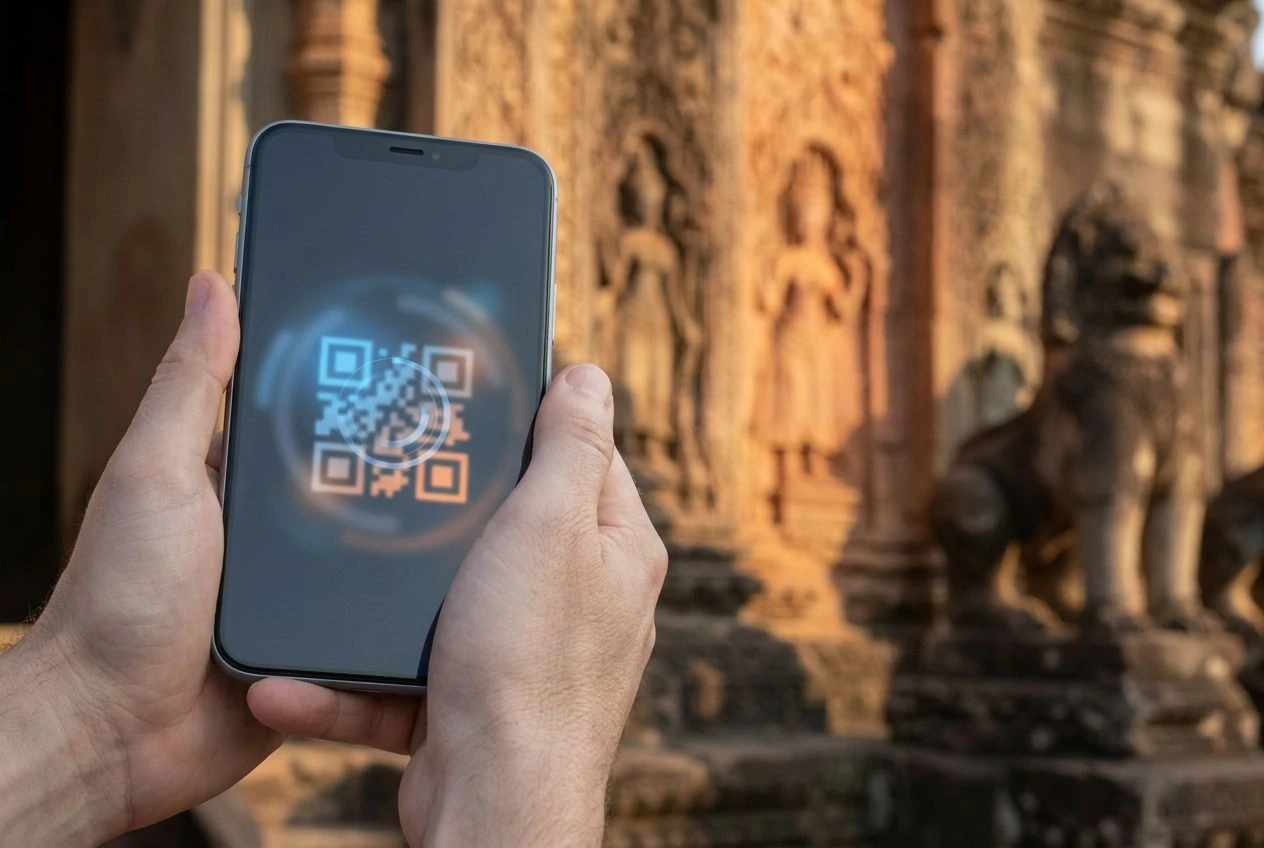
The mechanics are simpler than the acronyms suggest. An Indian traveler opens any UPI-enabled app, scans the KHQR (Khmer Quick Response) code at a merchant counter, confirms the amount in Cambodian riels, and authorizes with a PIN or biometrics. Conversion happens at real-time exchange rates. ACLEDA Bank handles local settlement; merchants receive credit in riels, with funds clearing through NIPL’s cross-border clearing house within 24 to 48 hours.
ACLEDA Bank Plc. holds a specific structural role here. Founded in 1995 as a microfinance institution, it grew into Cambodia’s largest private bank and operates more than 150 branches nationwide. Its KHQR merchant network was already in place long before UPI arrived, covering tourist zones, restaurants, retail, and hospitality across the country’s major commercial centers. NIPL connected to infrastructure it didn’t need to build.
Any UPI-enabled app works: Google Pay, PhonePe, Paytm, BHIM, and bank-native UPI applications from major Indian banks. This launch covers Phase 1 only, meaning Indian users paying in Cambodia. The partnership design explicitly includes Phase 2, in which Cambodian visitors to India will use their own domestic apps to pay at millions of Indian UPI QR locations. That reverse flow has no public activation date as of June 2026.
It ensures that Indian travellers enjoy a familiar, secure and seamless payment experience abroad, while Cambodian merchants gain access to millions of digital-first consumers.
Ritesh Shukla, MD and CEO of NPCI International, made that statement at the official India-Cambodia UPI-KHQR launch announcement in Phnom Penh. Dr. In Channy, President and Group Managing Director of ACLEDA Bank, called it “Phase 1 of our cross-border interoperability initiative, enabling Indian travellers to execute secure digital transactions via UPI-enabled applications across our extensive KHQR merchant network.”
Eight Countries Before Cambodia
Bhutan opened the list in July 2021, when Finance Minister Nirmala Sitharaman and Bhutan’s Finance Minister Lyonpo Namgay Tshering jointly launched UPI access via the BHIM app. Bhutan was the first country anywhere to adopt India’s UPI QR standards for deployment. The progression since then has followed a readable logic: immediate neighbors first, then Gulf corridors where Indian diaspora remittances create sustained demand, then high-tourism European markets, then Southeast Asia.
| Country | Year Live | Local Standard / Partner |
|---|---|---|
| Bhutan | July 2021 | Royal Monetary Authority, BHIM App QR |
| Mauritius | 2022 | Banking sector partners |
| Qatar | 2022 | Qatar National Bank (QNB) |
| France | 2023 | Lyra Group |
| Singapore | 2023 | PayNow (MAS / DBS Singapore) |
| Sri Lanka | 2023 | Banking sector partners |
| Nepal | March 2024 | Fonepay network |
| UAE | July 2024 | Network International / Mashreq Bank |
The Government of India has signed Memoranda of Understanding for Digital Public Infrastructure cooperation with 23 countries, covering digital identity, digital payments, and data exchange. Live UPI payments in nine countries is a subset of that diplomatic footprint. NIPL’s stated target is 20-plus markets with live payments by FY2028-29.
Singapore’s link, the UPI-PayNow bilateral corridor built with the Monetary Authority of Singapore, is the most sophisticated of the eight predecessors. It runs in both directions, connecting 19 Indian banks to Singapore-side accounts and processing both transfers and merchant payments. The Cambodia design starts one-directional and is explicitly engineered to reach the same full interoperability in Phase 2.
The Domestic Scale Behind the Expansion
NIPL walks into every bilateral negotiation with a single credential most payment networks can’t match: the verified scale of UPI’s domestic traffic.
- 228.3 billion transactions processed through UPI in full-year 2025, up from 172.2 billion in 2024
- 21.63 billion transactions in December 2025, the platform’s highest monthly volume on record
- Rs 27.97 lakh crore (roughly $335 billion) in transaction value in December alone
- 694 Indian banks currently live on UPI
- 500-plus million unique UPI users as of early 2026, with PhonePe and Google Pay together controlling over 85% of app-level volume
That scale makes a specific argument to prospective partner regulators: any merchant who accepts KHQR in Cambodia gains access to hundreds of millions of digitally fluent consumers who already transact at over 21 billion occasions a month. The merchant doesn’t need a new QR format. The KHQR code already displayed at checkout is the same one Indian travelers scan.
The cost argument compounds this. Visa and Mastercard charge merchants between 1.5% and 3% per international transaction. UPI’s zero MDR model, which the Indian government mandated for domestic merchant transactions, creates direct pricing competition wherever NIPL negotiates a new corridor. In December 2025, UPI’s monthly volume grew 29% year-on-year while its value grew 20%, with the average ticket size narrowing to roughly Rs 1,293 as UPI pushed deeper into everyday micro-purchases at grocery shops and street vendors.
Cambodia’s Position Inside ASEAN
Cambodia was already in NIPL’s planning well before June 2026. In September 2021, Liquid Group, a Singapore-based cross-border payments provider, signed an MoU with NIPL to introduce UPI QR payments across 10 Asian markets, including Cambodia, Vietnam, Malaysia, Thailand, and the Philippines. That MoU set a directional intent; the live implementation in Cambodia came through a separate bilateral deal with Cambodia’s largest private bank, not through the Liquid Group framework.
Cambodia now becomes the first mainland Southeast Asian country with a live UPI integration. Singapore went live earlier, but Singapore is a city-state with a large Indian diaspora, mature banking regulation, and distinct demographics from the rest of the region. Cambodia fits a different template: a developing economy with a national QR infrastructure already built, a growing Indian tourist inflow, and a central bank prepared to stake bilateral regulatory standing on the deal. That template is more replicable across the rest of ASEAN than the Singapore model.
Bakong, the National Bank of Cambodia’s payment system, was designed for multilateral interoperability. It connects banks and payment service providers across Cambodia on a single QR standard. NIPL plugged into that existing regulated network rather than negotiating with individual Cambodian institutions. The commercial logic of the three main tourist destinations reflects where Indian spending is concentrated:
- Phnom Penh: government district, business zone, international hospitality cluster
- Siem Reap: Angkor Wat corridor, highest Indian visitor concentration in Cambodia
- Sihanoukville: coastal resort area, growing regional tourism base
For Cambodian micro, small, and medium businesses, the economics are immediate. Cash-handling costs drop; real-time digital settlement replaces waiting on card batch cycles; and a high-spending, digitally native Indian traveler demographic arrives without requiring a separate card acceptance terminal. Local shopkeepers gain access to that demographic through the KHQR QR code they already display.
Why 23 MoUs Have Produced Nine Live Corridors
Every UPI international corridor announcement reads like a clean win. The harder question is whether live corridors scale or plateau as showcase deployments, and the answer lives in the revenue structure.
UPI’s domestic success rests partly on a 2020 policy decision: the Indian government mandated zero MDR for merchant transactions. That removed the commercial revenue that would normally cover fraud management, dispute resolution, infrastructure maintenance, and merchant acquisition costs. Domestically, cross-subsidization through the banking system covered the gap. Internationally, that subsidy structure doesn’t transfer automatically. Local acquiring banks in Cambodia, payment service providers bridging the two systems, compliance operations across two regulatory jurisdictions, and fraud controls all require funded economics to run at scale.
Currency settlement compounds the issue. Many international UPI transactions still depend on existing banking channels for foreign exchange conversion, adding cost and latency that pure domestic UPI doesn’t carry. “If acquirers, PSPs, and partner banks do not see a viable economics stack, rollout will remain limited to showcase deployments,” the Policy Circle wrote in its February 2026 analysis of UPI’s cross-border expansion mechanics, identifying revenue model sustainability as the binding constraint on international scale.
Fraud exposure adds another dimension. UPI fraud cases domestically reached 6.32 lakh (632,000) incidents in FY25, totaling Rs 485 crore in losses, up 85% year on year. Cross-border disputes add jurisdictional questions: which regulator governs a failed or fraudulent transaction between an Indian bank account and a Cambodian merchant? Phase 2 will sharpen those questions considerably.
India has DPI cooperation agreements with 23 countries; nine have live UPI payments. The 14 countries with agreements but no live corridor include markets that have been in discussion for several years, among them Thailand, Vietnam, and Malaysia.
Phase 2 and What Full Interoperability Means
When Phase 2 activates, the architecture flips. Cambodian citizens traveling to India will open their domestic banking or payment apps, scan UPI QR codes at shops and transport hubs across India, and pay in a currency their own bank handles. The bilateral payment relationship becomes genuinely reciprocal.
For NIPL, the two-way design carries a balance-of-payments rationale. One-directional corridors run a persistent FX settlement net in one direction indefinitely. A full two-way corridor creates clearing symmetry that makes the economics more manageable for both ACLEDA Bank on the Cambodian side and NIPL’s cross-border clearing function. The Singapore-PayNow corridor demonstrates this at scale: it runs bidirectionally and expanded to 19 Indian banks in 2025, a sign the economics held up under sustained load.
Governor Dr. Chea Serey of the National Bank of Cambodia and RBI representatives were both present at the June 3 ceremony in Phnom Penh. Their joint presence signals that the bilateral regulatory framework for Phase 2 is already in position. The operational launch date is not publicly confirmed.
A parallel multilateral track is advancing separately. Project Nexus, a Bank for International Settlements (BIS) initiative signed in June 2024, aims to interlink the instant payment systems of India via RBI, Singapore via MAS, the Philippines via Bangko Sentral ng Pilipinas, Thailand, and Indonesia as observer. If Project Nexus goes operational, Cambodia’s bilateral UPI link would sit adjacent to a wider ASEAN fast-payment network, potentially reducing the need for separate bilateral negotiations with each remaining ASEAN member country.
No public date has been set for Phase 2. Until then, the 4.5-million-outlet KHQR network accepts Indian payments in one direction only.
Frequently Asked Questions
Which UPI Apps Work for Payments in Cambodia?
Any UPI-enabled app works, including Google Pay, PhonePe, Paytm, BHIM, and bank-native UPI applications from major Indian banks. Travelers should confirm that international payment functionality is activated in their app before departure; most major Indian banks enable this automatically, but activation steps vary by institution.
Are There Foreign Exchange Fees on UPI Transactions in Cambodia?
Rupee-to-riel conversion uses real-time exchange rates, but individual banks typically charge a foreign exchange markup of 2% to 4% on international UPI transactions. The specific fee varies by bank and account type. Check your bank’s international payment fee schedule before traveling to compare the real cost against local currency exchange alternatives.
Which Cities in Cambodia Have the Best UPI Merchant Coverage?
Coverage is broadest in Phnom Penh, Siem Reap (the gateway to Angkor Wat), and Sihanoukville. The KHQR network extends to tourist attractions, restaurants, retail outlets, and hospitality venues, with coverage spreading to secondary cities. Smaller vendors in remote or rural areas may still operate cash-only, so carrying some Cambodian riels as backup is advisable.
Do Cambodian Merchants Need Special Setup to Accept Indian UPI Payments?
No additional setup is required. Any merchant already enrolled in Cambodia’s KHQR network can accept UPI payments from Indian users by displaying their existing KHQR QR code. Indian travelers scan the same code Cambodian customers use for domestic transactions; the merchant’s checkout experience is identical to any other KHQR payment.
When Will Cambodians Be Able to Pay in India Using Their Apps?
Phase 2 of the NPCI International and ACLEDA Bank partnership will enable Cambodian citizens to scan UPI QR codes at merchant locations across India using their domestic banking or payment apps. No specific activation date for Phase 2 has been announced as of June 2026. The bilateral regulatory infrastructure is in place; the operational timeline has not been publicly disclosed.


Lunit Turns Routine H&E Slides Into a Lung Pre-Screen

Meta’s Muse Agent Wants Your Inbox and Your Card

Police Chase Mules as AI Chatbots Run Romance Scams

Ticketmaster’s Personalized App Is Built to Move Empty Seats

Software Deals Now Hinge on Filing Accuracy, Not Beats

Iowa Counties Warn Workers That ChatGPT Keeps Their Files

Shaalan Beg’s Oncology AI Hits an Enrollment Wall

Exowatt Warns Gas-Fired AI Campuses May Not Last a Decade

Philips Splits Innovation and Hands AI to Partovi

Chrome 153 Puts the Whole Web on a Two-Week Clock

Oracle Cuts 21,000 Jobs in a Year, Cites AI in 10-K Filing

Fable 5 and Mythos 5 Return as US Lifts Anthropic Export Controls

SpaceX’s Google Deal Turns a Rocket Company Into a Cloud Landlord

CD Projekt Red Co-CEO: Redemption Arc Isn’t Done, Witcher 4 in 2027

XPL Rallies 30% Ahead of Plasma One Card Tier Launch

Google Search Profiles Build a Follow Graph Inside Discover

DGO App Brings Rs 549 Mobile Pass for FIFA World Cup 2026 in Nepal

Moonshot AI Targets $30 Billion in China’s Fastest AI Funding Sprint

Oppo’s ColorOS 17 Eligibility List Leaves A-Series Buyers Behind

Microsoft Xbox Layoffs Start in July as Sharma Slams 3% Margin
-
 AI3 months ago
Oracle Cuts 21,000 Jobs in a Year, Cites AI in 10-K Filing
-
 AI2 months ago
Fable 5 and Mythos 5 Return as US Lifts Anthropic Export Controls
-
 AI3 months ago
SpaceX’s Google Deal Turns a Rocket Company Into a Cloud Landlord
-
 GAMING3 months ago
CD Projekt Red Co-CEO: Redemption Arc Isn’t Done, Witcher 4 in 2027
-
 CRYPTO3 months ago
XPL Rallies 30% Ahead of Plasma One Card Tier Launch
-
 NEWS3 months ago
Google Search Profiles Build a Follow Graph Inside Discover
-
 APPS3 months ago
DGO App Brings Rs 549 Mobile Pass for FIFA World Cup 2026 in Nepal
-
 AI3 months ago
Moonshot AI Targets $30 Billion in China’s Fastest AI Funding Sprint