
COMPUTERS
Quobly Raises €115M to Build Silicon Quantum Chips at Scale
Quobly closed a €115M Series A to industrialize FD-SOI silicon qubits on 300mm wafers, targeting cloud access in 2026 and HPC deployments in 2027.

Quobly, the Grenoble-based silicon quantum computing company, closed a €115 million ($133.7 million) Series A on June 3 to industrialize its silicon-based quantum processors and bring its first commercial system to market by late 2026. The round is led by Bpifrance (France’s state-backed public investment bank), STMicroelectronics, and SEALSQ Corp (Nasdaq: LAES), a post-quantum security chipmaker. The European Innovation Council (EIC) Fund, Air Liquide’s venture capital arm ALIAD, and existing investor Innovacom also participated. Quobly was founded in 2022 in Grenoble and builds on over 15 years of research from the CEA (France’s atomic energy commission) and CNRS (its national science research center).
STMicroelectronics’ role extends past the capital commitment. Its 300mm silicon fab gives Quobly access to the same type of CMOS fabrication process used for classical computer chips, which superconducting quantum computing platforms are not currently built on. The chipmaker’s involvement covers both the investment and the manufacturing environment.
Superconducting Qubits and the Scale Ceiling
The dominant commercial quantum computing architectures, built by IBM, Google, and Rigetti Computing, use superconducting qubits. Each one is a circuit element roughly 0.1 to 1 millimeter across, fabricated on specialized substrates and cooled to about 15 millikelvin in a dilution refrigerator. Physical size and the cooling requirement put a practical ceiling on how densely qubits can be packed, and scaling toward the millions of error-corrected qubits fault-tolerant computing eventually needs is a fundamentally difficult manufacturing problem on such a platform.
Silicon spin qubits encode quantum information in the spin state of a single electron confined in a quantum dot, a structure roughly 50 nanometers across. That footprint is about 3,000 times smaller than a superconducting transmon qubit. Silicon spin qubits are, in principle, manufacturable on the same CMOS production lines that make classical computer chips.
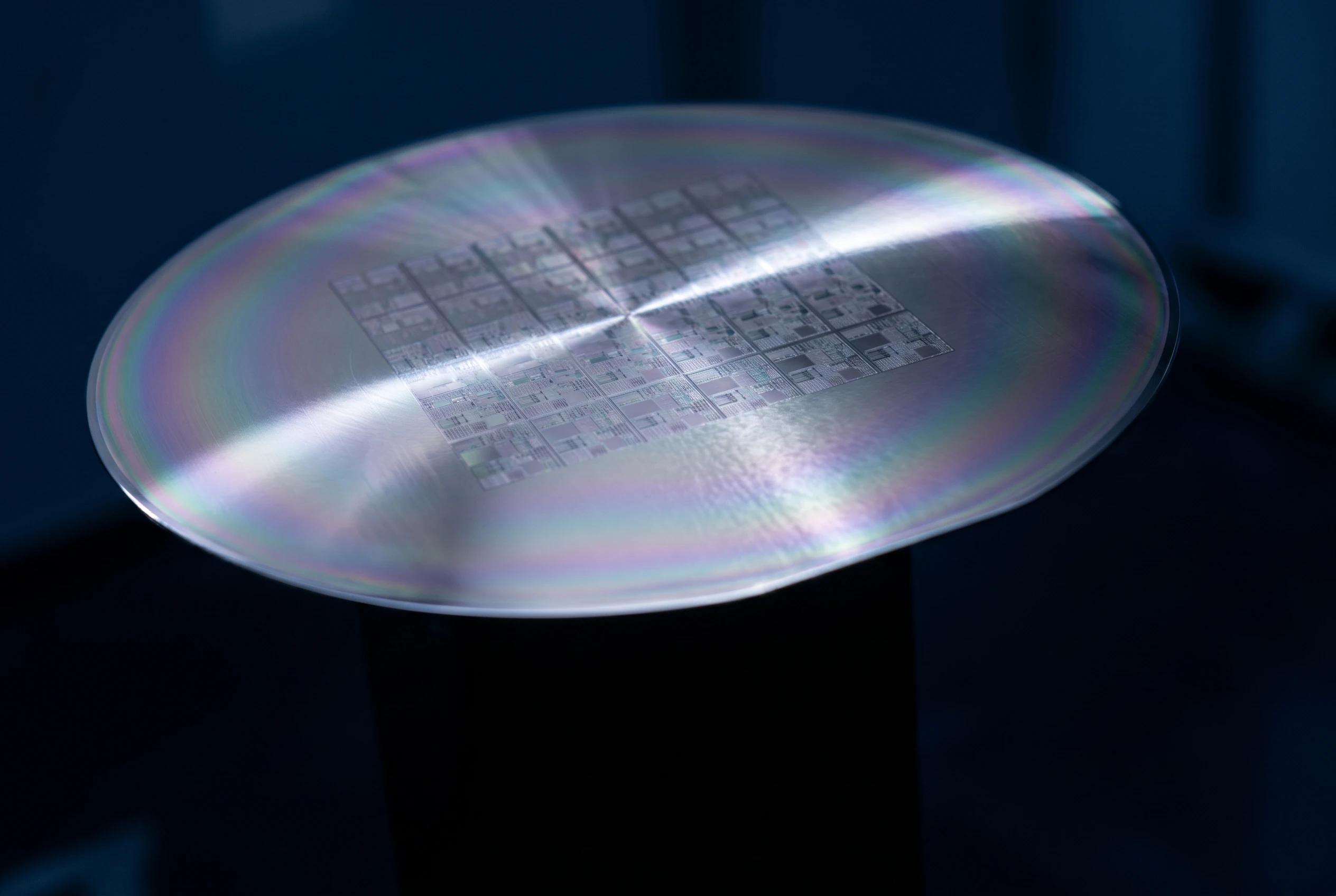
Getting from “in principle” to “in practice” requires solving the yield problem. Standard silicon transistors tolerate fabrication variability because they only need to switch between two states. Qubits need analog precision: each one must be individually tunable to hold a coherent quantum state. Quobly’s platform uses FD-SOI (fully depleted silicon on insulator, a chip architecture that isolates the active silicon layer on an insulating buried oxide for tighter transistor control) on 300mm wafers. The technology offers strong electrostatic control over each qubit, reduced threshold-voltage variability across a wafer, and lower power consumption at cryogenic temperatures. Quobly has also co-integrated electron and hole qubits on a single die, allowing both complementary qubit types and two-qubit gate standard cells to be fabricated in the same process step, which the December 2024 FD-SOI quantum processor demonstration confirmed at the device level.
This financing marks a transition from technology validation to industrial execution.
Maud Vinet, Quobly’s CEO and co-founder, said in the June 3 Series A announcement that the capital would accelerate “the deployment of our first commercial systems” and build a platform designed to integrate into existing computing infrastructure.
Who Backed the Round
Bpifrance is participating through its Deep Tech 2030 fund, managed on behalf of the French government under France 2030, a €30 billion state investment program. The bank has backed Quobly since the company’s €19 million seed round in 2023, when it still operated under the name Siquance.
| Investor | Type | Link to Quobly’s Manufacturing Stack |
|---|---|---|
| Bpifrance | State investment bank | Lead seed investor; France 2030 Deep Tech fund for sovereign quantum program |
| STMicroelectronics | Semiconductor manufacturer | 300mm fab environment; FD-SOI manufacturing partner since the seed phase |
| SEALSQ Corp (Nasdaq: LAES) | Post-quantum security chipmaker | Technical partner since November 2025; integrating PQC and hardware Root-of-Trust |
| EIC Fund | EU investment arm | European Innovation Council’s quantum competitiveness mandate |
| ALIAD (Air Liquide) | Industrial venture capital | Parent Air Liquide handles cryogenics supply chain for Quobly’s manufacturing |
| Blast / Innovacom | Deeptech VCs | Existing deeptech investors; Innovacom connected to FD-SOI substrate maker Soitec |
Existing shareholders CEA, CNRS, Quantonation, and Supernova Invest retain their positions on the cap table. Through its SEALQUANTUM.com Quantum Fund, SEALSQ had announced in January 2026 a proposed multi-stage investment in Quobly of up to $200 million. Prior to this round, the fund had deployed approximately $30 million across quantum and post-quantum security ventures including EeroQ, WISeSat, and IC’Alps, with the Quobly Series A representing the fund’s largest single deployment to date.
FD-SOI Performance on the Numbers
During its seed phase, Quobly demonstrated specific performance metrics for its silicon spin qubits on the FD-SOI platform.
- Over 99% fidelity in single- and two-qubit gate operations, the threshold commonly cited as the minimum for viable quantum error correction
- ~100nm² unit cell footprint per qubit, roughly 1,000 to 3,000 times smaller by area than a superconducting transmon circuit
- Microsecond gate speeds
- 300mm wafer diameter, compatible with industrial CMOS production lines
The 99% fidelity figure carries a specific technical weight. The surface code, the primary quantum error correction scheme, requires gate fidelities above roughly 99% to produce net error reduction after correction. Below that threshold, the overhead the correction scheme adds grows faster than the error rate improves, making a larger qubit array computationally counterproductive rather than more capable.
Two engineering problems separate these bench metrics from a full production processor. Cryogenic CMOS control electronics must function reliably at roughly one Kelvin, the temperature silicon spin qubits need to maintain coherence. Classical transistors are characterized at room temperature; at one Kelvin, threshold voltages shift, carrier mobility changes, and many circuit parameters deviate from room-temperature specifications in ways that require specialized cryogenic circuit designs or a split between temperature stages, with warmer stages handling latency-tolerant functions. The packaging challenge runs parallel: superconducting 3D interposers must route signals between the cold qubit die and warmer electronics without introducing thermal loading that collapses the qubit temperature budget. Both challenges are shared across every silicon spin qubit program targeting wafer-scale production.
Alloy Pioneer Ships to Cloud Customers in 2026
The Series A finances the commercial launch of Alloy Pioneer, the first system in Quobly’s Alloy product line. Targeted at early adopters in high-performance computing and research environments, it will be accessible through cloud access from Quobly’s Grenoble headquarters before the end of the year. Users reach it through Alloy Forge, Quobly’s quantum application development environment, which lets developers validate applications under real hardware constraints rather than in simulation.
- Cloud access from Grenoble, targeted for late 2026, via the Alloy Forge platform
- Direct deployment within HPC customer infrastructure, planned for 2027
- International commercial expansion, with offices already in France, Singapore, and Canada
The 2027 HPC deployment works because Quobly designed Alloy Pioneer with a data center-compatible footprint, power supply, and utilities profile. Superconducting quantum computers require large dilution refrigerators cooled to 15 millikelvin, a physical setup that doesn’t fit a standard rack environment. Alloy Pioneer’s cryogenic requirements, running at roughly one Kelvin, allow a substantially smaller physical footprint than dilution-refrigerator-based systems.
Beyond the Alloy Pioneer launch, the capital covers continued R&D, further industrialization of the silicon quantum processor line, and expansion of the hardware, control electronics, and software stack. The seed phase ran from 2023 to 2025 and focused on demonstrating silicon qubit viability within semiconductor manufacturing processes and building a system architecture that integrates the device, control, and software layers.
Partners Embedded in Both the Process and the Cap Table
Quobly’s industrial partnerships predate the Series A and now overlap with its investor list. STMicroelectronics, co-leading the round, provides the 300mm fab environment at commercial scale. Laurent Malier, the chipmaker’s Executive Vice President of Global Technology R&D, said in a statement accompanying the round that quantum computing reaches the scale HPC customers require “only if breakthrough quantum systems can be industrialized and integrated with semiconductor-grade rigor and backed by a robust ecosystem.” The company has operated 300mm production lines in France through multiple technology generations, and its FD-SOI collaboration with Quobly traces back to the CEA-Leti research environment where Quobly’s founders developed the underlying qubit architecture.
Air Liquide’s venture arm ALIAD invested in the round, and its parent company handles cryogenics in Quobly’s manufacturing supply chain. Silicon spin qubits must operate at roughly one Kelvin, a temperature range Air Liquide has supplied for other industrial applications for decades. Soitec, the Grenoble-based manufacturer of the silicon-on-insulator wafer substrates on which Quobly’s qubits are built, is connected through existing investor Innovacom. Orano, the nuclear fuel cycle company, brings yield optimization methods from uranium processing to Quobly’s chip fabrication line.
SEALSQ Corp adds a dimension the manufacturing partners don’t cover. The Geneva company builds post-quantum cryptography (PQC, cryptographic algorithms designed to resist attacks from quantum computers) hardware and has been a technical partner since November 2025. Through its SEALQUANTUM.com Quantum Fund, SEALSQ is combining its QVault TPM and PQC solutions directly with Quobly’s silicon quantum processors to build secure-by-design quantum computing systems, with protection built in at the qubit level. Its core PQC business protects classical systems against cryptographic attacks from future quantum computers. Through the SEALQUANTUM.com fund, it also holds equity in companies building those machines.
Quobly was co-founded by Maud Vinet, who holds more than 300 papers and 70 patents in quantum physics and spent her research career at CEA-Leti developing the FD-SOI transistor architectures that underpin the company’s qubit platform, and Tristan Meunier, a quantum semiconductor engineering specialist trained under Nobel laureate Serge Haroche, co-winner of the 2012 Nobel Prize in Physics for experimental methods enabling measurement and manipulation of individual quantum systems.
France’s Five-Horse Quantum Race
France launched a €1.8 billion national quantum strategy in 2021, with €1 billion committed from the state and €800 million expected from private partners. The PROQCIMA government program channels approximately €500 million of that toward five hardware companies in a structured competition: Alice & Bob (cat qubits), PASQAL (neutral atoms), Quandela (photonic qubits), C12 Quantum Electronics (carbon nanotube qubits), and Quobly (silicon spin qubits). The target is 128 logical qubits by 2030 and 2,048 by 2035. France’s state bank has backed all five through the Deep Tech 2030 fund and parallel investment instruments.
Alice & Bob, one of Quobly’s four PROQCIMA competitors, raised a €104 million Series B in January 2025, with the state bank investing through both the Deeptech 2030 Fund and the Defense Innovation Fund. Before the Quobly Series A, the five companies had raised approximately €350 million combined since 2021, a figure the bank’s chief executive Nicolas Dufourcq cited in public remarks on Europe’s quantum private capital shortfall. With the €115 million round complete, that combined figure exceeds €460 million. Dufourcq has said publicly that the bank intends to commit “around half a billion euros” to the French quantum effort overall, and has pushed European institutional investors to close what he described in late 2025 as a structural funding gap relative to US and Chinese quantum investment.
France holds about 20% of global quantum market share by Dufourcq’s measure, a figure covering companies, patents, and researcher presence. The country has around 5,000 quantum specialists across academic institutions and industry. Quobly’s Grenoble location places it at the intersection of France’s semiconductor geography: CEA-Leti, STMicroelectronics’ primary French manufacturing facility, and Soitec’s wafer production operations are all in the city or its adjacent industrial corridor.
Alloy Pioneer’s cloud debut before the end of 2026 gives external users their first direct access to Quobly’s silicon spin qubits outside a controlled laboratory setting.


Samsung’s Design Chief Molds the Fold8 Like a Passport

Qualcomm Stretches Snapdragon 8 Elite Gen 5 as Chip Costs Climb

Thailand and the Philippines Force Crypto Exchanges to Hunt Scammers

WhatsApp Adds Adobe-Powered PDF Tools and Hands-Free Car Mode

Samsung’s Smart Glasses Replay Android’s Old Playbook Against Meta

Xbox Backward Compatibility Hits PC After Microsoft Called It Done

A New Nautilus Extension Restores GNOME’s Lost Computer View

Bezos’s Prime Video AI Overhaul Puts Studio Deals at Risk

Samsung’s PCIe 6.0 AI SSD Arrives Five Months Behind Micron

Coinbase Grows Singapore Staff to 200 After Global Cuts

Fable 5 and Mythos 5 Return as US Lifts Anthropic Export Controls

SpaceX’s Google Deal Turns a Rocket Company Into a Cloud Landlord

CD Projekt Red Co-CEO: Redemption Arc Isn’t Done, Witcher 4 in 2027

XPL Rallies 30% Ahead of Plasma One Card Tier Launch

DGO App Brings Rs 549 Mobile Pass for FIFA World Cup 2026 in Nepal

Oracle Cuts 21,000 Jobs in a Year, Cites AI in 10-K Filing

Moonshot AI Targets $30 Billion in China’s Fastest AI Funding Sprint

Google Search Profiles Build a Follow Graph Inside Discover

Microsoft Xbox Layoffs Start in July as Sharma Slams 3% Margin

Oppo’s ColorOS 17 Eligibility List Leaves A-Series Buyers Behind
-
 AI4 weeks ago
Fable 5 and Mythos 5 Return as US Lifts Anthropic Export Controls
-
 AI2 months ago
SpaceX’s Google Deal Turns a Rocket Company Into a Cloud Landlord
-
 GAMING1 month ago
CD Projekt Red Co-CEO: Redemption Arc Isn’t Done, Witcher 4 in 2027
-
 CRYPTO1 month ago
XPL Rallies 30% Ahead of Plasma One Card Tier Launch
-
 APPS2 months ago
DGO App Brings Rs 549 Mobile Pass for FIFA World Cup 2026 in Nepal
-
 AI1 month ago
Oracle Cuts 21,000 Jobs in a Year, Cites AI in 10-K Filing
-
 AI2 months ago
Moonshot AI Targets $30 Billion in China’s Fastest AI Funding Sprint
-
 NEWS2 months ago
Google Search Profiles Build a Follow Graph Inside Discover