
COMPUTERS
The Air Force Pays $20 Million for a Hypersonic Physics Box
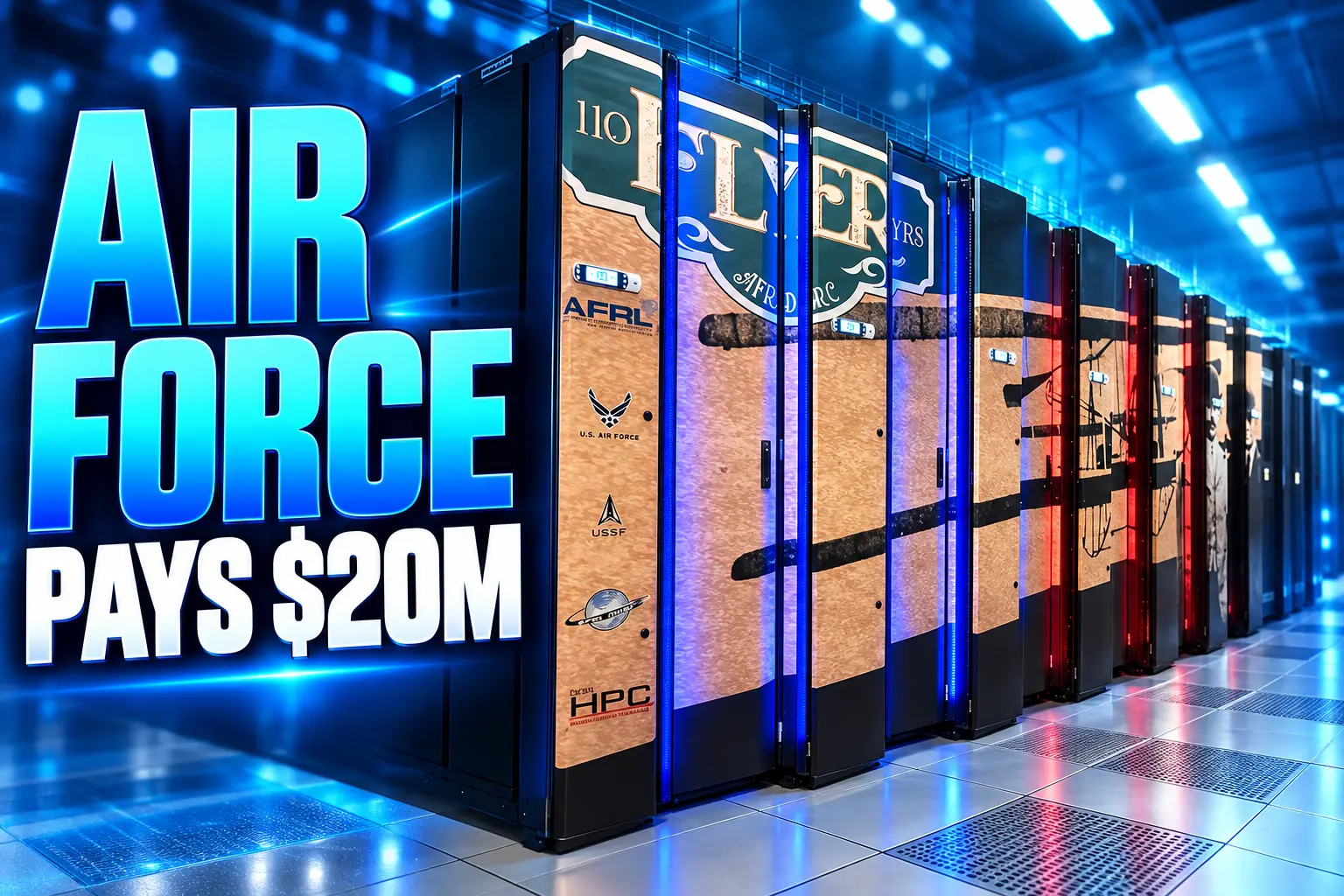
The Air Force’s $20 million Flyer supercomputer at Wright-Patterson delivers 8.7 petaFLOPS and 64 H100 GPUs for on-base hypersonic simulation.

The Air Force Research Laboratory switched on Flyer, a $20 million supercomputer, at Wright-Patterson Air Force Base on June 18, 2026. The Pentagon’s own hardware list rates the HPE Cray XD machine at 8.7 petaFLOPS, with 64 Nvidia H100 GPUs riding on 169,782 AMD EPYC cores.
Officials at the ribbon-cutting sold a laptop comparison and an artificial-intelligence pitch. The parts list is a CPU-heavy physics box on Area B, with a small GPU tray, because hypersonic and aircraft codes still have to live on a base the lab controls.
The Official Sheet Rates Flyer at 8.7 PetaFLOPS
Kelly Dalton, director of the High Performance Computing Modernization Program, named the machine after the Wright brothers and tied it to Dayton’s habit of calculating lift before anyone left the ground. “The Wright brothers did not just build an airplane. They calculated their way into the sky,” she said, adding that Flyer was dedicated in that spirit.
Bryon Foster, director of AFRL’s Supercomputing Resource Center, said a job that would take an average laptop 500 years would finish on Flyer in a day. Marc DeNofio, an AFRL spokesperson, put the same claim at 24 hours versus half a millennium on a standard computer. Ceremony briefers also said the system could hold 3.6 billion photos or 46 years of high-definition video.
The HPCMP systems summary is more precise than the talking points. It lists an 8.7 petaFLOP HPE Cray XD named Flyer with 884 compute nodes, 169,782 AMD EPYC “Genoa” cores, 64 Nvidia H100 GPUs, 16 Nvidia L40 GPUs, a 200 Gbps Cray Slingshot network, 738.9 TB of memory, and 19.4 PB of usable disk. That 8.7 petaFLOPS figure is 8.7 quadrillion calculations per second, the number Dayton stations used the day of the event.
In September 2023, AFRL said the TI-23 pair of Flyer and Raven would deliver 14 petaFLOPS together. The sheet now on the program’s hardware page adds to 12.0 petaFLOPS: 8.7 for Flyer and 3.3 for Raven. HPE lists El Capitan, the top verified civilian machine, at 1.742 exaFLOPS, about 200 times Flyer’s peak.
FLYER AND RAVEN ON THE HPCMP SHEET
| Spec | Flyer | Raven |
|---|---|---|
| Peak | 8.7 petaFLOPS | 3.3 petaFLOPS |
| Nodes | 884 | 300 |
| CPU cores | 169,782 AMD EPYC Genoa | 57,600 AMD EPYC Genoa |
| Nvidia H100 GPUs | 64 | 32 |
| Nvidia L40 GPUs | 16 | 2 |
| Memory | 738.9 TB | 245.7 TB |
| Usable disk | 19.4 PB | 5.9 PB |
| Network | 200 Gbps Cray Slingshot | 200 Gbps Cray Slingshot |
| Role | Unclassified | Classified |
Flyer is the tenth supercomputer AFRL has put at Wright-Patterson, and it is the unclassified member of the TI-23 pair. The project took more than two years. Officials priced it at about $20 million and said it would run nonstop for five years.
Classified Physics Still Cannot Live in a Public Cloud
The lab did not buy Flyer because commercial clouds lack chips. It bought a machine it can lock in a secure building, on a network it runs, for jobs that cannot leave the fence. Rep. Mike Turner stood at the ribbon-cutting and called the system the next level of work for airmen and the laboratory on the base.
Alexis Bonnell, then AFRL’s chief information officer, said the quiet part in 2023 when Raider, the previous unclassified box, came online. Cloud is fine until the mission is not.
Not every mission of AFRL, the Air Force, Space Force or DOD is appropriate for cloud. Outpacing the adversary often means out-racing them, ensuring our data can move faster, be analyzed more rapidly and gain insight driven advantage to keep the fight unfair.
Alexis Bonnell, AFRL chief information officer, Raider announcement
She added that in-house compute on secure networks is why high-performance computing remains a basic capacity. Flyer extends that bet. Unclassified users reach AFRL systems over the War Research and Engineering Network, still called DREN in the program’s guides. The codes that design a warhead or a hot airframe stay off that path and wait for Raven.
AFRL posted the ceremony after the fact, pointing to the full ribbon-cutting ceremony video on the Defense Visual Information Distribution Service.
ICYMI: Alongside @RepMikeTurner & DoD HPCMP, we cut the ribbon on “Flyer”! Our new supercomputer completes 500 years of laptop calculations in ONE DAY.
The full ribbon-cutting ceremony is on @DVIDSHub: https://t.co/7MYZWxXr7L #AFResearchLab | #FutureTech | #PartnerWithAFRL
— Air Force Research Lab – AFRL (@AFResearchLab) June 26, 2026
Raven Follows as the Secret Twin
AFRL’s 2023 order split the TI-23 buy on purpose. Flyer would serve unclassified work. Raven would serve classified work. The HPCMP hardware page still listed both under upcoming systems in late June 2026, with Raven scheduled for the fourth quarter of fiscal 2026.
Raven is the smaller twin: 300 nodes, 57,600 Genoa cores, 32 H100 GPUs, 2 L40 GPUs, 245.7 TB of memory, and 5.9 PB of disk, rated at 3.3 petaFLOPS. It is the machine that matters for the weapons problems the ceremony would not describe. Shared classified floors at the AFRL center go back years, including a 2019 expansion of Building 676 on Area B.
Foster told the June 18 crowd that all of this power would go to “difficult problems, for the Department of War.” The unclassified box is what they could put on camera. The classified twin is why the campus still needs extra locked floor space.
Why Hypersonic Work Goes to a Supercomputer First
Foster’s own example, given when Raider arrived, was hypersonic vehicles too fast to test on a range. Dalton said a researcher can model performance on a supercomputer without flying the article. She also said the runs augment flight test, they do not replace it.
That is the job Flyer actually matches. Computational fluid dynamics for a Mach-class airframe eats CPU cores and memory bandwidth. So do materials, sensors, and digital-twin work on the next aircraft. The 64 H100s are there so the same floor can train models and run AI-assisted design loops, not so AFRL can stand up a public chatbot.
A $20 million simulator does not put a missile on a rail. It cheapens the failures that used to require a range slot, a booster, and a wreck. Labs that already fly hypersonic weapons did not wait on this ribbon-cutting, and Flyer will not close that gap by itself. It will let Wright-Patterson iterate the shapes that are still too hot, too fast, or too secret to throw downrange every week.
JOBS THE LAB SAYS FLYER WILL TAKE
- Hypersonic vehicles: Model flights that are too fast, too hot, or too costly to run for real on a test range.
- Next aircraft: Run computational fluid dynamics and structural cases before metal is cut.
- Hazardous tests: Move experiments that cannot be staged in a lab into a digital environment.
- AI sidecars: Feed models more data on the 64 H100 GPUs and 16 L40 GPUs without leaving the base.
- Shared DoW work: Serve Air Force, Army, and Navy users, plus sponsored contractors, as a national HPCMP resource.
When Raider was new, Foster said a Navy project that had taken six months finished in three weeks at higher fidelity. Dalton said a five-year slog on a standard computer could compress to about 200 days. Those are the returns the program sells, measured in calendar time on acquisition programs, not in chatbot tokens.
AFRL Buys Supercomputers on a Rolling Cycle
Flyer is a technology insertion, TI-23, in a line that does not pause. Raider, the TI-21 Penguin TrueHPC system, arrived in 2023 at about 12 petaFLOPS and replaced Thunder, a 2015 machine AFRL rated at 3.1 petaFLOPS. Foster’s rule then was blunt: once a box is in, the next one is already on order, sometimes before the current one even runs, because the machines take so long to build, move, and bring up.
The AFRL center itself dates to 1994 and is one of five HPCMP Supercomputing Resource Centers, with the others at Aberdeen Proving Ground, Vicksburg, Maui, and Stennis Space Center. The program’s fiscal 2026 research line in Army budget materials is the $215.090 million fiscal 2026 HPCMP line. Flyer is a slice of that long buy, not a one-off moonshot.
THE AFRL SUPERCOMPUTER CYCLE
- 1994: The AFRL Supercomputing Resource Center opens at Wright-Patterson as one of the Pentagon’s HPCMP sites.
- 2015: Thunder, rated at 3.1 petaFLOPS, is the lab’s workhorse unclassified system.
- September 2023: Raider, the TI-21 system, comes online at about 12 petaFLOPS, and AFRL says Flyer and Raven are on order for a combined 14 petaFLOPS.
- June 18, 2026: AFRL cuts the ribbon on Flyer, the unclassified TI-23 HPE Cray XD, at 8.7 petaFLOPS.
- Fourth quarter, fiscal 2026: HPCMP lists Raven, the 3.3 petaFLOP classified twin, for this window, with a separate Dell system called Spitfire also on the AFRL upcoming list.
Brig. Gen. Douglas Wickert, commander of AFRL, reached for Dayton’s oldest line at the Flyer event. “The best way to predict the future is to invent it. And we are going to invent it here,” he said. The inventory says the lab invents by swapping boxes every few years so the last machine is never the last machine.
64 H100 GPUs Ride With 169,782 CPU Cores
Wickert named the Nvidia chips in the room, saying the GPUs on Flyer would help the lab invent the future. Nvidia’s own H100 page is the right scale check. The Nvidia H100 data-center GPUs are the same accelerators that fill civilian training halls by the thousand. Flyer has 64 of them, plus 16 L40 cards, against 169,782 CPU cores.
That mix is the tell. A commercial AI campus is a GPU building with CPUs in support. Flyer is a CPU building with GPUs in support. Double-precision fluid dynamics, structural meshes, and weapons physics still like fat memory and lots of cores. The H100 tray is large enough to train and infer on the same floor. It is not a factory.
Officials said the $20 million purchase would save the department more than $800 million over its life if it runs nonstop for five years. That is their claim, not an audited ledger. It only works if the alternative is years of extra lab time, extra flight tests, and extra contractor hours. The laptop-years line is a press device. The real comparison is a wind tunnel, a range, and a slipped aircraft program.
HPCMP still listed Flyer among upcoming systems after the ribbon-cutting, which is how these centers talk: a ceremony is not the same as a full user queue. The unclassified machine is on the floor. The classified twin is the one the weapons shops are waiting on.
Frequently Asked Questions
Who Is Allowed to Use the Flyer Supercomputer?
AFRL treats the Wright-Patterson center as a national HPCMP resource, so Air Force, Army, and Navy users share it, along with civilians, contractors, and other groups that have a Pentagon sponsor. Unclassified systems, including Flyer, are reached over DREN once a person is an active customer. Classified work waits for Raven and the locked rooms on Area B.
Does the Pentagon Charge Researchers for Time on Flyer?
HPCMP does not bill users for compute hours on its shared supercomputers. It divides time as 30 percent Air Force, 30 percent Navy, 30 percent Army, and 10 percent for other agencies. The $20 million check is a program cost, not a meter on each job.
How Do Scientists Get an Account on AFRL Machines?
Anyone who wants time at a Supercomputing Resource Center has to register with HPCMP first, a step the centers call a pIE account. Only after that file exists can a user request logins on a named machine such as Flyer or Raider. The centers’ help desk, based at 2435 Fifth Street on Wright-Patterson, handles unclassified tickets.
How Long Is Flyer Expected to Stay in Service?
Officials at the June 18, 2026 ceremony said Flyer would run nonstop for five years. Foster’s earlier description of the class of machines was broader: they stay up 24 hours a day, 365 days a year, for up to five to seven years, and the next system is ordered while the current one is still being installed so the floor never goes dark.
Raven is still the machine on the upcoming list for the fourth quarter of fiscal 2026, at 3.3 petaFLOPS and half Flyer’s H100 count, behind a higher fence. Until that twin is in production, the public ceremony is what the lab can show, and the hard cases remain a queue on an unclassified HPE Cray XD in Ohio.

Instagram Plus Tests a Read-Only Mode That Cuts Stories

Altman Asks the Public to Accept Some AI Harm

Google Freezes OSS VRP Product Reports After AI Flood

AI Agents Make Payment Rails the Scarce Prize

Turkey’s Crypto Boom Now Runs Through Three Banks

Fable 5 Came Back Under a Commerce On-Off Switch

Google’s SpaceX GPU Lease Has a Sept. 30 Deadline

Plasma One’s XPL Locks Face a 1.81 Billion Cliff

DGO’s Rs 549 World Cup Pass Cost Fans Sleep and Data

Moonshot AI’s $30 Billion Ask Became a $35 Billion Close
-
 AI3 months ago
Fable 5 Came Back Under a Commerce On-Off Switch
-
 AI4 months ago
Google’s SpaceX GPU Lease Has a Sept. 30 Deadline
-
 CRYPTO4 months ago
Plasma One’s XPL Locks Face a 1.81 Billion Cliff
-
 APPS4 months ago
DGO’s Rs 549 World Cup Pass Cost Fans Sleep and Data
-
 AI4 months ago
Moonshot AI’s $30 Billion Ask Became a $35 Billion Close
-

 NEWS4 months ago
ColorOS 17 Device List Spans Oppo, OnePlus and Realme
-

 GAMING4 months ago
Xbox Cuts 3,200 Jobs After Five Years of Thin Returns
-
 GAMING4 months ago
The RTX 4050 Under Rs 70,000 Hides a Wattage Gap