
NEWS
Australia and Vanuatu Sign Nakamal Agreement Banning Foreign Bases
Australia and Vanuatu signed the Nakamal Agreement on June 29, 2026, barring any foreign military base on Vanuatu. China keeps the economic relationship.

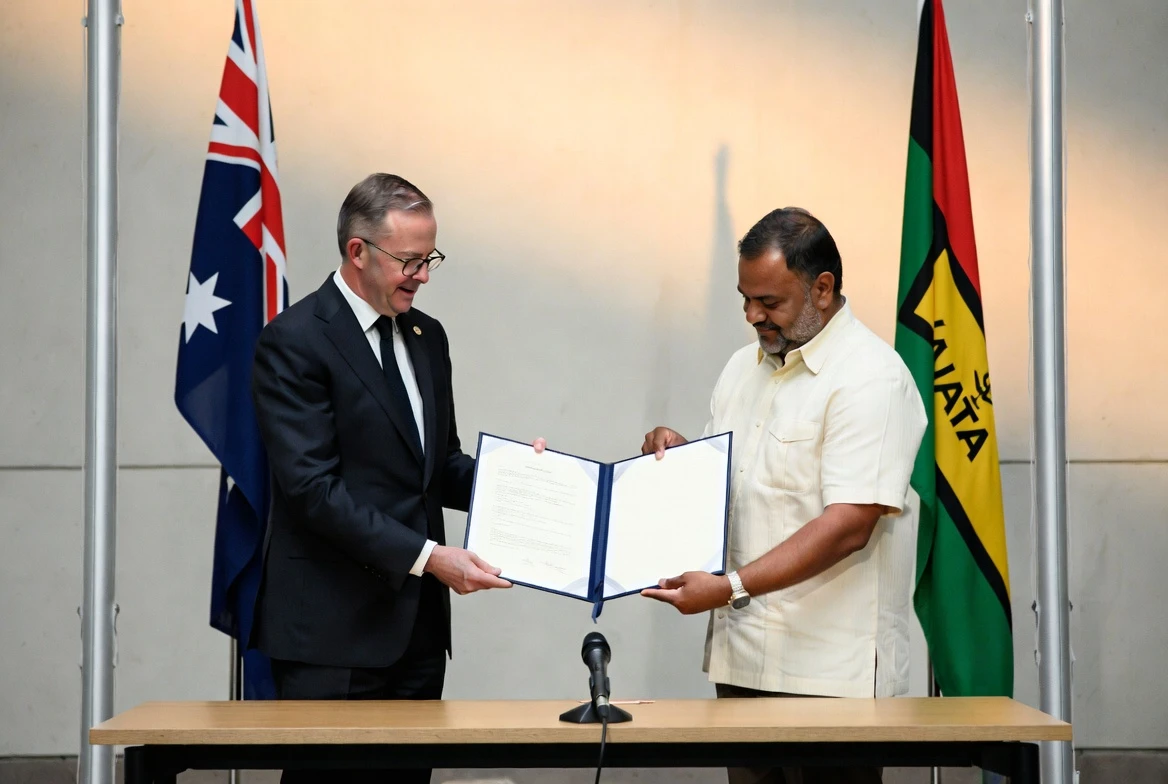
Australia and Vanuatu signed the Nakamal Agreement in Canberra on Monday, June 29, 2026, a sweeping security and economic pact that bars the establishment of any foreign military base on the Pacific island. Prime Minister Anthony Albanese and his Vanuatu counterpart, Jotham Napat, inked the treaty at Parliament House after ten months of stop-start negotiations.
The agreement commits Australia to A$500 million (US$344.50 million) over ten years and gives Canberra the right to be consulted on third-party investment in Vanuatu’s critical infrastructure. It does not, however, sever Vanuatu’s economic relationship with China, its largest external creditor and the builder of its presidential office, parliament building and road network. Vanuatu is separately negotiating an economic deal with Beijing called the Namele Agreement.
What the Nakamal Agreement Locks In
The agreement sets out Vanuatu’s commitments on foreign bases, policing, infrastructure and disaster response in a single document. The text, viewed by AFP, states that “to reinforce Pacific collective security and sovereignty Vanuatu shall not permit its territory to be used for any foreign military base or infrastructure.” It also names Australia as “Vanuatu’s longstanding primary policing partner.”
“What this does do is to provide certainty for Australia that there will be no foreign military base,” Albanese told reporters after the signing. “We have concluded a balanced agreement that will protect our collective and individual security and our sovereignty,” he added. Napat, at the same press conference, pointed to domestic legislation already on the books. In a written statement, Albanese called the agreement “an important step in our long-standing partnership with Vanuatu.”
The agreement also covers climate cooperation and mobility arrangements between the two countries, as set out in the official description of the Nakamal Agreement. A traineeships program is also included.
The core commitments are:
- No foreign military base: Vanuatu shall not permit its territory to be used for any foreign military base or infrastructure.
- Critical infrastructure consultation: Vanuatu will consult Australia on any third-party engagement in critical infrastructure.
- Primary policing partner: Australia is named Vanuatu’s longstanding primary policing partner.
- Pacific Islands Forum priority: Vanuatu will prioritise policing cooperation with Pacific Islands Forum members.
- Disaster-response preference: Vanuatu will turn first to Australia, New Zealand and France for humanitarian assistance.
The Ten-Month Hold-Out at Port Vila
The agreement was supposed to be signed in September 2025 but was delayed after Napat said his coalition partner had raised concerns that it could restrict Vanuatu’s ability to secure infrastructure funding from other countries. The deal was renegotiated over the following months. It reached its final form ahead of Napat’s first official visit to Australia, previewed in Albanese’s media statement announcing Napat’s trip.
Vanuatu’s cabinet approved a revised version in the months that followed. Police Minister Andrew Napuat said publicly that “overseas media has exaggerated these discussions with misrepresentations, giving wrong impressions of our relationship with our partners on topics of security and policing.” Napat faced repeated questions about the China relationship at Monday’s press conference and pointed to Vanuatu’s own legislation against militarisation of critical infrastructure. Australia’s Foreign Minister Penny Wong had earlier described the country’s Pacific posture as a “state of permanent contest in the Pacific.”
The Wharf at Luganville
Luganville, on the island of Espiritu Santo, sits at the centre of the base concern that drove the agreement’s military provisions. The town hosted what was once the largest US military base in the South Pacific. Beijing funded the expansion of a wharf there, and Australia and the United States read the work as preparation for a future Chinese naval presence. China and Vanuatu have said the wharf was for cruise ships.
China’s navy has made repeated port calls to Vanuatu. The new agreement addresses the wharf question by requiring Vanuatu to keep its critical infrastructure “free from militarisation, foreign interference or unauthorised access.” The text also commits Vanuatu to consulting Australia on any third-party engagement in critical infrastructure.
The agreement’s text uses the language “no foreign military base or infrastructure.” The clause is binding on Vanuatu’s government.
A$500 Million and What Australia Is Buying
Australia is committing A$500 million (US$344.50 million) over ten years to the Nakamal Agreement. The figure was first announced in 2025 and reconfirmed in the wire report from Sydney on signing day. The money funds police training and equipment, policing, maritime security, cybersecurity, intelligence cooperation, and infrastructure.
The agreement also formalises Australian support during Vanuatu’s natural disasters. It commits Vanuatu to come to Australia, New Zealand and France first for humanitarian assistance, a preference that mirrors the regional compact among Pacific Islands Forum members. On the climate front, the two governments agreed to work on renewable energy for Vanuatu, including on-grid and off-grid solutions. A new traineeships program is included. The agreement will enter into force after domestic processes in both countries.
Key funding figures:
- A$500 million in Australian funding over the life of the agreement
- US$344.50 million at the exchange rate the wire report cited
- 10 years of funding under the Nakamal Agreement
China Keeps the Economic Relationship
The Nakamal Agreement is the latest in a string of Australian pacts with Pacific island nations aimed at curbing China’s expanding security influence, but the text itself refers to “any foreign military base,” not to China by name. China is Vanuatu’s largest external creditor, having provided loans through Chinese banks that financed Chinese contractors to build the presidential office complex, parliament building and road network. Vanuatu is also separately negotiating an economic deal with China called the Namele Agreement. Beijing funded the expansion of a wharf in Luganville, a project Australia had flagged as a potential future military site.
The two deals cover different ground. The Nakamal Agreement handles security, policing and disaster response. The Namele Agreement covers economic cooperation.
“We will share the agreement, there is nothing to hide,” Napat told reporters when asked whether the China deal would contain security elements. Vanuatu’s police minister said earlier that any Chinese policing deal would resemble MoUs already in place with Australia, New Zealand, France, the UK and PNG.
A former Australian diplomat in the Pacific, James Batley, told AFP the contest between Beijing and Canberra for influence would continue. The agreement locks in a security relationship but does not end the underlying competition. Vanuatu continues to receive Chinese-built infrastructure.
| What the Nakamal Agreement does | What it leaves outside its scope |
|---|---|
| Security cooperation, policing, disaster response | Economic lending and debt |
| Australian consultation on third-party infrastructure engagement | Chinese-built infrastructure already on the ground |
| No foreign military base | Chinese navy port calls and existing police ties |
A Solomon Islands Shadow Over Policing
Since a secret security pact was signed in 2022, Chinese police have maintained a presence in the Solomon Islands. The Nakamal Agreement was negotiated against that backdrop.
Under the new agreement, Australia will provide additional training and equipment to the Vanuatu Police Force, plus greater maritime security, infrastructure, intelligence cooperation and cyber support. Vanuatu has committed to prioritise policing cooperation with Pacific Islands Forum members. The text names Australia as “Vanuatu’s longstanding primary policing partner.”
China formed policing ties with Vanuatu in 2023 and has donated equipment including drones, patrol boats and vehicles to the Vanuatu Police Force. Australia’s Department of Foreign Affairs and Trade said it was “aware China continues to have a small police presence in Vanuatu” and that Pacific security needs were “the responsibility of the Pacific.”
As a country, we have in fact passed an act in parliament not to allow any militarisation to actually be used for our critical infrastructure.
That was Prime Minister Jotham Napat, speaking in Canberra on Monday. The agreement’s clause covers critical infrastructure, the same category that includes the Luganville wharf.
The Contest That Continues
Albanese’s word for the agreement was “balanced.” The Nakamal Agreement locks in security and policing commitments but leaves Vanuatu’s economic alignment with China intact.
The contest between Australia and China in Vanuatu is not settled by Monday’s signing. China is still building roads and government buildings across the South Pacific, the Solomon Islands arrangement has not been unwound, and Vanuatu continues its Namele Agreement talks with Beijing. Former Australian diplomat James Batley framed the limits of the deal this way:
Vanuatu’s long tradition of non-alignment means that it won’t simply abandon its relationship with China. Nor will China abandon its attempts to undermine Australia’s interests in Vanuatu.
James Batley, a former Australian diplomat in the Pacific, gave AFP his read on the limits of the deal in Canberra on Monday. The agreement “will protect our collective and individual security and our sovereignty,” Albanese said.


OpenAI Ultrafast Puts GPT-5.6 Sol on Live Workloads

Apple’s 15% External Fee Bid Admits Its Own Zero Floor

JBL Beats Bose and Sony on Value for 2026 Soundbars

iPhone Users Pull 40 Percent More From Microdrama Apps

Nebius Q2 Turns AI Cloud Demand Into Prepaid Growth Machine

One UI 9.5 App Lock Ends Years of Samsung Delays

Shiprocket IPO Premium Hides ESOP Costs and Flat Merchant Base

Google Halves Gemini 3.7 Flash Price to Fuel Agent Swarms

Dawnwalker Time Clock Cracks Open-World RPG Habits

Gemini 3.7 Flash Cuts Agent Costs While Pro Stays Delayed

Fable 5 and Mythos 5 Return as US Lifts Anthropic Export Controls

Oracle Cuts 21,000 Jobs in a Year, Cites AI in 10-K Filing

SpaceX’s Google Deal Turns a Rocket Company Into a Cloud Landlord

CD Projekt Red Co-CEO: Redemption Arc Isn’t Done, Witcher 4 in 2027

XPL Rallies 30% Ahead of Plasma One Card Tier Launch

Google Search Profiles Build a Follow Graph Inside Discover

DGO App Brings Rs 549 Mobile Pass for FIFA World Cup 2026 in Nepal

Moonshot AI Targets $30 Billion in China’s Fastest AI Funding Sprint

Microsoft Xbox Layoffs Start in July as Sharma Slams 3% Margin

Oppo’s ColorOS 17 Eligibility List Leaves A-Series Buyers Behind
-
 AI1 month ago
Fable 5 and Mythos 5 Return as US Lifts Anthropic Export Controls
-
 AI2 months ago
Oracle Cuts 21,000 Jobs in a Year, Cites AI in 10-K Filing
-
 AI2 months ago
SpaceX’s Google Deal Turns a Rocket Company Into a Cloud Landlord
-
 GAMING2 months ago
CD Projekt Red Co-CEO: Redemption Arc Isn’t Done, Witcher 4 in 2027
-
 CRYPTO2 months ago
XPL Rallies 30% Ahead of Plasma One Card Tier Launch
-
 NEWS2 months ago
Google Search Profiles Build a Follow Graph Inside Discover
-
 APPS2 months ago
DGO App Brings Rs 549 Mobile Pass for FIFA World Cup 2026 in Nepal
-
 AI2 months ago
Moonshot AI Targets $30 Billion in China’s Fastest AI Funding Sprint