
AI
Firmus Ties AI Factories to 1.5 GWh of New Batteries
Firmus’s 12-year Gunvor deal locks 1.5 GWh of batteries and 220 hours of demand response, turning two South Australian AI factories into grid kit.

Firmus Technologies signed a 12-year wholesale deal with Gunvor Group for 600 MW of firm power, tying that load to 1.5 GWh of new batteries and 1.2 GW of new renewable plants by 2032. GreenPoint Energy’s 200 MW / 800 MWh Koolunga battery, near Brinkworth in South Australia’s Mid North, is more than half of the first firming slice, and Firmus will cut demand for up to 220 hours a year when wholesale prices spike.
Canberra’s March 2026 data-centre expectations already asked new AI sites to add generation, storage and demand flexibility. This contract puts numbers on those asks for two regional campuses, while leaving most of the advertised build still uncontracted.
Firmus Locks 1.5 GWh of Batteries Into a 12-Year Contract
The Sydney-registered AI factory company said on 30 June 2026 it had taken 600 MW of firm electricity for 12 years from Gunvor, the Geneva-based commodities trader. Gunvor will support 1.2 GW of new renewable generation and 1.5 GWh of new battery storage by 2032 to supply Firmus’s South Australian expansion.
That paper underpins the first phase of Project Southgate AI Factory campuses at Tailem Bend and Stirling North. The two sites carry 2.7 GW of planned capacity. The 600 MW contract is the first electrical slice, not the full campus rating.
THE SOUTH AUSTRALIA ENERGY SLICE
- Firm power: 600 MW on a 12-year wholesale supply agreement with Gunvor Group.
- New renewables: 1.2 GW of generation Gunvor is to support by 2032, double the contracted load.
- New storage: 1.5 GWh of batteries by 2032, with Koolunga as the first block.
- Demand response: up to 220 hours a year when wholesale prices pass agreed thresholds.
Co-CEO Oliver Curtis said the South Australian sites were chosen for the energy build as much as for the compute. “We’re building our AI Factories in regional South Australia because they’re the right locations for large-scale AI infrastructure and the energy investment that goes with it,” Curtis said.
Premier Peter Malinauskas welcomed the announcement as industrial proof of the state’s clean-energy pitch. “South Australia is leading the clean energy transition, and this project demonstrates how that leadership is attracting the industries of the future,” Malinauskas said.
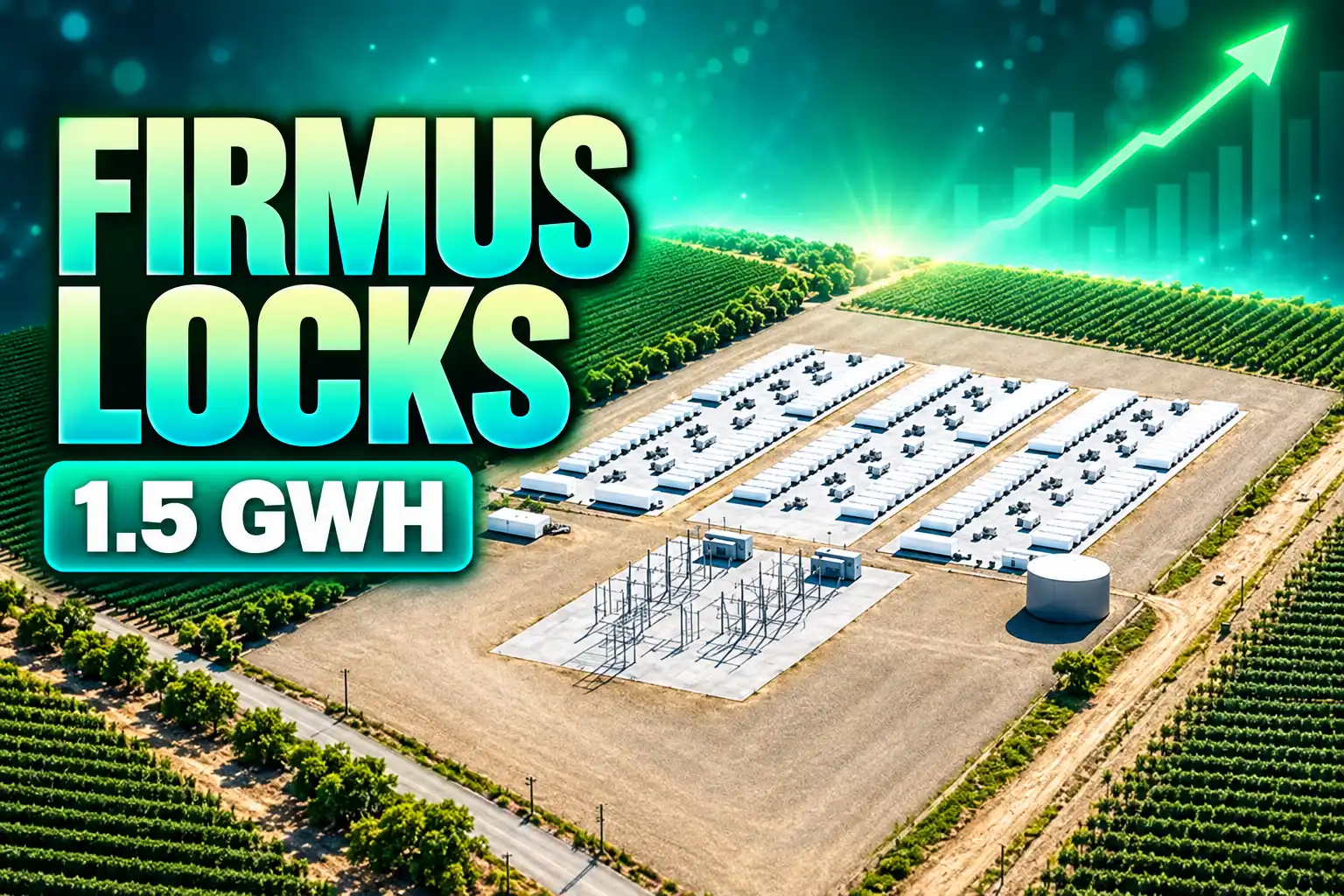
Koolunga Is More Than Half the First Firming Slice
Koolunga is a 200 MW / 800 MWh grid-forming battery on Power Station Road, about 1.1 km northeast of ElectraNet’s Brinkworth substation. GreenPoint Energy, the Australian platform of Singapore investor Equis, says the system connects to the 275 kV Brinkworth substation and can supply about 26,000 homes for four hours when full.
800 MWh is more than half of the 1.5 GWh Firmus has pledged to underwrite in the state, which is why the company calls the battery central rather than extra. Grid-forming inverters can hold voltage and frequency with synthetic inertia and fast frequency response, on a network that already runs among the highest renewable shares of any large connected grid.
The 200 MW discharge rating is one third of the 600 MW Firmus contracted. The rest of the 1.5 GWh stack still has to be built, and the battery’s job is firming and system strength, not a like-for-like backup of the whole campus.
KOOLUNGA FROM CONSENT TO SWITCH-ON
- 10 August 2023: The South Australian Planning Commission grants development approval.
- September 2025: The project wins a Capacity Investment Scheme contract in federal Tender Round Three.
- April 2026: GenusPlus takes an A$110 million engineering, procurement, construction and commissioning contract for balance-of-plant and battery installation.
- 30 June 2026: GreenPoint reaches financial close with a long-term offtake to Gunvor, tied to the Firmus supply agreement.
- Q1 2028: Gunvor has Koolunga targeted for commercial operations beside the Brinkworth 275 kV substation.
Mahesh Reddy Indluri, Co-Chief Executive Officer of GreenPoint Energy, said the offtake puts the battery inside a firm-load product built for large commercial customers, not a stand-alone merchant unit. The Capacity Investment Scheme already put a revenue floor under the asset; the Gunvor paper is what a trader can take to a 12-year customer.
Canberra’s March Rules Are Written Into the Paper
The Department of Industry, Science and Resources published Expectations of data centres and AI infrastructure developers on 23 March 2026. Meeting them, the department said, is the foundation of social licence for new or expanded sites, including large AI compute centres it calls AI factories. Small edge rooms and on-site enterprise halls are out of scope.
Expectation 2 is the clause this deal is built to answer. New centres “should not place upward pressure on energy prices” and should secure new and additional clean energy generation or storage to offset demand, pay their share of transmission and distribution costs, cut their own use, and improve grid stability with demand flexibility and peak-load management. Proposals that ignore that list will not be prioritised in Commonwealth regulatory assessments.
Firmus released an Australian Energy Policy the same day as the Gunvor signing and said the policy goes past those expectations with measurable pledges for grid-connected Australian operations. On its commitments page it says that for every megawatt it contracts, it is building two megawatts of new generation per megawatt of its own load, matching the 1.2 GW of plants sitting behind 600 MW of demand.
SEVEN ENERGY PLEDGES ON THE FIRMUS PAGE
- Build efficiently: Liquid cooling that takes heat off the processor so wasted electricity does not become extra grid demand.
- Switch off on spikes: Cut load when high wholesale prices show the system is stressed.
- Pay for new storage: Require suppliers to build new firming for every megawatt of demand added.
- Overbuild renewables: Match each megawatt-hour with a certificate from day one, and contract more new plants than the load.
- Pay the market price: Buy on commercial terms, with no special tariff and no subsidy.
- Fund the wires: Pay for the transmission and connection gear the factories need.
- Help retire coal: Use scale, where it pays, to replace coal stations with new renewable plant and storage.
The 1.5 GWh storage pledge on a 600 MW contract works out to 2.5 megawatt-hours of new firming for each megawatt of load. That is a commercial ratio, not a reliability standard set by the market operator. Hydro Tasmania said in September 2026 it is still working through how the two-for-one generation pledge would be met in practice at Firmus’s Tasmanian sites, which is the same arithmetic in another state.
220 Hours Off When the Wholesale Price Spikes
The demand-response clause is the part of the paper that treats the AI factory as a grid tool. Firmus will reduce consumption for up to 220 hours each year when wholesale prices pass agreed thresholds, which it says frees electricity for other users and eases pressure on the price cap during stress.
On its commitments page the company goes further than a trim. It describes a hard contractual promise to step off the South Australian grid when spot prices hit a defined level, for a minimum of 2.5 percent of hours each year. 220 hours is that floor on a standard 8,760-hour year.
For GPU training and inference, those hours are not free. A campus that has promised to vanish from the market on the most expensive intervals needs either spare compute in another region, jobs that can pause, or a commercial acceptance that some tokens will wait. Firmus has not published the strike price or which workloads get cut first.
David Maher, Head of APAC Power Trading and Origination at Gunvor, framed the whole structure as one product rather than a pile of PPAs. “This transaction demonstrates how long-term customer demand can help unlock renewable supply, firming and risk management through a single commercial solution,” Maher said. “As AI and digital infrastructure continue to develop in Australia, we believe models like this can support investment in new generation and storage while delivering reliable and flexible supply outcomes.”
The Campuses Outrun the Power Contract
Tailem Bend and Stirling North are billed as 2.7 GW of planned capacity. The Gunvor agreement covers 600 MW of firm electricity for the first phase. Anyone reading the 2.7 GW figure as power already underwritten is reading a campus masterplan, not a completed energy book.
CONTRACTED POWER AGAINST THE CAMPUS PLAN
| Item | On the Gunvor paper | On the South Australia plan |
|---|---|---|
| Firm electricity | 600 MW, 12 years | First phase only |
| Campus capacity | Not the full build | 2.7 GW planned at Tailem Bend and Stirling North |
| New renewable generation | 1.2 GW by 2032 | Tied to the 600 MW load, not to 2.7 GW |
| New batteries | 1.5 GWh by 2032 | Koolunga 200 MW / 800 MWh is the first block |
| Demand response | Up to 220 hours a year | Applies to contracted load, not the unbuilt remainder |
Later stages will need their own generation, storage and connection path if Firmus keeps the two-for-one and 2.5 megawatt-hour rules. The 2032 date on the 1.2 GW of plants is also a long fuse relative to an AI campus that wants chips in the floor as soon as buildings and transmission allow.
That timing gap is the practical pressure inside the announcement. Koolunga is aimed at Q1 2028. The rest of the 1.5 GWh and the 1.2 GW of generation run to 2032. Compute demand does not wait for a federal scheme’s last turbine.
A Geneva Trader Assembles the South Australia Stack
Corporate renewable deals in Australia have usually been a single wind or solar farm sold to a single buyer, with the customer left to buy firming in the spot market. Gunvor sits in the middle of several assets and several risk books and sells Firmus a firm 600 MW product. The trader, not the AI company, has to make wind, solar, batteries and hedges add up on the hour.
Gunvor is one of the world’s largest independent commodities houses, with main trading hubs in Geneva, Singapore and Houston. In 2025 it generated US$144 billion of revenue on 253 million tonnes of commodities. Days before the Firmus announcement, the Australian Competition and Consumer Commission waived a proposed purchase of Zen Energy’s retail book and a small hedge set that included South Australian solar and a battery toll. That waiver is a separate file from the Firmus paper, but it shows the same move: a global trader buying Australian market access so it can originate firm power.
Our South Australia energy agreement puts our commitments into practice, backing new renewable generation, major battery storage and flexible energy use that supports the grid.
Oliver Curtis, Co-CEO, Firmus Technologies
Curtis also said Firmus would pay its own way on infrastructure and keep benefits in the host towns. The energy policy repeats that households and small firms are not meant to carry the connection bill. Whether that holds will show up in ElectraNet’s connection works and in who is named on the invoices, not in the launch copy.
Why GPU Ramps Need a Battery in Front
AI halls do not draw power the way a chilled office block does. Training and inference clusters can jump from a low idle toward full rack power in seconds, then drop just as fast when a job ends. Wärtsilä, which designs engine plants and storage for data centres, has said those swings are the hard part, because generators cannot move that fast and a raw grid connection does not like the jolt either.
Wärtsilä’s working start point on a large swing is one megawatt of batteries for each megawatt of load change, then hours of duration on top. Koolunga’s 200 MW inverter rating is useful for a slice of a 600 MW contracted load and for the inertia the South Australian system wants. It is not sized as a one-for-one shock absorber for every GPU transient on a finished 2.7 GW campus.
That is why the offtake matters more than the ribbon on a single battery. Firmus needs milliseconds of power electronics between the grid and the racks, hours of stored energy to make wind and solar dispatchable, and a contractual right to disappear for 220 hours when the market is tight. The Gunvor paper buys the last two in bulk. The first still has to be engineered into each hall.
Koolunga is due in Q1 2028. The 1.2 GW of new plants and the rest of the 1.5 GWh of storage are due by 2032. Until those dates land, the 600 MW product is a promise sitting on a trader’s book, and the 2.7 GW campus plan is still waiting for its next energy contract.
Frequently Asked Questions
What is the Koolunga battery energy storage system?
Koolunga is GreenPoint Energy’s 200 MW / 800 MWh grid-forming battery about 1.1 km northeast of the Brinkworth substation, approved on 10 August 2023 and backed by a federal Capacity Investment Scheme contract from September 2025. GenusPlus holds an A$110 million contract to install the plant and balance of plant, and GreenPoint says a full charge can cover about 26,000 homes for four hours.
What do Australia’s National Data Centre Expectations require?
The 23 March 2026 document sets five tests: national interest and data sovereignty, support for the energy transition, sustainable water use, Australian jobs and skills, and local research capability. They are a prioritisation tool for Commonwealth assessments, not a new statute, and they do not apply to small-scale edge or on-site enterprise data centres.
How does Firmus’s 220-hour demand response work?
The Gunvor agreement requires Firmus to cut consumption for up to 220 hours a year when wholesale prices pass agreed thresholds, which the company treats as a minimum of 2.5 percent of hours. Its commitments page says the factories are designed to step off the South Australian grid entirely at a defined spot-price level; the strike price and the workloads that pause have not been published.
Who is Gunvor Group in this energy deal?
Gunvor is an independent commodities trader with hubs in Geneva, Singapore and Houston that, according to the Firmus announcement, generated US$144 billion of revenue in 2025 on 253 million tonnes of cargo. In this structure it originates firm power for Firmus and holds the Koolunga offtake, rather than selling a single wind or solar farm as a classic corporate PPA.
Does the Gunvor agreement cover Firmus’s full 2.7 GW South Australia plan?
No. The 12-year paper is 600 MW of firm electricity for the first phase at Tailem Bend and Stirling North, which together are described as 2.7 GW of planned capacity. The 1.2 GW of new generation and 1.5 GWh of new storage are tied to that 600 MW load by 2032; later campus stages would need new contracts if Firmus keeps the same ratios.

Huang Sells Cybersecurity as AI’s Next Always-On App

Gemini for Windows Cannot Act on Gmail or Drive

Apple Health App Will Sell $119 Quest Blood Tests

AMD’s EPYC Playbook Now Runs Against NVIDIA’s AI Lead

A Nevada Ring Clip Turns a Door Kick Into Evidence

Fable 5 Came Back Under a Commerce On-Off Switch

Google’s SpaceX GPU Lease Has a Sept. 30 Deadline

Plasma One’s XPL Locks Face a 1.81 Billion Cliff

DGO’s Rs 549 World Cup Pass Cost Fans Sleep and Data

Moonshot AI’s $30 Billion Ask Became a $35 Billion Close
-
 AI3 months ago
Fable 5 Came Back Under a Commerce On-Off Switch
-
 AI4 months ago
Google’s SpaceX GPU Lease Has a Sept. 30 Deadline
-
 CRYPTO4 months ago
Plasma One’s XPL Locks Face a 1.81 Billion Cliff
-
 APPS4 months ago
DGO’s Rs 549 World Cup Pass Cost Fans Sleep and Data
-
 AI4 months ago
Moonshot AI’s $30 Billion Ask Became a $35 Billion Close
-

 NEWS4 months ago
ColorOS 17 Device List Spans Oppo, OnePlus and Realme
-

 GAMING4 months ago
Xbox Cuts 3,200 Jobs After Five Years of Thin Returns
-

 GAMING3 months ago
The RTX 4050 Under Rs 70,000 Hides a Wattage Gap