
AI
Anthropic’s Claude Science Workbench Bundles 60+ Tools on One Model
Anthropic ships Claude Science, a workbench bundling 60+ research databases and a reviewer agent, into a market OpenAI and Google also chase.

Anthropic launched Claude Science on June 30, a research workbench that connects more than 60 scientific databases, file viewers, and high-performance compute behind one chat-style app. The product runs the same Claude models available to anyone today, including Claude Opus 4.8, with no new biology model behind it. Anthropic is positioning Claude Science as a packaging play for scientists at the bench, with reproducibility built into every output.
What Anthropic Just Shipped
Anthropic put Claude Science in front of users on June 30, 2026, in beta for subscribers on its Pro, Max, Team, and Enterprise plans on macOS and Linux. The application pulls PubMed, Jupyter, R, a cluster terminal, and other research staples into a single workspace, per Anthropic’s Claude Science announcement and skill list. Free-plan users are excluded; the Team tier now offers discounted seats for academic and nonprofit research labs.
A generalist coordinating agent sits on top of the stack, wired into more than 60 curated skills and connectors. Scientists query scientific literature, run multi-step analyses, generate figures, write manuscripts, and explain how each result was produced, all without switching applications. The agent can spin up sub-agents and hand work off to user-built expert agents, while a separate reviewer agent checks citations and calculations. Anthropic says it is releasing Claude Science in beta so the team can refine the platform with feedback from real workloads.
- Genomics
- Single-cell
- Proteomics
- Structural biology
- Cheminformatics
Why a Workbench, Not a New Model
Anthropic is explicit that Claude Science is a packaging play. The company states the workbench is “not a new AI model and not a more capable model for biology. It runs the same Claude models already available to everyone today (including Claude Opus 4.8), with no special access and no gating,” per TechCrunch’s reporting. The product ships on the back of Claude for Life Sciences from October 2025, which augmented the chatbot with skills and connectors for biological work.
TechCrunch’s read is that the launch fits Anthropic’s broader push to be more than a model provider and to own the operating layer for specific industries, the way Claude Code has become the operating layer for software development. The same Claude models, then, run a new industry-specific shell.
That positioning matters because the rival labs are not packaging the same way. OpenAI shipped GPT-Rosalind in April 2026, a model fine-tuned for biological reasoning and gated behind a qualification and safety review for qualified enterprise customers in the U.S. Google DeepMind owns AlphaFold and AlphaGenome, the foundational models the other two can only call into, and bundles them through Gemini for Science. Anthropic, by contrast, is going wide: any Pro subscriber gets the workbench today, with no enterprise gate.
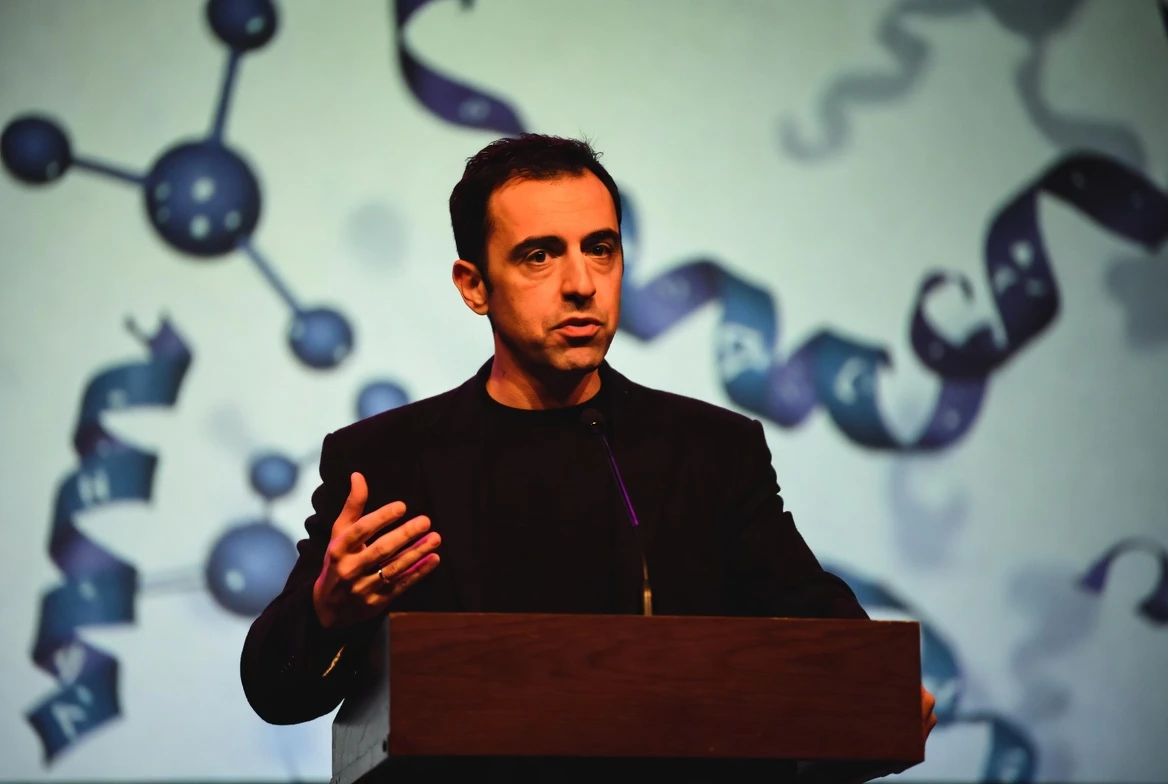
We don’t know for sure if that’s going to work out. But I think we’re seeing signs that we’re seeing the beginnings of it.
Anthropic CEO Dario Amodei, speaking at the launch event in San Francisco on June 30, 2026, per STAT. Amodei framed the workbench as a “general purpose technology” to make sense of biology’s complexity “in its full complexity, better,” and conceded the bet is unproven.
How Reproducibility Is Built In
Reproducibility is the wedge Claude Science leans on, and the design treats every output as an auditable artifact. When the app draws a protein structure, a genome browser track, or a chemical structure, it ships the exact code and computing environment that produced it, a plain-language description of how it was made, and the full message history. That bundle stays attached to the figure, so a lab can validate the result or rerun the analysis months later. Edit the artifact in plain language and the agent rewrites its own code underneath, whether the request is to drop gridlines or change an axis to log scale. Every output is meant to be reproducible without the scientist who made it still being in the room.
The session holds context in memory, so even massive datasets only load once. The user can fork the session at any point to compare two approaches without losing the original thread. Claude Science displays proteins, structures, and molecules natively rather than as flat images a reader has to take on faith.
A reviewer agent runs in parallel with the work. It inspects outputs, flagging incorrect citations, untraceable numbers, and figures that don’t match their underlying code, and self-corrects as it goes. The session lives on the scientist’s own infrastructure, laptop, Linux box, or HPC login node, so sensitive datasets do not leave the systems they were already on. Only the context needed for each step is sent to Claude. For labs under IP or HIPAA pressure, that boundary is the feature that makes the rest usable.
Compute scales through the same local path. Claude Science drafts a plan, asks before reaching new resources, and submits jobs to a lab’s HPC cluster over SSH or to a Modal account for on-demand GPUs. The workbench connects natively to NVIDIA’s BioNeMo Agent Toolkit and the Evo 2, Boltz-2, and OpenFold3 models inside it.
- UniProt
- PDB
- Ensembl
- Reactome
- ClinVar
- ChEMBL
- GEO
Specialist agents query and synthesize across all of them without the user learning each one’s schema. Anthropic says the user can also save a pipeline as a reusable skill for future sessions, so the lab’s own validated tools travel forward with each new project.
The Early Results From Beta
Three early users described real workloads. Manifold Bio, which designs tissue-targeting medicines that home to a specific organ or cell type, used Claude Science to nominate the targets for its latest experiments.
The workbench assessed surface expression, trafficking, and safety for each tissue and target, ranking candidates against criteria Manifold had learned from its own proprietary data. Anthropic quoted Manifold saying Claude Science could do this end-to-end, gathering the right data and applying the right judgment with context from past programs built in. At the Allen Institute, neuroscientist Jérôme Lecoq built a multi-agent “computational review template” with about 20 custom skills to write long-form reviews. Sub-agents read thousands of papers, pulled central claims and key quantitative findings, and stored them in an evidence database.
Actor-critic pairs then wrote the review section by section, with one agent drafting and a separate reviewer agent checking for accuracy and citation fidelity. Lecoq’s team said reviews that used to take up to two years now run to about 10 reviews, many more than 100 pages, with citations checked by reviewer agents. At the UCSF Brain Tumor Center, associate professor Stephen Francis said the workbench brought comprehensive germline workups on glioma to “roughly one-tenth the time”, and his lab independently validated the results.
Three Distribution Strategies for the Same Market
The launch lands in a market with three very different distribution strategies, per TechCrunch. Anthropic is going wide on subscription access. OpenAI is going narrow and enterprise-gated. Google is leaning on owned, proprietary models nobody else has. The three approaches map to three different bets about how AI wins the lab, and they put the same big-pharma customer in three different procurement queues.
| Vendor | Strategy | Access model | Key models |
|---|---|---|---|
| Anthropic | Broad workflow workbench | Beta to Pro, Max, Team, Enterprise subscribers | Claude Opus 4.8 and other existing Claude models |
| OpenAI | Narrow, gated specialist model | Research preview for qualified U.S. enterprise customers | GPT-Rosalind (fine-tuned for biological reasoning) |
| Owned foundational models bundled into a skill set | Gemini for Science platform | AlphaFold, AlphaGenome, and 30+ life sciences databases |
OpenAI’s first wave of GPT-Rosalind partners is the same roster Anthropic is now naming. Per TechCrunch, Amgen, Allen Institute, Moderna, Thermo Fisher, and Novo Nordisk got early access to Rosalind. Anthropic, in turn, named Novo Nordisk and the Allen Institute as Claude Science customer case studies, a sign that pharma organizations are already running multi-vendor AI stacks rather than picking one.
The stakes for open science sit with the third player. Per Isomorphic’s closed drug-discovery model, Isomorphic Labs, the Alphabet spin-off, has announced an updated proprietary drug-discovery model meant to succeed AlphaFold 3, and is keeping the innovation to itself. Scientists developing open-source tools are, in Nature’s words, “left guessing how to achieve similar results.” Claude Science can call into Isomorphic’s models where partners allow, but Anthropic’s deeper pull is the workspace itself, the layer where scientists spend their day.
The Fact-Checker Is the Same Model
The reviewer agent sits inside Claude Science as the response to a real, growing problem in scientific publishing. Per 2025 publications flagged for AI citations, tens of thousands of publications from 2025 may include invalid references generated by AI. Anthropic’s design treats the reviewer as a guardrail, flagging incorrect citations and untraceable numbers before they reach a manuscript. There is a catch, and TechCrunch names it plainly: it is still the same underlying model checking itself, not an independent source of truth. So the reviewer can still fail in the same ways the creator can, especially on edge citations where the source is hard to fetch.
That limitation shows up most where the workbench leans hardest on the reviewer, in long-form literature reviews and multi-agent manuscript drafting. Actor-critic pairs help, and a forked session lets a scientist compare two approaches, but the critic and the creator share training, blind spots, and failure modes. The reviewer agent can still be wrong, especially on citations it cannot resolve to a fetched source.
Anthropic’s mitigation is process, not architecture: the reviewer is a distinct agent with a distinct prompt, and the user can fork or re-run any session where the check fails. Independent validation will have to come from outside, the same way it always has in science, through reanalysis by another lab. Claude Science makes that reanalysis cheaper, but it does not automate trust.
Funding and Seats for the First 50
Anthropic is funding the rollout with a grant program aimed at labs and academic groups. The company will support up to 50 Claude Science AI for Science projects with up to $30,000 in credits each. Modal, the compute partner, adds up to $2,000 in compute for select projects. Applications are open through July 15, 2026, with award notifications sent out by July 31. Projects will run from September 1 to December 1, 2026.
The focus is biology and biomedical research at the outset, with Anthropic looking for postdoctoral and graduate projects that span domains and explore the boundaries of science. Anthropic’s launch lands alongside a broader AI-for-drug-discovery push across the industry. Bayer’s parallel move on Iambic, announced June 22, 2026, asks the same question from a different angle: whether AI can shrink the high failure rate pharma has lived with in clinical trials. Bayer’s parallel AI drug discovery bet lays out the drug-pipeline version of the wager on the same timeline. That broader race gives Claude Science a peer set rather than a clear lead.
Claude Science is Anthropic’s version of that question, framed for the scientist at the bench. Per Amodei, the AI for Science team will learn whether the approach works from the projects that ship between September and December. Anthropic is also betting its growth on vertical workflow products rather than raw model capability, per TechCrunch, an early signal for how AI vendors may compete in law, finance, and engineering next. The workbench ships first, and the verdict waits for the science it produces.


South Korea Retail Investors Face Reckoning After KOSPI AI Rally Collapses

Surrey AI Maps Three Heart Attack Paths and Their Molecular Roots

Germany Locks Neutral Apple ATT Prompts Across Most of Europe

Apple’s 5% EU Fee Quietly Rewrites Alternative App Store Math

Apple’s EU Fee Truce Cuts Complexity but Leaves Rivals Fuming

Pixel 11 Pro Fold Trades Thinness for Durability and Seven-Year Stay

Mayo AI Flags HCM Obstruction From Everyday Ultrasound Videos

Indian Brands Quietly Scale Landmark Screens and Home Tech

Navin Vatsa Turns Grief Into a Lifetime of Quiet Seeing

Google Bets Pixel 11 Agentic AI Will Redefine Phones

Oracle Cuts 21,000 Jobs in a Year, Cites AI in 10-K Filing

Fable 5 and Mythos 5 Return as US Lifts Anthropic Export Controls

SpaceX’s Google Deal Turns a Rocket Company Into a Cloud Landlord

CD Projekt Red Co-CEO: Redemption Arc Isn’t Done, Witcher 4 in 2027

XPL Rallies 30% Ahead of Plasma One Card Tier Launch

Google Search Profiles Build a Follow Graph Inside Discover

DGO App Brings Rs 549 Mobile Pass for FIFA World Cup 2026 in Nepal

Moonshot AI Targets $30 Billion in China’s Fastest AI Funding Sprint

Oppo’s ColorOS 17 Eligibility List Leaves A-Series Buyers Behind

Microsoft Xbox Layoffs Start in July as Sharma Slams 3% Margin
-
 AI2 months ago
Oracle Cuts 21,000 Jobs in a Year, Cites AI in 10-K Filing
-
 AI2 months ago
Fable 5 and Mythos 5 Return as US Lifts Anthropic Export Controls
-
 AI3 months ago
SpaceX’s Google Deal Turns a Rocket Company Into a Cloud Landlord
-
 GAMING2 months ago
CD Projekt Red Co-CEO: Redemption Arc Isn’t Done, Witcher 4 in 2027
-
 CRYPTO2 months ago
XPL Rallies 30% Ahead of Plasma One Card Tier Launch
-
 NEWS3 months ago
Google Search Profiles Build a Follow Graph Inside Discover
-
 APPS2 months ago
DGO App Brings Rs 549 Mobile Pass for FIFA World Cup 2026 in Nepal
-
 AI3 months ago
Moonshot AI Targets $30 Billion in China’s Fastest AI Funding Sprint