
AI
AI Crypto Coins Ride the Nvidia Boom. The Funding Gap Is the Story.
AI crypto coins jumped on Nvidia’s GTC $1 trillion AI chip forecast and OpenAI’s $110B raise. Funding, dilution, and regulation are reshaping the sector.

AI crypto coins jumped after Nvidia’s GTC 2026 keynote forecast $1 trillion in chip orders through 2027, sending Bittensor’s TAO up 94.9% in 30 days. OpenAI had closed a $110 billion raise at a $730 billion valuation the month before, with Amazon, Nvidia, and SoftBank on the cap table.
The harder story for AI crypto coins in 2026 is the centralized AI scale surrounding them and the dilution, regulation, and tokenomics mechanics every long-term holder has to size. Investors looking past the rally need to compare what the decentralized AI stack is actually building against the resources the centralized stack already commands.
Nvidia’s GTC Forecast Reignited the AI Token Trade
Jensen Huang opened his GTC 2026 keynote on March 16 at the SAP Center in San Jose and walked the audience through Nvidia’s roadmap. Near the end, he pegged cumulative revenue from Blackwell and Vera Rubin systems at at least $1 trillion between 2025 and 2027, a number larger than anything Wall Street had modeled. For AI tokens, the read-through was mechanical. The 2024 AI crypto rally had been triggered by similar Nvidia signals.
This time the impact was sharper because the sector had spent the intervening quarters bleeding. Most AI tokens still traded well below their 2024 highs, liquidity had thinned, and developer mindshare had drifted toward centralized AI labs. GTC reset the narrative in a single keynote.
Tokens tied to decentralized AI training, GPU compute, agent economies, and AI data all moved higher, with TAO and VVV printing outsized weekly gains. The rally cooled by April. As of early July 2026, TAO trades around $205 with a market cap near $4.27 billion, according to crypto price aggregators, and the 30-day surge has flattened. Nvidia keynotes move the AI complex in the short term and do not, on their own, change the structural economics of any individual token, with the earlier coverage of AI crypto coins falling on SpaceX IPO and OpenAI delay news tracking how quickly the same sector reverses on a different catalyst.
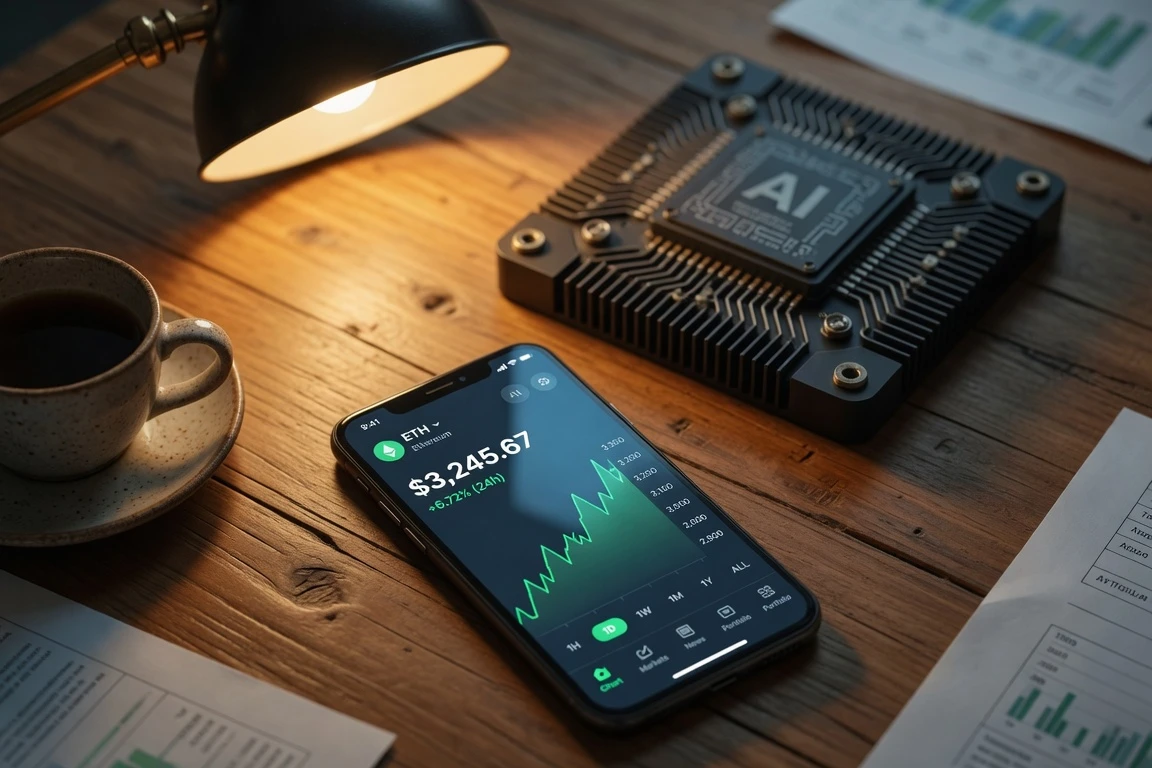
The Funding Gap That Frames the Whole Sector
The hardest fact for any AI crypto investor to absorb is how the centralized AI funding scale compares to the entire crypto AI sector put together. OpenAI’s February 2026 raise alone, $110 billion at a $730 billion pre-money valuation, is larger than the combined market cap of the named projects in CoinMarketCap’s AI category several times over, with Amazon putting in $50 billion and Nvidia and SoftBank each adding $30 billion.
Nvidia’s earnings tell the same story from the other side of the table. The chipmaker’s fiscal Q1 2027 report showed $81.6 billion in revenue, up 85% from a year earlier, with Data Center hitting a record $75.2 billion, up 92% year over year. For comparison, Bittensor, the largest decentralized AI project by market cap, trades around a $4 billion valuation. The scale gap is not a rounding error.
That gap does not mean decentralized AI is doomed. It means the projects worth holding are the ones solving specific infrastructure problems the centralized stack does not, including censorship-resistant inference, private AI, decentralized identity, and agent-to-agent commerce. Tokens that try to be a cheaper OpenAI will get crushed on funding.
Tokens that build rails centralized AI cannot or will not build have a structural reason to exist. The next several sections walk through the largest AI crypto projects by market cap and what their economics actually look like under the surface.
Sector scale, July 2026:
- Nvidia Blackwell and Vera Rubin revenue forecast: at least $1 trillion from 2025 through 2027
- OpenAI funding round, February 2026: $110 billion
- OpenAI pre-money valuation: $730 billion
- Nvidia fiscal Q1 2027 revenue (quarter ended April 26, 2026): $81.6 billion, up 85% year over year
- Bittensor (TAO) market cap, July 1, 2026: about $4.27 billion
We’re pushing the frontier across infrastructure, research, and products to make AI more capable, reliable, and broadly useful. SoftBank, NVIDIA, and Amazon are long-term partners who share our ambition to turn real scientific progress into systems that deliver meaningful benefits for people at global scale.
That was Sam Altman, co-founder and CEO of OpenAI, writing in the company’s February 2026 funding announcement.
Inside Bittensor’s Subnet Stack and the 21 Million Cap
Bittensor runs a network of up to 128 specialized subnets, each dedicated to a distinct AI task. Developers contribute machine learning models to the subnet that matches their specialty and earn TAO based on the usefulness of their outputs. Subnet 64, branded Chutes, brings serverless AI inference to the network using Trusted Execution Environment (TEE) technology, which isolates code and data from the rest of the processor.
Other subnets handle text, image, and audio tasks. The architecture is closer to a coordinated compute grid than a single AI model. TAO is modeled on Bitcoin’s supply curve, capped at 21 million tokens.
As of mid-2026, roughly 35% (about 7.3 million TAO) is in circulation, with the rest released on a predetermined schedule. That fixed cap gives TAO the same scarcity narrative Bitcoin uses, though the demand side is far less proven. Polychain Capital has added more than $200 million in exposure to TAO, making it the most institutionally backed decentralized AI token by a wide margin.
The subnet model is Bittensor’s biggest structural advantage and its biggest execution risk. Subnet 64 can ship end-to-end encryption and confidential inference in a single release, as it did in late 2025. A misaligned subnet, by contrast, can drain emissions without producing useful output. Holders are underwriting the network’s continued output quality, which can swing sharply when individual subnets over- or under-perform.
Venice Token’s Subscription-to-Burn Loop
Venice.ai is a privacy-focused AI platform founded in May 2024 by Erik Voorhees and Teana Baker-Taylor. It offers text, image, and code generation routed through decentralized infrastructure, avoiding the centralized providers most AI apps rely on. Venice Token (VVV) is the native token of that platform, and its design is the closest thing the AI crypto sector has to a real value-accrual mechanism.
The mechanism works in two steps. First, Venice cuts new VVV emissions on a published schedule. Annual emissions fell from 8 million to 6 million starting February 10, 2026, a 25% reduction. The Venice team’s permanent emission cut announcement details the February schedule change. The team then cut emissions to 5 million in May 2026 and to 3 million in July 2026.
Second, Venice introduced a Sub Burn Program in April 2026 that uses part of its fiat subscription revenue to buy back and permanently burn VVV, with between $5 and $10 worth of VVV burned per subscriber per month depending on tier. Most AI tokens in this sector rise and fall on narrative. VVV’s price is tied to a working supply-side mechanism that converts fiat subscriptions into permanent token burns.
As of early June 2026, VVV traded around $21.31 with a market cap of roughly $610 million. The deflationary design is the reason VVV moved sharply on Nvidia’s GTC keynote. Holders should still expect volatility. Analysts covering the AI token complex have noted that many of the sector’s biggest names remain more than 90% below their all-time highs.
Worldcoin, Token Unlocks, and the Regulatory Math
Worldcoin sits in a different category from the rest. Its core product, World ID, uses an iris-scanning device called the Orb to verify that a user is a real person, addressing a problem created by AI itself. As bots and AI-generated content become harder to distinguish from humans, proof-of-personhood becomes infrastructure for the AI economy. The project is co-founded by Sam Altman.
Worldcoin’s biometric model has already triggered concrete regulatory action. Hong Kong banned the project, citing that it was retaining iris images for up to a decade. Spain’s data protection authority ordered the deletion of all iris scan data collected since launch. Argentine authorities opened investigations into the project’s data practices, and in November 2025 Thai authorities shut down World’s biometric data collection and called for deletion of stored data. The biometric data model remains the project’s biggest growth obstacle.
Token unlocks are the quieter risk across the sector. Bittensor has roughly 35% of TAO in circulation, while Worldcoin has about 49% of WLD circulating out of a maximum supply of 10 billion, and Render has roughly 520 million RENDER in circulation with no fixed supply cap. The fully diluted valuation gap, the difference between market cap and the theoretical cap if all tokens were unlocked, is the number every AI crypto holder should track.
Four sector-specific risks to size:
- Token unlocks and FDV gaps. Many AI tokens have less than half their supply circulating. The gap creates dilution risk as locked tokens release into thinner markets.
- Regulatory pressure on identity and biometric data. Worldcoin has been banned, investigated, or ordered to delete data in multiple jurisdictions.
- Centralized AI funding dominance. A single OpenAI raise was larger than the entire AI crypto sector’s combined market cap.
- Narrative volatility. A single Nvidia keynote or CEO comment can move the entire sector in either direction.
What the Sector Categories Actually Build
The “AI crypto” label covers projects doing very different jobs. A useful mental model separates them into six categories, each tied to a different part of the AI stack. The table below maps each category to what it actually builds and which named projects sit in it.
Most casual coverage of the sector lumps these together, which is where most of the misreads come from. The distinction matters for both risk and entry timing.
| Category | What it does | Examples |
|---|---|---|
| Decentralized AI training | Networks where models compete and earn tokens based on output quality | Bittensor |
| Decentralized GPU compute | Marketplaces for renting GPU capacity across a global network | Render, Internet Computer |
| AI data and indexing | Capturing and structuring data for AI training pipelines | Grass, The Graph |
| AI agent economies | Platforms for tokenized autonomous agents that transact on-chain | Virtuals, FET |
| Private AI inference | Decentralized AI that avoids centralized providers | Venice Token |
| Proof-of-personhood | Biometric identity to distinguish humans from bots | Worldcoin |
Tokens in different categories respond to different catalysts. Infrastructure tokens like TAO and RENDER move with GPU demand signals. Agent tokens like VIRTUAL move with adoption of autonomous workflows. Identity tokens like WLD move with regulatory decisions. Treating the sector as one trade obscures more than it reveals.
How to Read AI Crypto Beyond the Headlines
A GTC-triggered 90% rally is not, on its own, a reason to buy. The evaluation work is what separates a hold from a loss. Five checks cover most of what matters:
- Real AI utility. The project should use AI in its core architecture, not as a marketing layer.
- Token utility. The token should be needed for something the network does, paying for compute, staking for security, or voting in governance.
- Developer activity. Active code commits, protocol upgrades, and growing subnet or app counts indicate a living project.
- Adoption signals. Real users, paying customers, and recurring revenue matter more than partnership announcements.
- Tokenomics and FDV. A market cap well below fully diluted valuation means more supply is coming.
The single biggest filter across the AI crypto sector is the gap between market cap and fully diluted valuation. A token trading at $1 billion with a $10 billion FDV is being priced on only a fraction of its eventual supply. The remaining tokens, when unlocked, are sold by someone, and that someone is usually the team or early backers.
Projects with circulating supply already above 70% to 80% of the maximum have a structurally cleaner setup than those with less than half unlocked. For long-term positioning, diversification across categories matters more than picking the single best AI crypto coin.
Combining a decentralized compute token, an agent-economy token, and a private-AI token spreads exposure across three different catalysts. Categorization matters because each token responds to a different driver. Compute tokens track GPU demand, agent tokens track workflow adoption, and identity tokens track regulatory decisions.
Treating the sector as one trade ignores those differences. The AI crypto sector carries four specific risks as of mid-2026: OpenAI’s $110 billion raise is larger than the sector’s combined market cap, many leading AI tokens still have less than half their supply circulating, Worldcoin has been banned in multiple jurisdictions, and a single Nvidia keynote can move every AI token at once.
Bittensor’s subnet output, VVV’s subscription-burn loop, and Worldcoin’s regulatory path each test a different one of those forces. Long-term holders should pick the project whose risk they can underwrite and treat narrative strength as a secondary consideration.
Frequently Asked Questions
What are the best AI crypto coins in 2026?
The most-cited AI crypto projects by market cap in mid-2026 include Bittensor (TAO), NEAR Protocol, Render, the Artificial Superintelligence Alliance (FET), Internet Computer (ICP), Virtuals Protocol, Grass, Venice Token (VVV), The Graph (GRT), and Worldcoin (WLD). Each covers a different part of the AI stack, from decentralized training and GPU compute to AI agent economies and proof-of-personhood.
Which AI crypto project has the highest market cap?
By mid-2026, NEAR Protocol and Bittensor have alternated as the largest by market cap, both trading in the multi-billion-dollar range. Worldcoin, Render, and ICP sit just below. Rankings shift as token prices move, and the order should be checked against a live aggregator before any investment decision.
Are AI crypto coins a good long-term investment?
They combine two rapidly expanding industries, AI and blockchain, but carry sector-specific risks that include token unlocks, regulatory scrutiny on biometric and data-heavy projects, and competition from centralized AI labs with far larger funding bases. Long-term holders should focus on projects with real adoption, working tokenomics, and FDV gaps they can underwrite.
What risks do AI tokens carry that other crypto sectors do not?
The largest additional risks are regulatory. Worldcoin has been banned in Hong Kong, ordered to delete iris data in Spain, and investigated in Argentina. AI data projects face privacy rules that other crypto sectors do not. Token unlocks are also larger in the AI sector because many projects launched with low circulating supply and multi-year vesting schedules.
How do I buy AI crypto coins?
Most leading AI tokens, including TAO, NEAR, RENDER, FET, ICP, GRT, and WLD, are listed on major exchanges such as Binance, Coinbase, Kraken, Bybit, and OKX. The standard process is account creation with email and KYC identity verification, fiat deposit via bank transfer or card, and purchase through the exchange’s trading interface. Hardware wallets add custody security for larger positions.
Disclaimer: This article is for informational purposes only and does not constitute financial advice. AI cryptocurrency tokens are highly volatile, and prices can change rapidly. Regulatory and competitive risks in this sector are substantial, and past performance does not guarantee future results. Figures cited are accurate as of publication in July 2026 and may have changed. Consult a qualified financial professional before making investment decisions.


Surrey AI Maps Three Heart Attack Paths and Their Molecular Roots

Germany Locks Neutral Apple ATT Prompts Across Most of Europe

Apple’s 5% EU Fee Quietly Rewrites Alternative App Store Math

Apple’s EU Fee Truce Cuts Complexity but Leaves Rivals Fuming

Pixel 11 Pro Fold Trades Thinness for Durability and Seven-Year Stay

Mayo AI Flags HCM Obstruction From Everyday Ultrasound Videos

Indian Brands Quietly Scale Landmark Screens and Home Tech

Navin Vatsa Turns Grief Into a Lifetime of Quiet Seeing

Google Bets Pixel 11 Agentic AI Will Redefine Phones

Samsung Locks Odyssey and Gaming Hub Into Modern Warfare 4 Launch

Oracle Cuts 21,000 Jobs in a Year, Cites AI in 10-K Filing

Fable 5 and Mythos 5 Return as US Lifts Anthropic Export Controls

SpaceX’s Google Deal Turns a Rocket Company Into a Cloud Landlord

CD Projekt Red Co-CEO: Redemption Arc Isn’t Done, Witcher 4 in 2027

XPL Rallies 30% Ahead of Plasma One Card Tier Launch

Google Search Profiles Build a Follow Graph Inside Discover

DGO App Brings Rs 549 Mobile Pass for FIFA World Cup 2026 in Nepal

Moonshot AI Targets $30 Billion in China’s Fastest AI Funding Sprint

Oppo’s ColorOS 17 Eligibility List Leaves A-Series Buyers Behind

Microsoft Xbox Layoffs Start in July as Sharma Slams 3% Margin
-
 AI2 months ago
Oracle Cuts 21,000 Jobs in a Year, Cites AI in 10-K Filing
-
 AI2 months ago
Fable 5 and Mythos 5 Return as US Lifts Anthropic Export Controls
-
 AI2 months ago
SpaceX’s Google Deal Turns a Rocket Company Into a Cloud Landlord
-
 GAMING2 months ago
CD Projekt Red Co-CEO: Redemption Arc Isn’t Done, Witcher 4 in 2027
-
 CRYPTO2 months ago
XPL Rallies 30% Ahead of Plasma One Card Tier Launch
-
 NEWS2 months ago
Google Search Profiles Build a Follow Graph Inside Discover
-
 APPS2 months ago
DGO App Brings Rs 549 Mobile Pass for FIFA World Cup 2026 in Nepal
-
 AI2 months ago
Moonshot AI Targets $30 Billion in China’s Fastest AI Funding Sprint