
NEWS
Motorola Turns Millions of Phones Into Travel eSIM Shops
Motorola’s Global Connect app, powered by Gigs, puts a travel eSIM shop on millions of phones in five Latin American markets with 1GB free.

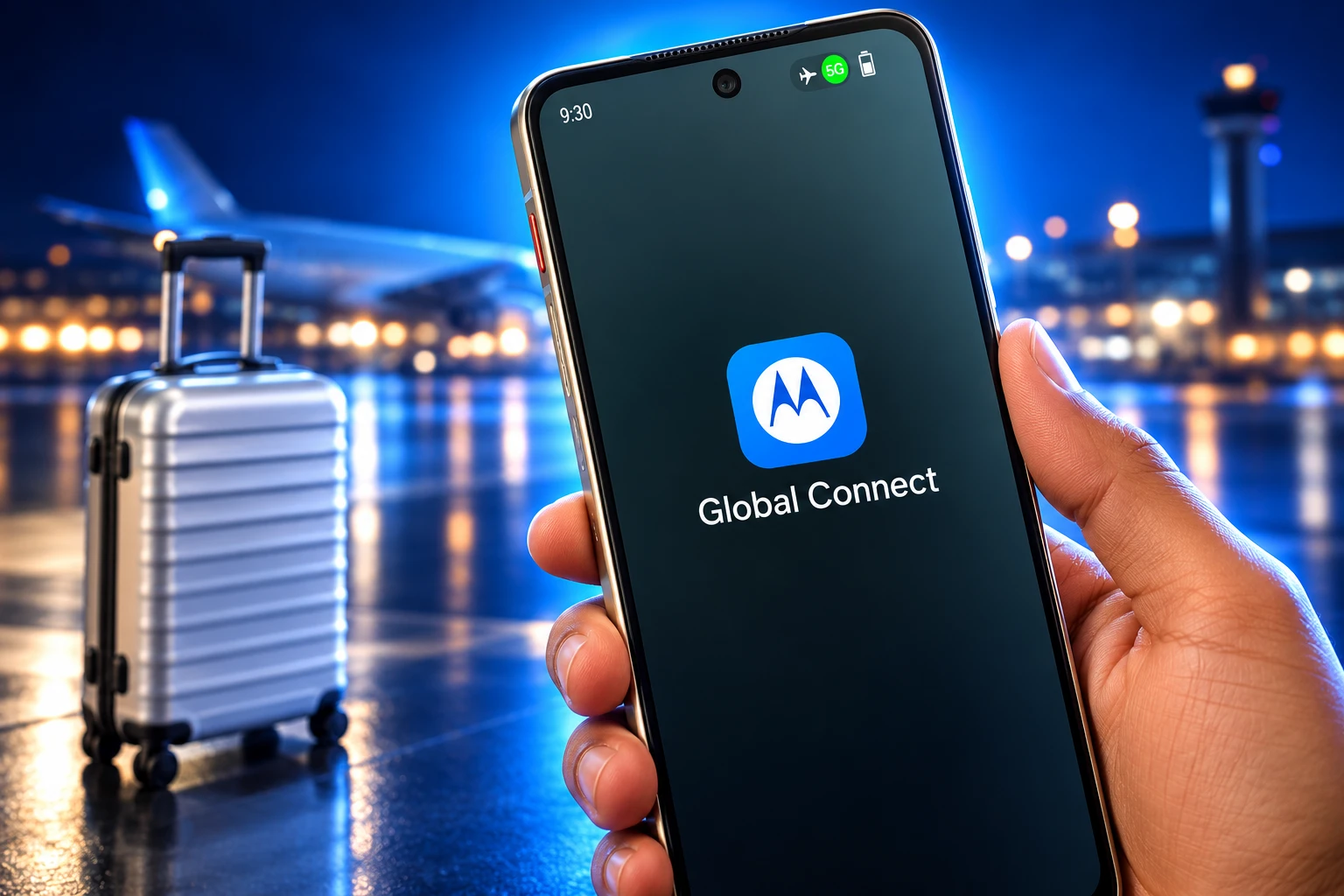
Motorola started selling travel data from inside its own phones on July 1, 2026, through a Gigs-powered app called Global Connect. Eligible owners in Brazil, Mexico, Argentina, Peru and Chile get 1GB of free data that works in more than 160 countries.
The app is already sitting on millions of eSIM Motorola devices. Gigs, not Motorola, is the firm that actually provisions the plans, and the football-season giveaway is how that shop gets its first checkout.
Gigs Runs the Network Motorola Does Not Own
Gigs is a San Francisco company that lets other brands sell phone plans without building a carrier. Founded in 2020 by Hermann Frank and Dennis Bauer, it calls itself the operating system for mobile services and lists itself as carrier of record, which means it handles licenses, taxes and the messy carrier contracts.
Motorola’s job is the face of the product. Sudhir Chadaga, vice president of partnerships at Motorola, said in the travel data a built-in phone feature note that staying connected abroad has always been more complicated than it should be, and that Global Connect is meant to be there from the moment a user sets up the device.
Users still have to install the app and create a Gigs account, Chadaga said when the product opened. The Motorola logo is on the storefront. The account, the eSIM and the billing stack belong to Gigs.
Motorola is one of the world’s most recognized smartphone brands with tens of millions of users who travel each year. This partnership puts global connectivity into every Motorola user’s pocket, ensuring they land with maps, banking, rides and all the essentials working instantly, wherever they travel.
Hermann Frank, CEO and co-founder, Gigs
That line is the product. Global Connect is a data pack for maps, banking apps and ride hail, not a new phone number from a local carrier. Chat and navigation work. A traditional roaming voice line is not the pitch.
Gigs already sells the same idea to other consumer brands. By May 7, 2026, it said it had raised $100 million and that customers including Revolut, Klarna, Nubank, NETGEAR and OnePay represented a combined distribution footprint of over 850 million users. Backers named in its own pages include Ribbit Capital, Google and Y Combinator, plus the chief executives of Uber, DoorDash and OpenAI.
GIGS BRANDS ALREADY SELLING DATA
- Motorola: Global Connect travel eSIM inside the phone maker’s own app.
- Nubank and Latam Airlines: Regional names Gigs already listed before the Motorola deal.
- Revolut, Klarna and ShopBack: Finance and rewards apps with travel eSIMs or full mobile plans on the same rails.
- NETGEAR: An eSIM shop inside a hardware maker’s app, the closest cousin to what Motorola just shipped.
Motorola is the first big phone brand in that set. The company calls Global Connect the first native travel connectivity app built into a major smartphone. That is a marketing line, and it is not the same as being the first handset maker to sell roaming from the device.
Five Launch Markets Share One Travel eSIM
The Play Store fronts that opened on July 1, 2026, are Brazil, Mexico, Argentina, Peru and Chile. Motorola’s launch copy also says the software comes pre-installed on millions of Motorola devices, as long as the phone supports eSIM.
Chadaga said the service can run on any Motorola phone with eSIM, including the 2026 Moto G Play, a model sold around $180. The cheap phones matter more than the flagships. A travel shop that only lives on a $1,000 foldable is a demo. A shop on a G-series handset is a retail channel.
THE LAUNCH HOOK
- Free credit: Every eligible user gets 1GB of complimentary global data for a limited time.
- Claimed use: Motorola says 1GB covers about one hour of video or more than 10 hours of web browsing.
- Coverage: That credit, and paid top-ups after it, can be used in more than 160 countries.
- Hardware gate: A Motorola device with eSIM is required; a plastic SIM alone will not open the shop.
The technical trick is a single eSIM installed once. Motorola says users do not load a new digital SIM each time they cross a border. They pick a destination and a data amount, pay, install, and the same profile keeps working in supported countries.
That one-profile model is already common in standalone travel eSIM apps. Motorola’s difference is placement. The storefront is a Motorola-branded app, and on many phones it does not even need a store visit.
HOW A PAID TOP-UP WORKS
- Open Global Connect: Choose the country you are heading to.
- Pick a data amount: The app shows the packs Motorola is selling for that trip.
- Pay in the app: Motorola says pricing is shown up front, with no hidden fees.
- Install and connect: The eSIM attaches and the phone uses partner networks for the strongest signal Gigs can buy.
Motorola says those partners number in the hundreds. Gigs, as carrier of record, is the firm doing the buying. The football timing was not subtle. Motorola tied the launch to “football’s biggest tournament” and summer travel, and Mexico was both a host market for that travel and one of the five Play Store countries.
Motorola Still Holds 14 Percent of Latin America
Starting in those five countries is not a soft launch in a corner of the map. It is a launch in the region where Motorola still moves a mass of devices, even as that mass is shrinking.
Omdia’s first-quarter 2026 count put the Latin American smartphone market at 34.8 million units, up 3 percent from a year earlier. Motorola shipped 4.9 million units and 14 percent share, down 5 percent from 5.2 million a year earlier, and slipped to third behind Samsung and Xiaomi.
LATIN AMERICA SHIPMENTS, 1Q 2026
| Vendor | Units | Share |
|---|---|---|
| Samsung | 12.9 million | 37% |
| Xiaomi | 6.0 million | 17% |
| Motorola | 4.9 million | 14% |
| Honor | 3.4 million | 10% |
| Apple | 1.8 million | 5% |
Omdia tied Motorola’s drop in part to a 37 percent fall in shipments of phones priced between $100 and $200. That is the same band where a built-in travel shop can still reach people who will never open Airalo. Nubank, a Gigs customer, is also a Brazilian everyday app. Latam Airlines, another Gigs name, sits on the same regional travel path.
The phone maker is adding a data checkout to a base it already paid to put in pockets, while Xiaomi takes the second-place shelf. A free gigabyte is cheap compared with the cost of winning those users back later.
Counterpoint’s second-quarter 2026 U.S. shipment table put Motorola at 11 percent. Motorola has not announced a U.S. Global Connect storefront, and Chadaga had nothing to share on U.S. timing when the Latin American app opened.
What a Gigabyte Costs After the Free Credit
The 1GB of free eSIM data in five markets is a limited-time hook, not the business. Chadaga said paid rates run about $3 (USD) for 1GB for 30 days, up to $14 for 20GB, and that the same travel eSIM can be reused on later trips.
PACKS MOTOROLA QUOTED AT LAUNCH
| Pack | Price | Terms Motorola gave |
|---|---|---|
| Introductory credit | Free | 1GB, limited time, more than 160 countries |
| 1GB | $3 | 30 days |
| 20GB | $14 | Quoted as the top of the range |
Those two paid figures are Motorola’s claim, not an independent audit of every country pack in the app. A 20GB bundle at $14 is $0.70 per gigabyte if you use the whole pack, which is why the large SKU exists. The $3 gigabyte is the emergency buy at the gate.
Standalone travel eSIM shops already sell the same one-profile-for-life trick. Motorola’s edge is that the shop is on the home screen of phones people already own, including cheap G-series models, so the comparison that matters is roaming from the home carrier and the kiosk at arrivals, not another QR code in a browser.
Motorola also promises high-speed data and no hidden fees. The networks underneath are still the local operators Gigs contracts with. If a stadium or a border town has poor coverage on those partners, the Motorola app cannot invent a tower.
Germany and the UK Have Not Opened
On July 1, 2026, Gigs said Germany, the United Kingdom and select devices in Europe were expected to follow in the coming weeks. Motorola’s own launch note was looser, pointing to select European countries later in 2026.
Seventy-five days later, on September 14, 2026, neither firm had posted a UK or German Play Store opening. Motorola’s product page still described Europe as coming soon. Local posts from Chile and Peru in early July treated the Latin American app as the news, and that chatter did not move on to a European date.
WHAT WE KNOW
- Live storefronts: Brazil, Mexico, Argentina, Peru and Chile opened on July 1, 2026.
- Named next markets: Gigs listed Germany and the United Kingdom, plus select European devices.
- Motorola’s wording: Select European countries later in 2026, with eSIM required.
WHAT IS UNCONFIRMED
- UK and Germany dates: No opening has been announced since the “coming weeks” line.
- United States: Motorola has not given a storefront plan.
- Free 1GB window: The credit is still described as limited time, with no public end date.
THE ROLLOUT MOTOROLA PUT ON PAPER
- July 1, 2026: Global Connect opens in five Latin American Play Store markets, with 1GB free for eligible users.
- July 1, 2026: Gigs names Germany, the United Kingdom and select European devices as the next step in the coming weeks.
- July 1, 2026: Motorola separately says select European countries will follow later in 2026.
- September 14, 2026: No UK or German storefront announcement has been published.
The football window the launch was built around has already closed. The Latin American shop has not. For Motorola, that still leaves a working checkout on phones that are in the region. For Gigs, the OEM experiment is live even if the European aisle is dark.
People who bounce between African borders, or anyone outside those five Play Store countries, do not get the Motorola button. The same airport-SIM pain exists there. Motorola has not opened those fronts.
The 2015 Xiaomi Roaming Playbook
Handset makers sold on-device roaming long before this app had a name. On August 13, 2015, Xiaomi put a feature then called Xiaomi roaming into MIUI 7, using a virtual SIM so owners could buy local-rate data without swapping plastic. It opened in 36 regions, including the United States, the United Kingdom, Hong Kong, Taiwan, Japan and Australia, at about $0.02 per MB.
Huawei sold a similar add-on around the same time. Xiaomi later wound the feature down. Motorola and Gigs can still say no major brand currently ships a native travel eSIM shop of this type, and that is a narrower claim than “first.”
The 2015 version lived in settings and leaned on a virtual-SIM vendor. Global Connect lives as a Motorola app on Gigs’ rails, with a free gigabyte and a top-up sheet. The mechanism is newer. The instinct is not.
What Motorola has now, and Xiaomi did not keep, is a partner that already bills Revolut and Nubank users and is willing to be the licensed carrier behind a phone logo. The 1GB credit will run out. The Gigs account on those Latin American phones is the part that can still ring up another pack in 2027.
Motorola already has the checkout on millions of devices in five countries. Gigs already sits as carrier of record behind the Motorola badge. Europe can wait; the shop in Brazil does not need a stadium calendar to keep selling data.

Instagram Plus Tests a Read-Only Mode That Cuts Stories

Altman Asks the Public to Accept Some AI Harm

Google Freezes OSS VRP Product Reports After AI Flood

AI Agents Make Payment Rails the Scarce Prize

Turkey’s Crypto Boom Now Runs Through Three Banks

Fable 5 Came Back Under a Commerce On-Off Switch

Google’s SpaceX GPU Lease Has a Sept. 30 Deadline

Plasma One’s XPL Locks Face a 1.81 Billion Cliff

DGO’s Rs 549 World Cup Pass Cost Fans Sleep and Data

Moonshot AI’s $30 Billion Ask Became a $35 Billion Close
-
 AI4 months ago
Fable 5 Came Back Under a Commerce On-Off Switch
-
 AI5 months ago
Google’s SpaceX GPU Lease Has a Sept. 30 Deadline
-
 CRYPTO4 months ago
Plasma One’s XPL Locks Face a 1.81 Billion Cliff
-
 APPS4 months ago
DGO’s Rs 549 World Cup Pass Cost Fans Sleep and Data
-
 AI5 months ago
Moonshot AI’s $30 Billion Ask Became a $35 Billion Close
-
 NEWS5 months ago
ColorOS 17 Device List Spans Oppo, OnePlus and Realme
-

 GAMING4 months ago
The RTX 4050 Under Rs 70,000 Hides a Wattage Gap
-

 AI4 months ago
Boris Cherny’s Loops Still Demand a Higher Production Bar