
AI
Archer Materials’ $1.5M IonQ Deal Reframes Its Quantum Story
Archer Materials signed a $1.5 million, three-year Quantum Compute Agreement with IonQ, securing cloud access and an Australian deployment study.

Archer Materials will pay IonQ US$1.5 million over three years for cloud access to a 36-qubit trapped-ion quantum system and a joint study on hosting an IonQ machine in Australia. The deal, announced through the ASX on Wednesday, is the first concrete output of a strategic review management flagged in June 2026 to shortcut the commercial path. Newer Tempo-class hardware is set to follow as IonQ ships it.
For Archer, the agreement reframes the company from a single-milestone graphene qubit bet into a potential sovereign quantum services operator, with a Tier 1 partner whose customer list already includes Airbus, Lockheed Martin, AstraZeneca and the US Air Force Research Lab. For IonQ, it extends an Australian footprint that already includes a separate partnership with Emergence Quantum and ongoing work with the Australian National University.
The Deal Terms
The commercial mechanics sit in the ASX announcement. Archer pays US$1.5 million across three years for access to IonQ Quantum Cloud and the Forte-class system. The agreement, Archer’s strategic Quantum Compute Agreement with IonQ, gives Archer’s chief executive the platform to describe it as “a significant milestone.”
This is a significant milestone for Archer, and we are delighted to enter this strategic Quantum Compute Agreement with the world’s leading quantum platform.
The line came from Dr Simon Ruffell, chief executive of Archer Materials, in the company’s ASX announcement on Wednesday.
The scope covers technical support, advisory services and cloud-based quantum computing resources, with a stated aim of building applications across artificial intelligence, cybersecurity, defence, healthcare, mining, logistics and financial services. Archer and IonQ will jointly assess data centre suitability for an onshore IonQ deployment. As of Tuesday’s close, Archer shares sat at $0.31 against a $79 million market capitalisation on the ASX, making this a sub-A$100 million Australian company sitting on a Tier 1 global partner’s compute stack for the first time.
Why Archer Is Paying to Ride IonQ’s Hardware
Archer is the only ASX-listed pure quantum name, a position that gives it a natural seat in any conversation about sovereign Australian quantum infrastructure. The IonQ agreement is the first concrete output of a strategic review management flagged in June 2026 to shortcut the path to revenue. It reads as the early fruit of that hunt.
What changed is the equity story. Until now, valuation has hinged on whether the company’s graphene qubit hardware demonstration lands on schedule. Cloud access through IonQ gives Archer a revenue-shaped line of sight independent of that single milestone. The Q3 2026 qubit demonstration is still targeted, but it is no longer the only gate the stock has to clear.
IonQ’s existing customer list sets a credibility floor few local quantum names can match. Airbus, Lockheed Martin, AstraZeneca and the US Air Force Research Lab are already running on IonQ systems. That supply chain of validated use cases is something a smaller partner can hand to a Tier 1 procurement team.
The two-track framing is the actual story. Track one is compute hours sold against IonQ hardware under the three-year cloud arrangement. Track two is the joint data-centre study, which is where the optionality sits if Canberra decides Australia is worth a physical quantum deployment for sovereign workloads. Defence, banking, government and research are exactly the sectors named in the agreement, and they are exactly where data sovereignty rules prevent workloads leaving the country. That overlap is what turns a $1.5 million cloud contract into something more strategic than its line-item price.
Inside the IonQ Forte Enterprise Box
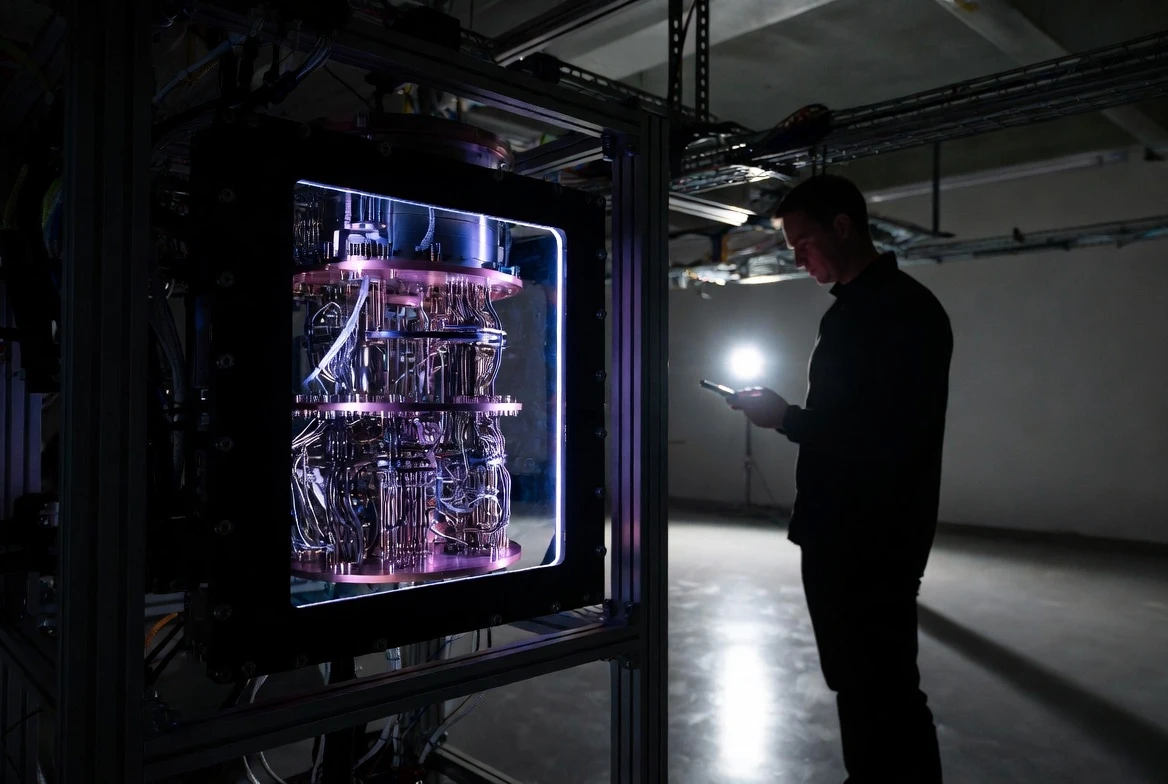
IonQ Forte Enterprise is the company’s highest performing commercially available quantum computer and the first generation of its data centre deployable systems. The unit packs 36 qubits into a rack-mounted form factor designed to slot into a typical modern data centre, as detailed on IonQ Forte Enterprise data centre specifications. Archer’s engineers will get cloud hours against this system for the three-year term, with Tempo-class hardware set to follow. It is also the unit IonQ positions as the most production-ready step on its own roadmap.
The architecture is trapped-ion, meaning qubits are individual atoms held in a linear chain by electromagnetic fields. That gives the system all-to-all connectivity, with any qubit directly entangled with any other, plus full software configurability, since the qubit structure and addressable control lasers can be reconfigured through IonQ’s control software. The combination is rare among commercial quantum systems, where superconducting designs are typically locked into static qubit topologies.
The headline spec sheet carries the numbers that procurement teams actually compare. The Forte Enterprise runs at 36 physical qubits. The error rates sit at 0.02% on a one-qubit gate, 0.4% on a two-qubit gate, and 0.5% on state preparation and measurement. Each of those figures is taken from the Forte Enterprise specification page as published by IonQ.
| Spec | Value |
|---|---|
| Qubit count | 36 |
| 1-qubit gate error | 0.02% |
| 2-qubit gate error | 0.4% |
| SPAM error | 0.5% |
Australia’s Sovereign Quantum Moment
Australia has a national quantum strategy and a forecast to match. CSIRO’s $6 billion Australian quantum forecast projects the country’s quantum technology sector could reach $6 billion in annual revenue by 2045 and support 19,400 jobs. The agency’s walk to that number runs through $2.2 billion and 8,700 jobs by 2030, $3.3 billion by 2035 and $4.6 billion by 2040. CSIRO is Australia’s national science agency, and the forecast was published as an update to its Growing Australia’s Quantum Technology Industry roadmap. CSIRO chief executive Larry Marshall described Australia as sitting at a tipping point between research and commercial development.
The industries the IonQ deal names read like a CSIRO strategy document. Artificial intelligence, cybersecurity, defence, healthcare, mining, logistics and financial services are the same verticals where the national quantum strategy expects commercial uptake. Several of them carry data sovereignty rules that prevent workloads leaving Australian jurisdiction. That overlap is what makes a local compute partner strategically more than a sales channel.
Defence, banking, government and research are exactly the sectors the agreement scopes. They are also exactly where data sovereignty rules prevent workloads leaving the country. Archer sits on the Australian side of that line.
The combined picture is what makes this deal worth more than its contract value. CSIRO’s forecasts describe a domestic market that does not yet exist at scale. IonQ has the hardware. Australia has the regulatory environment that requires a local compute presence for the highest-value workloads, and Archer is the only listed ASX quantum pure-play positioned to operate that bridge. The current agreement is the vehicle through which that decision gets studied.
The QML Fraud Work Gets an Upgrade
Archer’s quantum machine learning fraud-detection model caught 118 of 148 frauds with one false positive in a June 2026 test. That run was on IQM’s 20-qubit Garnet machine through AWS Braket, a useful but limited platform for a real procurement conversation. The hardware was the bottleneck, not the algorithm. The IonQ agreement puts a commercial-grade system behind the same workload.
IonQ’s Forte and Tempo systems run at 99.99% two-qubit gate fidelity, a figure described as a world record set in 2025. Moving the QML work onto that infrastructure gives Archer a materially better platform to pitch to Australian banks that care about precision fraud detection and cannot send transaction data offshore. A 20-qubit academic machine is hard to procure against. A 36-qubit commercial-grade stack with a sovereign local partner is a different procurement conversation. The fraud model is no longer stranded on rented cloud minutes.
The Skeptical Read
The cap disparity is the first thing to write down. Archer is worth $79 million on the ASX. IonQ is a US$21 billion platform, so the partnership is a small local company riding a much larger global one.
A skeptical read is available. Archer just spent $1.5 million renting a competitor’s technology stack. The deal could be read as an admission that the in-house graphene qubit roadmap will take longer than the market wants. IonQ builds trapped-ion hardware while Archer’s 12CQ chip is a graphene qubit project, so the cloud deal is a substitution play, not a partnership of equals.
The counter is that Archer had the option to do nothing, and the next twelve months would still have judged it on a single qubit demonstration. The IonQ agreement opens a commercial channel today while the graphene work continues on its own longer timeline, and both tracks can run at once. The strategic review flagged in June is not over, so the next concrete output may be another deal rather than a single result.
What Has to Land for the Bet to Pay Off
The next twelve months will be judged on commercial tests, not scientific ones. Customers have to convert from cloud-rented compute hours into paid commercial engagements. The joint data-centre assessment has to produce a real deployment proposal, not a study. The Q3 2026 qubit demonstration on the 12CQ chip is still on the calendar, and the strategic review flagged in June 2026 needs to keep producing deals.
- Sign paying Australian customers onto IonQ-backed compute services
- Convert the data-centre assessment into a concrete deployment proposal
- Land the 12CQ working qubit demonstration this quarter
- Continue the strategic review with at least one more IP or acquisition deal
The Australian government’s national quantum strategy and CSIRO’s 2045 projections are the macro tailwind. Archer’s identity as a quantum technologies company developing the 12CQ chip is laid out on Archer Materials’ company site. The graphene qubit roadmap continues in parallel. The IonQ agreement will not generate meaningful revenue on its own. What it gives Archer is a credible commercial vehicle, a Tier 1 partner and a plausible path to being the sovereign operator in a market Canberra actively wants to seed.
Frequently Asked Questions
What is IonQ Forte?
Forte is IonQ’s flagship commercial trapped-ion quantum computer, with a 36-qubit single-core processor that is software-configurable and designed to fit inside a standard data centre rack. The company sells access to it through IonQ Quantum Cloud, which is the channel Archer will use for the three-year term.
What does $1.5 million buy in a cloud quantum deal?
Three years of cloud access to IonQ Forte-class hardware, technical support from IonQ specialists, advisory services and compute hours Archer’s customers can use to build applications. Newer Tempo-class hardware is set to follow as IonQ ships it.
Has IonQ deployed hardware outside the US before?
Yes. IonQ has a separate collaboration with Emergence Quantum, an Australian research and development company, announced in July 2025, and ongoing work with the Australian National University. IonQ has also delivered ion-trap hardware to Switzerland as part of an EMEA quantum innovation hub.
What is Archer’s 12CQ chip?
The 12CQ chip is Archer’s in-house quantum computing project, built around carbon-based qubit material designed to be readable on a semiconductor-style chip. Archer is targeting a working qubit demonstration in Q3 2026.
What is the size of Australia’s quantum market?
CSIRO forecasts the country’s quantum technology sector could reach $6 billion in annual revenue and support 19,400 jobs by 2045. The same forecast walks through $2.2 billion by 2030, $3.3 billion by 2035 and $4.6 billion by 2040.


Pixel 11 Trails Galaxy Phones That Last as Long

OpenAI’s Research Intern Arrives With a Warning Attached

Robinhood Prices XRP Into a Two-Cent 9 a.m. Bet

Sony’s 10 Percent Disc Drop Leaves the 2028 Cutoff Intact

Chip Allocation Sidelines the Base iPhone 18 This Fall

Miami-Dade Fights the Vice City Brand It Already Wears

IFA 2026 Awards Put Tecno Ahead of Flagship Phones

USB-C Gadgets Made the Junk Drawer Rechargeable

Pixel 11 Pro Asks $1,099 for a Light Google Locked

The iPhone Ultra Sells Two Retired Minis as One Foldable

Oracle Cuts 21,000 Jobs in a Year, Cites AI in 10-K Filing

Fable 5 and Mythos 5 Return as US Lifts Anthropic Export Controls

SpaceX’s Google Deal Turns a Rocket Company Into a Cloud Landlord

CD Projekt Red Co-CEO: Redemption Arc Isn’t Done, Witcher 4 in 2027

XPL Rallies 30% Ahead of Plasma One Card Tier Launch

Google Search Profiles Build a Follow Graph Inside Discover

DGO App Brings Rs 549 Mobile Pass for FIFA World Cup 2026 in Nepal

Moonshot AI Targets $30 Billion in China’s Fastest AI Funding Sprint

Oppo’s ColorOS 17 Eligibility List Leaves A-Series Buyers Behind

Microsoft Xbox Layoffs Start in July as Sharma Slams 3% Margin
-
 AI3 months ago
Oracle Cuts 21,000 Jobs in a Year, Cites AI in 10-K Filing
-
 AI2 months ago
Fable 5 and Mythos 5 Return as US Lifts Anthropic Export Controls
-
 AI3 months ago
SpaceX’s Google Deal Turns a Rocket Company Into a Cloud Landlord
-
 GAMING3 months ago
CD Projekt Red Co-CEO: Redemption Arc Isn’t Done, Witcher 4 in 2027
-
 CRYPTO3 months ago
XPL Rallies 30% Ahead of Plasma One Card Tier Launch
-
 NEWS3 months ago
Google Search Profiles Build a Follow Graph Inside Discover
-
 APPS3 months ago
DGO App Brings Rs 549 Mobile Pass for FIFA World Cup 2026 in Nepal
-
 AI3 months ago
Moonshot AI Targets $30 Billion in China’s Fastest AI Funding Sprint