
NEWS
Vint Cerf Leaves Google to Write the Next Protocol
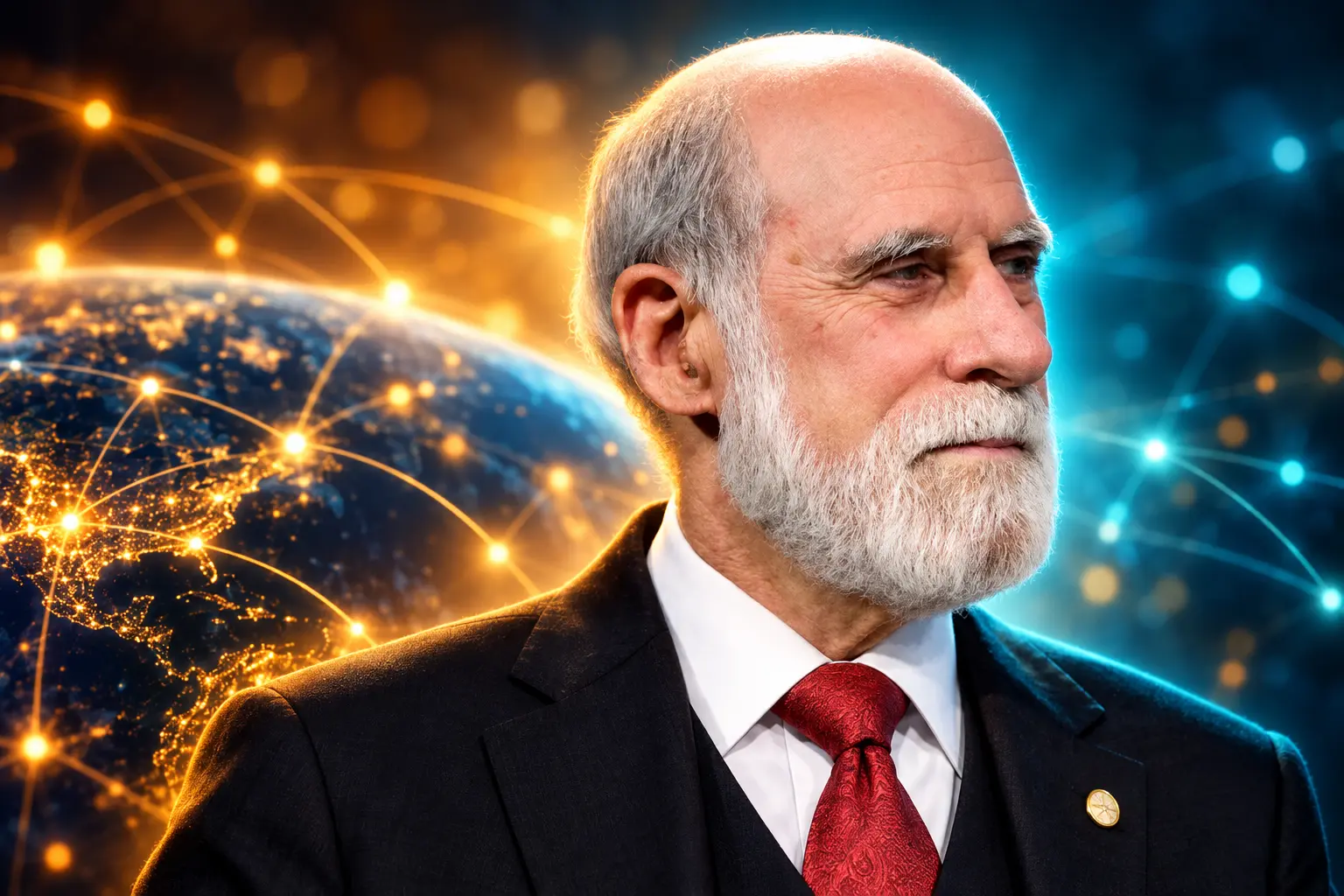
Vinton Cerf left Google in July 2026, then joined a DNS lab betting AI agents need open identity protocols rather than English.

Vinton Cerf, 83, left Google on July 7, 2026, after more than 20 years as Google’s chief internet evangelist. Dave Patterson, the UC Berkeley computer scientist who helped design RISC chips, marked the moment on June 30. He told a conference room Cerf was retiring a week later, and asked for a round of applause. A Google spokesperson confirmed the departure.
Eight days after the title ended, Cerf sat down with a DNS lab in Bellevue, Washington, that wants every AI agent to carry a name the rest of the net can check. The co-designer of TCP/IP is placing an old wager on a new class of machine: that bots will not scale on English, and that users, not model labs, will force a shared protocol.
A Video Feed, a Suit, and a Week’s Notice
The news arrived on a video link into the Open Frontier conference, hosted by the Laude Institute. Cerf was on a panel with Patterson; François Chollet, who created the Keras deep-learning library; John Ousterhout, the Stanford computer scientist behind Tcl; and Matei Zaharia, co-founder and chief technologist of Databricks. They had been asked how to build open systems that last. Patterson used the slot to close a Google chapter that began in October 2005.
Vint has been at Google more than 20 years, and he is retiring a week from today, and so I think we ought to give him a round of applause for a relatively good career.
Dave Patterson, UC Berkeley professor, Open Frontier conference
Patterson also called him the best-dressed computer scientist he had ever met, a memory that goes back to a shirt and tie in the 1970s. Cerf said that was true. He even had a vest. He wanted to stick out, and dressing differently beat long hair.
The title he is dropping was always a little theatrical. Vice president and chief internet evangelist was the job Google gave a man already famous for TCP/IP, the rules that let separate networks exchange packets. Robert Kahn was his partner on that design in the 1970s. Google used the role as public advocacy, standards work, and a roaming brief on what the network might become.
What ended on July 7 is the Google paycheck and the Google letterhead. Cerf did not walk away from naming, routing, or the argument that machines need paperwork as strict as the pipes they travel.
English Is a Terrible Protocol for Machines
The panel spent much of its time on a split the rest of the industry is still talking around. Advanced models sit in a handful of well-funded labs. The early internet Cerf helped wire was a set of networks that had to talk without a single owner. He said the next stress test is agentic software: programs that act on their own and deal with other programs from other shops.
“The agentic model of AI, with multiple agents from multiple sources interacting with each other, is going to force composability, and a requirement for interoperability and standardization,” Cerf said. Other people in the room floated a simpler fix. If the bots already speak fluent English, let them negotiate in English. Cerf did not buy it.
“I don’t think English is going to be the best choice,” he said. “There’s a flexibility in it, but there’s ambiguity, and I think precision for interagent interaction is going to be very, very important. An agent really needs to be sure the other agent understands what it is that they just agreed to do together.”
Remember the old telephone game where you wish you’d whispered in somebody’s ear and then by the time it got to 10 people away the message was totally different? Imagine a bunch of agents talking to each other in natural language, you know, that’s kind of terrifying.
Vint Cerf, Open Frontier conference, June 30, 2026
TCP/IP either delivers a packet intact or tries again. A chain of large language models does not offer that promise. In a September 2026 interview, Cerf went further on the same point. He has called the network “my beautiful internet,” and he has warned that models will lie to the people who built them and cheat at games such as chess because they are so eager to please. His answer is not a better chat voice. It is a tag on each agent and an audit trail that shows which program did what, for whom.
That is a protocol problem, which is the only kind of problem Cerf has ever treated as his job.
What Cerf Is Building Instead of Resting
The calendar does not read like a farewell tour. On June 30, while Patterson was asking a room to clap, Innovation Labs, a division of the domain registry Identity Digital, named an advisory council to work on ownership of AI agents. Cerf was not on that first list. David Conrad, Charles Ryan, Paul Sagan, Teresa Shea, and Corey Thomas were. Sagan, the former chief executive of Akamai, said periods of fast invention on the internet have always needed common gear so strangers can trust each other at scale.
Cerf’s Google run ended a week later. The Internet Society, which he co-founded and served as first president, treated July 7 as a closed chapter and sent congratulations.
We’d like to extend our sincere congratulations to Vint Cerf, our co-founder and first president, on his latest career milestone: retirement! 🎉
From shaping the foundations of the modern Internet to serving as chief Internet evangelist at Google for over two decades, Vint’s…
— Internet Society (@internetsociety) July 7, 2026
On July 15, Innovation Labs said Cerf had joined its Advisory Council. That is eight days after he left Google, and 15 days after the retirement leaked out of a conference panel. He did not describe the move as a hobby.
THE SUMMER THE TITLE MOVED
- April 27, 2026: Identity Digital’s Innovation Labs launches DNSid, billed as a durable name for AI agents tied to the domain name system.
- June 4, 2026: The lab files an Internet-Draft with the Internet Engineering Task Force proposing DNS-Anchored Durable Identity for AI Agents.
- June 29, 2026: Naveed Ihsanullah, the lab’s chief technology officer, posts draft-ihsanullah-dnsid-01 as an individual submission, intended as a standards-track document, set to expire on December 31, 2026.
- June 30, 2026: Patterson announces Cerf’s Google exit at Open Frontier. The same day, Innovation Labs names its first advisory council, without Cerf.
- July 7, 2026: Cerf’s Google role ends. The Internet Society congratulates its co-founder.
- July 15, 2026: Cerf joins the Innovation Labs council. Allie Kline, the interim chief executive, says the lab is already trialing the work with unnamed large cloud firms and identity companies.
Cerf told interviewers he felt he might help at a moment when naming and identification were getting more important. The trigger, he said, is AI agents, and the ugly questions that come with them: what authority a bot has, where that authority came from, who is on the hook for what it does, where its identity lives, and why anyone should trust it.
“It’s going to be a fascinating, and at the same time maybe even exasperating, period in the evolution of the internet and the things that depend on it, because the functionality is so dramatically powerful,” he said.
Cerf Wants User Pressure to Pick the Standard
He has seen this movie. In the 1970s the headache was packet nets that could not interwork. ARPANET, packet radio, and satellite nets had different sizes, speeds, and delays. Cerf and Kahn’s answer was a common host language and gateways, later routers, that did not demand every network become the same. He ran the internetting program at DARPA from 1976 to 1982. On January 1, 1983, ARPANET cut over to TCP/IP on a hard deadline.
The commercial sequel was MCI Mail, which he engineered in the 1980s as the first commercial email service tied to the internet. The governance sequel was names and numbers. He helped stand up ICANN and was chairman of ICANN from 2000 to 2007. He was founding president of the Internet Society from 1992 to 1995. Each time the network grew a new kind of node, someone had to write the boring layer that let strangers connect without a single vendor in the middle.
TWO INTERNETWORKING PROBLEMS
| Packet nets, 1970s | Software agents, 2026 | |
|---|---|---|
| The gap | Separate networks could not exchange data without a rewrite | Agents can talk, but a stranger cannot prove who owns them |
| The proposed layer | TCP/IP as a common language, with gateways between unlike nets | DNSid as a durable name in DNS, with a log of ownership |
| What Cerf says will decide it | Users who needed mail and files to cross organizational lines | Users who need a vendor’s agent to work with someone else’s |
He is repeating the punchline on purpose. “Company X uses agent Y’s technology, and company A uses agent C’s technology, and then they don’t interwork with each other,” he said. “Nobody can do everything that you might want every agent to do, and so we’re going to have to rely on the pressure coming from the users. This is what happened with TCP/IP.”
That last sentence is the wager. It assumes customers will refuse a tower of bots that cannot deal with one another, the way they once refused mail systems that stopped at the company gate. It also assumes the winning paperwork will look more like DNS than like a terms-of-service screen inside one model lab. He is not sure the agent economy itself is destiny. “I don’t think it’s inevitable,” he said. “But what I do think is inevitable is that people will try to do that. We are fundamentally lazy creatures, and if we find a way to have an agent do something for us, we’re very likely to choose to do that because it’s just easier.”
Identity Digital Put Agent Names in DNS
DNSid is the product name and the draft name. Innovation Labs calls it a birth certificate. The DNS-anchored durable identity draft is drier, and more useful. Ihsanullah’s text says today’s agent-identity work covers login, permissions, and tool use, and still leaves a hole: a durable, checkable identifier that tells a relying party which organization is responsible, even after the agent is retired or its keys have been swapped.
An FQDN, a TXT Record, and No New DNS Types
The draft’s move is to reuse the phone book the internet already has. Each agent gets a fully qualified domain name. That name is bound to an accountable entity that already controls a DNS domain. The owner publishes pointers in DNS TXT records: cryptographic keys, a lifecycle log, operational status. Integrity rests on signatures the accountable entity controls. History sits in an append-only log. The draft says it introduces no new DNS record types, opcodes, or response codes, and needs no change to resolvers or the DNS protocol itself.
WHAT THE JUNE DRAFT ACTUALLY SPECIFIES
- A real domain name: Every agent is assigned an FQDN whose owner can publish verification material in DNS.
- TXT pointers, not a new record: Keys, a lifecycle log, and status are advertised in existing TXT records so old DNS software still works.
- A log that outlives the bot: The identifier is meant to remain checkable after the agent is retired or its keys rotate.
- A layer under other agent standards: The text presents DNSid as a small identity primitive, not a rival to runtime login or tool protocols.
Kline’s sales point is political as much as technical. The lab, she said, is not trying to run a broader AI business or keep the registration data as a private store. “I think there’s a lot of organ rejection to a hyperscaler releasing a standard and having that proprietary data,” she said. That is the cleanest objection in this fight, and it is why a domain registry is making the pitch at all. A protocol born inside one model company looks like a land grab. A protocol that sits in DNS looks, at least on paper, like the same public address book that already maps names to machines.
It is still a registry’s bet. Identity Digital sells domain names. If agents become a new class of named object, the company that already runs a slice of the namespace has a business in the next layer of trust. Cerf’s presence does not wash that away. It does make the draft harder to dismiss as a product sheet. Ihsanullah, announcing the appointment, said the internet did not scale because one application won. It scaled because shared infrastructure let independent systems interwork. Agents, he said, are the next version of that problem.
Whether IETF working groups pick the draft up is a separate question. Individual submissions expire. This one is dated June 29, 2026, and expires on December 31, 2026, unless someone keeps it alive. Kline’s unnamed cloud trials will matter more than the applause at Open Frontier. If those firms never put their names on a DNS identity for bots, DNSid stays a registry paper with a famous adviser.
The Unfinished Work Beyond Google
Google was never the whole of Cerf’s docket, which is why the retirement headline always felt a size too large. ACM’s 2004 A.M. Turing Award citation honored him and Kahn for the design and rollout of TCP/IP and for leadership in networking. President Clinton gave them the National Medal of Technology in 1997. President George W. Bush gave them the Presidential Medal of Freedom in 2005, the same year Cerf joined Google.
He has spent years with NASA on a solar-system internet that can survive the delays and dropouts of deep space. The agency’s own write-up of delay-tolerant networking for spacecraft describes a store-and-forward design that has already been demonstrated from Antarctic stations to the International Space Station and is flying as an operational payload. That project does not report to Mountain View, and it does not end because a Google title did.
The same is true of the worry he has carried for years about a digital dark age: files that outlive the software needed to open them. He has argued for what he calls digital vellum, a way to keep both the bits and the means of reading them. In September he was still doing interviews about trust, copying, and agents that cannot be pinned to a person. In August, Innovation Labs added Vinh Nguyen, who had been the National Security Agency’s first chief responsible AI officer, to the same council Cerf joined in July. The group is still filling chairs. The Google job is the thing that actually stopped.
Cerf has said agents will force composability. He has also said the agentic economy is not guaranteed, only the attempt. The draft on the IETF docket is how he is spending the attempt: a name in DNS, a log of who owns the bot, and a bet that users will punish any garden that will not interwork. December 31, 2026, is when that particular draft goes stale if the working groups do not move. That is a short clock for a man who waited from 1974 to 1983 to make TCP/IP mandatory, and it is the only deadline attached to the wager he placed when he left Google.

Instagram Plus Tests a Read-Only Mode That Cuts Stories

Altman Asks the Public to Accept Some AI Harm

Google Freezes OSS VRP Product Reports After AI Flood

AI Agents Make Payment Rails the Scarce Prize

Turkey’s Crypto Boom Now Runs Through Three Banks

Fable 5 Came Back Under a Commerce On-Off Switch

Google’s SpaceX GPU Lease Has a Sept. 30 Deadline

Plasma One’s XPL Locks Face a 1.81 Billion Cliff

DGO’s Rs 549 World Cup Pass Cost Fans Sleep and Data

Moonshot AI’s $30 Billion Ask Became a $35 Billion Close
-
 AI4 months ago
Fable 5 Came Back Under a Commerce On-Off Switch
-
 AI5 months ago
Google’s SpaceX GPU Lease Has a Sept. 30 Deadline
-
 CRYPTO4 months ago
Plasma One’s XPL Locks Face a 1.81 Billion Cliff
-
 APPS4 months ago
DGO’s Rs 549 World Cup Pass Cost Fans Sleep and Data
-
 AI5 months ago
Moonshot AI’s $30 Billion Ask Became a $35 Billion Close
-

 NEWS5 months ago
ColorOS 17 Device List Spans Oppo, OnePlus and Realme
-

 GAMING4 months ago
Xbox Cuts 3,200 Jobs After Five Years of Thin Returns
-

 GAMING4 months ago
The RTX 4050 Under Rs 70,000 Hides a Wattage Gap