
AI
Volkswagen and Bosch End AI Driving Alliance at Series Production
Volkswagen’s Cariad and Bosch completed an AI-based Level 2 driving stack, but VW is unwinding the four-year, €1.5 billion alliance and turning to Mobileye.

Volkswagen’s CARIAD and Bosch jointly completed an AI-based Level 2 driver-assistance software stack inside their Automated Driving Alliance, and on July 1 the partners said the four-year collaboration itself is now over. The announcement framed the conclusion as a milestone rather than a break. Both companies retain the underlying intellectual property. Each will incorporate the results into its own series-production products.
Volkswagen plans to buy its next round of Level 2++ driving systems from a new supplier, with Mobileye the most widely named candidate, and aims to sign a replacement contract by the end of September 2026. The pair invested around €1.5 billion (about $1.71 billion) in the alliance that began in 2022. The conclusion lands inside a much wider Volkswagen restructuring that puts up to 100,000 jobs and four German plants under review.
The AI Stack the Four-Year Alliance Built
Bosch and CARIAD said on July 1 that the partnership has reached a series-production milestone with the delivery of an AI-based Level 2 driver-assistance software stack. The stack is now available to both companies for further development and integration into their own series-production products. The Volkswagen ID.EVERY1 is the first announced production vehicle to carry technology developed inside the alliance, with a market launch set for 2027. Both sides have secured engineering teams to continue independent development from a shared foundation.
The architecture is end-to-end and AI-driven, covering all four cognitive tasks: perception, interpretation, decision-making, and action. Bosch and CARIAD built the system around modern AI methods, including generative-AI-inspired techniques that analyse complex urban traffic scenarios and anticipate the behaviour of other road users. The stack is also designed with vision-language-action approaches in mind, a class of multimodal AI that links visual and linguistic inputs and is meant to detect hidden risks in traffic.
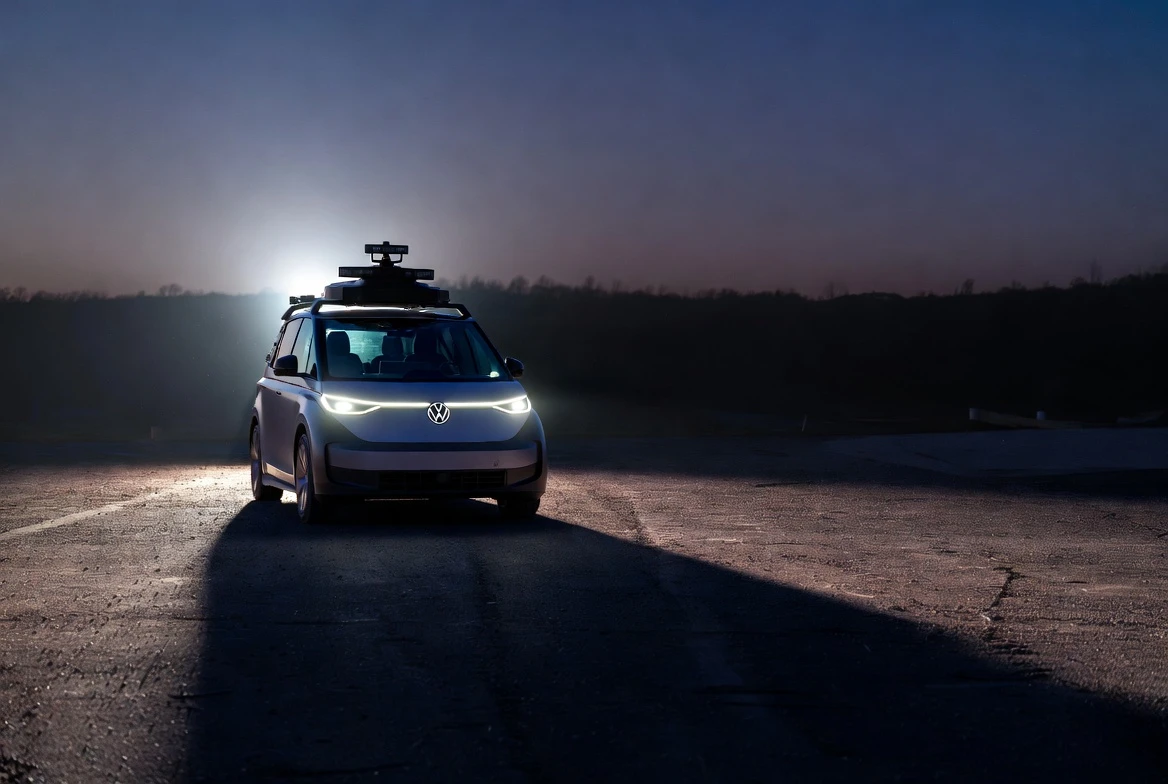
The system was trained on data from fleets totalling up to 1,500 vehicles on public roads across Europe, the United States, and Japan, with software updates pushed to test vehicles multiple times per day. The first versions are already running in the ID.Buzz and the Audi Q8, per CARIAD’s August 2025 statement on the AI software stack. The data-collection and validation regime fits a broader industry shift toward how AI is forcing automakers to rebuild their engineering teams.
| Capability | What the AI handles | Training data source | Production milestone |
|---|---|---|---|
| Perception | Object recognition and sensor fusion across cameras and radar | ID.Buzz and Audi Q8 test fleets, daily data uploads | Series-production ready from mid-2026 |
| Decision-making | Behaviour prediction for other road users in urban scenarios | Global validation fleets including logistics and leasing operators | ID.EVERY1 first announced production vehicle, 2027 |
| Control | Automated steering, braking, and powertrain management | Validation fleets in Europe, U.S., and Japan | Shared IP retained by both companies |
| Safety | Traceable, explainable AI actions with VLA-ready architecture | Rare corner case recordings from operational fleets | Available to other manufacturers through Bosch licensing |
Why Volkswagen Says the Stack Wasn’t Competitive Enough
Volkswagen’s internal review found the technology was not yet competitive, with the clearest gap in Level 2++ systems, the category that enables hands-free automated driving in urban environments. The verdict sits at the centre of the decision to walk away from the partnership. Blume argued internally that progress was lagging behind developments in China.
Several rivals have already pushed into that category. Tesla has received approval for its FSD (Supervised) system in the first European markets following its rollout in the United States. Mercedes-Benz is preparing to launch MB.Drive Assist Pro in Europe after introducing the system in the United States. BMW offers a comparable Motorway & City Assistant on the new iX3, per VW reportedly ending the Bosch automated driving partnership.
Volkswagen Group CEO Oliver Blume made the final call internally, with critics inside the company arguing that the technology had fallen behind Chinese competitors. The alliance with Bosch is being unwound under the existing contract. Legal and financial consequences of the split are still being discussed internally.
The German carmaker aims to reduce planned investment by almost €1 billion between 2027 and 2031 by buying an existing solution instead of continuing in-house development. Volkswagen is in the process of choosing a new partner for Level 2++ hardware and software. The carmaker wants to sign a replacement contract by the end of September 2026.
- €1.5 billion (about $1.71 billion) invested in the alliance since 2022
- More than 1,000 specialists worked within the Automated Driving Alliance
- 4-year run, launched in early 2022
- Almost €1 billion in planned investment cuts targeted between 2027 and 2031
Mobileye Becomes the Replacement Bet
Volkswagen is in the process of choosing a new partner and wants to sign a replacement contract by the end of September 2026, according to Bild’s reporting. The candidate the report names is Mobileye, the Israeli autonomous-driving specialist spun out of Intel.
Mobileye is not a new name inside Volkswagen. The two have worked together since 2024 on Level 2+ motorway assistance systems for combustion-engine vehicles. Volkswagen also uses Mobileye technology for the Level 4 self-driving ID.Buzz that its Moia mobility unit is preparing to deploy in the United States with Uber.
Mobileye has flagged the Volkswagen relationship as a near-term revenue driver. In its most recent results, the supplier cited an expanded robotaxi roadmap with the German group. It also pointed to its EyeQ6-based SuperVision Level 2++ and Chauffeur Level 3 programs as proof the advanced portfolio is converting into future revenue. Volkswagen has narrowed CARIAD’s mandate over the past year, routing future Western-market architecture to a multibillion-dollar joint venture with Rivian and pushing China-specific software toward XPeng and Horizon Robotics. The transition is part of the cost-saving push detailed in VW’s plan to cut planned investment by €1 billion.
- Mobileye (Level 2+ motorway assistance for combustion vehicles, Level 4 ID.Buzz with Uber)
- Bosch (jointly developed Level 2 stack with shared IP retention, first planned deployment on ID.EVERY1 in 2027)
- Rivian joint venture (Western-market electrical and software architecture)
- Horizon Robotics (automated driving systems for the Chinese market)
- XPeng and CARIAD’s CORIZON joint venture (Level 2+ and Level 2++ for China)
CARIAD Workers Push to Keep ADAS Inside the Group
CARIAD’s general works council chairman Gerhard Retzer and his deputy Claudia Richter issued a statement on Monday against outsourcing advanced driver-assistance systems. The two listed the destinations Volkswagen must not send the work to. They framed driver assistance as the ground on which CARIAD’s future rests. The pushback was aimed at the plan now before management to source Level 2++ systems from an outside supplier.
Know-how is created by doing. Not by buying.
That line came from the works council statement issued by Retzer and Richter on behalf of CARIAD’s workforce and the IG Metall union. The two wrote that ADAS is a key technology for the future of the automobile and that whoever sells it “hands over know-how, added value and future viability.”
The works council insisted the technology stay inside the group and demanded the board deliver an in-house system “from a single source, scalable for the entire Group.” The statement rejected specific alternatives by name. It listed “Not to China. Not to the USA. Not to external providers” as unacceptable destinations for the work.
CARIAD’s roughly 5,000 employees are now directly tied to the decision, and the unit’s employment guarantee runs to the end of 2029, per CARIAD works council pushing back on outsourcing ADAS. The dispute sits inside a much larger restructuring under CEO Oliver Blume, who aims to cut up to 100,000 of the group’s roughly 657,000 jobs over the coming years. The supervisory board is set to review the package on July 9. Any attack on the 2029 employment guarantee would meet resistance, the works council warned.
How the Alliance End Fits Volkswagen’s Wider Crisis
Volkswagen’s Automated Driving Alliance is the latest casualty of a much wider restructuring under Oliver Blume. The CEO is targeting the elimination of up to 100,000 jobs from a workforce of roughly 657,000. He wants to halt production at four German plants (Hanover, Zwickau, Emden, and Audi’s Neckarsulm factory). The plan would spin off the core Volkswagen brand and the components business as standalone units. The proposal would also override a 2024 union deal barring German plant closures this decade and double a previously agreed reduction of 50,000 jobs by 2030.
The financial pressure behind the plan is visible in the latest quarterly numbers. Volkswagen posted first-quarter net profit of €1.56 billion, down 28% from a year earlier. Finance chief Arno Antlitz has put the hit from US tariffs at about €4 billion a year, while Chinese sales fell about 20% as domestic brands led by BYD eroded Volkswagen’s once-commanding position there.
Volkswagen’s stock price reflects the strain. The shares closed on the Xetra at 69.94 EUR on July 1, down 0.23% on the day, down 8.00% over five trading sessions, and down 32.46% year-to-date. CARIAD’s own operating losses help explain why the in-house build-versus-buy debate keeps coming back to buy: the unit posted operating losses of about €2.4 billion in 2023 and roughly €2.6 billion in 2024, contributing to cumulative losses well above $7.5 billion across 2022 to 2024 on a fraction of that in revenue.
- 100,000 jobs at risk across the Volkswagen Group
- Four German plants slated for production halts
- €1.56 billion in first-quarter net profit, down 28% year-on-year
- -32.46% year-to-date stock performance as of July 1, 2026
What Bosch Walks Away With
Both companies retain shared access to the intellectual property and data generated inside the Automated Driving Alliance. Each will incorporate the results into its own series-production products and continue independent development from that shared foundation, per Bosch and CARIAD concluding the Level 2 automated driving alliance. That gives Bosch a license-ready software stack to bring to other vehicle manufacturers.
Bosch says it has already secured worldwide orders from vehicle manufacturers for the software stack, with all projects on schedule for planned series launches. Markus Heyn, chairman of Bosch Mobility and deputy chairman of the board of management, said the companies have developed “high-performance and competitive technologies for assisted and automated driving up to Level 2.” The systems support both hands-on and hands-free driving tailored to different markets.
Frequently Asked Questions
What was the Automated Driving Alliance between Volkswagen and Bosch?
The alliance put more than 1,000 specialists on the project and built validation fleets across Europe, the United States, and Japan. Its goal was a scalable platform for assisted and automated driving up to SAE Level 3, with Volkswagen targeting the technology across its brand portfolio. The partners announced the conclusion on July 1, 2026, alongside the delivery of the AI software stack.
How much did Volkswagen invest in the partnership with Bosch?
Volkswagen invested around €1.5 billion, equivalent to about $1.71 billion at the time, in the Automated Driving Alliance, according to German newspaper Bild. Internal assessments cited in the reporting found the technology had not reached the expected stage of development, though the AI stack itself has now reached series-production readiness.
What is Level 2++ driving?
Level 2++ is the higher tier of SAE Level 2 driver assistance, where a car can steer, accelerate, and brake itself in defined conditions (including some urban environments) without the driver holding the wheel, while the driver remains responsible for monitoring the road. It sits below Level 3, in which the car itself drives under defined conditions. Volkswagen’s internal review found its gap to rivals was sharpest in Level 2++.
When will Volkswagen’s next automated driving system reach production?
Volkswagen has not committed to a date for the externally sourced Level 2++ system, with a contract targeted by the end of September 2026 and the supplier widely reported to be Mobileye. The first vehicle announced to carry Alliance-derived technology remains the Volkswagen ID.EVERY1, which is set for a 2027 launch.
Will Volkswagen still use any of the AI software developed with Bosch?
Yes. Both companies walk away with shared rights to the IP and data the alliance generated, with each integrating the technology into its own production programmes independently. Volkswagen itself is shifting Level 2++ sourcing to Mobileye, while Bosch says it has lined up orders from other vehicle manufacturers for the stack. The first announced production vehicle carrying Alliance-derived technology remains the Volkswagen ID.EVERY1 in 2027.


Google Opens Gmail to Voice and Gates Docs Live

Lenovo Prices the IdeaPad Vibe Against Apple’s $699 Neo

Xbox Caps Game Pass Cloud Gaming at 15 Hours

GTA 6 DualSense Controllers Follow Sony’s Usual $84.99 Script

South Korea Retail Investors Face Reckoning After KOSPI AI Rally Collapses

Surrey AI Maps Three Heart Attack Paths and Their Molecular Roots

Germany Locks Neutral Apple ATT Prompts Across Most of Europe

Apple’s 5% EU Fee Quietly Rewrites Alternative App Store Math

Apple’s EU Fee Truce Cuts Complexity but Leaves Rivals Fuming

Pixel 11 Pro Fold Trades Thinness for Durability and Seven-Year Stay

Oracle Cuts 21,000 Jobs in a Year, Cites AI in 10-K Filing

Fable 5 and Mythos 5 Return as US Lifts Anthropic Export Controls

SpaceX’s Google Deal Turns a Rocket Company Into a Cloud Landlord

CD Projekt Red Co-CEO: Redemption Arc Isn’t Done, Witcher 4 in 2027

XPL Rallies 30% Ahead of Plasma One Card Tier Launch

Google Search Profiles Build a Follow Graph Inside Discover

DGO App Brings Rs 549 Mobile Pass for FIFA World Cup 2026 in Nepal

Moonshot AI Targets $30 Billion in China’s Fastest AI Funding Sprint

Oppo’s ColorOS 17 Eligibility List Leaves A-Series Buyers Behind

Microsoft Xbox Layoffs Start in July as Sharma Slams 3% Margin
-
 AI2 months ago
Oracle Cuts 21,000 Jobs in a Year, Cites AI in 10-K Filing
-
 AI2 months ago
Fable 5 and Mythos 5 Return as US Lifts Anthropic Export Controls
-
 AI3 months ago
SpaceX’s Google Deal Turns a Rocket Company Into a Cloud Landlord
-
 GAMING2 months ago
CD Projekt Red Co-CEO: Redemption Arc Isn’t Done, Witcher 4 in 2027
-
 CRYPTO3 months ago
XPL Rallies 30% Ahead of Plasma One Card Tier Launch
-
 NEWS3 months ago
Google Search Profiles Build a Follow Graph Inside Discover
-
 APPS3 months ago
DGO App Brings Rs 549 Mobile Pass for FIFA World Cup 2026 in Nepal
-
 AI3 months ago
Moonshot AI Targets $30 Billion in China’s Fastest AI Funding Sprint