
AI
Mercedes Pushes Culture Change After Drive Pilot Stalls
After pausing Drive Pilot on new US cars, Mercedes says autonomous driving now hinges on AI, data quality and India R&D culture, not more hardware.

Mercedes-Benz’s India driving chief said in June 2026 that autonomous driving’s next leap depends on AI, data and culture. He spoke five months after the company kept certified Level 3 Drive Pilot off new US cars and put an eyes-on SAE Level 2 assistant on the stage instead.
Parthiv Shah, senior vice president for automated driving, base software, zone controllers and wiring harness at Mercedes-Benz Research and Development India, described a shift from rule-based code to models that learn whole driving behaviour. The product timeline around him already showed what that shift costs: a legal chauffeur that barely sold, and a software factory in Bengaluru that now has to carry the next bet.
After Drive Pilot Stalled, Mercedes Started Talking Culture
Shah’s June 8, 2026 remarks treated hardware as the old bottleneck. Radar clusters, hand-written logic and Adaptive Cruise Control, he said, gave way to camera-based machine learning and then to large models that swallow multi-sensor logs and learn perception, planning and control together. Those models, he said, are often 10 to 50 times larger than earlier designs, and they demand GPUs, high-performance computing and a data platform that can keep context attached to every clip.
Volume is not the win. “Scale alone is not sufficient, and the data must be curated to ensure it remains context-aware,” Shah said. Complexity, in his telling, has moved off algorithm design and onto data work, scenario analytics, ML Ops, simulation, logging and traceability. Automakers that want production autonomy have to rebuild around data and platforms, then keep safety open after the car is sold.
That is a culture speech. It landed after Mercedes had already changed the product on the lot.
The most critical and underestimated barrier is organisational readiness. Without evolving into cross-functional, data-centric and security-aware organisations, even strong technology and infrastructure will not translate into safe, scalable and production-ready autonomous driving solutions.
Parthiv Shah, Senior Vice President, Automated Driving, Mercedes-Benz Research and Development India
Jörg Burzer, the Mercedes-Benz Group board member for development and procurement, made the geography plain in June 2026. Infotainment and autonomous driving, he said, are the two fields where the India centre now holds real weight, and MB.OS, the company’s own vehicle operating system, was designed in large part there. Broader Level 3, in his account, waits until 2028, with Level 4 after that.
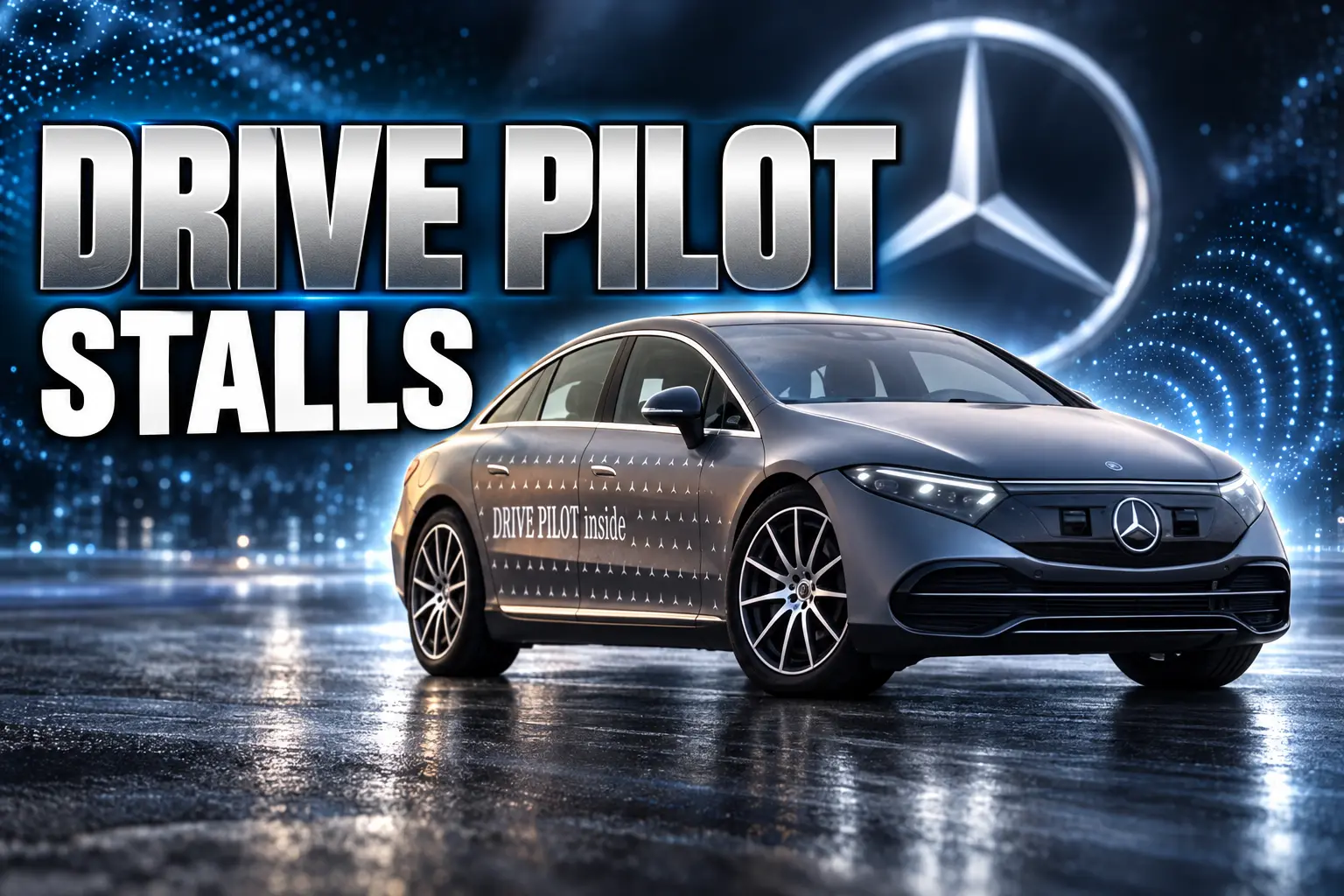
The Certified Chauffeur That Rarely Left the Fast Lane
DRIVE PILOT was the trophy. Mercedes was first to sell SAE Level 3 conditional automation to retail buyers, and in Germany the system still has a live, certified life. On December 17, 2024 the German Federal Motor Transport Authority cleared a software update that lets Drive Pilot run at 95 km/h on German motorways across the 13,191 km Autobahn network, with sales from early 2025. The option starts at 5,950 euros including VAT on the S-Class and EQS. Cars already built got the speed rise free, over the air or in the shop.
When the system is on, German law lets the driver watch video, read, work or rest, so long as they can take over when the car asks. If they do not, the car brakes to a stop with the hazards on. Mercedes built electrics, steering and braking twice, and it uses more than 35 sensors, cameras, radars, ultrasonics and LiDAR. For Level 3 and above, the company says LiDAR is required. A high-detail map plus a positioning stack is meant to know the lane to within a few centimetres. Turquoise marker lights, tested in California and Nevada, are meant to tell other road users the chauffeur is on.
The US envelope is smaller. On approved freeways in California and parts of Nevada, Drive Pilot may run only under 40 mph on approved freeways, in daylight, in clear weather, with a driver visible to a cabin camera, and not in a work zone. Existing equipped S-Class and EQS Sedan cars can still use it. New 2026 US S-Class and EQS cars do not get it. Mercedes is putting MB.DRIVE ASSIST PRO on those cars instead, an advanced SAE Level 2 system that keeps legal responsibility on the person in the seat.
German law already allows conditional automation up to 130 km/h. Mercedes says it wants that speed by the end of the decade. The gap between 40 mph in two US states and 95 km/h on German asphalt is the product problem Shah’s culture line is meant to outrun: a certified chauffeur that is legal in a thin slice of road, weather and traffic, and expensive to keep that way.
DRIVE PILOT VERSUS MB.DRIVE ASSIST PRO
| Feature | DRIVE PILOT (SAE Level 3) | MB.DRIVE ASSIST PRO (SAE Level 2) |
|---|---|---|
| Who is responsible while it is on | The system, inside its approved envelope | The driver at all times |
| Eyes off the road | Yes, in the approved envelope | No |
| Where it is sold to work | German Autobahn (13,191 km) at 95 km/h; US freeways in California and Nevada at 40 mph | City and highway routes, parking lot to destination, first in China |
| Sensor suite | More than 35 sensors, including LiDAR | Around 30 sensors: ten cameras, five radars, twelve ultrasonics; no LiDAR in the published kit |
| On new 2026 US S-Class and EQS | Not offered | The system Mercedes is fielding |
| Price, Germany | Starts at 5,950 euros including VAT | Not listed on the same official page |
Owner video of Drive Pilot in daily traffic is still scarce, and the clips that do surface show a system that drops out of its envelope often enough to feel like a demo, not a chauffeur. That is the commercial verdict Mercedes is now writing around, even while the German type approval stays in force.
What Replaces Eyes-Off Driving on New Mercedes Cars?
MB.DRIVE ASSIST PRO is an advanced SAE Level 2 assistant that merges navigation and driver aid so the car can help from a parking space to a destination, including city streets, lights, lane changes and dense traffic. The driver can nudge the wheel without killing the system. The driver still has to watch the road. Mercedes showed the package on the new CLA at CES on January 7, 2026, with NVIDIA as the global partner for the next ADAS generation, supplying AI, full-stack DRIVE AV software and the DRIVE AGX computer.
The published kit uses around 30 sensors and 508 TOPs of onboard compute, with raw camera, radar and ultrasonic feeds going into one supercomputer. The function has been on sale in China since the end of 2025 and was slated for the US during 2026. Mercedes communications on the China kit also pointed to ECE markets from early 2027, once the local rules take effect. Burzer has called the company’s current offer Level 2++, the extra pluses describing city behaviour, not a change in who is liable.
This is the product you ship when Level 3’s legal win does not pay. It works in more places. It does not let anyone watch a film. It also does not require LiDAR on the list Mercedes published, which is the cost and supply problem that sat under the old chauffeur option.
Bengaluru’s Over 8,500 Engineers Inherit the Stack
Mercedes-Benz Research and Development India, founded in 1996, is the company’s largest research and development centre outside Germany, with offices in Bengaluru and Pune and over 8,500 professionals in digital product work, interiors, IT engineering and services. Shah sits in that centre. So does the automated-driving software, zone-controller and wiring work his title names. Burzer said Bengaluru teams are on the software stacks, testing and automated parking that the next driving systems need, and that Mercedes is widening work with Infosys, KPIT and Tata Elxsi as it scales software.
MBRDI AT A GLANCE
- Founded: 1996, now in its 30th year as Mercedes’s India engineering base.
- People: Over 8,500 professionals across Bengaluru and Pune.
- Rank: Largest Mercedes-Benz R&D centre outside Germany.
- Driving brief: ADAS support for headquarters since 2012, now software, simulation, validation and MB.OS content for global cars.
Manu Saale, managing director and chief executive of the India centre, has spent years saying there is a little bit of India in every Mercedes. Burzer used the same line in June 2026. The claim is no longer a branding flourish. If Shah is right that the bottleneck is data curation, scenario analytics and ML Ops, those jobs sit with software people, not with the classic V-cycle teams that signed off Drive Pilot as a type-approved option.
That is also why a culture speech from Bengaluru is not HR. The centre that once did CAD, CAE and captive IT is being asked to run the learning loop for a car that is supposed to keep changing after it leaves the plant. Germany still owns the badge, the type approval and the liability. India is being asked to own the data factory.
Safety Work Never Closes Once the Model Learns
Classic car safety is a requirements list and a test you pass once. Shah said AI in core driving functions does not work that way, because behaviour comes from training data, weather and live variance. Safety engineering, he said, is moving from a deterministic, requirements-driven mindset toward system-level assurance. The practical list is simulation, operational data, runtime monitoring, redundancy and planned fall-backs. “Safety shifts from a one-time certification milestone to a continuously managed responsibility aligned with system operation and evolution,” he said.
Virtual validation is how you manufacture the rare crash you cannot hunt on a public road. Shah said teams can generate and amplify edge cases with synthetic data, which is slow, costly and often unsafe to stage in real traffic. He refused the next slide, the one where simulation replaces the road. On-road testing, he said, still catches nuance that the lab misses. Simulation is a complement.
Drive Pilot was the old model in metal: a bounded domain, a LiDAR, a map, a KBA stamp, a turquoise lamp. MB.DRIVE ASSIST PRO is the interim model: more miles, eyes on, driver still on the hook. The AI models Shah wants are the third model, and they only stay safe if someone is still curating the data after the press cycle ends. That is a staffing problem dressed as a safety paper.
The Robotaxi Plan Rides on Nvidia and MB.OS
On January 29, 2026 Mercedes said the new S-Class would be the launchpad for a driverless shuttle, with fail-safe redundancies in steering, braking, compute and power, running on MB.OS. NVIDIA is to put DRIVE Hyperion and full-stack DRIVE AV Level 4 software on that car, plus Alpamayo open models, simulation tools and datasets. Uber is the planned retail network. NVIDIA’s own technical note on the work describes an L4-ready S-Class architecture aimed at chauffeur-style rides. A separate Level 4 project with Momenta, to be operated by Lumo in Abu Dhabi, was due to put the first S-Class robotaxi test vehicles on the road in 2026.
THE 20-MONTH PRODUCT TURN
- December 17, 2024: Germany clears Drive Pilot at 95 km/h on the full Autobahn network, with sales from early 2025 at 5,950 euros.
- End of 2025: MB.DRIVE ASSIST PRO goes on sale in China as an SAE Level 2 city-to-destination assistant.
- January 7, 2026: Mercedes shows the system on the new CLA at CES, with NVIDIA DRIVE AV and DRIVE AGX named as the partner stack.
- January 29, 2026: Mercedes, NVIDIA and Uber announce the S-Class robotaxi plan; Momenta and Lumo are named for Abu Dhabi tests.
- June 8, 2026: Shah says organisational readiness, not raw technology, is the barrier to production autonomy.
- June 2026: Burzer says India is now central to the software stack and that broader Level 3 is planned from 2028.
NVIDIA’s urban demos in a Mercedes CLA still leave a supervisor in the seat. The stack can read signs, pick through double-parked cars and react to cyclists, which is the point of the Level 2 product. It is not Drive Pilot, and it is not a robotaxi. Mercedes is buying a training and compute environment. It still has to fill that environment with curated miles, then accept the liability when the model is wrong. Tesla-style fleet scale is the objection that will not die, because Mercedes never ran a mass data loop on ordinary cars the way a software-first maker did.
Cross-Functional Teams, or the Models Stay in the Lab
Shah’s warning is blunt enough that it does not need a gloss. Autonomous programmes moving into production, he said, now fail on system-level problems, not on a missing chip. The V-cycle cannot host a model that learns after sign-off. AI people, platform engineers, validators, safety officers and security staff have to sit in one loop. Competitive edge, in his closing, is the ability to combine data, computers, safety rules and operating speed at once.
WHAT SHAH SAYS TEAMS MUST NOW BUILD
- Data curation: Keep clips context-aware so scale does not wash out the rare case.
- Scenario analytics: Find the edge cases that matter instead of hoarding undifferentiated miles.
- ML Ops: Treat driving models as living software with lineage, not as a frozen ECU release.
- Simulation and logging: Manufacture hard cases in the lab, then prove the car still behaves on the road.
- Traceability: Show why the model did what it did when safety, regulators and courts ask.
Those are not optional extras on top of a LiDAR. They are the product, once you have admitted that a 5,950-euro chauffeur at 95 km/h in Germany, and a 40 mph chauffeur on a handful of US freeways, is not a business. Bengaluru already has the headcount. Burzer has already pointed at 2028 for a wider Level 3. Shah’s point is the unglamorous one: if the company does not actually run as a data and security organisation, the models, the GPUs and the India centre will not add up to a car you can sell as safe.

Instagram Plus Tests a Read-Only Mode That Cuts Stories

Altman Asks the Public to Accept Some AI Harm

Google Freezes OSS VRP Product Reports After AI Flood

AI Agents Make Payment Rails the Scarce Prize

Turkey’s Crypto Boom Now Runs Through Three Banks

Fable 5 Came Back Under a Commerce On-Off Switch

Google’s SpaceX GPU Lease Has a Sept. 30 Deadline

Plasma One’s XPL Locks Face a 1.81 Billion Cliff

DGO’s Rs 549 World Cup Pass Cost Fans Sleep and Data

Moonshot AI’s $30 Billion Ask Became a $35 Billion Close
-
 AI4 months ago
Fable 5 Came Back Under a Commerce On-Off Switch
-
 AI4 months ago
Google’s SpaceX GPU Lease Has a Sept. 30 Deadline
-
 CRYPTO4 months ago
Plasma One’s XPL Locks Face a 1.81 Billion Cliff
-
 APPS4 months ago
DGO’s Rs 549 World Cup Pass Cost Fans Sleep and Data
-
 AI4 months ago
Moonshot AI’s $30 Billion Ask Became a $35 Billion Close
-

 NEWS4 months ago
ColorOS 17 Device List Spans Oppo, OnePlus and Realme
-

 GAMING4 months ago
Xbox Cuts 3,200 Jobs After Five Years of Thin Returns
-
 GAMING4 months ago
The RTX 4050 Under Rs 70,000 Hides a Wattage Gap