
NEWS
Hyundai’s NOVA Lab Validates SDV Software Before the Car Is Built
Hyundai’s NOVA Lab wire car validates SDV controllers before any complete vehicle is built, catching 150 to 200 issues per project as Kia’s R&D restructures.

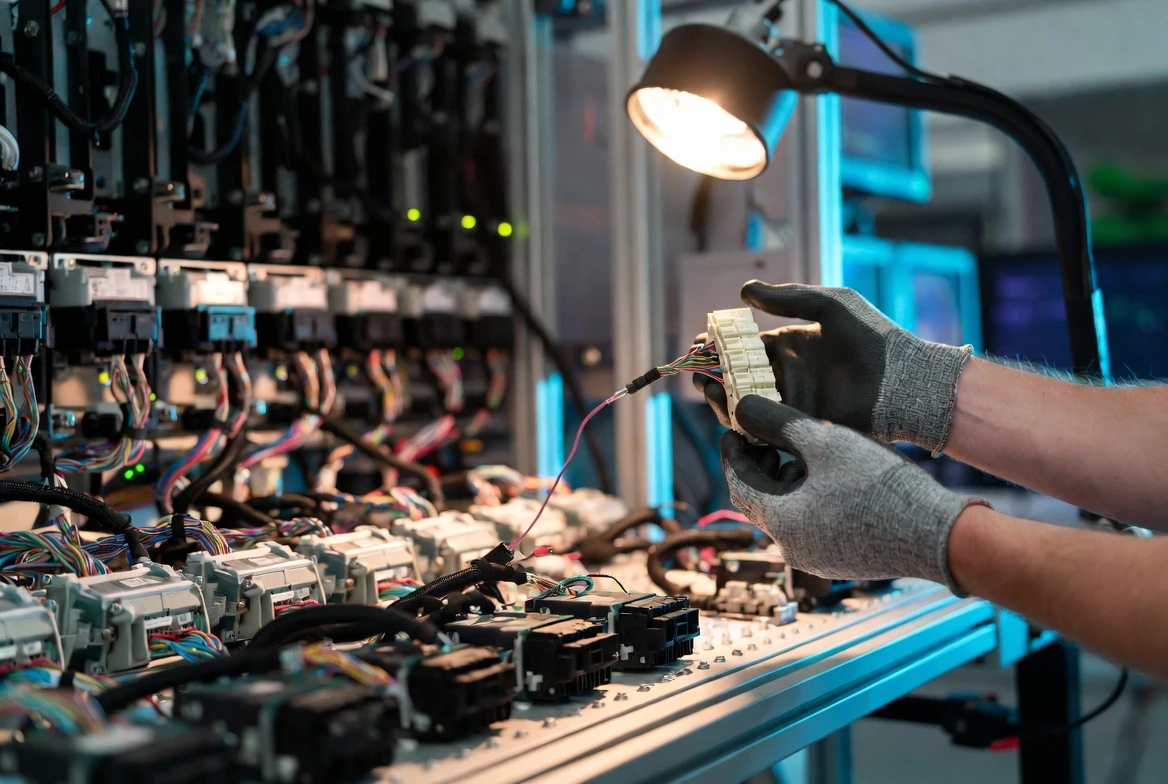
Hyundai Motor Group has opened a new lab at its Namyang R&D Center in Hwaseong, Gyeonggi Province, where a stripped-down test bench shaped like a vehicle body is being used to validate software-defined vehicle (SDV) controllers before any complete car is built. Called NOVA Lab, the facility uses the wire car as the first physical checkpoint for an SDV’s electronics, several stages before any complete vehicle is assembled.
Hyundai says the Wire Car catches an average of 150 to 200 issues per project during this stage, including controller conflicts and communication errors. The lab is the latest expression of a multi-year restructuring of Hyundai and Kia R&D around software, with sister programs touching the Namyang driving simulator, the Digital Measurement Center, and a 3D printing facility now consolidated under the new Advanced Mobility Solutions Building opened in June 2026.
Why Build a Test Bench With No Body?
The reasoning behind the wire car is a problem that has grown sharper as cars have become more electronic. A research vehicle, once assembled, hides its controllers deep inside the body, panels, and trim, and prying them out for inspection is its own engineering project. Kim Sangyeon, a part head on Hyundai Motor’s pilot electronic control development team, said the wire car grew out of the idea of gathering the electronic components together before the new vehicle is built, verifying their functions and fixing problems at the first stage.
The shift is more urgent in the SDV era, where the dozens of electronic control units scattered through an internal combustion engine vehicle are being consolidated into a few high-performance vehicle computers and zone controllers. With more software governing more functions, the cost of a missed integration bug grows in step. Hyundai completed construction of the NOVA Lab in February 2026 and publicly unveiled it to journalists in June 2026, alongside the rest of its Namyang R&D reorganization.
The Four Verification Zones at NOVA Lab
NOVA Lab runs automated validation across four areas: circuits, communication, functions, and diagnostics. For large vehicle models, the number of connected controllers and electrical components can reach 300 to 500, and the number of wiring connectors can reach about 500. A compact dynamometer and drive load equipment let engineers recreate conditions close to real driving, including automatic door locking at speed, regenerative braking, and driver warning systems. An ADAS simulator in the lab validates smart cruise control, rear-side collision warning, lane keeping assist, and Forward Collision-Avoidance Assist.
The four validation areas run in parallel: circuits catch power and grounding issues, communication checks the network traffic between controllers, functions exercise the actual behaviors, and diagnostics confirms that the vehicle can identify and report its own faults. Through this stage, the lab surfaces 150 to 200 issues per project on average, a figure that quantifies how much validation work the SDV transition has moved onto the wire-car floor, before any sheet metal is stamped.
We plan to continue SDV verification at the wire car stage and keep raising the level of completeness.
Lee Ho-jin, a senior manager at NOVA Lab, gave that as the team’s near-term direction. His fuller remark, as reported by the Herald Business: the consolidation of controllers into units responsible for major vehicle functions has raised both development complexity and the difficulty of verification, and the lab’s job is to filter out electrical system errors before they propagate into finished vehicles.
From Dozens of Controllers to a Single Vehicle Computer
The wire car’s job is shaped by an architectural shift that goes deeper than consolidation. Inside the SDV validation cell at NOVA Lab, the power architecture is migrating from 12V to 48V, and communications are moving from CAN to high-speed Ethernet to handle the higher data rates that consolidated controllers demand. The dozens of ECUs found in conventional vehicles are being absorbed into a high-performance vehicle computer and zone controllers responsible for major vehicle functions. Hyundai is one of several global automakers running this transition, and the validation surface area multiplies when one vehicle computer takes over functions that used to live on dozens of separate boxes.
That consolidation is also why verification now happens earlier. Hyundai’s Unlock the Software Age strategy, announced in 2022, set a target of transforming all vehicles to SDV by 2025, and the four-year push has put pressure on the validation floor. The lab’s role, in Lee Ho-jin’s framing, is to catch the conflicts between consolidated controllers before they reach a finished vehicle, where each fix grows more expensive.
| Aspect | ICE-era vehicle | SDV-era vehicle |
|---|---|---|
| Control units | Hundreds, scattered by function | Few, consolidated around a vehicle computer |
| Power architecture | 12V | 48V |
| Communication | CAN | High-speed Ethernet |
| Validation timing | After a test vehicle is built | Before a vehicle is built, on a wire car |
The Genesis G80 Simulator at Namyang
Alongside NOVA Lab, Hyundai’s Namyang R&D Center added a driving simulator launched in February 2026. The simulator replicates the driver’s seat of a Genesis G80, with a six-axis motion platform and a 270-degree curved screen. As a researcher presses the pedals and turns the steering wheel, the vehicle tilts and transmits vibrations that the team says are difficult to distinguish from a real test drive. The cockpit is surrounded by eight external monitors that stream real-time vehicle data as the simulation runs.
The realism comes from digital twin technology. Researchers used LiDAR to scan Hyundai’s Namyang test track down to the 1mm precision, and replicated overseas proving grounds the same way, capturing slopes, bumps, and even asphalt texture. Where data once took tens of seconds to several minutes to load, the team developed its own terrain server approach that renders only the data around the vehicle’s current position in near real time.
Jung Pil-young, a senior manager on the ride performance concept development team, told the Herald Business that the simulator cuts tests that used to take one to two months down to about one to two weeks, because engineers can evaluate ride comfort, handling, tire behavior, and suspension settings under identical conditions without traveling to Europe or the United States. Chosun Biz reports that every mass-production Hyundai and Kia model released since 2020 has gone through the simulator, and the high-performance Hyundai N and Genesis Magma programs rely on it because the platform reproduces roll, pitch, and yaw.
Restoring a Vintage Pony With 3D Printing
The third pillar of the Namyang reorganization is the Additive Manufacturing Solutions Center (AMSC), a 3D printing facility on the third floor of the new AMS Building that consolidates equipment previously scattered across the campus. AMSC produces parts directly from design data without molds, using three main methods: DLP and SLA, which cure liquid resin with ultraviolet light; WAAM, which melts and layers metal wire; and metal powder bed fusion, which fuses powder with a laser. Hyundai’s first 3D printer arrived at Namyang in 1996, three decades before the new facility was built out.
The center’s workload spans four parallel tracks:
- Heritage vehicle restoration. When Hyundai revived parts for the vintage Pony using 3D scanning, components with no surviving original drawings were scanned from physical samples, converted into three-dimensional data, and reproduced through 3D printing.
- Discontinued parts supply. In 2024, the Namyang center used metal powder bed fusion to produce engine intake parts for discontinued Mohave and Veloster models and supplied them to consumers, Chosun Biz reports.
- Lightweight motorsport components. AMSC builds parts for Hyundai’s N performance and Genesis Magma programs that cannot be produced by casting or pressing.
- Emergency parts when molds are damaged. A Hyundai Motor source said the technology also covers emergency replacement parts when tooling fails.
Reading a Car Across 1,000 Measurement Points
The Digital Measurement Center (DMC) handles dimensional quality, the kind of work that decides whether a door closes cleanly, whether panel gaps look right, and whether wind noise and water leaks stay out. Engineers capture roughly 1,000 measurement points per vehicle and combine that data into 600 to 700 evaluation criteria. Rather than checking whether any single point falls within a tolerance, the system cross-references distances, parallelism, and left-right balance across multiple points to predict where problems might arise.
Han Jin-su, head of the pilot quality verification team, said the approach goes beyond looking at individual points: the team combines multiple points to judge actual quality, and can determine in advance, from data alone, whether the exterior will fit cleanly, whether the doors will close properly, and whether noise or water leaks will occur. Robotic arms with 3D scanners now read component geometry while autonomous transport robots move parts between stations.
The DMC, AMSC, and related functions were brought under one roof in June 2026, when Hyundai completed construction of the Advanced Mobility Solutions Building. By consolidating previously dispersed measurement and manufacturing functions, the AMS Building carries quality standards established during the development phase directly into mass production factories.
Hyundai’s Four-Year Path to Namyang’s New Floor
The NOVA Lab sits at the end of a four-year restructuring of Hyundai and Kia R&D, with five steps that brought it to the current validation floor:
- 2022: The group announces its Unlock the Software Age strategy, with a target of transforming all vehicles to software-defined vehicles by 2025.
- April 2023: Hyundai Motor and Kia sign an MOU with 17 industry partners to form the 19-company MBD Consortium formed in April 2023.
- September 2025: Hyundai Mobis, the group’s parts subsidiary, completes the Mobis Development Studio launch announcement from September 2025 with Wind River.
- February 2026: Namyang driving simulator launches, and construction of NOVA Lab completes.
- June 2026: The AMS Building opens and NOVA Lab is publicly unveiled to journalists.
A Hyundai Motor Group official, asked about the direction of the program, said only that the company would continue vehicle development by building a server that aggregates dimensional and quality data across stages, and that the goal remains to resolve most problems before anything physical is made.
Frequently Asked Questions
What is a Wire Car in Hyundai’s NOVA Lab?
A wire car is a test bench that uses a vehicle’s wiring and electronic control units without the body shell in place. Hyundai’s NOVA Lab at Namyang uses it as the first physical checkpoint for an SDV’s electronics, well before any complete vehicle enters the production plan.
How many issues does the Wire Car phase catch?
According to Kim Sangyeon, part head on Hyundai Motor’s pilot electronic control development team, the NOVA Lab catches an average of 150 to 200 issues per project during the wire car stage, before a new model is developed.
When did NOVA Lab open?
NOVA Lab construction wrapped up in February 2026. Hyundai held its first public tour for journalists in June 2026, alongside the opening of the Advanced Mobility Solutions Building next door.
What is the broader SDV roadmap behind NOVA Lab?
The lab sits at the end of a four-year Hyundai Motor Group roadmap that began with the Unlock the Software Age strategy in 2022, was followed by the 19-company Model-Based Development Consortium in April 2023, and added the Mobis Development Studio with Wind River in September 2025.
Does the Wire Car replace real-world driving tests?
Physical vehicle testing still happens, Lee Ho-jin, senior manager at NOVA Lab, said. The wire car simply moves electrical and software integration checks earlier in the cycle, so finished prototypes arrive at road testing with fewer basic integration issues to clear.


Sony’s 10 Percent Disc Drop Leaves the 2028 Cutoff Intact

Chip Allocation Sidelines the Base iPhone 18 This Fall

Miami-Dade Fights the Vice City Brand It Already Wears

IFA 2026 Awards Put Tecno Ahead of Flagship Phones

USB-C Gadgets Made the Junk Drawer Rechargeable

Pixel 11 Pro Asks $1,099 for a Light Google Locked

The iPhone Ultra Sells Two Retired Minis as One Foldable

Google Opens Gmail to Voice and Gates Docs Live

Lenovo Prices the IdeaPad Vibe Against Apple’s $699 Neo

Xbox Caps Game Pass Cloud Gaming at 15 Hours

Oracle Cuts 21,000 Jobs in a Year, Cites AI in 10-K Filing

Fable 5 and Mythos 5 Return as US Lifts Anthropic Export Controls

SpaceX’s Google Deal Turns a Rocket Company Into a Cloud Landlord

CD Projekt Red Co-CEO: Redemption Arc Isn’t Done, Witcher 4 in 2027

XPL Rallies 30% Ahead of Plasma One Card Tier Launch

Google Search Profiles Build a Follow Graph Inside Discover

DGO App Brings Rs 549 Mobile Pass for FIFA World Cup 2026 in Nepal

Moonshot AI Targets $30 Billion in China’s Fastest AI Funding Sprint

Oppo’s ColorOS 17 Eligibility List Leaves A-Series Buyers Behind

Microsoft Xbox Layoffs Start in July as Sharma Slams 3% Margin
-
 AI3 months ago
Oracle Cuts 21,000 Jobs in a Year, Cites AI in 10-K Filing
-
 AI2 months ago
Fable 5 and Mythos 5 Return as US Lifts Anthropic Export Controls
-
 AI3 months ago
SpaceX’s Google Deal Turns a Rocket Company Into a Cloud Landlord
-
 GAMING3 months ago
CD Projekt Red Co-CEO: Redemption Arc Isn’t Done, Witcher 4 in 2027
-
 CRYPTO3 months ago
XPL Rallies 30% Ahead of Plasma One Card Tier Launch
-
 NEWS3 months ago
Google Search Profiles Build a Follow Graph Inside Discover
-
 APPS3 months ago
DGO App Brings Rs 549 Mobile Pass for FIFA World Cup 2026 in Nepal
-
 AI3 months ago
Moonshot AI Targets $30 Billion in China’s Fastest AI Funding Sprint