
GAMING
The $999 Cube Valve Put in Its CES Booth
Valve showed the Xi3 Piston at CES 2013, then walked away. Its 2026 Steam Machine is a six-inch cube that starts at $1,049 and fixes what that Utah box got wrong.

Valve now sells a six-inch Steam Machine that starts at $1,049. In January 2013 it put a smaller metal box, the Xi3 Piston, in its own CES booth as a Steam Box stand-in, then cut the tie in public two months later.
The Utah cube cost $999, ran Windows, used laptop graphics, and shipped with no Wi-Fi. Thirteen years later Valve built the living-room cube itself, charged $50 more, and reversed every one of those calls.
A Four-Inch Cube in Valve’s CES Booth
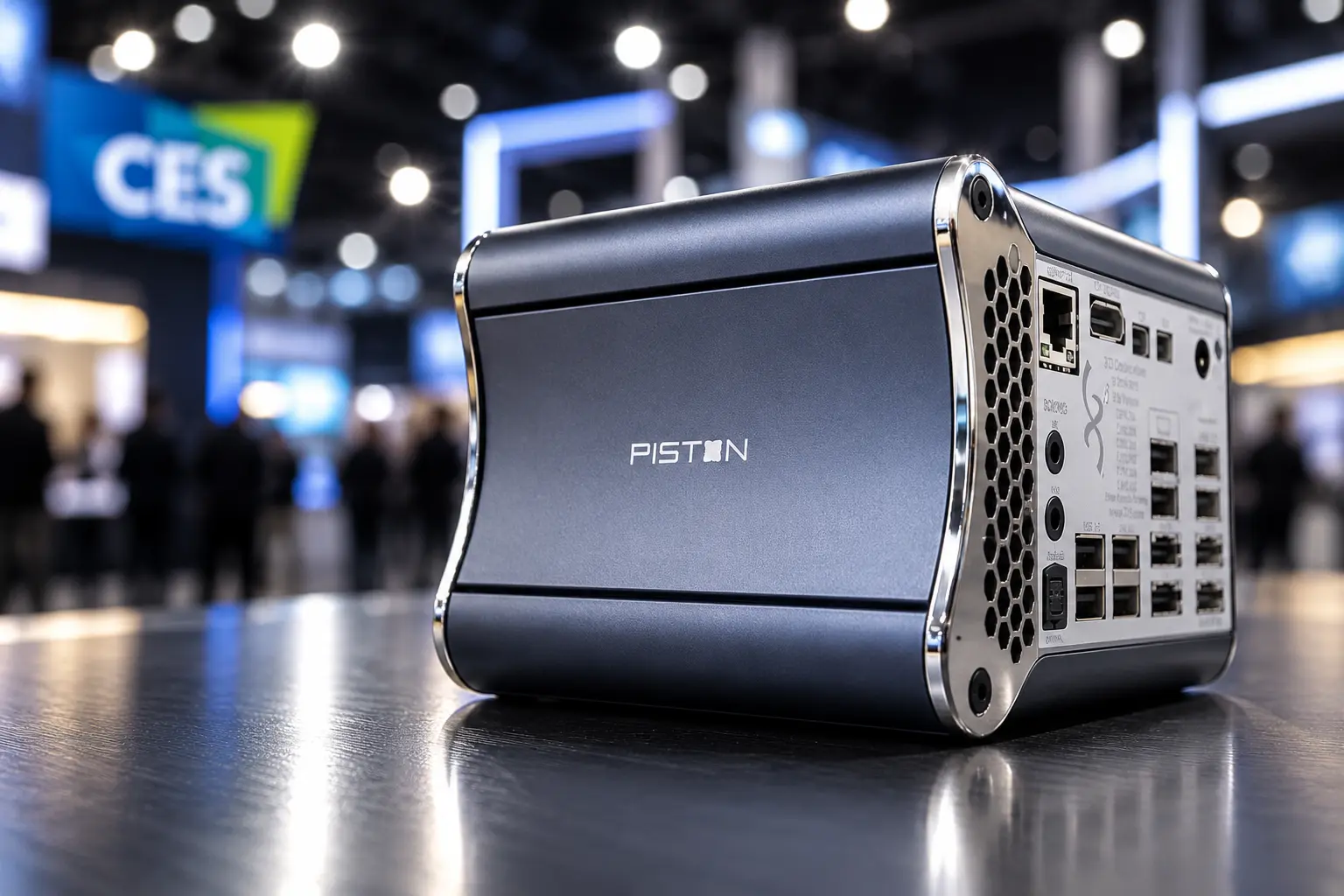
Xi3 Corporation walked into CES 2013 with a compact aluminum machine that looked more like shop art than a console. The Piston was about four inches on each side, with indented faces and a front grille, and it sat in Valve’s booth as well as Xi3’s.
The Salt Lake City firm had been building modular computers for offices and factories since 2010. Founder and CEO Jason A. Sullivan designed a chassis that swapped a single motherboard for three stacked boards you could slide out. The Piston was the first time that idea was aimed at a TV and a couch.
Chief marketing officer David Politis told press the machine was based on Xi3’s performance X7A line, which already carried a $999 sticker, and that storage could reach 1TB. A demo I/O board showed gigabit Ethernet, analog and optical audio, four USB 3.0 ports, four USB 2.0 ports, four eSATAp ports, two Mini DisplayPorts, and a DisplayPort/HDMI output.
Gabe Newell, Valve’s then-CEO, talked that same week about quiet boxes, low latency, and “appropriate form factors.” He also said Valve would sell its own unit. The Piston was treated as one prototype among several, not as the finished Steam Box, even while both companies showed the same cube.
Doug Lombardi Cut the Cord in March
Pre-orders opened around $999 as SXSW ran, and the Steam Box label followed the product into every write-up. On March 12, 2013, Valve marketing chief Doug Lombardi shut that down in a single sentence.
“Valve began some exploratory work with Xi3 last year, but currently has no involvement in any product of theirs,” Lombardi said.
Sullivan answered the next day in a written statement. He said Xi3 had taken an investment from Valve with written permission, had been asked to build a product for Valve, and had shown the Piston in both booths. He also said Newell had asked him at CES not to disclose more about the relationship, and that Xi3 had kept that request.
Just because Valve may not currently have any involvement with any product of ours doesn’t mean that such involvement won’t exist in the future. So Gabe, it’s up to you. The ball is in your court.
Jason A. Sullivan, founder and CEO, Xi3 Corporation, written statement, March 13, 2013
Sullivan was already drawing a product line Valve would not cross. The Piston would ship with Windows, he said, because that is where the games and the players were, and it would open other storefronts rather than live on Steam alone. Valve wanted a Linux box it sold itself. Xi3 wanted a small Windows PC that could run Steam. Those are different machines.
What $999 Bought in 2013
Wider pre-orders opened on September 30, 2013, for a November 29 ship date. The price stayed $999 for a 128GB SSD, 8GB of DDR3, and an AMD R-Series R-464L quad-core chip clocked at up to 3.2 GHz with Radeon HD 7660G graphics, 384 shaders on the same die. Under load the box drew about 40 watts.
That APU was the embedded twin of a 2013 laptop chip, not a desktop graphics card. It could drive three monitors at up to 4K on paper. It was not going to sit next to a new PlayStation or Xbox on raw image quality, and it was easy to beat with a small tower that still left change from $999.
A 512GB SSD option added $750, which nearly doubled the bill. Xi3’s November 2013 Canadian release set a Canadian list price of $1,169.60 for the standard Piston.
THE THREE BOARDS INSIDE THE CUBE
- Processor board: The APU and its cooling sat on one slide-out panel, the piece Xi3 said you could swap when faster chips arrived.
- Primary I/O board: Most ports and an mSATA slot lived here, so storage and connectors could change without opening a full tower.
- Secondary I/O board: Extra ports and room to grow, plus an optional drive module that clipped to the bottom on rails.
The port count was the one spec that felt like a joke on a four-inch shell: 12 USB connections in total, HDMI, DisplayPort, mini DisplayPort, eSATAp, gigabit Ethernet, and audio. Wireless networking was not built in. Some kits shipped with a pad that looked like an Xbox 360 controller so you could sit on the couch anyway.
Tinkerers who still have a unit have since written SteamOS onto it and run period games, which is a fair test of the chassis and a poor test of the 2013 APU. The hardware was always a small Windows PC with a Trinity chip. The Steam Box story was the booth, the investment claim, and Big Picture mode on a TV.
Windows First Was the Whole Strategy
Newell had already described Valve’s own product before the March split, and he did not describe a Windows cube.
We’ll come out with our own and we’ll sell it to consumers by ourselves. That’ll be a Linux box, and if you want to install Windows you can. We’re not going to make it hard. This is not some locked box by any stretch of the imagination.
Gabe Newell, CEO, Valve, January 2013 interview
He sorted partners into good, better, and best: cheap streamers, dedicated CPU-and-GPU boxes, and whatever high-end builders wanted to make. Valve’s job, he said, was a quiet, high-performance machine in the right shape. The Piston’s shape was the part he was willing to put on a table. The OS was not.
Sullivan made the opposite bet in public. “Contrary to Valve’s vision, Xi3 believes that the way to take this to market today is to do so with a Windows OS at the core,” he wrote, with every storefront open. Politis later said the companies had gone separate directions and that Xi3 still liked Steam, and Origin, and anything else a PC could run. “If you can play it on a computer you should be able to play it on a Piston,” he said.
By late 2013 Xi3 was careful not to print “Steam Box” on the product, even as the nickname stuck. A company FAQ blamed journalists for the phrase. Valve, for its part, moved the language to Steam Machines and SteamOS, a Linux stack it controlled.
Steam Machines Shipped Without the Cube
CES 2014 brought the first wave of official Steam Machines, a mixed shelf of partner PCs from names such as Alienware, Zotac, Origin, and Falcon Northwest. Xi3 was not in that group with a SteamOS SKU.
Whitney Merrifield of Xi3 said the Piston was not getting SteamOS “at the moment” and that the company was waiting on a larger Linux library, while the shipping unit ran Windows 7. The modular cube that had sat in Valve’s booth a year earlier had become a side PC with a Steam client, not a Steam Machine.
AMD still treated the chassis as a real product. On April 19, 2014, the AMD Radeon account posted a Piston still and called it a new player packed with a Radeon 7000-series GPU. The chip inside remained integrated 7660G graphics. Production stayed small, the $999 tag kept drawing the same comparison to a cheaper, faster mini tower, and the living-room pitch moved on without the cube.
Xi3 Shut Down in 2018
In December 2013, just after launch, Sullivan’s company employed more than 100 people in downtown Salt Lake City and talked about popping new boards in as chips got cheaper. The consumer bet was the Piston. The older business was still those modular boxes for agencies, campuses, and shops.
PitchBook’s company file listed Xi3 as out of business on May 1, 2018, with a Salt Lake City office at 299 South Main Street. The same record shows a firm founded in 2010, a cancelled crowdfunding round on October 28, 2012, a $570K seed round on January 16, 2013, a 2014 venture round, and $19.6 million raised over its life. The January 2013 seed sits days after CES; the file does not name Valve as the check.
FROM CES BOOTH TO CLOSED FILE
- January 2013: Xi3 and Valve show the Piston at CES. Newell says Valve will sell its own Linux box.
- March 12, 2013: Lombardi says Valve has no involvement in any Xi3 product. Sullivan answers the next day.
- November 29, 2013: The Piston ships at $999 as a Windows cube.
- January 2014: Partner Steam Machines debut. Xi3 is not on SteamOS.
- May 1, 2018: PitchBook marks Xi3 out of business.
- November 12, 2025: Valve announces a Steam Machine, a new Steam Controller, and Steam Frame.
- June 22, 2026: Valve posts pricing and a reservation draw, then starts purchase emails on June 29.
The industrial modular-PC line never became a living-room brand. Valve’s 2015 partner machines faded too. What survived was SteamOS, later proven on Steam Deck, and the idea that a small box under a TV should log into Steam and get out of the way.
Valve Now Sells a Six-Inch Cube for $1,049
Valve’s hardware page lists the official six-inch Steam Machine specs as a roughly 160mm cube running SteamOS 3, with a semi-custom Zen 4 six-core chip, a discrete RDNA 3 GPU with 28 compute units and 8GB of GDDR6, 16GB of DDR5, and Wi-Fi 6E. Valve’s line is “over six times the horsepower of Steam Deck.”
On June 22, 2026, Valve set $1,049 for the 512GB model and $1,349 for 2TB, or $1,128 and $1,428 with a Steam Controller. Memory and storage costs, the company wrote, had killed an earlier, lower target. First purchase emails went out June 29, 2026, through a randomized reservation queue.
TWO CUBES, THIRTEEN YEARS APART
| Spec | Xi3 Piston (2013) | Steam Machine (2026) |
|---|---|---|
| US price | $999 | $1,049 (512GB) |
| Size | About 4 inches | Roughly 6-inch cube |
| Operating system | Windows (Linux optional) | SteamOS 3 |
| CPU | AMD R-464L, 4 cores, up to 3.2 GHz | Semi-custom Zen 4, 6 cores / 12 threads, up to 4.8 GHz |
| Graphics | Integrated HD 7660G, 384 shaders | Discrete RDNA 3, 28 CUs, 8GB GDDR6 |
| System memory | 8GB DDR3 | 16GB DDR5 |
| Storage | 128GB SSD | 512GB or 2TB NVMe |
| Wireless | None built in | Wi-Fi 6E, Bluetooth 5.3, Steam Controller radio |
| Maker | Xi3, Valve as early backer then out | Valve, sold by Valve |
The new box splits video into HDMI 2.0 and DisplayPort 1.4 instead of the Piston’s combo jack, which is the one 2013 idea some owners still prefer. It does include the wireless the Piston omitted, a discrete GPU the Piston never had, and the Linux image Newell promised the week of CES. SSD and DDR5 SODIMMs are meant to be swapped, a quieter version of Xi3’s three-board pitch.
Valve’s June 22 note even answers “Is this the Valve console?” by saying it thinks of Steam Machine as an extension of PC gaming, not as a console, and that buyers can run SteamOS 3.8 on other living-room PCs. The hardware page adds that you can install another operating system. That is the line Newell used in January 2013, the week the Piston sat in his booth.
Sullivan told Newell the ball was in his court. Valve waited until Xi3 was gone, then sold a larger cube for $50 more and put SteamOS inside it.

Instagram Plus Tests a Read-Only Mode That Cuts Stories

Altman Asks the Public to Accept Some AI Harm

Google Freezes OSS VRP Product Reports After AI Flood

AI Agents Make Payment Rails the Scarce Prize

Turkey’s Crypto Boom Now Runs Through Three Banks

Fable 5 Came Back Under a Commerce On-Off Switch

Google’s SpaceX GPU Lease Has a Sept. 30 Deadline

Plasma One’s XPL Locks Face a 1.81 Billion Cliff

DGO’s Rs 549 World Cup Pass Cost Fans Sleep and Data

Moonshot AI’s $30 Billion Ask Became a $35 Billion Close
-
 AI4 months ago
Fable 5 Came Back Under a Commerce On-Off Switch
-
 AI5 months ago
Google’s SpaceX GPU Lease Has a Sept. 30 Deadline
-
 CRYPTO4 months ago
Plasma One’s XPL Locks Face a 1.81 Billion Cliff
-
 APPS5 months ago
DGO’s Rs 549 World Cup Pass Cost Fans Sleep and Data
-
 AI5 months ago
Moonshot AI’s $30 Billion Ask Became a $35 Billion Close
-
 NEWS5 months ago
ColorOS 17 Device List Spans Oppo, OnePlus and Realme
-
 GAMING4 months ago
The RTX 4050 Under Rs 70,000 Hides a Wattage Gap
-

 AI4 months ago
Boris Cherny’s Loops Still Demand a Higher Production Bar