
NEWS
India’s UPI Reaches Greece, the Tenth Country on Its Network
UPI went live in Greece on June 30 via Eurobank, the tenth country to accept it, putting a zero-MDR rail into a market that has run on card-network pricing.

UPI went live in Greece on June 30, 2026, the world’s largest retail fast-payment system reaching its tenth country. Commerce and Industry Minister Piyush Goyal watched a live cross-border transaction at Eurobank’s Athens headquarters alongside the bank’s chief executive, Fokion Karavias, and Sanjay Tugnait, President and CEO of Fairfax Digital Services. Eurobank’s mobile app and NPCI International’s clearing rails powered the demonstration.
The launch marks the tenth country to accept UPI, capping a four-week stretch that began with Cambodia on June 3 and included a France expansion at Galeries Lafayette in Nice on June 16. The system handled roughly 49% of global real-time payment transaction volume in 2024, per ACI Worldwide data cited by Eurobank’s release.
Eurobank Opens Europe’s First UPI Corridor
Eurobank hosted the live demonstration at its Athens headquarters on Tuesday, with India’s Ambassador to Greece, Ravi Shankar, in attendance. The bank framed the event as the first time a European bank has activated a cross-border UPI payment service linking Greece and India, anchored on its mobile app and NIPL’s cross-border clearing rails. Fairfax Digital Services’ President and CEO Sanjay Tugnait joined the demonstration alongside Eurobank’s chairman George P. Zanias and deputy CEOs Stavros Ioannou and Konstantinos Vassiliou. India’s Commerce Minister led the Indian business delegation through the demo, calling the launch a key milestone in UPI’s global expansion.
Today’s presentation marks another milestone in our strategic partnership with India. Following the opening of our Representative Office in Mumbai, we are proud to showcase our collaboration with NPCI International to enable UPI transactions between India and Europe.
Fokion Karavias, CEO of Eurobank, said that in the press release Eurobank issued after the Athens event. The bank also operates in Cyprus and described Greece and Cyprus as “strategic gateways” for the India-Middle East-Europe Economic Corridor, or IMEC, with a Mumbai representative office opened earlier in 2026. The live demonstration showed a cross-border payment running from Greece to India through Eurobank’s app, the first such European-to-India flow through a UPI corridor.
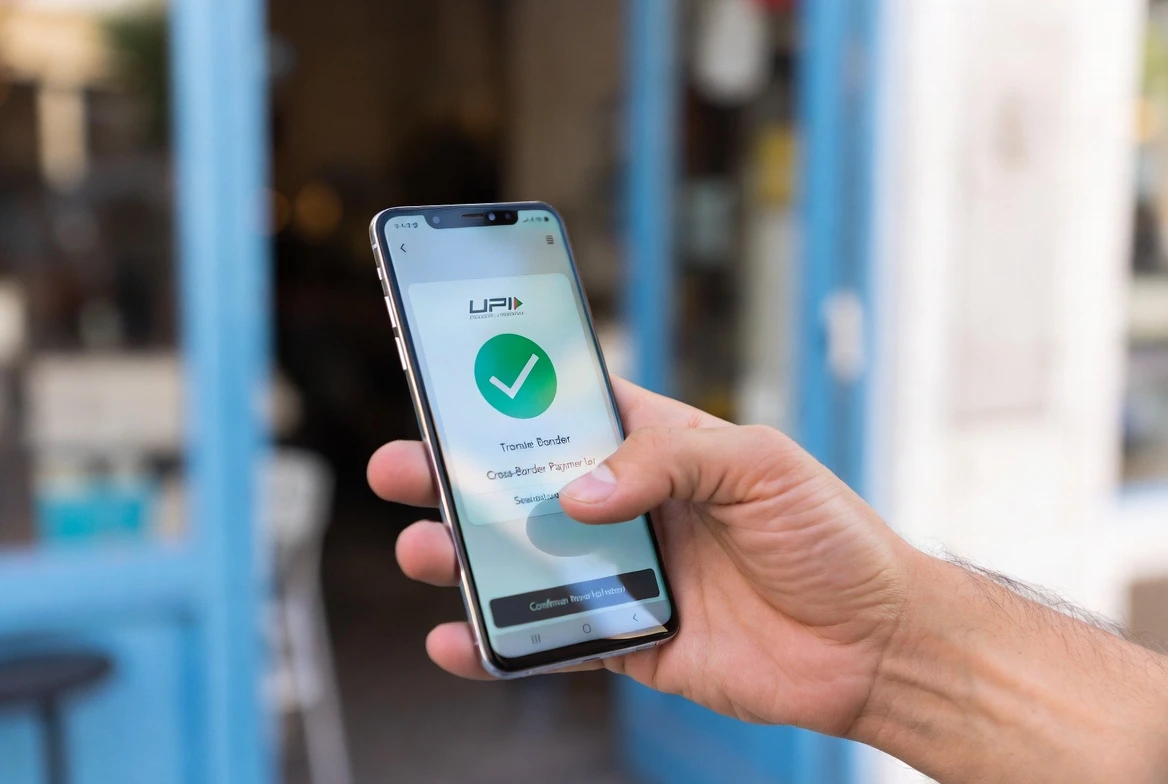
Greece Becomes the Tenth Country to Accept UPI
UPI’s reach now covers ten countries. The list mixes established Indian-diaspora corridors with newer tourism and trade routes. The rollouts follow a recognizable logic: neighbors first, Gulf remittance markets next, then European retail destinations, then Southeast Asia.
| Country | Year Live | Local Standard or Partner |
|---|---|---|
| Bhutan | 2021 | Royal Monetary Authority, BHIM QR |
| Mauritius | 2022 | Banking sector partners |
| Qatar | 2022 | Qatar National Bank |
| Singapore | 2023 | PayNow (MAS, DBS) |
| Sri Lanka | 2023 | Banking sector partners |
| Nepal | 2024 | Fonepay network |
| France | 2024 | Lyra Group; Galeries Lafayette added 2026 |
| UAE | 2024 | Network International, Mashreq Bank |
| Cambodia | 2026 | ACLEDA Bank via KHQR |
| Greece | 2026 | Eurobank and NIPL |
Cambodia opened on June 3 through a partnership between NIPL and ACLEDA Bank, linking UPI to Cambodia’s national KHQR QR network. The deal put 4.5 million Cambodian merchants within reach of Indian travelers, with conversion to Cambodian riels handled at real-time rates, per the June 2026 Cambodia launch details. ACLEDA Bank processes local settlement, and merchant funds clear through NIPL’s cross-border clearing house within 24 to 48 hours. Cambodia is the first mainland Southeast Asian country with a live UPI integration.
France added Galeries Lafayette Nice Massena on June 16, weeks after UPI first launched at the Eiffel Tower in Paris in 2024. The two French deployments show how UPI is moving from landmark retail sites into general merchant coverage. Moneycontrol, citing the Ministry of Finance, lists Singapore, the UAE, France, Mauritius, Nepal, Bhutan, Qatar, and Sri Lanka as the eight countries where UPI was already accepted before Cambodia and Greece joined, per the ten-country list of UPI’s global footprint. Greece follows France as the second European country to host a live UPI service.
Eurobank described Greece and Cyprus as strategic gateways to Europe under the India-Middle East-Europe Economic Corridor, or IMEC. The bank’s Mumbai representative office opened earlier in 2026, ahead of the UPI launch.
The Scale UPI Brings Into Every New Negotiation
UPI processed 228 billion transactions in full-year 2025, with a total value of nearly ₹300 lakh crore ($3.4 trillion), per Forbes’ February 2026 analysis of why UPI’s overseas expansion keeps running into limits. The IMF, in a June 2025 report titled “Growing Retail Digital Payments (The Value of Interoperability),” identified UPI as the world’s largest retail fast-payment system by transaction volume, a figure Eurobank cited in its launch release. ACI Worldwide’s 2024 “Prime Time for Real-Time” report puts UPI at 49% of global real-time payment transaction volume, a figure Eurobank also cited. Together those numbers frame UPI as both the world’s largest retail fast-payment system and a rail processing almost half of all real-time payments globally. The volume-to-value gap, with UPI handling nearly 230 billion transactions a year against a fraction of that volume in dollars, signals a system built for high-frequency, low-ticket use.
UPI processed 21.63 billion transactions in December 2025, worth ₹27.97 lakh crore (about $335 billion), the platform’s highest monthly volume on record. The same month, UPI’s monthly volume grew 29% year-on-year while its value grew 20%, with the average ticket size narrowing to roughly ₹1,293 as UPI pushed deeper into grocery and street-vendor transactions.
That scale is the lever NIPL walks into every new bilateral negotiation. Any merchant who signs onto KHQR in Cambodia, or onto Eurobank’s UPI corridor in Greece, gains access to hundreds of millions of digitally fluent consumers transacting hundreds of billions of times a year. The conversion runs at real-time rates, with local acquiring banks handling settlement on the partner side.
Card Networks Face a Zero-MDR Counterweight
UPI’s domestic success rests on a 2020 policy decision by the Indian government. The mandate set zero merchant discount rate, or MDR, on UPI transactions, removing the per-transaction fee that normally funds card network infrastructure. Internationally, that pricing model travels with NIPL into every new corridor deal. The same zero-MDR structure gives UPI a pricing gap wherever it competes with Visa and Mastercard’s cross-border fees.
The increasing global acceptance and appreciation of UPI reflects the trust in PM @NarendraModi ji’s vision of building technology-led solutions that create value beyond borders and deepen partnerships for shared growth and prosperity.
Piyush Goyal, India’s Commerce and Industry Minister, posted the remark on X the day of the Athens launch, in his announcement of the Athens UPI demonstration. Visa and Mastercard charge merchants between 1.5% and 3% per international transaction, a pricing band UPI’s zero-MDR model sits well below. The gap is what NIPL leans on in every corridor negotiation. The structural alternative is real, since outside India UPI competes against Alipay, WeChat Pay, UnionPay, and Brazil’s Pix. None of those systems, however, pair zero MDR with UPI’s domestic volume.
Why UPI’s Global Map Stays Patchy
Ten countries is the visible UPI footprint, but India has signed Memoranda of Understanding for Digital Public Infrastructure cooperation with 23 countries, covering digital identity, digital payments, and data exchange. Fourteen agreements have not yet produced a live UPI corridor. The June 2026 run added two new countries, Cambodia and Greece, in four weeks. Yet even that pace leaves long-running talks with Thailand, Vietnam, and Malaysia without a live deployment.
- China, where UPI has no foothold inside the closed Alipay and WeChat Pay ecosystems.
- Japan, with stable India ties and a domestic digital payments stack already in place.
- South Korea, which runs its own fast-payment infrastructure and has not adopted UPI.
- Indonesia, with the largest unconnected pool of Indian-tourist spend in Southeast Asia.
- Vietnam, where bilateral talks have not converted to a live deployment.
Forbes called UPI’s expansion pattern “piecemeal, country-by-country deals” and identified a possible fix: a partnership with Alipay+, which would give UPI access to more than 150 million merchants globally. NPCI has signaled a target of 20-plus live markets by financial year 2028-29. The zero-MDR pricing model is the lever UPI carries into each of those negotiations.
Greece becomes the tenth country. The next ten live markets will arrive only if NIPL closes bilateral deals it has not yet signed.
Frequently Asked Questions
Which countries accept UPI today?
Ten countries accept UPI as of June 30, 2026. Services range from merchant QR payments for Indian travelers in France, Singapore, and Cambodia to bilateral remittance corridors from the Gulf and Greece.
How does the UPI service in Greece work?
Eurobank demonstrated a cross-border payment running from Greece to India at its Athens headquarters, using the Eurobank mobile app integrated with UPI through NPCI International. The service launches as a remittance corridor in its first phase, enabling users in Greece to send money to Indian accounts.
What is NPCI International?
NPCI International Payments Limited (NIPL) is the wholly owned overseas arm of the National Payments Corporation of India, the entity that built UPI. NIPL signs the bilateral agreements that enable UPI corridors and operates the cross-border clearing layer between Indian and partner-country banks.
How do UPI’s costs compare with Visa and Mastercard abroad?
UPI operates under a zero-MDR model mandated by the Indian government for domestic transactions. Visa and Mastercard charge merchants between 1.5% and 3% per international transaction, a pricing gap NIPL uses in negotiations. The same zero-MDR structure is what the Greek and Cambodian corridors launched under.
Can I get a refund if an overseas UPI transaction fails?
Cross-border dispute resolution depends on the regulatory framework agreed between the two countries’ banks and central banks. India’s Cambodia launch in June 2026 flagged unresolved jurisdictional questions on failed transactions between an Indian account and a foreign merchant, with those questions expected to sharpen as reciprocal flows go live.


South Korea Retail Investors Face Reckoning After KOSPI AI Rally Collapses

Surrey AI Maps Three Heart Attack Paths and Their Molecular Roots

Germany Locks Neutral Apple ATT Prompts Across Most of Europe

Apple’s 5% EU Fee Quietly Rewrites Alternative App Store Math

Apple’s EU Fee Truce Cuts Complexity but Leaves Rivals Fuming

Pixel 11 Pro Fold Trades Thinness for Durability and Seven-Year Stay

Mayo AI Flags HCM Obstruction From Everyday Ultrasound Videos

Indian Brands Quietly Scale Landmark Screens and Home Tech

Navin Vatsa Turns Grief Into a Lifetime of Quiet Seeing

Google Bets Pixel 11 Agentic AI Will Redefine Phones

Oracle Cuts 21,000 Jobs in a Year, Cites AI in 10-K Filing

Fable 5 and Mythos 5 Return as US Lifts Anthropic Export Controls

SpaceX’s Google Deal Turns a Rocket Company Into a Cloud Landlord

CD Projekt Red Co-CEO: Redemption Arc Isn’t Done, Witcher 4 in 2027

XPL Rallies 30% Ahead of Plasma One Card Tier Launch

Google Search Profiles Build a Follow Graph Inside Discover

DGO App Brings Rs 549 Mobile Pass for FIFA World Cup 2026 in Nepal

Moonshot AI Targets $30 Billion in China’s Fastest AI Funding Sprint

Oppo’s ColorOS 17 Eligibility List Leaves A-Series Buyers Behind

Microsoft Xbox Layoffs Start in July as Sharma Slams 3% Margin
-
 AI2 months ago
Oracle Cuts 21,000 Jobs in a Year, Cites AI in 10-K Filing
-
 AI2 months ago
Fable 5 and Mythos 5 Return as US Lifts Anthropic Export Controls
-
 AI3 months ago
SpaceX’s Google Deal Turns a Rocket Company Into a Cloud Landlord
-
 GAMING2 months ago
CD Projekt Red Co-CEO: Redemption Arc Isn’t Done, Witcher 4 in 2027
-
 CRYPTO2 months ago
XPL Rallies 30% Ahead of Plasma One Card Tier Launch
-
 NEWS3 months ago
Google Search Profiles Build a Follow Graph Inside Discover
-
 APPS2 months ago
DGO App Brings Rs 549 Mobile Pass for FIFA World Cup 2026 in Nepal
-
 AI3 months ago
Moonshot AI Targets $30 Billion in China’s Fastest AI Funding Sprint