
GAMING
MSI Claw 8 EX AI+ Costs $1,799 as Gaming Handheld Prices Reset
MSI’s Claw 8 EX AI+ debuts at $1,799 at Computex 2026 as ASUS answers with a bundle above $2,000 and Steam Deck OLED rises. The memory crisis behind the surge.

MSI’s Claw 8 EX AI+ landed on the company’s US store at $1,799, with Newegg listing the same machine at $1,699, per Tom’s Hardware. At the same Computex 2026 stage where that price arrived, ASUS answered with the ROG Xbox Ally X20 anniversary bundle, reported by outlets at above $2,000 once the bundled AR glasses are included. Valve’s Steam Deck OLED has moved to $789 for the 512GB model and $949 for the 1TB version.
The cheap era of portable PC gaming is over. The repricing is being driven by a memory supply chain that the AI buildout has reordered, and the manufacturers themselves are openly warning that this is only the beginning.
Computex 2026 Sets the New Handheld Ceiling at $1,799
MSI’s Claw 8 EX AI+ appeared on the company’s own US store at $1,799, with Newegg listing the same handheld at $1,699, according to the $1,799 MSI Claw 8 EX AI+ Computex launch. The hardware is built around Intel’s just-launched Arc G3 Extreme APU with Arc B390 integrated graphics, paired with 32GB of LPDDR5X memory.
The MSI price carries an extra signal, because the company has been unusually open about what comes next. MSI’s product marketing lead Andy Chu told FRVR the company is absorbing heavy cost hikes on memory and storage, and signaled the $1,799 sticker could climb further (per Tom’s Hardware).
It’s a really difficult year for Intel and especially the OEM like us […] because we also need to take those cost hikes for those key components like memory and also storage.
That admission came from Andy Chu, MSI’s product marketing lead, speaking to FRVR at Computex 2026 and reported by Tom’s Hardware. The same launch stage introduced the most expensive mass-market Windows handheld on sale today. Tom’s Hardware noted that AMD’s Strix Halo-equipped handhelds already sit above $2,000, putting MSI’s flagship in a category of its own for a Windows handheld sold at mainstream retail rather than as a limited boutique build.
ASUS Pushes the Bundle Above $2,000 With the ROG Xbox Ally X20
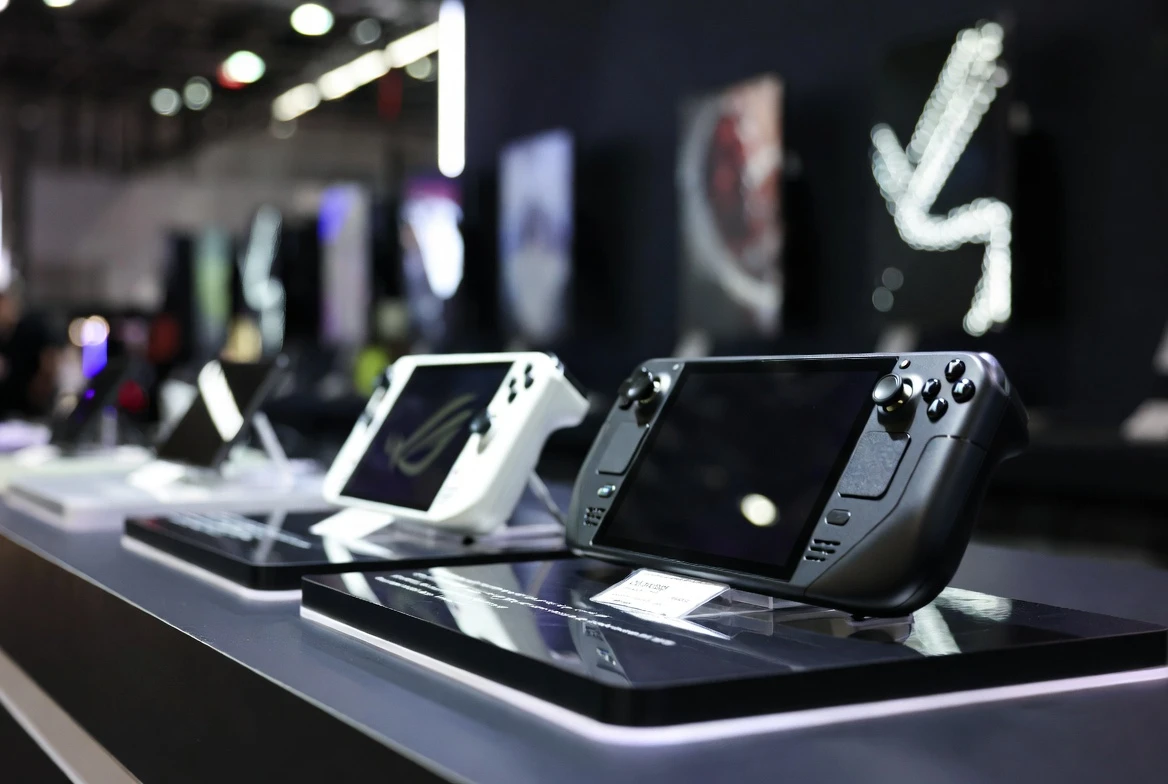
ASUS answered from the same Computex stage with the ROG Xbox Ally X20, a 20th-anniversary bundle for its Republic of Gamers sub-brand. The hardware swaps IPS for a 7.4-inch Nebula HDR OLED panel running at 120Hz with FreeSync Premium Pro, peak HDR brightness of 1,400 nits, and Dolby Vision support, all wrapped in a translucent black chassis with a custom gold internal structure (per the ROG Xbox Ally X20 anniversary bundle page).
Under the hood, ASUS kept the AMD Ryzen AI Z2 Extreme processor, 24GB of RAM, and 1TB of storage from the standard Xbox Ally X, per PCMag’s hands-on coverage. The anniversary pitch is the bundle itself: ROG XREAL R1 Edition 20 AR glasses that project a 171-inch virtual screen at 240Hz over USB-C.
ASUS has not confirmed a US price for the bundle. The ROG XREAL R1 Edition 20 launches next month on its own at $849, and the standard ROG Xbox Ally X retails at $999.99 (per PCMag). PCMag’s hands-on coverage expected the anniversary bundle to be ‘very expensive’ given the collector framing, but stopped short of naming a number. Treat the above-$2,000 estimate as reported rather than official.
The Steam Deck’s Budget Anchor Has Doubled
Valve’s cheapest current handheld is now the Steam Deck OLED 512GB at $789. the Steam Deck OLED 512GB and 1TB price jump pushed the 512GB from $549 to $789 and the 1TB from $649 to $949, per Tom’s Hardware. Valve attributed the change to ‘rising memory and storage costs’ in a blog post.
The original LCD Steam Deck has been discontinued, leaving the OLED line as the only Steam Deck on sale. The cheapest Steam Deck now costs $789, a price level the device itself occupied at its OLED refresh in 2023. The category’s defining bargain has effectively been pushed up a tier, and the rest of the field is re-pricing around it.
The Memory Math: How AI Data Centers Reset the Bill
The single largest force behind the move is memory. DRAM contract prices surged 90% in the first quarter of 2026 versus the fourth quarter of 2025, according to TrendForce data cited by Counterpoint Research and reported by TechTimes. TrendForce’s own April survey projected a 58 to 63% QoQ rise for conventional DRAM in Q2 2026, with NAND Flash contract prices up 70 to 75% over the same window.
The mechanism is structural. Samsung, SK Hynix, and Micron, who together control roughly 95% of global DRAM production, have reallocated wafer capacity toward High Bandwidth Memory for AI accelerators, where an HBM module sells for 10 to 20 times the price of a comparable amount of conventional DDR5 (per Lenovo’s ISC 2026 memory briefing). A 32GB DDR5 kit that cost $80 to $120 in mid-2025 now retails at $300 to $500 when available at all.
That reallocation explains the consumer squeeze. A handheld stuffed with 24GB or 32GB of LPDDR5X cannot hold its 2025 price once the memory bill itself roughly doubles.
Jefferies Equity Research, in a forecast summarized by gHacks, expects a further 40 to 50% memory price rise in Q3 2026, another 30 to 40% in Q4, and 40 to 45% year-on-year increases through 2027, with limited reductions of 15 to 20% only arriving in 2028. The same dynamic is already pushing fixed consoles higher; see how console prices keep rising on AI memory demand. IDC’s separate scenario analysis puts 2026 DRAM and NAND supply growth below historical norms at 16% and 17% year-on-year, respectively, and frames the shift as a structural reallocation rather than a cyclical shortage.
| Metric | Move | Source |
|---|---|---|
| Conventional DRAM contract prices, Q1 2026 vs Q4 2025 | +90% | TrendForce via Counterpoint, TechTimes |
| Conventional DRAM contract prices, Q2 2026 forecast | +58 to 63% QoQ | TrendForce April 2026 survey |
| NAND Flash contract prices, Q2 2026 forecast | +70 to 75% QoQ | TrendForce April 2026 survey |
| 32GB DDR5 kit, mid-2025 to mid-2026 | $80 to $120 to $300 to $500 | TechTimes |
| DRAM market controlled by Samsung, SK Hynix, Micron | roughly 95% | TechTimes |
| Memory price rise forecast, Q3 2026 | +40 to 50% | Jefferies via gHacks |
| Memory price rise forecast, Q4 2026 | +30 to 40% | Jefferies via gHacks |
New Silicon and OLED Displays Are Adding Their Own Markup
Memory is the largest line item, but the rest of the 2026 bill is higher too. Intel’s Arc G3 Extreme brings 12 Xe3 graphics cores into the handheld form factor, a step up in transistor count and wafer cost from the chips it replaces. AMD’s Ryzen AI Z2 Extreme, which powers both the Xbox Ally X and Lenovo’s Legion Go 2 reviewed by Tom’s Hardware at $1,349.99, adds a dedicated NPU for on-device AI workloads.
Nvidia used Computex 2026 to reveal Nvidia’s RTX Spark Arm-based superchip, a 20-core Grace CPU paired with a Blackwell GPU equivalent to a desktop GeForce RTX 5070 (per PCMag). The chip pairs 6,144 CUDA cores with up to 128GB of unified LPDDR5X memory, and Nvidia’s own framing pegs its gaming performance against discrete RTX 5070 cards.
The panels are pricier too. The shift to OLED, a Steam Deck feature in 2023, has spread to the Xbox Ally X20 and Lenovo Legion Go 2 in 2026, with screens rated for 1,000-plus nits and Dolby Vision HDR certification. TMR and Hall-effect joystick upgrades, larger batteries, and redesigned vapor-chamber cooling round out a more complex device that would have cost more to build even without the memory crunch.
Who Pays: The Buyers, the Survivors, and the Sub-$500 Vanish
The buyer who loses most clearly is the one the Steam Deck was built for: the mainstream gamer who wanted PC freedom without a PC budget. With new handhelds from major vendors now starting at $599.99, the sub-$500 entry tier that seeded the category’s growth has effectively disappeared from retail channels (per Valve’s discontinuation of the original LCD Deck and the new Steam Deck OLED pricing).
The pressure is already thinning the field of smaller vendors. AYANEO suspended pre-orders on its flagship Next 2 handheld in 2026, citing ‘unsustainable’ rises in RAM and storage costs (per MeinMMO’s translation of AYANEO’s own statement). The base Next 2 carried 32GB of RAM and a 1TB SSD, the same memory footprint now priced into MSI’s $1,799 flagship.
| Device | Processor | Memory | Price (USD) |
|---|---|---|---|
| MSI Claw 8 EX AI+ | Intel Arc G3 Extreme | 32GB LPDDR5X | $1,799 MSI; $1,699 Newegg |
| ROG Xbox Ally X20 (bundle) | AMD Ryzen AI Z2 Extreme | 24GB RAM, 1TB SSD | above $2,000 reported |
| ROG Xbox Ally X | AMD Ryzen AI Z2 Extreme | 24GB RAM, 1TB SSD | $999.99 |
| Lenovo Legion Go 2 (reviewed) | AMD Ryzen Z2 series | not stated in source | $1,349.99 |
| Steam Deck OLED 1TB | AMD custom APU | not stated in source | $949 |
| Steam Deck OLED 512GB | AMD custom APU | not stated in source | $789 |
The cheapest major-vendor handheld on the market today remains the entry-level ROG Xbox Ally at $599.99, which Tom’s Hardware noted may look ‘more attractive than ever’ against the new Steam Deck pricing if it holds its $599.99 sticker. Lenovo’s Legion Go 2 sits in the same four-figure range, with the configuration Tom’s Hardware reviewed priced at $1,349.99, and the MSI Claw plus the ASUS anniversary bundle occupy the summit.
Lenovo’s Five-Year Warning: Memory Pricing Won’t Return
Lenovo’s executive director Martin Hiegl told attendees at ISC 2026 in Hamburg that DRAM and NAND flash prices would not return to their pre-surge levels within a five-year window, describing a structurally higher baseline persisting through 2030 and beyond (per TechTimes). The same memory bill that lifted the MSI Claw to $1,799 also pushed Microsoft’s Xbox Series X to $649 and Sony’s PS5 Pro to $899, the gHacks reporting notes.
DRAM and NAND flash prices will ‘never’ return to the levels seen before the current surge.
The ‘never’ framing came from Martin Hiegl, Lenovo’s executive director, addressing ISC 2026 in Hamburg as reported by TechTimes. Micron has signed 16 non-cancelable Strategic Customer Agreements worth roughly $100 billion in committed revenue, $22 billion of it already deposited in cash, with floor prices locked in through 2030 (TechTimes). Microsoft has separately said memory prices have risen more than 2.5 times since the beginning of 2026 and expects them to double again by late 2027.
The practical upshot: 2028 is the earliest year in which a meaningful price reset sits on any analyst’s forecast. Buyers weighing a purchase today are not catching a spike to wait out. They are buying into a new baseline, and that baseline looks closer to a $789 Steam Deck than the device that started the category.
Frequently Asked Questions
How much does the MSI Claw 8 EX AI+ cost?
The MSI Claw 8 EX AI+ lists at $1,799 on MSI’s US store and $1,699 on Newegg, per Tom’s Hardware. It ships with Intel’s new Arc G3 Extreme APU and 32GB of LPDDR5X memory.
Why are gaming handheld prices rising so fast in 2026?
Samsung, SK Hynix, and Micron have redirected manufacturing capacity toward High Bandwidth Memory for AI accelerators. TrendForce data shows DRAM contract prices surged 90% in Q1 2026, with another 58 to 63% rise projected for Q2. A 32GB DDR5 kit that cost $80 to $120 in mid-2025 now retails at $300 to $500.
How much does the ROG Xbox Ally X20 cost?
ASUS has not announced an official MSRP. The X20 ships only as a bundle with ROG XREAL R1 Edition 20 AR glasses, which retail on their own for $849 per PCMag, and the standard ROG Xbox Ally X at $999.99, leaving the anniversary package’s exact price unconfirmed.
Is the Steam Deck still a good value in 2026?
Relative to rivals, yes. The Steam Deck OLED at $789 for the 512GB model and $949 for the 1TB version is the cheapest OLED-equipped current-generation handheld from a major vendor, undercutting the $999.99 ROG Xbox Ally X and Lenovo’s Legion Go 2 reviewed at $1,349.99.
Will gaming handheld prices come down later in 2026?
Probably not. Jefferies Equity Research forecasts a further 40 to 50% memory price rise in Q3 2026 and 30 to 40% in Q4, with no meaningful relief until 2028. Lenovo’s ISC 2026 briefing warned the elevated baseline could persist through 2030.


LexisNexis and Promon Pair Up to Catch Mobile Fraud Inside the App

Five Channel Islands Experts on Why Technology Alone Falls Short

Gartner Warns $234 Billion in SaaS Spend Faces Agentic AI Reshuffle

Logitech G Becomes Modern Warfare 4’s Official PC Peripheral Partner

Sony PlayStation Handheld Rumors Reignite After Nishino Q&A

Huawei’s Standard Mate 80 Tops H1 2026 Sales, Pro Max Trails

SMS Authentication Is Failing Australian Mortgage Brokers

WiseTech’s 32-Year Data Trove Is Now Its Logistics AI Edge

Samsung Unpacked July 22 Confirmed by Members App Voucher Leak

A $6.99 Manga Subscription Just Pooled 10-Plus Publishers

Google Search Profiles Build a Follow Graph Inside Discover

Microsoft Xbox Layoffs Start in July as Sharma Slams 3% Margin

Google DeepMind and A24 Sign $75 Million AI Partnership Deal

Apple Strikes Preliminary Deal For Intel To Make iPhone And Mac Chips

DGO App Brings Rs 549 Mobile Pass for FIFA World Cup 2026 in Nepal

Anthropic Tells Senators Alibaba Ran the Largest Claude Distillation Attack

VinRobotics’ VR-H3 Debuts at Vienna, VinFast Is Next

Andreessen Horowitz Bets $2.2B on Crypto’s Quiet Cycle

Oracle Cuts 21,000 Jobs in a Year, Cites AI in 10-K Filing

Oppo’s ColorOS 17 Eligibility List Leaves A-Series Buyers Behind
-
 NEWS4 weeks ago
Google Search Profiles Build a Follow Graph Inside Discover
-
 GAMING3 weeks ago
Microsoft Xbox Layoffs Start in July as Sharma Slams 3% Margin
-
 AI1 week ago
Google DeepMind and A24 Sign $75 Million AI Partnership Deal
-
 NEWS2 months ago
Apple Strikes Preliminary Deal For Intel To Make iPhone And Mac Chips
-
 APPS3 weeks ago
DGO App Brings Rs 549 Mobile Pass for FIFA World Cup 2026 in Nepal
-
 AI1 week ago
Anthropic Tells Senators Alibaba Ran the Largest Claude Distillation Attack
-
 AI4 weeks ago
VinRobotics’ VR-H3 Debuts at Vienna, VinFast Is Next
-
 CRYPTO2 months ago
Andreessen Horowitz Bets $2.2B on Crypto’s Quiet Cycle