
AI
Mainland Tech Drives Hong Kong to No. 2 IPO Rank in H1 2026
Hong Kong closed H1 2026 as global No. 2 IPO venue, raising HK$203.3 billion from 78 listings driven by mainland Chinese tech, food and chip issuers.

Hong Kong’s stock exchange ended the first half of 2026 as the world’s No. 2 venue for initial public offerings, with 78 new listings raising HK$203.3 billion and posting a roughly 90% jump in proceeds from a year earlier, per Deloitte’s 1H 2026 China and Hong Kong IPO review. Nasdaq held the No. 1 slot at HK$872.4 billion, but did so mostly on SpaceX’s US$75 billion June 12 debut, a single transaction larger than Hong Kong’s entire H1 haul. Nearly every name near the top of Hong Kong’s leaderboard is a mainland Chinese issuer. The US listing window for those companies has narrowed to its smallest in years.
Hong Kong Closes H1 at No. 2 Globally
Last year already marked Hong Kong’s strongest year for new listings since before the pandemic. The first quarter of 2026 produced 40 IPOs that raised HK$110.4 billion, the second-highest Q1 total HKEX has recorded, per HKEX’s Q1 2026 market update. By the end of June, total H1 fundraising had reached HK$203.3 billion on 78 listings, up from HK$107.1 billion on 42 listings in the same stretch of 2025. Deloitte counts an 86% rise in the number of IPOs against a 90% rise in proceeds. New economy names (semiconductors, AI value chain companies, robotics, biotech, specialist technology) took up more than 70% of the count and nearly four-fifths of total proceeds during the half.
Outside Hong Kong and Nasdaq, the rest of the leaderboard moved further than usual. The New York Stock Exchange took third, with 31 listings raising around HK$124.2 billion, per RTHK’s write-up of the Deloitte numbers. Euronext came fourth, helped by a Czech defense listing. Shanghai and Shenzhen climbed back into the top five, with ChiNext’s new fourth listing standard and STAR Market reforms drawing more hard tech to the A-share side.
One Single Deal Skews the Whole Leaderboard
The single biggest reason Nasdaq finished ahead is a company that has almost nothing to do with Chinese listings. SpaceX priced its US$75 billion offering on June 12, the largest IPO in history, according to Business Insider and KYUK reporting. By Deloitte’s reckoning, SpaceX alone contributed HK$675.8 billion of Nasdaq’s HK$872.4 billion H1 total. Without SpaceX in the mix, Hong Kong would have “narrowly surpassed” the Nasdaq to take the global crown, said Edward Au, Deloitte China’s southern region managing partner.
Hong Kong’s pipeline is still carrying on. The H1 race, restated in clean terms, comes down to two transactions: SpaceX in New York, and the parade of mainland tech, food and components names in Hong Kong, with everything else in the ranking scored against that backdrop. Deloitte still expects Hong Kong to land inside the global top three for full-year 2026, with roughly 160 new listings raising at least HK$300 billion. The consultancy sees more than 600 active listing applications as of the end of May, with over 100 from companies already listed on A-shares. About a quarter of those 600 applicants are technology firms and one-fifth are high-end manufacturers.
What shrank instead was the US side of the equation. Chinese companies completed only one US IPO in the first half of 2026, raising US$12 million, per Deloitte. That compares with 39 Chinese US IPOs that raised US$886 million in H1 2025, with Deloitte’s US capital markets leader Zhang Wei calling the window for new Chinese listings in the US slim and slow after the SEC cleared tighter Nasdaq rules for Chinese issuers.
The pattern has hardened on both sides. Hong Kong’s secondary fundraising was equally active in H1, with ECM volume hitting a five-year Q1 high of US$30.6 billion in Q1 alone, up 45% from a year earlier, per HKEX. Average daily turnover on the Hong Kong cash market reached HK$276.7 billion in Q1, a 14% rise year on year, and held near HK$300 billion in early June. The TMT complex delivered more than half of Q1 proceeds, with eight of the world’s ten largest TMT IPOs in Q1 pricing in Hong Kong, per HKEX.
The Five Deals That Carried the Half
Five mega listings and twelve large ones accounted for more than 60% of Hong Kong’s H1 IPO proceeds, according to Deloitte. Three of the five priced in Q1; the other two came in April and late June. All five were already listed on Shenzhen or Shanghai, joining a parade of A-share issuers turning to Hong Kong for the international book and the Stock Connect back door.
| Company | Sector | HKD deal size | USD equivalent | Listing date |
|---|---|---|---|---|
| Victory Giant Technology | AI accelerator PCBs | HK$20 billion | US$2.6 billion | April 21, 2026 |
| Muyuan Foods | Hog farming | ~HK$12 billion | ~US$1.4 billion | February 6, 2026 |
| Eastroc Beverage | Energy drinks | HK$10.14 billion | US$1.3 billion | February 3, 2026 |
| Lingyi iTech | Apple supplier precision parts | HK$8.3 billion | US$1.06 billion | June 26, 2026 |
| Montage Technology | DDR5 memory interface chips for AI servers | ~HK$7 billion | – | February 9, 2026 |
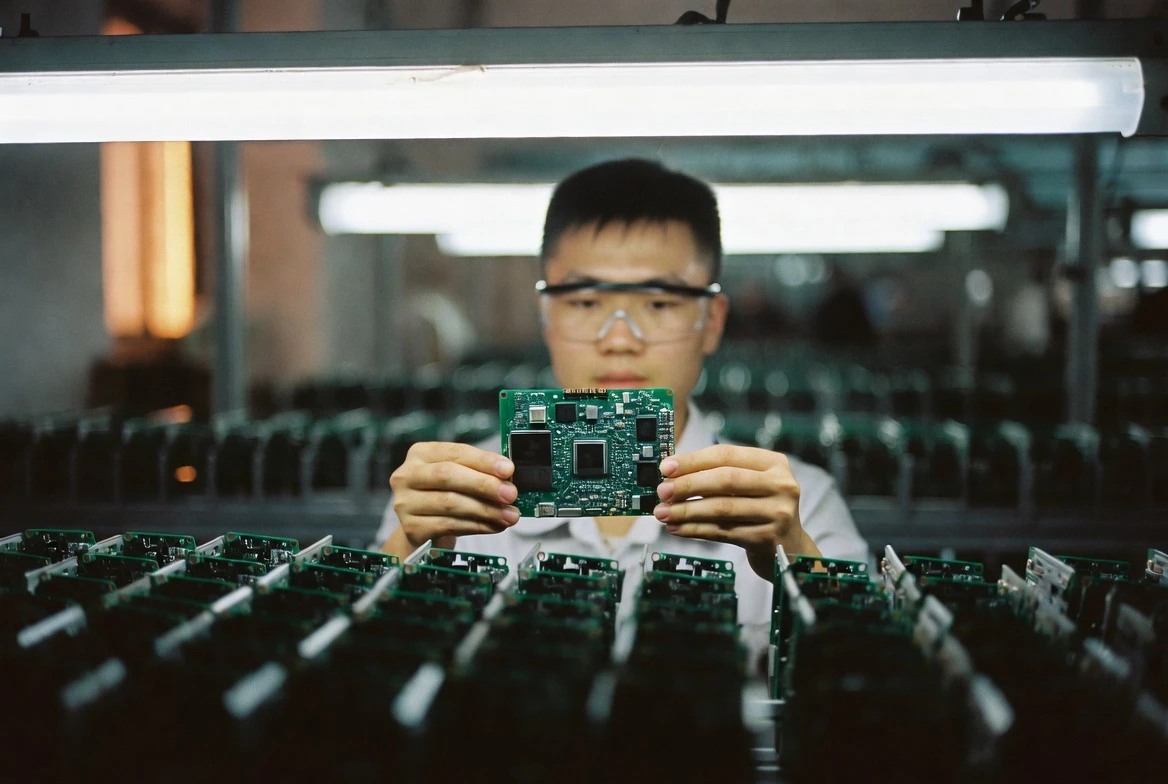
Three of the five map directly onto the AI hardware stack. PCB-maker Victory Giant Technology spent two years climbing into Nvidia’s H-series AI accelerator supply chain, and the company’s filings show it led global PCB makers in AI and high-performance computing revenue in H1 2025 with a 13.8% market share, up from seventh place and 1.7% the year before, per the South China Morning Post’s Victory Giant write-up. Lingyi iTech supplies metal casings, structural parts and thermal management systems to Apple, Huawei and Samsung, and roughly 37.6% of the IPO proceeds (about HK$3.07 billion) will go toward AI-focused production, with about HK$1.71 billion earmarked over three years for high-density AI servers, humanoid robot hardware and AI optical communications, per MacDailyNews’ coverage of Lingyi iTech’s IPO proceeds allocation. Montage Technology’s chips sit inside DDR5 memory modules that go into AI servers from Samsung, SK Hynix and Micron. Muyuan Foods, China’s largest hog producer by volume, and Eastroc Beverage, the country’s leading energy drink maker, round out the top five with consumer-staples offerings.
The AI PCB supply chain that Victory Giant anchors is already under acute pressure, with prices for high-purity substrate materials up about 40% in a recent four-week stretch, per coverage of China PCB prices spiking 40% after the Saudi strike. Victory Giant’s 57.23% first-day pop on April 21 was the largest for any Hong Kong listing in 2026 to date, per the South China Morning Post. Montage Technology opened 57% above its HK$106.89 offer price in February, per Yahoo Finance. Lingyi’s 6% first-day gain looked small next to those, but it still priced at the top of its range and signaled appetite for AI-adjacent listings that don’t already trade as Nvidia suppliers.
Why the Capital Is Flowing to Victoria Harbour
Hong Kong’s listing regime has been quietly rebuilt for this moment. The 2018 reform opened the doors to unprofitable new-economy names, the 2023 change added a specialist technology regime, and 2025’s Technology Enterprises Channel gave A-share issuers a faster on-ramp. Between June 2025 and end of May 2026, the pipeline grew to over 600 active applications, with more than 100 from companies already listed on A-shares, per Deloitte.
The alternative for those issuers has narrowed at the same time. The Securities and Exchange Commission cleared tighter Nasdaq rules for Chinese companies in H1 2026, raising minimum public float and tightening governance requirements. Only one Chinese company completed a US IPO in the first six months of 2026, Deloitte notes, raising US$12 million. The comparable H1 2025 had 39 Chinese US IPOs raising US$886 million. CSRC sign-offs for new Chinese listings in the US have slowed alongside that rule change, with only two companies winning regulator approval this year. The combined effect has been to push most large Chinese issuers toward the Hong Kong on-ramp.
We are very excited to see Hong Kong continue to come top 2 in the global fundraising ranking in 1H 2026. The market is also transforming with a strong mix of new economy companies ranging from semiconductors, AI value chain companies, robotics, biotech, specialist technology companies and hard technology companies from the A-share market. They altogether took up more than 70% of the number of Hong Kong IPOs and nearly four-fifths of the total IPO proceeds raised in Hong Kong in 1H 2026.
Alvin Tse, Deloitte’s national HK Offering leader, made that case in the firm’s 1H 2026 review. The same report notes that the new-economy dominance is partly a function of how the post-2018 listing regime was rebuilt, and partly of where the A-share system has decided it does not want to compete. Edward Au, Deloitte’s southern region managing partner, said Hong Kong is set to continue offering an international fundraising platform for what Beijing calls new quality productive forces sectors, including AI hardware, robotics, biotech, advanced manufacturing, and low-altitude economy. The clean overlap with the Five-Year Plan sector list keeps the pipeline feeding itself.
The other side of the flow is the Stock Connect program. Many Hong Kong H-shares have matching A-shares on Shenzhen or Shanghai, and once a Connect-eligible Hong Kong listing is included, mainland retail and institutional money can buy either side. Capital often rotates between the two venues depending on price differential and liquidity. That dual-trading mechanism is part of why Hong Kong’s average daily turnover held near HK$300 billion through early June 2026, per Edward Au.
Connect trading records fell in Q1. Southbound average daily turnover rose 11.5% year on year to HK$122.5 billion and Northbound average daily turnover climbed 69.6% to RMB324.1 billion, per HKEX’s Q1 update. Mainland investors drove more than HK$220 billion in net Southbound inflows during the quarter, much of it into Hong Kong tech and consumer names. The deeper liquidity on both sides is part of why a single HK$20 billion raise absorbs in one week.
The Aftermarket Is Still Misbehaving
The H1 numbers tell only half the story. Of 179 Hong Kong listings since January 2025, about half have traded lower over the three months through early June, per Wind Information as cited by CNBC’s June analysis of Hong Kong’s IPO performance problem. The benchmark Hang Seng has dropped only slightly in the same window, and the FTSE Renaissance Global IPO Index is up more than 10%. Hong Kong’s IPOs have been getting beaten by both the local market and a global basket of new issues. State media has begun to notice: Securities Times, the regulator-adjacent newspaper, ran a feature on May 29 flagging the pattern of sharp post-listing drops.
The mechanism is the Stock Connect program. Many of Hong Kong’s H-shares are duplicated as A-shares on Shenzhen or Shanghai, and once a name enters Connect, mainland retail investors can buy it on either side. Leonid Mironov, a portfolio manager at Gavekal, told CNBC that capital retreats to the often-cheaper A-share once a Hong Kong listing joins the Connect program. CNBC’s reporting noted that of 33 names that joined Connect on March 9, more than half had doubled between IPO and inclusion, with eight (including AI startup Deepexi) up more than 300%; all eight had fallen 10% or more since, and Deepexi was down 51% as of June 3.
Hedge funds and brokers are starting to lean against the trade. Goldman Sachs this spring predicted companies would raise about US$60 billion in 2026 Hong Kong listings, nearly double the US$36 billion raised in 2025, and on the same day downgraded Hong Kong H-shares in favor of mainland A-shares for greater AI hardware exposure. Ding Wenjie, an investment strategist at China Asset Management, told CNBC that some funds in Hong Kong have used Connect inclusion as a way to harvest additional returns, while China Market Research Group’s Benjamin Cavender warned that low fees and intense competition are forcing intermediaries to focus on short-term performance.
What Is Actually Listing
The H1 lineup tells a sector story with little overlap with Nasdaq. More than half of Hong Kong’s Q1 fundraising came from the technology, media and telecommunications complex, per HKEX. The Q1 mega-deal list covered AI accelerator silicon, PCB substrates, energy drinks, pork production, and the metalwork that goes around them, and none of those categories features prominently on the Nasdaq leaderboard.
Q2’s two mega-deal additions are both AI hardware suppliers. Victory Giant’s PCBs go into Nvidia’s H-series accelerators, and filings show the company led global PCB makers in AI and high-performance computing revenue in H1 2025 with a 13.8% market share, up from seventh place and 1.7% the year before. Lingyi iTech supplies metal casings, structural parts and thermal management systems to Apple, Huawei and Samsung, with about HK$1.71 billion of its HK$8.3 billion in proceeds earmarked over three years for high-density AI servers, humanoid robot hardware and AI optical communications. The January debut of Knowledge Atlas Technology (Zhipu AI), the first of China’s AI tigers to go public, raised US$558 million at a HK$116.20 offer price and closed up 13.1% on day one, per CNBC. The overlap with Nasdaq is real; the issuer profiles are not.
What 600 Applications Mean for H2 2026
The pipeline is thicker than the half that closed in mid-2026. HKEX had more than 600 active applications on file, per CNBC’s June reading of the exchange’s website, with over 100 A-share issuers in the queue and about a quarter of applicants classified as technology firms. Deloitte kept its full-year forecast at roughly 160 new listings raising at least HK$300 billion, which would keep Hong Kong inside the global top three. Edward Au, Deloitte’s southern region managing partner, said the firm is cautiously optimistic on H2 2026.
The demand backdrop looks favorable to Hong Kong, even with the US door open by inches. China’s 15th Five-Year Plan, which began its planning year in early 2026, lists commercial aerospace, AI hardware, biotech, low-altitude economy, quantum technology and biotech manufacturing as priority sectors, and many of those categories are already concentrated in Hong Kong’s listing pipeline. Names like Moonshot AI, with a Hong Kong listing in early discussion, fit the pipeline profile: see Moonshot AI’s $30 billion target and Hong Kong listing talks. Beijing’s continued resistance to fast-track CSRC sign-offs for new Chinese US listings keeps the deck stacked in Hong Kong’s favor. The mainland A-share market is also accelerating, with about 70 H1 new listings raising RMB69.3 billion, up from 51 IPOs that raised RMB37.3 billion in H1 2025, per Deloitte.
Two US-bound mega AI listings could still tug Hong Kong’s ranking lower if they land before year-end. Deloitte’s Edward Au said two gigantic AI company listings in the US later this year would compete with the Hong Kong pipeline, though he argued US mega-listings can give more guidance on the valuations of similar firms in Hong Kong. Those US mega-listings could also pull capital toward US-listed AI peers if those names out-trade Hong Kong’s.
Most of those forecasts depend on Hong Kong’s liquidity staying intact. Cash market average daily turnover reached HK$276.7 billion in Q1, a 14% year on year rise, and held near HK$300 billion through early June, per HKEX. Stock Connect northbound and southbound records were both set in Q1, with mainland investors driving over HK$220 billion in net southbound inflows. ECM volume of US$30.6 billion in Q1 marked a five-year first-quarter high.
Headline Numbers From H1 2026
- HK$203.3 billion raised from 78 Hong Kong IPOs in H1 2026 (vs 42 listings / HK$107.1 billion in H1 2025, per Deloitte)
- +90% YoY in proceeds; +86% in deal count
- 5 mega + 12 large IPOs accounted for over 60% of H1 proceeds
- 70%+ of H1 listings were new-economy (AI value chain, semiconductors, biotech, robotics, specialist technology), taking nearly four-fifths of total proceeds
- 600+ HKEX active applications as of end-May 2026, including 100+ A-share issuers
Frequently Asked Questions
How much did Hong Kong raise in IPOs in H1 2026?
Deloitte’s 1H 2026 review puts the figure at HK$203.3 billion raised from 78 IPOs, versus HK$107.1 billion from 42 listings in H1 2025. The number of new listings rose 86%; the proceeds total rose 90%. Hong Kong ended the period as the world’s No. 2 IPO venue by fundraising, behind only Nasdaq.
Why did Nasdaq rank No. 1 in H1 2026?
Nasdaq raised HK$872.4 billion from 60 listings in H1 2026, but nearly the entire gap between Nasdaq and Hong Kong came from one transaction: SpaceX’s US$75 billion June 12 listing. Deloitte’s count has SpaceX contributing HK$675.8 billion of Nasdaq’s H1 total. Drop SpaceX and Hong Kong would have narrowly surpassed the Nasdaq to take the global crown, Deloitte China’s Edward Au said.
What were Hong Kong’s biggest IPOs in H1 2026?
Deloitte counted five mega Hong Kong deals and twelve large ones, together accounting for more than 60% of H1 proceeds. The five mega listings, by HKD deal size, were Victory Giant Technology (HK$20 billion / US$2.6 billion), Muyuan Foods (~HK$12 billion / ~US$1.4 billion), Eastroc Beverage (HK$10.14 billion / US$1.3 billion), Lingyi iTech (HK$8.3 billion / US$1.06 billion), and Montage Technology (~HK$7 billion). All five were already listed on Shenzhen or Shanghai before adding an H-share offering in Hong Kong.
Why are Chinese companies listing in Hong Kong instead of the US?
The US listing window for Chinese issuers is at its tightest in years. Only one Chinese company completed a US IPO in H1 2026 (US$12 million raised), against 39 that raised US$886 million in H1 2025, per Deloitte. The SEC cleared tighter Nasdaq rules for Chinese issuers in H1 2026, and CSRC sign-offs for new Chinese US listings have slowed. Hong Kong has spent three years rebuilding its listing regime for specialist technology and A-share issuers, and the exchange had more than 600 active applications as of end-May 2026.
Are Hong Kong-listed IPOs performing well after listing?
Mixed. Of 179 Hong Kong listings since January 2025, about half traded lower over the three months through early June, per Wind Information via CNBC. The Hang Seng dropped only slightly in the same window and the FTSE Renaissance Global IPO Index is up more than 10%. The performance gap is largely a Stock Connect mechanic, with capital rotating to the cheaper A-share after a Connect inclusion. Goldman Sachs this spring downgraded Hong Kong H-shares in favor of mainland A-shares for AI hardware exposure.
What is the forecast for Hong Kong IPOs in full-year 2026?
Deloitte forecasts about 160 new Hong Kong listings raising at least HK$300 billion in full-year 2026, which would keep the city inside the global top three. Goldman Sachs’s spring forecast was US$60 billion in 2026 HK IPO proceeds, nearly double the US$36 billion raised in 2025. HKEX had more than 600 active listing applications as of end-May 2026, with about a quarter classified as technology firms.


Trade Me taps Kul Singh Kargil as CEO after Anders Skoe exit

Windows 11 Experimental build finally toggles Win32 camera access app by app

A20 Pro’s 18% Gain Is Process Math, Not a Chip Promise

OnePlus Nord and N hikes push major-brand sub-20K 5G out of reach

Snowflake routes AI tasks to cut spend inside its data cloud

Joe Hisaishi’s Guinness haul shows Ghibli packing classical halls

Cyberleek’s GTA 6 drops attack digital sales while selling a token

Hybrid model pins X-ray landmarks under 1.5 mm for surgery plans

Free Android AI Apps Quietly Replace Laptop Study and Design Work

Apple and Google Betas Lock Hardware Gates Before September

Fable 5 and Mythos 5 Return as US Lifts Anthropic Export Controls

Oracle Cuts 21,000 Jobs in a Year, Cites AI in 10-K Filing

SpaceX’s Google Deal Turns a Rocket Company Into a Cloud Landlord

CD Projekt Red Co-CEO: Redemption Arc Isn’t Done, Witcher 4 in 2027

XPL Rallies 30% Ahead of Plasma One Card Tier Launch

Google Search Profiles Build a Follow Graph Inside Discover

DGO App Brings Rs 549 Mobile Pass for FIFA World Cup 2026 in Nepal

Moonshot AI Targets $30 Billion in China’s Fastest AI Funding Sprint

Oppo’s ColorOS 17 Eligibility List Leaves A-Series Buyers Behind

Microsoft Xbox Layoffs Start in July as Sharma Slams 3% Margin
-
 AI2 months ago
Fable 5 and Mythos 5 Return as US Lifts Anthropic Export Controls
-
 AI2 months ago
Oracle Cuts 21,000 Jobs in a Year, Cites AI in 10-K Filing
-
 AI2 months ago
SpaceX’s Google Deal Turns a Rocket Company Into a Cloud Landlord
-
 GAMING2 months ago
CD Projekt Red Co-CEO: Redemption Arc Isn’t Done, Witcher 4 in 2027
-
 CRYPTO2 months ago
XPL Rallies 30% Ahead of Plasma One Card Tier Launch
-
 NEWS2 months ago
Google Search Profiles Build a Follow Graph Inside Discover
-
 APPS2 months ago
DGO App Brings Rs 549 Mobile Pass for FIFA World Cup 2026 in Nepal
-
 AI2 months ago
Moonshot AI Targets $30 Billion in China’s Fastest AI Funding Sprint