
NEWS
Joe Hisaishi’s Three Titles Came From Film Nights
Guinness logged Joe Hisaishi as a classical composer for Ghibli film nights that packed Tokyo Dome, the Hollywood Bowl, and Radio City.

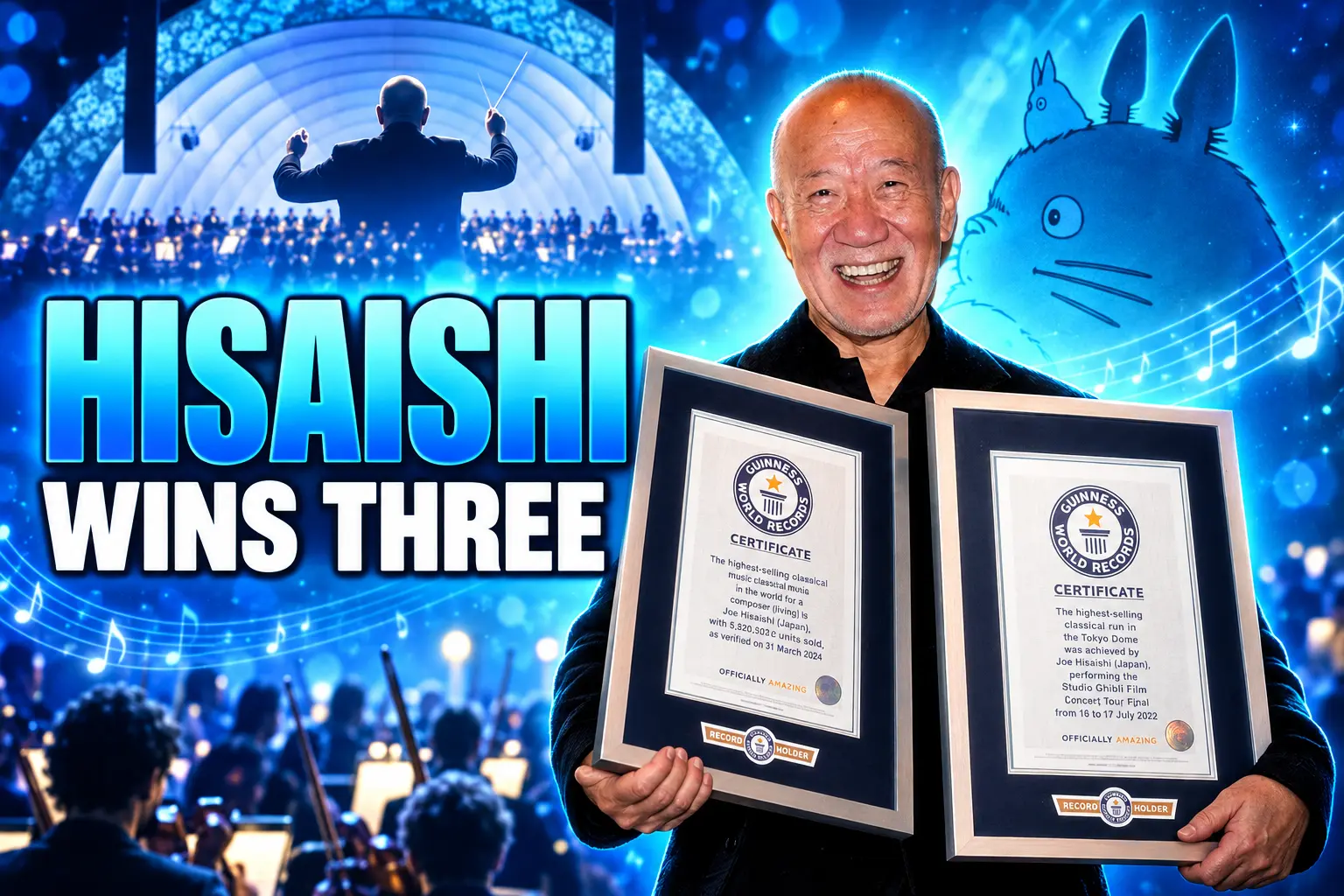
Joe Hisaishi collected three Guinness World Records in August 2026 for packing halls with film music billed as classical. The Japanese composer, 75, closed seven nights at Radio City Music Hall on August 17, and the certificates all name him as a classical composer.
The programs that sold the tickets were Ghibli film concerts, with clips on the walls and crowds that cheered the first bars of familiar cues. Orchestras and halls have learned they can fill a week that way.
Guinness Filed the Film Nights as Classical
A Guinness official handed him two certificates backstage after opening night on August 11. The third title landed on the seventh Radio City show. His own account posted the haul when the New York run ended.
Each mark is venue-specific. Together they describe one touring product: Hisaishi on the podium, an orchestra in the pit, and Studio Ghibli pictures in the air.
THE THREE GUINNESS MARKS
| Record | Venue | Dates | Figure |
|---|---|---|---|
| Highest-selling classical run | Hollywood Bowl | July 21-23, 2026 | 45,538 tickets |
| Most tickets sold by a classical composer (single run) | Tokyo Dome | July 16-17, 2025 | 133,453 tickets |
| Longest residency by a classical composer (single run) | Radio City Music Hall | August 11-17, 2026 | 7 nights |
Guinness lists the Los Angeles figure as the highest-selling classical run in the Hollywood Bowl, set while he conducted the Los Angeles Philharmonic. The Tokyo and New York titles use the same “classical composer” label on shows sold as film concerts.
THE YEAR THE CERTIFICATES LANDED
- July 16-17, 2025: Three Tokyo Dome performances close the Ghibli concert tour that began in 2017.
- June 2026: He opens a new global tour, Joe Hisaishi Cinema Music Concert.
- July 21-23, 2026: Three Bowl nights with the Los Angeles Philharmonic sell 45,538 tickets.
- August 11, 2026: Radio City opens; Guinness presents the Bowl and Tokyo certificates backstage.
- August 17, 2026: The seventh New York night adds the longest classical-composer run at the hall.
- September 11, 2026: The Los Angeles Philharmonic says its 2026 Bowl classical programs topped 158,000 tickets, with the Hisaishi trio beating the single-program mark.
Mamoru Fujisawa took the stage name as a phonetic nod to Quincy Jones. Guinness still files the nights under classical, and the rooms still print Ghibli on the poster.
An Orchestra Inside Tokyo Dome
The Dome date was the tour final, and it was also something the building had not tried. Nippon Television’s release on the shows called it the first orchestra concert at Tokyo Dome. He conducted the Royal Philharmonic Orchestra, the British band that lists him as Composer-in-Association, through music from Hayao Miyazaki’s features, from Nausicaa of the Valley of the Wind (1984) to the 2023 film The Boy and the Heron.
THE TOKYO DOME RUN
- Three performances: July 16 at 19:00, then July 17 at 13:00 and 19:00, the middle show added after demand spiked.
- Applications: 1,180,000 ticket orders hit the sale.
- Certified sales: Guinness logged 133,453 tickets for the run.
- Top seat: S seats were 15,000 yen, with A at 13,000 and B at 8,500.
About 200 musicians from Japan’s Ground, Maritime, and Air Self-Defense Force bands marched the arena floor during Castle in the Sky. Soprano Ella Taylor took the Princess Mononoke theme. Mandolin player Marie Bulleux stepped into The Wind Rises. Vocalist Mai, who had sung Nausicaa as a girl on the original soundtrack, returned for Spirited Away and the Totoro finale.
The printed program ran ten Ghibli titles before encore. He sat down for a piano-led “Ask Me Why,” a cue from The Boy and the Heron that still rarely appears on concert bills, then hit “Madness” from Porco Rosso and “Ashitaka and San.” A baseball park held an orchestra because the pictures, and the tunes tied to them, could sell the seats.
45,538 Tickets Over Three Bowl Nights
The Los Angeles Philharmonic had already named him its Los Angeles Philharmonic Composer in Focus for 2026 when the Bowl dates went on sale. The 2026 Hollywood Bowl summer season kit billed a Joe Hisaishi Film Music Concert with Ghibli scores, Takeshi Kitano cues, and film clips, July 21 to 23 at 8 p.m., with the California State University, Fullerton University Singers.
Those three nights sold 45,538 tickets. On September 11, after the classical portion of the Bowl summer ended, the orchestra said more than 158,000 tickets were bought across 17 classical programs, about 13% above a prior high of about 140,000 in 2017. It also said the Hisaishi trio surpassed the Bowl attendance record for a single classical program, the same run Guinness later certified.
President and CEO Kim Noltemy said the season showed that orchestral music, from film soundtracks to older masterworks, still draws Los Angeles under the Bowl lights. The amphitheater already treats movie nights as core programming. A John Williams tribute still occupies Labor Day weekend, with more than 50 minutes of clips in the 2026 edition. Hisaishi’s week is the newer franchise in that slot, and it now has a Guinness line attached.
Why Radio City Booked Seven Straight Nights
MasterVoices posted a seven-night Radio City residency for August 11 through 17, every show at 8:00 p.m., with Hisaishi conducting and playing piano beside the New York choir and the Orchestra of St. Luke’s. The Bowery Presents promoted the stand. Madison Square Garden Entertainment puts the hall at roughly 6,000 seats. Seven straight dates at that size is a pop routing, not a one-night orchestral visit.
The bill promised Ghibli scores plus Kitano and Isao Takahata films. Three screens hung from the ceiling. The venue warned that some clips show gun violence and shootings, a Kitano holdover, and that strobe lighting and loud effects are part of the night. When the opening bars of Nausicaa, My Neighbor Totoro, Princess Mononoke, and Spirited Away started, the room came in loud on the first phrase, the way a hits show does, not a subscription concert.
He brought his daughter on for “One Summer’s Day,” the Spirited Away piano theme, and played under her vocal. Miles Gooden, who turned 31 that week, rode a one-day bus from Washington with a family of five and said he wanted the main theme from Howl’s Moving Castle and anything from Spirited Away. People who know the films through the scores will cross a state line for the live version. Choir directors who work in anime music went too, and came out talking about the night as a Ghibli concert that happened to use an orchestra.
The scores were written as story, not as underscoring to be ignored. That is why a hall can hang three screens, play the tunes in order, and hold a week of dates that a Beethoven cycle would not be asked to fill at this address.
Ten Orchestras Commissioned a Concerto Anyway
The film nights pay the freight. They are not the whole job. Hisaishi started as a minimalist after conservatory, released Information in 1982, and has put out nearly 40 solo albums. Deutsche Grammophon’s A Symphonic Celebration (2023) hit No. 1 on Billboard’s Classical Albums and Classical Crossover charts. He has scored more than 80 films, including 11 Miyazaki features from Nausicaa onward, Kitano’s Hana-bi, and Takahata’s The Tale of Princess Kaguya. Guinness notes he wrote the Totoro theme in 20 minutes.
THE ORCHESTRA POSTS HE HOLDS
- Royal Philharmonic: Composer-in-Association since April 2024, the band on the Tokyo Dome floor and at his BBC Proms debut in August 2025.
- Japan Century Symphony: Music director since April 2025.
- Philadelphia Orchestra: Composer-in-Residence from October 2025.
- Los Angeles Philharmonic: Composer in Focus for the 2026 Bowl season.
- Philharmonie de Paris: Composer in Association for the 2026/27 season.
In May 2026 he conducted the world premiere in Washington of a Concerto for Orchestra commissioned by ten orchestras and halls, including Carnegie Hall, the Chicago Symphony Orchestra, and the Orchestre de Paris. Newer concert works sit beside the film catalog: The East Land Symphony, a horn concerto, Metaphysica, a viola saga, a harp concerto written for the Los Angeles Philharmonic’s Emmanuel Ceysson. Japan awarded him the Medal of Honor with Purple Ribbon in 2009 and the Order of the Rising Sun in 2023. The Annie Awards gave him the Winsor McCay Award in 2024.
Guinness can call him a classical composer because that paperwork is real. The records themselves still came from the movie nights, which is the part the halls can sell in blocks of three and seven.
He Still Aims at One Listener
After the New York certificates, he talked about the touring years in flat terms. Japan first, then rooms abroad, then crowds larger than the classical circuit around him usually sees.
I’ve just been taking things one step at a time. At first, I was doing this in Japan, and then when I started doing it around the world, people all over the world accepted it.
Joe Hisaishi, composer, in New York
He added that people were coming in numbers that even classical players on those stages probably could not draw. He still describes the work as delivering music to each person, the brief he set when the Miyazaki films were new and the Dome date was not on any map.
Radio City is dark on this bill now. The Bowl classical tally is in. Tokyo Dome has hosted its first orchestra. The certificates are on the shelf, and the next dates on his own calendar are orchestra weeks, not cartoon marathons. The halls that want another full week already know which half of the catalog fills the seats.

Instagram Plus Tests a Read-Only Mode That Cuts Stories

Altman Asks the Public to Accept Some AI Harm

Google Freezes OSS VRP Product Reports After AI Flood

AI Agents Make Payment Rails the Scarce Prize

Turkey’s Crypto Boom Now Runs Through Three Banks

Fable 5 Came Back Under a Commerce On-Off Switch

Google’s SpaceX GPU Lease Has a Sept. 30 Deadline

Plasma One’s XPL Locks Face a 1.81 Billion Cliff

DGO’s Rs 549 World Cup Pass Cost Fans Sleep and Data

Moonshot AI’s $30 Billion Ask Became a $35 Billion Close
-
 AI4 months ago
Fable 5 Came Back Under a Commerce On-Off Switch
-
 AI4 months ago
Google’s SpaceX GPU Lease Has a Sept. 30 Deadline
-
 CRYPTO4 months ago
Plasma One’s XPL Locks Face a 1.81 Billion Cliff
-
 APPS4 months ago
DGO’s Rs 549 World Cup Pass Cost Fans Sleep and Data
-
 AI4 months ago
Moonshot AI’s $30 Billion Ask Became a $35 Billion Close
-

 NEWS4 months ago
ColorOS 17 Device List Spans Oppo, OnePlus and Realme
-

 GAMING4 months ago
Xbox Cuts 3,200 Jobs After Five Years of Thin Returns
-

 GAMING4 months ago
The RTX 4050 Under Rs 70,000 Hides a Wattage Gap