
NEWS
Sri Sathya Sai Collector Inspects SIR Digitisation in Gorantla
Sri Sathya Sai Collector A Shyam Prasad reviewed SIR enumeration form digitisation at Gorantla Secretariat on Tuesday, stressing accuracy and the stipulated timeframe.

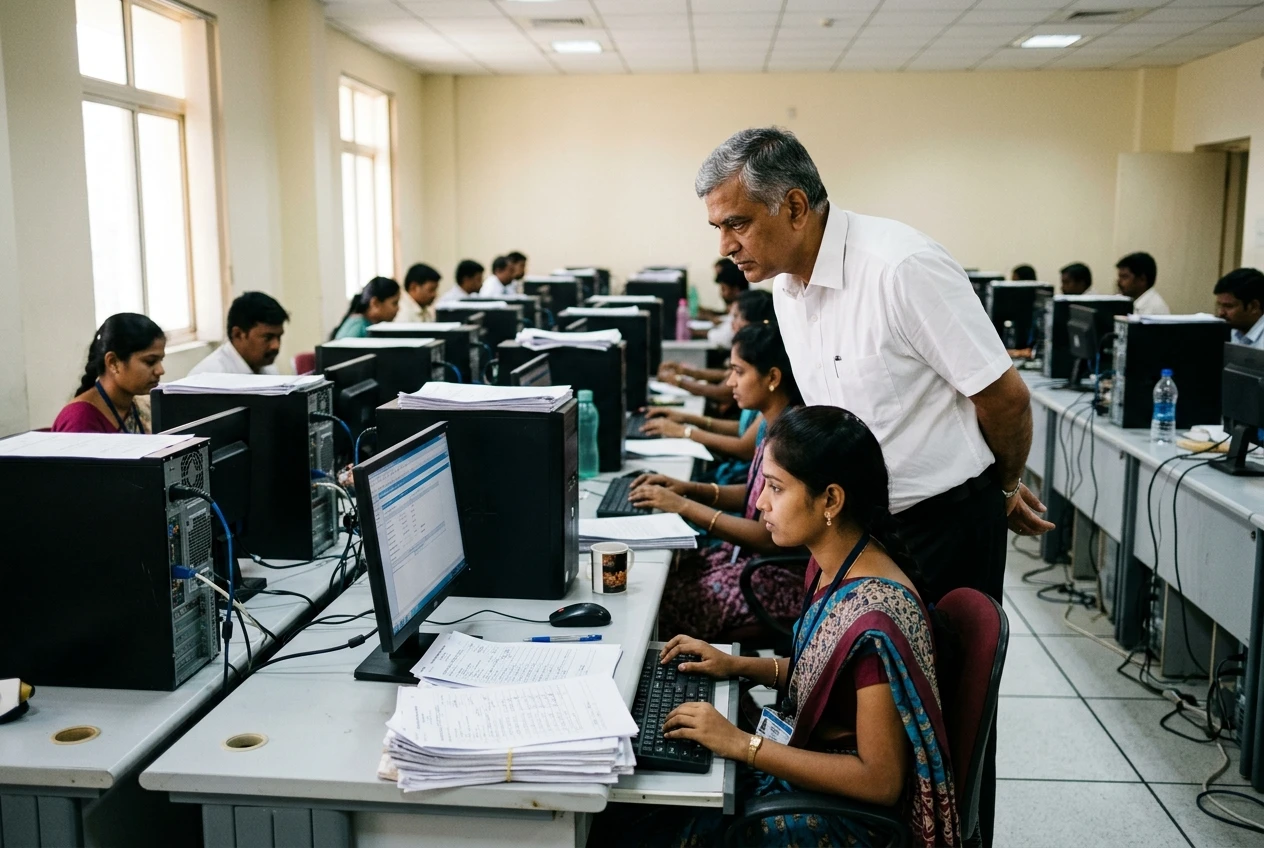
District Collector A Shyam Prasad made an unannounced visit to the Gorantla Secretariat on Tuesday to audit the digitisation of Special Intensive Revision (SIR) enumeration forms tied to polling stations in Gorantla mandal. He sat with the data-entry staff, watched screens, and walked out with pointed instructions on accuracy, supervision and the clock.
Sri Sathya Sai district’s top administrator also serves as its District Election Officer, and the inspection slots into a nationwide SIR rollout that began on 14 May 2026 across 16 states and three Union Territories, including Andhra Pradesh. The forms being typed in the secretariat will feed into the draft electoral rolls the Election Commission of India is now preparing for the state. Each enumeration form is one line in those draft rolls, and the same form can be filled online by voters who prefer not to wait for a household visit. The Gorantla audit is the local-government version of the larger Phase III verification chain the Commission is now running across all 16 Phase III states.
Inside the Gorantla Secretariat Surprise Audit
A Shyam Prasad, the Collector and District Election Officer of Sri Sathya Sai district (his official profile on the district site), walked into the Gorantla Secretariat without prior notice and asked to see the digitisation workflow. Officials at the secretariat said he personally monitored data entry on the computer systems and asked staff to walk him through how each enumeration form was being transcribed. He spent time scrutinising the progress registers that track the pace of the work. The visit was unannounced and neither the secretariat nor the election department had time to prepare for it.
In his instructions to staff, the Collector asked for the highest standards of accuracy. He told staff to avoid even minor errors while digitising the enumeration forms. He told the team the election-related exercise had to be completed within the stipulated timeframe without sacrificing quality. He added that the deadline still had to be met and that precision had to be maintained alongside it. He made it clear that error-free work was not negotiable for any reason.
He also directed the team to keep continuous supervision in place and offer staff the guidance needed to finish the exercise error-free. Tahsildar Madhu Naik, the mandal’s MPDO, election department personnel and secretariat staff were part of the inspection.
Where Gorantla Fits in the National SIR Picture
Andhra Pradesh is one of 16 states and three Union Territories that the Election Commission of India pulled into Phase III of the Special Intensive Revision on 14 May 2026 (the full Phase III rollout across 16 states and 3 UTs). Phase III covers about 36.73 crore electors across the country and deploys more than 3.94 lakh Booth Level Officers, with 3.42 lakh Booth Level Agents appointed by political parties supporting the work. The Commission has framed SIR as a participative exercise that depends on house-to-house enumeration by BLOs and parallel verification by party agents. Gorantla mandal, in the Penukonda Assembly Constituency of Sri Sathya Sai district, sits inside that national machinery.
The Special Intensive Revision is a verification and revision of India’s electoral rolls run by the Election Commission of India. It seeks to remove the names of deceased, permanently shifted, duplicate and non-citizen voters while making sure no eligible citizen is left out. Under Article 324 of the Constitution and Section 21 of the Representation of the People Act, 1950, the Commission has the power to revise rolls without prior permission from any authority. The nationwide SIR process was announced on 27 October 2025 by Chief Election Commissioner Gyanesh Kumar from Vigyan Bhawan, New Delhi. On 27 May 2026, the Supreme Court of India upheld the SIR’s legal legitimacy and described the exercise as part of the Commission’s constitutional obligation to conduct free and fair elections.
- States and UTs in Phase III: 16 states and 3 Union Territories
- Electors in scope: 36.73 crore across India
- Booth Level Officers deployed: over 3.94 lakh
- Booth Level Agents from parties: 3.42 lakh
- Phase III order date: 14 May 2026
Why the District Collector Stepped In
A Shyam Prasad was posted as Collector of Sri Sathya Sai district on 11 September 2025, according to the State government’s personnel records. In the seven months since, he has built a pattern of surprise inspections at sub-registrar offices, mandal secretariats and other frontline units. Surprise audits are a familiar administrative tool in Indian districts: the unannounced visit tests whether the procedure works when no one has had time to prepare the room.
In the SIR context, accuracy at the data-entry terminal carries consequences far upstream. A name typed wrong, a birth date jumbled by a digit or an address field missed: any one of those errors can knock an eligible voter off the roll or leave an ineligible name in place. The Commission has built the SIR process around verification. Pre-filled forms go door-to-door with BLOs, then electors either submit them back through the BLO or upload them online, and only after a draft publication do claims and objections get heard. That is why the Collector’s instruction on error-free data entry matters more than a routine administrative check.
The Gorantla inspection also illustrates how Phase III is being run from multiple levels. At the field edge, Booth Level Officers carry forms to households, fill them and collect them. Booth Level Agents appointed by political parties may collect up to 50 forms a day from the public and hand them to the BLO before the draft publication. At the district level, election officials compile and digitise those forms. At the state and Commission level, the data is consolidated.
His directives on accuracy, supervision and the deadline were the three instructions that mattered most. They map directly to the three failure modes the SIR has historically invited: typos and data errors, unsupervised work that lets small mistakes compound, and last-minute rushes that trade quality for pace. The instruction to keep supervision continuous was the response to all three.
- Accuracy: Digitisation must meet the highest standards; minor errors should be avoided.
- Timeframe: The election-related exercise must be completed within the stipulated timeframe while maintaining quality and precision.
- Supervision: Officials must keep continuous supervision in place and provide on-the-spot guidance to staff for error-free completion.
How Phase II’s Numbers Shape Phase III
Phase II of the SIR ran from 27 October 2025 across nine states and three Union Territories and delivered the first hard data on what the process does to a roll. It covered about 50.99 crore electors; the official end figure came in at 45.81 crore, and the net deletion rate was approximately 10.2%. Uttar Pradesh recorded the largest absolute deletion at ~2.05 crore voters, while West Bengal followed at 83.86 lakh. Those Phase II numbers are the comparison every Phase III state now gets measured against.
| State | Pre-SIR voters | Final roll | Net deletions | Deletion share |
|---|---|---|---|---|
| Uttar Pradesh | 15.44 crore | 13.39 crore | ~2.05 crore | 13.21% |
| West Bengal | 7.69 crore | 6.86 crore | 83.86 lakh | 10.9% |
| Tamil Nadu | 6.41 crore | 5.67 crore | 74 lakh | 11.5% |
| Madhya Pradesh | 5.74 crore | 5.39 crore | 34.25 lakh | 5.96% |
| Gujarat | 5.08 crore | 4.40 crore | 68 lakh | 14.5% |
| Kerala | 2.78 crore | 2.69 crore | 9 lakh | 3.24% |
Within Phase II, the deletion share ranged from 16.6% in Andaman and Nicobar Islands to 0.35% in Lakshadweep, a spread inside a single exercise. Smaller states and union territories straddled the range; Kerala came in at 3.24% and Chhattisgarh at 11.8%. That spread is what Phase III officials will watch as digitisation work happens in every mandal.
Bihar, the first state to undergo intensive revision in 2025, gave an earlier look. Roughly 47 lakh electors were deleted from a 7.89 crore roll, a 5.95% reduction. By Phase II the absolute numbers were larger but the patterns varied widely across states. Across Phase II states and UTs, deletions added up to roughly 5.18 crore voters. Phase III in Andhra Pradesh will start producing its own deletion numbers once the Enumeration Phase and subsequent digitisation close in the state.
After Digitisation, What Becomes of the Forms
The forms now being typed into the Gorantla Secretariat systems will travel upward through the electoral bureaucracy after digitisation. Booth Level Officers collect the filled enumeration forms at the household level and pass them to the Electoral Registration Officer for the Assembly Constituency. The ERO consolidates the data, validates it against the previous SIR electoral roll and produces a draft roll for claims and objections. Where an elector’s previous roll details do not match the database, the ERO will issue a notice asking for supporting documents.
The Commission has supplied a list of acceptable documents ranging from Aadhaar and passports to matriculation certificates, Forest Right Certificates and extracts of the Bihar SIR roll dated 1 July 2025 (full Enumeration Form instructions and document checklist on the Commission site). Andhra Pradesh voters can check whether their name appears on the previous electoral roll online at the Election Commission’s Citizen Service Portal. The same portal hosts the Enumeration Form that can be filled online and submitted for the current SIR cycle. National and state recognised parties can also appoint additional Booth Level Agents to assist BLOs in collecting and verifying forms. Electors who want their name on the new roll submit the Enumeration Form either to the BLO during the door-to-door visit or directly through the portal.
Frequently Asked Questions
What is Special Intensive Revision (SIR)?
The Special Intensive Revision is an exercise run by the Election Commission of India to verify and revise the country’s electoral rolls through house-to-house enumeration, pre-filled forms and cross-checking against old voter data. The nationwide SIR was announced on 27 October 2025 by the Chief Election Commissioner, and the Supreme Court of India upheld the exercise’s legal validity on 27 May 2026.
Which documents can an elector submit with the Enumeration Form?
The Commission accepts a defined list of documents. Acceptable proofs include Aadhaar, passports, birth certificates, matriculation or educational certificates issued by recognised boards, permanent residence certificates, OBC/SC/ST caste certificates, Forest Right Certificates, National Register of Citizens extracts where they exist, family registers prepared by state or local authorities, and land or house allotment certificates by the government. Electors born in India after 2 December 2004 also need a parent-linked birth or identity document from the same list.
What does a Booth Level Officer (BLO) do during Phase III?
BLOs conduct house-to-house visits during the Enumeration Phase, distributing Enumeration Forms to existing electors and collecting them once filled. They carry at least 30 blank Form 6 forms with declarations on each visit so any newly eligible resident can also apply. Across SIR Phase III, more than 3.94 lakh BLOs are deployed to cover 36.73 crore electors.
Where can a voter check if their name is on the previous electoral roll?
Voters can verify their previous-SIR enrolment through the Election Commission’s Citizen Service Portal. The same portal also hosts the Enumeration Form that can be filled and submitted online. Electors with no internet access can submit the form back to the BLO during the household visit.


CAA Demands Meta Default Muse Image to Opt-In Consent

Memory Costs Are Quietly Squeezing Low-End Phones and PA Suppliers

Social Media Algorithms Now Reward Watch Time, Not Conversation

ResMed Cuts a $490 Million Deal to Exit MatrixCare Software

Nothing’s Phone (4b) Lands at £299, Just £50 Below the Better 4a

Parents’ Phone Distraction Tied to Teen Insecure Attachment

AirPods Custom EQ and Adaptive Audio Slider Arrive in iOS 27 (9A5314b)

EU Court Rejects Apple’s Three Challenges to Its Gatekeeper Status

Black Flag Resynced Playable Build Leaks Ahead of July 9 Launch

Penton Publications Enters Liquidation on 3 July 2026

Microsoft Xbox Layoffs Start in July as Sharma Slams 3% Margin

Google Search Profiles Build a Follow Graph Inside Discover

Google DeepMind and A24 Sign $75 Million AI Partnership Deal

DGO App Brings Rs 549 Mobile Pass for FIFA World Cup 2026 in Nepal

Oracle Cuts 21,000 Jobs in a Year, Cites AI in 10-K Filing

Oppo’s ColorOS 17 Eligibility List Leaves A-Series Buyers Behind

Anthropic Tells Senators Alibaba Ran the Largest Claude Distillation Attack

Apple Strikes Preliminary Deal For Intel To Make iPhone And Mac Chips

Andreessen Horowitz Bets $2.2B on Crypto’s Quiet Cycle

Google Home Spring Update Adds Gemini 3.1 And Old Nest Cam AI
-
 GAMING4 weeks ago
Microsoft Xbox Layoffs Start in July as Sharma Slams 3% Margin
-
 NEWS1 month ago
Google Search Profiles Build a Follow Graph Inside Discover
-
 AI2 weeks ago
Google DeepMind and A24 Sign $75 Million AI Partnership Deal
-
 APPS4 weeks ago
DGO App Brings Rs 549 Mobile Pass for FIFA World Cup 2026 in Nepal
-
 AI2 weeks ago
Oracle Cuts 21,000 Jobs in a Year, Cites AI in 10-K Filing
-
 NEWS1 month ago
Oppo’s ColorOS 17 Eligibility List Leaves A-Series Buyers Behind
-
 AI2 weeks ago
Anthropic Tells Senators Alibaba Ran the Largest Claude Distillation Attack
-
 NEWS2 months ago
Apple Strikes Preliminary Deal For Intel To Make iPhone And Mac Chips