
AI
Fleek Raises $25m to Build AI for Secondhand Fashion Infrastructure
London startup Fleek raised $25m Series B led by Vinted backer Burda, with eBay joining, to scale the AI that sorts and prices secondhand clothes.

Fleek, the London startup building AI for the global secondhand clothing industry, has raised a $25m Series B led by Burda Principal Investments, the early backer of Vinted and the lead investor in Vinted’s Series C. eBay, FJ Labs, and H14 joined the round, alongside existing investors Andreessen Horowitz, HV Capital, and Y Combinator.
Founded in 2021 by Abhi Arora and Sanket Agarwal, the company runs a B2B marketplace that connects roughly 2,000 wholesale suppliers and graders in Pakistan, India, and Dubai with more than 50,000 retailers, resellers, and boutiques across over 100 countries. The Series B brings total funding to $45m and will be used to expand Fleek Sort, the company’s custom AI for grading, pricing, and merchandising secondhand inventory at scale.
Fleek Lands $25m to Digitise the Secondhand Supply Chain
The Series B was led by Burda Principal Investments, an early Vinted backer and the lead investor in Vinted’s Series C round. Joining Burda were eBay, FJ Labs, and H14, with existing investors Andreessen Horowitz, HV Capital, and Y Combinator also adding capital. Fleek, headquartered in London, says the raise will accelerate development of the AI platform that underpins its wholesale secondhand fashion marketplace.
The startup spent its first three years building the marketplace itself before turning to AI roughly a year ago. That AI now sits at the centre of the platform inside Fleek Sort, a custom model trained on four years of the company’s own transactions. The Series B will fund continued work on that model, an expansion of the engineering team, and growth on both the supplier and buyer sides of the marketplace. Fleek declined to disclose its valuation following the funding.
With the new round, the company has now raised $45m in total since Arora and Agarwal founded it in 2021. “Most people have no idea what happens to a piece of clothing after they part with it,” Arora, the co-founder and CEO, said in the announcement. “We started Fleek because that system is broken, the market it serves is exploding, and nobody is building the technology and infrastructure to fix it.”
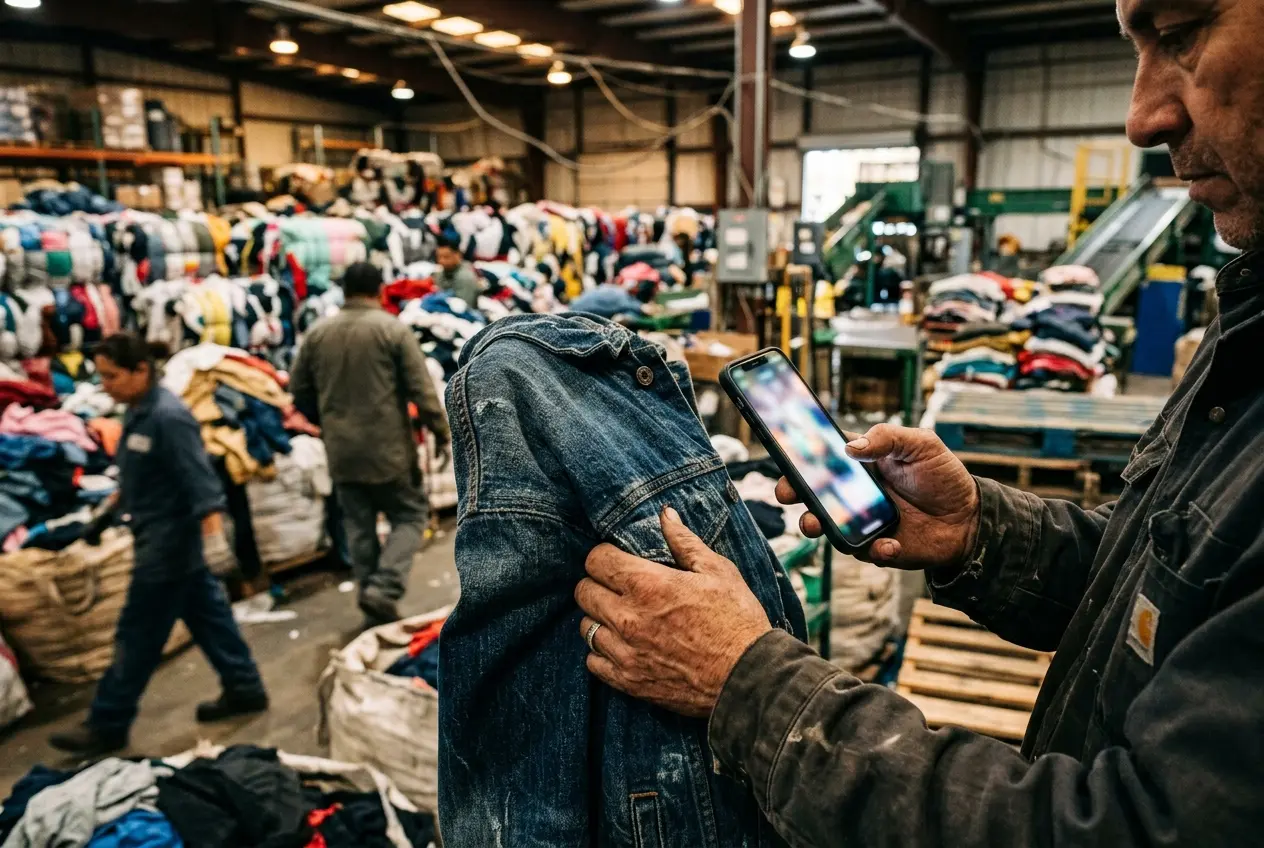
What Happens to a Donated Coat
Up to 24 billion secondhand garments move through the global supply chain each year, according to Fleek, travelling from donation bins in cities such as London, Paris, and New York to sorting centres scattered across the world. Yet the $200bn-plus industry they feed remains stubbornly manual: garments are assessed by hand, graded against inconsistent standards, and traded through disconnected networks with little pricing transparency. The buyers at the end of that chain are largely vintage clothing shops in the United States and Europe, many of which once travelled to Asia and the Middle East to source directly.
The COVID-19 pandemic ended those trips, and online brokers filled the gap. Fleek’s $25m Series B and what it funds
She used to source her vintage items directly, going on buying trips to Asia and the Middle East to purchase directly from the wholesale suppliers of second hand clothes. The COVID-19 pandemic had put an end to those buying trips and gave rise to online brokers who charged high commissions. Some of brokers were also less than scrupulous. The Brick Lane vintage store owner had been scammed out of more than $15,000 by one of these brokers and, unable to recover the funds and with her margins shrunk by brokerage fees, she reluctantly decided to close her store.
That was the conversation that pushed Arora to start the company. It took place between him and the owner of his favourite Brick Lane vintage shop in London’s East End, as reported by Fortune. He teamed up with Agarwal, whom he had met in an online founders’ community and whose mother-in-law also sold vintage clothing and had run into the same sourcing trouble. Arora and Agarwal saw the same problem from opposite ends of the chain: supply was not scaling as fast as demand. Fleek’s marketplace now stands behind every transaction, removing the room for the broker scams that pushed the Brick Lane shop out of business.
Fleek Sort Reads a Garment From a Photo
Fleek Sort is a custom vision-language model, a system that combines image recognition with text reasoning. It was trained on millions of secondhand transactions from Fleek’s own network over four years.
The model is built to do four things with a single photograph:
- Identify the garment’s brand, style, and category
- Flag defects such as rips, stains, or faulty seams
- Estimate the price the item will clear for on the marketplace
- Predict how long it will take to sell
Sellers and buyers can still negotiate their own prices, particularly since many buyers purchase hundreds or thousands of pieces at a time. The company says it built the model in-house out of necessity: at the volumes involved, relying on third-party AI would have been prohibitively expensive. Fleek’s largest partner moves some 600,000 pounds of clothing a day.
Fleek Sort is already in use by graders in sorting hubs in Pakistan, India, and Dubai, with pilots launching in the UK, Europe, and the US. The team is extending the technology from photos to video, and studying how it might eventually be applied to conveyor belts in sorting facilities. Agarwal, Fleek’s chief technology officer, cautions that robots who can sort and grade garments as fast as humans currently do in those facilities are still a way off. For now, the model handles identification and pricing recommendations, while quality-check centres in Karachi and Delhi inspect items from brands and categories the data flags as frequently counterfeited.
A $200bn-plus Market Still Running on Handshakes
The April 2026 UK resale market analysis from Barclays put the global secondhand market at $210-$220bn, growing three times faster than the firsthand market with annual growth of around 10%. That puts it among the fastest-expanding slices of retail, yet most of the underlying plumbing still runs on phone calls, hand-graded assessments, and personal relationships. The volume moving through the system every year, up to 24 billion items according to Fleek, is roughly the entire annual clothing production of the global apparel industry.
Demand is running ahead of supply. In February 2026, Barclays’ consumer research found 38% of UK consumers had bought from a resale platform in the past year, and 19% said they were using platforms such as Vinted and Depop specifically to keep costs down. Vinted alone now has more than 17 million users in the UK, putting it just behind Primark and Next in customer reach. The wave of consumer demand is hitting a supply chain built for a smaller trade.
Fleek’s current footprint:
| Network footprint | Fleek |
|---|---|
| Wholesale suppliers and graders | 2,000+ |
| Retailers, resellers, and boutiques | 50,000+ |
| Countries served | 100+ |
| Items kept in circulation to date | 12 million+ |
| Estimated water saved | 13 billion litres |
| Estimated CO₂ emissions avoided | 23,000 tonnes |
Vinted’s €8bn secondary transaction earlier in 2026 is the cleanest benchmark for where the consumer-facing layer of this trade has gone. That valuation, set by an €880m secondary share sale in April, was up from €5bn in a previous €340m secondary in 2024. Vinted’s 2025 gross merchandise value rose 47% to €10.8bn, a useful proxy for the underlying flow of secondhand clothing through retail. Fleek plays a different layer of the same market: where Vinted connects individual sellers to individual buyers, Fleek connects the wholesale graders that supply vintage shops and resellers.
Why Burda’s Bet on Vinted Is Back
Burda Principal Investments has been invested in Vinted since 2015, a year when secondhand fashion was still considered niche by most venture investors. Burda led Vinted’s Series C in August 2018, then participated in each subsequent round, including Vinted’s €250m Series F in 2021. Eleven years after first backing Vinted, Burda is placing the same wager on the wholesale layer underneath it.
There’s more data locked inside the global secondhand supply chain than almost any other market, yet historically very little of it has been captured. We’ve built the world’s first AI trained specifically to understand secondhand inventory – what it is, what it’s worth, who wants it and where demand exists.
That is Agarwal, Fleek’s co-founder and CTO, framing the bet as one about captured data as much as sorting automation. “Every transaction improves that understanding, creating an intelligence layer we believe will become critical infrastructure for the future of the industry,” he said. The thesis is that the B2B layer has captured less of its own activity than consumer-facing resale, leaving the largest untouched dataset in fashion. eBay’s participation gives that thesis a US-facing distribution leg, since eBay runs its own fashion marketplace and acquired secondhand clothing service Depop from Etsy earlier in 2026 for about $1.2bn.
“We backed Vinted when secondhand fashion was still considered niche,” Julian von Eckartsberg, managing director for Europe at Burda Principal Investments, said in the announcement. “We know what it takes to build a platform that scales in this market.” The Burda investment pattern is a familiar one: a thesis-level lead into a category-defining company, then follow-on capital as the market matures. The thesis here is that the wholesale supply chain is the bottleneck, and that whoever digitises it first gets the data moat.
The Regulatory Pressure Pushing Supply Into the Channel
EU rules that went into effect last year require member states to collect textiles separately for recycling, Fortune reports. Other regulations coming into force prohibit retailers from simply junking unsold inventory. Those two pieces of legislation pull more clothing into the secondhand channel every season, even as consumer demand is already outrunning supply.
The size of the prize, in numbers:
- Up to 24 billion secondhand garments move through the global supply chain each year, per Fleek.
- Barclays values the global secondhand market at $210-$220bn as of April 2026, growing three times faster than the firsthand market.
- Fleek has helped keep more than 12 million items in circulation, saving an estimated 13 billion litres of water and avoiding 23,000 tonnes of CO₂ emissions.
- Vinted’s 2025 gross merchandise value rose 47% to €10.8bn, with a €8bn secondary valuation following in April 2026.
That backdrop is why eBay, Zara, H&M, and Marks and Spencer are all now responding with their own pre-owned and resale offerings, the Barclays analysis notes.
“Supply is the biggest constraint in the industry,” Arora told Fortune. Vinted scrapped selling fees to attract more sellers, and Depop and eBay followed. Vintage resellers in the US, the largest end market Fleek serves, say they are increasingly unable to source enough volume through brokers. The pressure that pushed the Brick Lane shop out of business is now a structural shortage across the entire resale industry.
What the New Capital Funds
Arora said the new capital will go toward continuing to develop Fleek Sort, expanding the engineering team, and growing the network of buyers and sellers. That work includes extending the model from photos to video and studying its application to conveyor belts in sorting facilities. It also includes the build-out of Fleek’s quality-check centres, which currently operate in Karachi and Delhi to inspect high-risk counterfeit categories. The company did not break out how much of the $25m is earmarked for each line, but engineering and AI model development are expected to take the largest share.
The round arrives as the resale sector sees a wave of new capital and corporate activity. Vinted closed its €880m secondary at €8bn in April, Depop was acquired by eBay earlier in 2026 for about $1.2bn, and major retailers from Zara to H&M to Marks and Spencer are launching or expanding their own pre-owned programmes. That backdrop suggests the supply chain layer Fleek is digitising is about to come under more, not less, pressure. The next test for Fleek Sort will be whether it can hold accuracy as the network expands from a few thousand graders to the thousands more signing on across the UK, Europe, and the US.
Frequently Asked Questions
What does Fleek do?
Fleek runs a B2B marketplace and AI system that connects wholesale secondhand clothing suppliers and graders in countries such as Pakistan, India, and the UAE with vintage retailers, resellers, and boutiques across more than 100 countries. The company was founded in London in 2021 by Abhi Arora and Sanket Agarwal.
Who led Fleek’s Series B?
Burda Principal Investments led the $25m round. Burda has backed Vinted since 2015 and led Vinted’s Series C in 2018. eBay, FJ Labs, and H14 participated, alongside existing investors Andreessen Horowitz, HV Capital, and Y Combinator.
What is Fleek Sort?
Fleek Sort is a custom vision-language model trained on four years of secondhand transactions from Fleek’s own marketplace. From a photograph it identifies brand, style, and condition, flags defects, estimates sale prices, and predicts time-to-sell. It is in use in sorting hubs in Pakistan, India, and Dubai, with pilots in the UK, Europe, and the US.
How big is the secondhand fashion market?
Barclays valued the global secondhand market at $210-$220bn in April 2026, with annual growth of around 10% and three times the pace of the firsthand market. Vinted alone reported €10.8bn in gross merchandise value for 2025, up 47% year-on-year.
Why did eBay invest in Fleek?
eBay runs its own fashion marketplace and earlier in 2026 acquired Depop from Etsy for about $1.2bn. The investment gives eBay a foothold in the wholesale supply chain that feeds its consumer resale business, a layer that has remained largely offline as secondhand demand has grown.
Disclaimer: This article is for informational purposes only and does not constitute investment advice. Startup funding rounds carry risk, and figures quoted reflect publicly reported information as of publication date. Readers should consult a qualified professional before making any investment decisions.


CAA Demands Meta Default Muse Image to Opt-In Consent

Memory Costs Are Quietly Squeezing Low-End Phones and PA Suppliers

Social Media Algorithms Now Reward Watch Time, Not Conversation

ResMed Cuts a $490 Million Deal to Exit MatrixCare Software

Nothing’s Phone (4b) Lands at £299, Just £50 Below the Better 4a

Parents’ Phone Distraction Tied to Teen Insecure Attachment

AirPods Custom EQ and Adaptive Audio Slider Arrive in iOS 27 (9A5314b)

EU Court Rejects Apple’s Three Challenges to Its Gatekeeper Status

Black Flag Resynced Playable Build Leaks Ahead of July 9 Launch

Penton Publications Enters Liquidation on 3 July 2026

Microsoft Xbox Layoffs Start in July as Sharma Slams 3% Margin

Google Search Profiles Build a Follow Graph Inside Discover

Google DeepMind and A24 Sign $75 Million AI Partnership Deal

DGO App Brings Rs 549 Mobile Pass for FIFA World Cup 2026 in Nepal

Oracle Cuts 21,000 Jobs in a Year, Cites AI in 10-K Filing

Oppo’s ColorOS 17 Eligibility List Leaves A-Series Buyers Behind

Anthropic Tells Senators Alibaba Ran the Largest Claude Distillation Attack

Apple Strikes Preliminary Deal For Intel To Make iPhone And Mac Chips

Andreessen Horowitz Bets $2.2B on Crypto’s Quiet Cycle

Google Home Spring Update Adds Gemini 3.1 And Old Nest Cam AI
-
 GAMING4 weeks ago
Microsoft Xbox Layoffs Start in July as Sharma Slams 3% Margin
-
 NEWS1 month ago
Google Search Profiles Build a Follow Graph Inside Discover
-
 AI2 weeks ago
Google DeepMind and A24 Sign $75 Million AI Partnership Deal
-
 APPS4 weeks ago
DGO App Brings Rs 549 Mobile Pass for FIFA World Cup 2026 in Nepal
-
 AI2 weeks ago
Oracle Cuts 21,000 Jobs in a Year, Cites AI in 10-K Filing
-
 NEWS1 month ago
Oppo’s ColorOS 17 Eligibility List Leaves A-Series Buyers Behind
-
 AI2 weeks ago
Anthropic Tells Senators Alibaba Ran the Largest Claude Distillation Attack
-
 NEWS2 months ago
Apple Strikes Preliminary Deal For Intel To Make iPhone And Mac Chips