
GADGETS
Skyroot’s Vikram-1 Reaches Orbit on Its First Try, Defying the Odds
Skyroot’s Vikram-1 reached orbit on its maiden flight, bucking a pattern of failed rocket debuts at Rocket Lab, Astra and Firefly, CEO Chandana tells Moneycontrol.

Skyroot Aerospace’s Vikram-1 rocket reached orbit on its first attempt on July 18, becoming the first privately built Indian launch vehicle to pull off the feat and pushing India into a club of just three nations with private orbital launch capability. The broadcast looked clean. Mission control did not.
Speaking to Moneycontrol on July 20, Skyroot co-founder and chief executive Pawan Kumar Chandana described the flight as “a suspense movie.” Engineers caught a software glitch eleven minutes before liftoff, then lost contact with the rocket mid-flight. Almost no private rocket company gets its orbital debut right on the first try. Skyroot just did, and that fact alone separates this launch from most of the small-satellite launch industry’s history.
The Countdown That Stopped With Eleven Minutes Left
The first scare came before Vikram-1 ever left the pad. According to Chandana, a 35-year-old former Indian Space Research Organisation (ISRO) scientist, the automated launch sequence halted on its own after detecting a mismatch in the software.
“It wasn’t anything related to the vehicle,” he told Moneycontrol. “It was a small software glitch in the automatic launch sequence.”
The team pulled the countdown, fixed the mismatch and restarted the sequence. It held the second time.
The system worked perfectly the second time. From that point onwards, every milestone was a suspense because we didn’t know if another hold would come.
That is how Chandana described the moments after the restart. The uncertainty did not end at liftoff, either. Once Vikram-1 finished its ascent, Skyroot briefly lost telemetry from an overseas ground station during the orbit adjustment phase, the point where the rocket’s liquid upper stage fires to place satellites precisely.
“We lost contact with one of our ground stations,” Chandana said. “Until the next station acquired the vehicle, we didn’t know exactly what had happened.” Signal came back only once Vikram-1 came within range of a tracking station in Australia, by which point the rocket had already finished its orbital work and released every customer satellite. “When we finally confirmed everything had worked,” Chandana said, “that’s when we could really celebrate.”
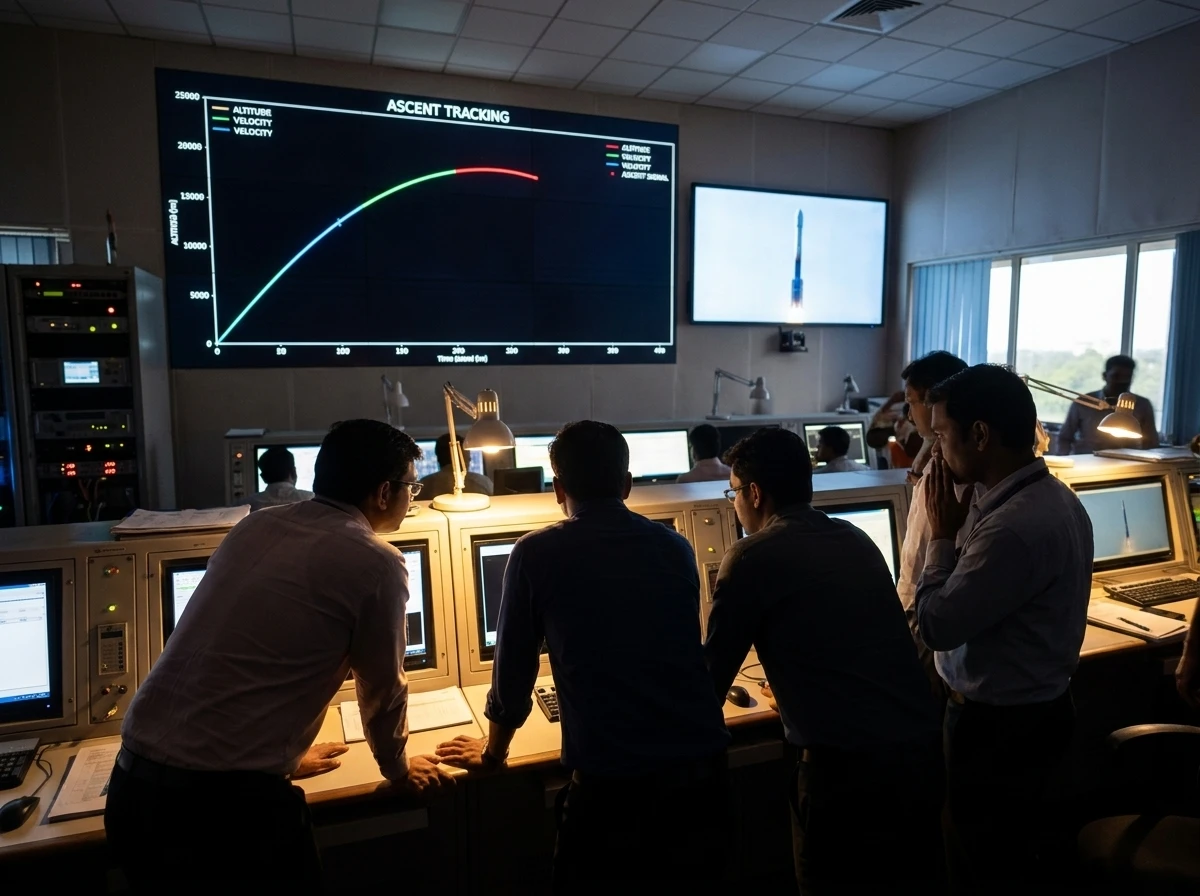
Inside Mission Aagaman’s Flight to Orbit
The mission carried the name Aagaman, Sanskrit for arrival, and it lifted off from the Satish Dhawan Space Centre in Sriharikota at 11:30 a.m. India time within a launch window that had opened on July 12 and ran through August 4. About 200 people, roughly a fifth of Skyroot’s workforce, staffed the launch team that day.
Vikram-1 is a four-stage, expendable rocket standing about 22 meters tall on a 1.7 meter diameter carbon composite frame. Its first three stages run on solid propellant; the fourth is a restartable liquid stage built to fine-tune the satellites’ final orbits. The rocket is designed to carry up to 350 kg to low Earth orbit, and on this flight it pushed its payloads to roughly 450 kilometers (280 miles) at a 60 degree inclination.
That cargo was not a dummy mass. Vikram-1 carried real customers into space on its very first flight, a bet few rocket makers are willing to place on an unproven vehicle:
- DCUBED – a technology demonstration payload from the German company
- Solaras S3 – a nanosatellite pathfinder built by Indian startup Grahaa Space
- Embrace – a robotic arm from Indian firm Cosmoserve Space, designed for in-orbit capture work
- SCOPE – Skyroot’s own satellite, built to gather data on how the rocket performed in flight
Every one of them reached orbit and deployed. That result put India alongside the United States and China as the only nations where a privately developed rocket has reached orbit.
Rockets Rarely Work on the First Try
What makes Vikram-1’s debut unusual is not just that it happened. It is that almost nobody else in this business has managed the same thing on their first swing.
Rocket Lab’s Electron failed to reach orbit on its debut flight in 2017 before succeeding on its second attempt in January 2018, a run that would eventually stretch past two dozen missions with only two failures on the whole record. Virgin Orbit’s LauncherOne came up short on its first try in May 2020. Astra’s first orbital test in September 2020 ended early when a stuck valve triggered an over-pressurization event, and the company was still carrying a 1-for-5 orbital record nearly two years later after a separate mission dropped four NASA-funded satellites into the Atlantic.
Firefly Aerospace had it worse. Alpha’s maiden flight in September 2021 flipped end over end and exploded in the air less than three minutes after leaving Vandenberg Space Force Base. SpaceX’s own Falcon 1 needed several attempts before it ever reached orbit. Three of those four companies eventually got there. None of them got there first try.
| Company | First Orbital Attempt | What Happened |
|---|---|---|
| Rocket Lab | 2017 | Electron’s debut flight failed; success followed on flight two in January 2018 |
| Virgin Orbit | May 2020 | LauncherOne failed to reach orbit on its first flight |
| Astra | September 2020 | Rocket 3.1 fell short after a valve stuck open; the company later carried a 1-for-5 orbital record |
| Firefly Aerospace | September 2021 | Alpha’s engine cut out early and the rocket exploded roughly two and a half minutes after liftoff |
| Skyroot Aerospace | July 2026 | Vikram-1 reached orbit and deployed every customer satellite on its first flight |
Vikram-1’s launch also landed on a date with its own quiet symmetry. It came 46 years after ISRO’s SLV-3 first put an Indian satellite into orbit in 1980, this time run entirely by a private company instead of the state.
A Billion-Dollar Wager Lands
Skyroot was founded in Hyderabad in 2018 by Chandana and Naga Bharath Daka, who both left stable jobs at ISRO to build rockets from nothing. That decision looked far riskier than it does today.
The company became India’s first space unicorn in May, when a $60 million round pushed its valuation past $1.1 billion, co-led by Singapore’s GIC and Sherpalo Ventures, with the founders of Greenko Group and Arkam Ventures also joining in. That round brought Skyroot’s total capital raised to $160 million, all committed before Vikram-1 had ever flown. BlackRock added a further show of confidence with a debt financing round in March, the kind of loan lenders extend to hardware they consider bankable rather than speculative.
Chandana told Via Satellite before the flight that Skyroot was aiming for four to six launches this financial year. “Depending on the observations of the first flight, we may have to change that,” he said. “But currently, we do plan to follow up quickly.” He added that Skyroot expects roughly a third of its demand to come from domestic customers, with the rest split across Southeast Asia, Japan, the United States and Europe.
Agnikul Cosmos Is Still Chasing Orbit
Skyroot is not India’s only private rocket builder, just the one that got there first. Chennai based Agnikul Cosmos, born out of IIT Madras, has spent 2026 pushing its own Agnibaan rocket toward an orbital debut of its own after a successful suborbital test flight back in May 2024.
Agnikul recently fired a cluster of four 3D-printed engines together, a milestone the company needs before it can attempt its own trip to orbit, and the test still targets a maiden orbital flight by late 2026. The company, valued above $500 million, has also brought former ISRO chairman S. Somanath on as a board observer and announced plans to recover an orbital-class rocket booster, a reusability push modeled on what SpaceX has already done hundreds of times over.
Agnikul’s own materials acknowledge the industry Skyroot just beat: the smallsat launch business, the company has said, is defined by a high failure rate on first orbital attempts. Skyroot got its shot in first, and it landed clean.
What Skyroot Does With Its Head Start
A single successful flight does not make a launch business. Skyroot still has to prove it can fly Vikram-1 again, and often, at a cadence that satisfies the customers now watching from Germany, Japan and the rest of the world lining up behind the ones already flown.
Chandana’s own account of Mission Aagaman makes clear how thin the margin felt from inside the room, glitch, hold, restart, blackout, signal. None of that showed up in the launch footage. Vikram-2 is next in line, and this time the countdown will carry the weight of a rocket that has already proven it works, not one still waiting to find out.


Pixel 11 Trails Galaxy Phones That Last as Long

OpenAI’s Research Intern Arrives With a Warning Attached

Robinhood Prices XRP Into a Two-Cent 9 a.m. Bet

Sony’s 10 Percent Disc Drop Leaves the 2028 Cutoff Intact

Chip Allocation Sidelines the Base iPhone 18 This Fall

Miami-Dade Fights the Vice City Brand It Already Wears

IFA 2026 Awards Put Tecno Ahead of Flagship Phones

USB-C Gadgets Made the Junk Drawer Rechargeable

Pixel 11 Pro Asks $1,099 for a Light Google Locked

The iPhone Ultra Sells Two Retired Minis as One Foldable

Oracle Cuts 21,000 Jobs in a Year, Cites AI in 10-K Filing

Fable 5 and Mythos 5 Return as US Lifts Anthropic Export Controls

SpaceX’s Google Deal Turns a Rocket Company Into a Cloud Landlord

CD Projekt Red Co-CEO: Redemption Arc Isn’t Done, Witcher 4 in 2027

XPL Rallies 30% Ahead of Plasma One Card Tier Launch

Google Search Profiles Build a Follow Graph Inside Discover

DGO App Brings Rs 549 Mobile Pass for FIFA World Cup 2026 in Nepal

Moonshot AI Targets $30 Billion in China’s Fastest AI Funding Sprint

Oppo’s ColorOS 17 Eligibility List Leaves A-Series Buyers Behind

Microsoft Xbox Layoffs Start in July as Sharma Slams 3% Margin
-
 AI3 months ago
Oracle Cuts 21,000 Jobs in a Year, Cites AI in 10-K Filing
-
 AI2 months ago
Fable 5 and Mythos 5 Return as US Lifts Anthropic Export Controls
-
 AI3 months ago
SpaceX’s Google Deal Turns a Rocket Company Into a Cloud Landlord
-
 GAMING3 months ago
CD Projekt Red Co-CEO: Redemption Arc Isn’t Done, Witcher 4 in 2027
-
 CRYPTO3 months ago
XPL Rallies 30% Ahead of Plasma One Card Tier Launch
-
 NEWS3 months ago
Google Search Profiles Build a Follow Graph Inside Discover
-
 APPS3 months ago
DGO App Brings Rs 549 Mobile Pass for FIFA World Cup 2026 in Nepal
-
 AI3 months ago
Moonshot AI Targets $30 Billion in China’s Fastest AI Funding Sprint