
COMPUTERS
Timothy Olyphant’s No-Computer Life Fits a Bigger US Trend
Timothy Olyphant’s SmartLess confession about ditching computers matches Pew Research data showing 16% of US adults now live smartphone-only.

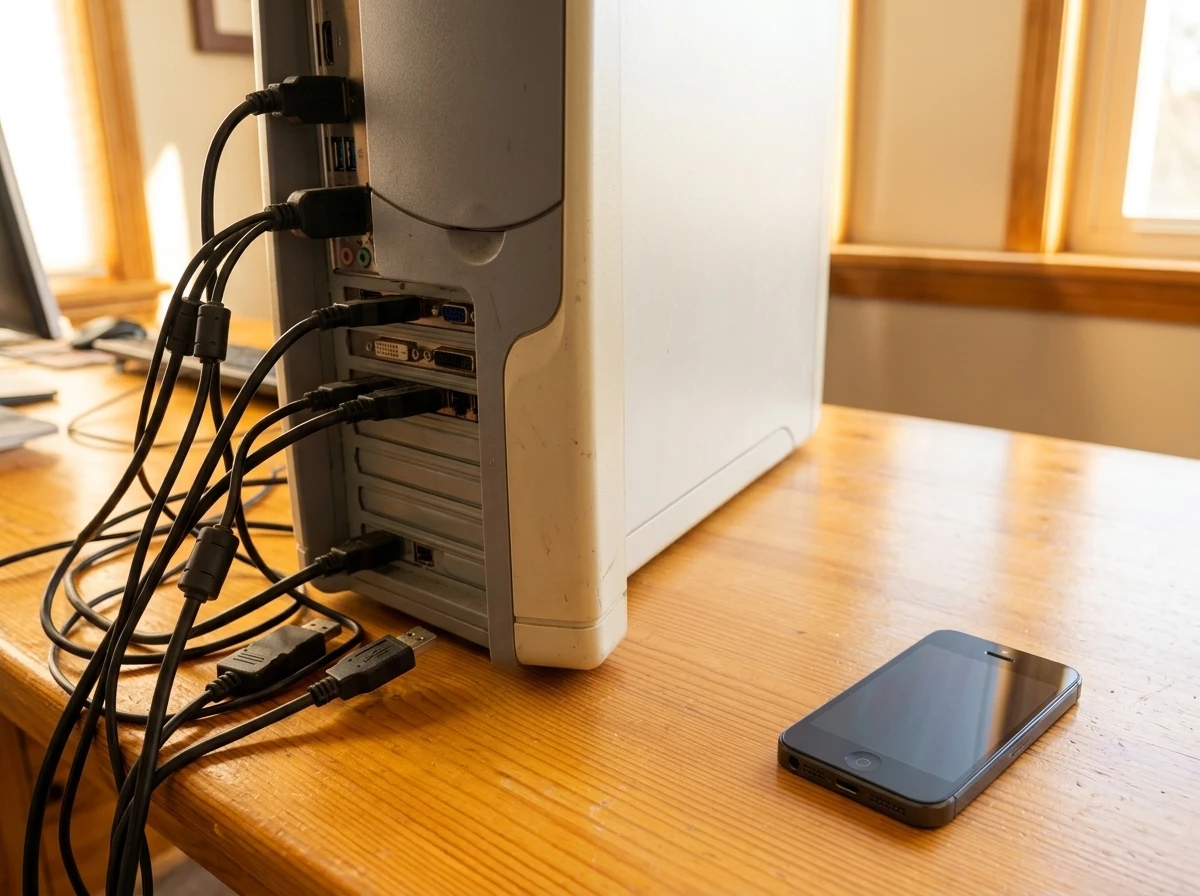
Timothy Olyphant had to raid his own house for spare parts just to get on a podcast. The 58-year-old actor told the hosts of SmartLess that he dragged an old desktop tower out of storage, plugged in a snarl of USB cables, and still ended up recording from a friend’s office because his home setup would not cooperate. He does not own a working computer. He gets by, he says, on a phone and “a thing.”
That sounds like a bit built for a comedy podcast. Pew Research Center’s own numbers say it is closer to a lifestyle a measurable, growing slice of the country already lives, for reasons that have nothing to do with being an eccentric movie star.
An Old Desktop, a Tangle of USB Ports
Olyphant made the confession to hosts Jason Bateman, Will Arnett and Sean Hayes, who spent much of the segment refusing to believe him. “I needed a computer,” Olyphant told them. “I guess you can’t do your show if you don’t own a computer.”
Bateman pushed back immediately. “I don’t buy it,” he said. “You don’t have, and you being an artist, you don’t have an iPad with one of those little, one of those little stylist pen thingies?” Olyphant’s answer was simpler than Bateman expected. “I got like a, you know, I got a phone and I got a thing,” the Justified star said. “That’s all you gotta do.”
Pressed on how he actually pulled off the interview, Olyphant admitted the desktop in his house had been sitting untouched long enough to become its own small project. “We went, I had a, we went and got out an old desktop computer that we still have in the house and plugged it in and started it up, and they were all USB things,” he said. He joked that the whole ordeal took real effort, adding that he does not even listen to the show he was appearing on, he reads the transcripts instead.
Bateman kept going, asking if Olyphant had ever been tempted to buy a laptop “just to see the landscape out there, like all the different sites you can go visit to expose yourself to.”
Felt condescending.
That was Olyphant’s entire reply, delivered flat. Bateman then pivoted to artificial intelligence, asking if Olyphant was at least curious what the fuss was about. “But you can do all that on, on the little phones,” Olyphant said, treating a smartphone as a complete substitute for a computer, the same claim that put him in this position in the first place. The full exchange is preserved in the SmartLess episode where Olyphant explained himself.
Olyphant Just Joined Pew’s Fastest-Growing Tech Habit
Strip away the jokes and Olyphant is describing something Pew Research Center has tracked since 2013: Americans who own a smartphone but have no home broadband connection, a group researchers call “smartphone-only” internet users. The share has never been higher. 16% of US adults now smartphone-only, according to Pew’s most recent tracking.
That number has moved around over the years but the direction is clear. In 2013, just 8% of Americans relied solely on a smartphone for internet access. It roughly doubled from there, and the gap is not evenly spread across age groups.
| Year | Population Segment | Share Smartphone-Only |
|---|---|---|
| 2013 | All US adults | 8% |
| 2018 | All US adults | 20% |
| 2019 | All US adults | 17% |
| 2021 | Adults 18 to 29 | 28% |
| 2021 | Adults 30 and older | 12% |
| 2025 to 2026 | All US adults | 16% |
Olyphant does not fit the usual profile. Pew and federal data both show smartphone dependence concentrated among younger adults and lower income households, the opposite of a wealthy 58-year-old actor with an entire house to search for spare parts. He landed in the same statistical bucket by choice, not circumstance, which is exactly why the anecdote is worth more than a laugh line.
Two Different Generations Landed in the Same Place
Olyphant is not alone in treating the traditional computer as optional. Professors across the country have spent the past several years reporting the opposite problem from the other end of the age spectrum: students who have never needed to understand a computer the way older generations did.
The Verge reported in 2021 that university students, including those studying physics and engineering, were struggling with the basic concept of files and folders. Peter Plavchan, an associate professor of physics and astronomy at George Mason University, told The Verge that his students routinely dump work into one folder without any structure. “Students have had these computers in my lab; they’ll have a thousand files on their desktop completely unorganized,” he said.
Saavik Ford, a professor of astronomy at the Borough of Manhattan Community College, described the same shift in her own students to The Verge, saying they no longer think in terms of file locations at all. “They have a laundry basket full of laundry, and they have a robot who will fetch them every piece of clothing they want on demand,” she said, describing how her students treat search functions as a replacement for organization.
Olyphant chose to opt out of computers. Plavchan’s and Ford’s students grew up in a world of search bars and cloud syncing that made the underlying machine invisible to begin with. Both groups end up doing the same thing: reaching for a phone or a search box instead of a file tree, just for entirely different reasons and from opposite ends of a career.
Why Can’t Everything Be Done on a Phone?
A phone handles browsing, messaging, banking apps and video calls well, but tasks built around forms, file uploads or multi-step verification, like the login system that stopped Olyphant, tend to break down on a small screen. Research on smartphone-only users backs this up directly, and it is not a small-sample problem.
A 2026 study out of the University at Albany, examining digital behavior in Taiwan as a stand-in for other advanced, highly connected economies, found the biggest gaps for phone-only users showed up in exactly this kind of task. the largest gaps in banking and government tasks appeared for people relying only on a phone, according to the research.
“Smartphones are incredibly powerful tools, but they’re not functionally equivalent to having access to a computer,” said Zong-Xian Huang, a graduate researcher involved in the study. “Tasks that involve forms, transactions or complex navigation are simply harder to complete on a phone. That shapes what people end up doing or avoiding online.”
The kinds of tasks that tend to trip up phone-only users show up again and again in this research:
- Job applications and cover letters that require uploading formatted documents
- Government benefit forms and identity verification steps
- Online banking transactions beyond basic balance checks
- Telehealth visits that need a stable camera and microphone setup
Olyphant hit a version of that wall the moment a podcast login demanded a real computer instead of an app. His fix was borrowed office space and an antique tower. Most people in his statistical position do not have a spare desktop or a friend’s office to fall back on.
2026’s Chip Shortage Is Turning Everyone Into a Hoarder
Olyphant’s decision to dig out an old machine instead of buying a new one happens to match exactly what the computer industry expects nearly everyone to do this year, for reasons that have nothing to do with lifestyle choices and everything to do with memory chips.
A memory chip shortage has pushed component costs sharply higher through 2026, and analysts are watching PC shipments fall as a direct result.
- 10.4%, the drop Gartner expects in global PC shipments this year, which the firm calls the steepest contraction in device shipments in more than a decade
- 11.3%, IDC’s own separate forecast for the same full-year PC decline, running even steeper than Gartner’s estimate
- 130%, the surge Gartner projects in combined memory chip prices by the end of the year
- 20%, how much longer Gartner expects ordinary consumers to hold onto a PC before replacing it
“This is the steepest contraction in device shipments witnessed in over a decade,” said Ranjit Atwal, a senior director analyst at Gartner. Rising prices, Atwal said, will push buyers to hang onto devices longer, PC shipments forecast to fall 10.4% as a result. IDC’s separate tracking shows conditions worsening toward a 20% Q4 drop, with no meaningful relief expected before 2027.
Olyphant did not wait for a supply chain crunch to start reviving old hardware. He was already doing it, out of habit rather than necessity, months before the rest of the market got pushed into the same behavior by rising memory prices.
Frequently Asked Questions
Which Americans Are Most Likely to Be Smartphone-Only?
A 2024 analysis from the National Telecommunications and Information Administration found smartphone dependence is highest among Hispanic adults at 25%, American Indian and Alaska Native adults at 22% and Black Americans at 16%, compared with 12% among white and Asian adults. Age and income track the same pattern, with younger and lower earning households far more likely to rely on a phone alone.
Are Smartphones Getting More Expensive Too?
Yes. Gartner’s own 2026 forecast projects smartphone prices rising roughly 13% this year alongside the PC price increase, driven by the same memory chip shortage. IDC has separately reported smartphone average selling prices climbing toward record levels as manufacturers shift production toward higher priced models and away from budget phones.
Did Professors Really Say Students Don’t Understand Files and Folders?
Yes, and the reporting went well beyond one classroom. Aubrey Vogel, a journalism major at Texas A&M, told The Verge in 2021 that her own family teased her about the state of her screen, saying, “My family always gives me a hard time when they see my computer screen, and it has like 50 thousand icons.” Professors in physics, astronomy and engineering programs around the country reported similar patterns among incoming students that same year.
Does an Old Computer or Phone Create Security Risks?
It can. Gartner’s 2026 forecast specifically warns that as buyers hold onto older PCs and phones for longer stretches, the challenge of patching and managing that aging hardware fleet raises the odds of unaddressed security vulnerabilities, a tradeoff that comes with stretching a device’s working life well past its original replacement cycle.


Samsung’s Design Chief Molds the Fold8 Like a Passport

Qualcomm Stretches Snapdragon 8 Elite Gen 5 as Chip Costs Climb

Thailand and the Philippines Force Crypto Exchanges to Hunt Scammers

WhatsApp Adds Adobe-Powered PDF Tools and Hands-Free Car Mode

Samsung’s Smart Glasses Replay Android’s Old Playbook Against Meta

Xbox Backward Compatibility Hits PC After Microsoft Called It Done

A New Nautilus Extension Restores GNOME’s Lost Computer View

Bezos’s Prime Video AI Overhaul Puts Studio Deals at Risk

Samsung’s PCIe 6.0 AI SSD Arrives Five Months Behind Micron

Coinbase Grows Singapore Staff to 200 After Global Cuts

Fable 5 and Mythos 5 Return as US Lifts Anthropic Export Controls

SpaceX’s Google Deal Turns a Rocket Company Into a Cloud Landlord

CD Projekt Red Co-CEO: Redemption Arc Isn’t Done, Witcher 4 in 2027

DGO App Brings Rs 549 Mobile Pass for FIFA World Cup 2026 in Nepal

XPL Rallies 30% Ahead of Plasma One Card Tier Launch

Oracle Cuts 21,000 Jobs in a Year, Cites AI in 10-K Filing

Google Search Profiles Build a Follow Graph Inside Discover

Moonshot AI Targets $30 Billion in China’s Fastest AI Funding Sprint

Microsoft Xbox Layoffs Start in July as Sharma Slams 3% Margin

WhatsApp Meta Business Agent Reaches India, With a New Pricing Meter
-
 AI3 weeks ago
Fable 5 and Mythos 5 Return as US Lifts Anthropic Export Controls
-
 AI2 months ago
SpaceX’s Google Deal Turns a Rocket Company Into a Cloud Landlord
-
 GAMING1 month ago
CD Projekt Red Co-CEO: Redemption Arc Isn’t Done, Witcher 4 in 2027
-
 APPS1 month ago
DGO App Brings Rs 549 Mobile Pass for FIFA World Cup 2026 in Nepal
-
 CRYPTO1 month ago
XPL Rallies 30% Ahead of Plasma One Card Tier Launch
-
 AI1 month ago
Oracle Cuts 21,000 Jobs in a Year, Cites AI in 10-K Filing
-
 NEWS2 months ago
Google Search Profiles Build a Follow Graph Inside Discover
-
 AI2 months ago
Moonshot AI Targets $30 Billion in China’s Fastest AI Funding Sprint