
CRYPTO
Kazakhstan’s Crypto Tax Holiday Meets Split Rulebooks and Off-Grid Gas
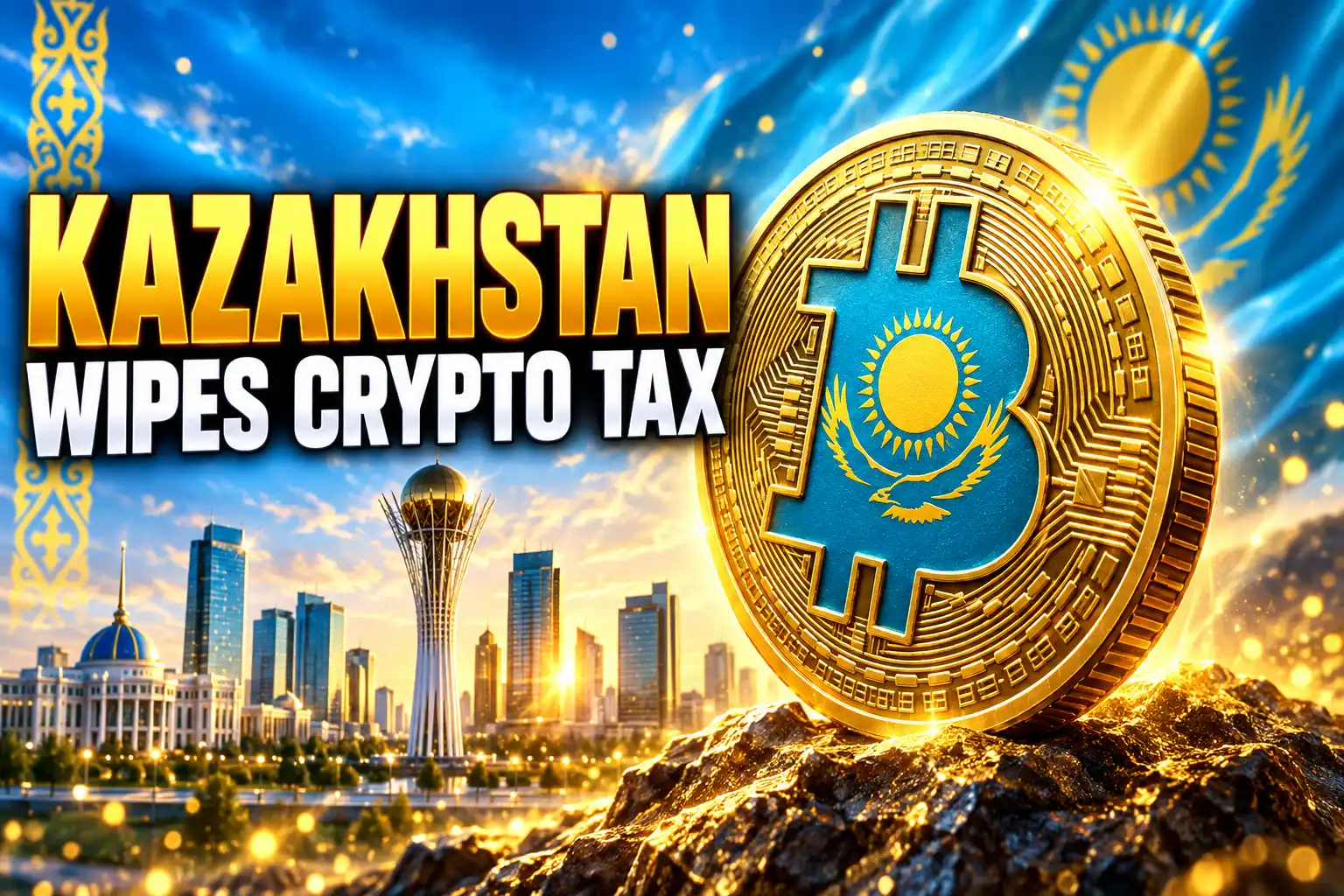
Kazakhstan is wiping personal income tax on licensed crypto trades for three years, while oilfield gas and dual rulebooks decide if wallets move.

President Kassym-Jomart Tokayev signed a 7 July 2026 decree on the digital asset industry that wipes personal income tax on licensed crypto trades for 2026, 2027 and 2028. The Astana International Financial Centre says Kazakh citizens hold about 1 million crypto wallets. Authorized local exchanges had 256,900 registered users in March.
The rate cut is the public offer. The same order also tries to fix the power crunch, the bank freezes and the split legal system that pushed those wallets onto foreign apps after the 2021 mining rush.
Nearly Four Times as Many Wallets Sit Off Licensed Books
AIFC figures put citizen wallets at nearly four times the March count on authorized local exchanges. The gap is the target of the tax holiday: personal income from digital-asset trades is meant to be tax-free when the trade runs through Kazakhstan’s regulated platforms, and only if the coins are not tied to fraud, money laundering or unlicensed services.
THE ONSHORE GAP IN ONE SHEET
| Measure | Figure | As of |
|---|---|---|
| Citizen crypto wallets | about 1 million | AIFC estimate |
| Users on authorized local exchanges | 256,900 | March 2026 |
| Personal income tax on licensed trades | 0% | 2026, 2027 and 2028 |
| AIFC investment-residency ticket in digital assets | $150,000 | from 13 August 2026 |
Dauren Karashev, founder of Kazakhstan’s Crypto Forensics Laboratory, wrote that no official count exists of citizens who hold coins on foreign platforms, which is a narrower group than the AIFC wallet estimate. Those holders, he argued, still have no clean way to come into the light until a disclosure window actually opens.
On 13 August 2026 the AIFC added digital assets to its residency programme for foreigners. The ticket is $150,000 on AFSA-licensed platforms, against $60,000 for shares, fund units and AIX-listed securities. Applicants must be over 18, must not be Kazakh citizens, and must not have been tax resident in the previous 20 years. That channel is inbound capital. It does not move the domestic wallets the holiday is aimed at.
The 2021 Boom That Tripped the Grid
After China banned Bitcoin mining in 2021, Kazakhstan absorbed a wave of machines chasing cheap power. Cambridge’s Bitcoin electricity index put the country’s share of global hashrate at 6% early that year and at 18% in August, second only to the United States at 35%. People ran kits on balconies. Some farms were dressed up as vegetable stores, greenhouses or AI halls on old Soviet sites so the power draw would not show.
Kazakhstan never banned mining. It did load an ageing grid until the lights failed.
FROM THE CHINA EXIT TO THE DECREE
- Early 2021: Cambridge puts Kazakhstan at 6% of global Bitcoin hashrate as Chinese machines start to move.
- August 2021: The same index puts the share at 18%, behind only the United States at 35%.
- October 2021: Surging demand feeds outages at three power plants in the northeast, with rolling blackouts in several regions; at peak, miners take an estimated 8% of national electricity.
- 1 May 2026: A nationwide digital-asset regime takes effect under amendments to the Law on Digital Assets in Kazakhstan, ending the AIFC-only circulation model.
- 7 July 2026: Tokayev signs the stimulation decree drawn up with the National Bank, the Ministry of Artificial Intelligence and Digital Development, and the AIFC.
Authorities answered the blackouts by tightening rules on power use and on how digital assets could be legalised. Miners left or went underground. The legal door stayed ajar so the state could try again later, on its own terms.
Miners Are Being Pointed at Leftover Oilfield Gas
The decree’s energy clause is the admission that the national grid still cannot take a second rush. Associated gas from oil fields, and natural gas that the state does not need, may be used to make power for mining. That is off-grid by design. It is also a delayed instruction: the AIFC notice frames the gas path as work still to be drawn up, not as a socket miners can plug into now.
Kazakhstan has already done the easy part of the flare story. The World Bank’s 2026 Global Gas Flaring Tracker says the country has cut flaring by 87 percent since 2012, one of the sharpest falls among large oil producers. What remains for miners is remote field gas that is awkward to pipe, not a vast idle flare stack sitting next to towns.
A separate July track offers large miners capped power for ten years if they send coins into a national crypto reserve funded by miners. That is a quota bargain for industrial farms. It is not how a balcony miner, or a household wallet, comes home.
Why Licensed Kazakh Platforms Still Lose Users
Users pick an app on deposits, withdrawals in tenge, liquidity and whether the rules stay put, not on a temporary personal income tax rate. Nurkhat Kushimov, general manager of Binance Kazakhstan, still called the tax incentive the strongest measure in the decree, because it makes a licensed venue cheaper to use. Bakhytzhan Kenzhebayev, chairman of Kazakhstan’s Association of Fintech, AI and Crypto Industry, put the chooser elsewhere.
Users choose a platform not based on the tax rate, but on a combination of factors: how easy it is to deposit and withdraw (the local currency), the liquidity, and how clear the rules are. For a licensed participant, the predictability of the rule is more valuable than the benefit itself.
Bakhytzhan Kenzhebayev, Chairman, Kazakhstan’s Association of Fintech, AI and Crypto Industry
Kenzhebayev also warned that a holiday drawn too wide could be used to shelter assets that have nothing to do with crypto, which would invite a reversal in a year or two. A flip, he said, would hurt the market more than a high rate that does not move.
The AIFC’s own July notice quietly names the banking failure behind those foreign apps. Licensed providers have had their bank accounts frozen when the state wanted to act. The decree tells agencies to build a way to freeze an individual client’s account instead, so the platform’s bank rail can stay open. Until that switch exists, a 0% tax on a venue you cannot fund in tenge is a discount on a closed door.
Kushimov listed the same stack in plainer words: convenience, liquidity, the instruments on offer, speed, and the ability to work with banks. Daniyar Mubarakov, president of Kazakhstan’s Blockchain and Digital Mining Association, welcomed any support and then asked how long it lasts, because a cut now can be followed by a several-fold tax rise once volumes grow.
AIFC Rules and National Law Still Split One Asset
From 1 May 2026, unsecured digital-asset exchanges need a National Bank licence and trading platforms must sit on a National Bank register. AIFC firms still live under AFSA and the AIFC Rules on Digital Asset Activities. One coin can be two legal objects depending on which perimeter it sits in.
Kenzhebayev’s cost complaint sits there. A firm that wants to serve both perimeters builds two stacks, two custody setups and two reporting lines. The decree tries to narrow the seam by recognising digital assets and tokenised securities issued in the AIFC across the rest of the country, and by letting stablecoins from licensed AIFC issuers settle non-resident import and export trades. Recognition on paper is not a merged rulebook. Dual compliance remains the working model until the national law and AFSA’s rulebook are actually aligned.
Vice Minister of AI and Digital Development Gizzat Baitursynov said his ministry is drafting a simpler tax after the holiday ends, and is working to cancel tax audits of private investors for the previous three years. Both items are still proposals. They are the predictability Kenzhebayev says licensed firms will price, and they are not in force.
What the Three-Year Tax Holiday Leaves Unfinished
The holiday covers personal income on trades through Kazakh regulated infrastructure in 2026, 2027 and 2028. It does not, by itself, create a tenge on-ramp, a custody standard the banks will live with, or a single definition of a digital asset. The rest of the July order is a to-do list.
WHAT THE JULY DECREE ALSO INSTRUCTS
- Foreign-to-local shift: Tax incentives are to be designed so holders move coins off foreign services onto Kazakh regulated platforms.
- Voluntary disclosure: A mechanism must be ready by 31 December 2026 for previously bought or mined assets, which then have to sit with domestic providers.
- AIFC tokens at home: Digital assets and tokenised securities issued in the AIFC are to be recognised across Kazakhstan.
- Stablecoin trade rails: Licensed AIFC stablecoins are to be usable by non-residents for import and export settlement.
- Client-level freezes: Agencies are to freeze an individual client account rather than the provider’s bank account when the law requires a freeze.
- Field gas for miners: Associated gas and natural gas not needed by the state may be turned into power for mining, once the follow-on rules exist.
Ainur Zhumatova, director of the AIFC Expat Centre, presented the $150,000 digital-asset residency ticket as a new way to pull foreign capital into AFSA-licensed venues. That is a parallel lure, with a higher floor, aimed at people who are not Kazakh tax residents. It leaves the domestic 1 million-wallet problem with the holiday, the disclosure window and the banking fix.
A Disclosure Window Runs Until 31 December 2026
Karashev’s objection is mechanical. If the coins sit on a foreign exchange, the holder does not own a specific coin on a chain. The holder owns a row in the operator’s database, and the coins sit commingled in omnibus wallets. A lawful-origin check written as if each applicant can produce a clean chain of title cannot be performed as worded, he argued, by the state or by a local provider.
That is the classic trap in a legalisation window. FATF voluntary tax compliance programme guidance has, since 2012, treated origin checks as the point on which these windows stand or collapse. If Kazakhstan cannot verify source without the foreign exchange’s files, the honest applicant and the nominee applicant look the same on a form.
WHAT WE KNOW
- The dates: The decree is dated 7 July 2026; the personal income tax holiday is written for 2026, 2027 and 2028; the disclosure mechanism is due by 31 December 2026.
- The perimeter: The break applies to trades through Kazakh regulated infrastructure and excludes assets tied to fraud, money laundering or unlicensed services.
- The wallet gap: AIFC estimates about 1 million citizen wallets against 256,900 users on authorized local exchanges in March.
WHAT IS UNCONFIRMED
- Origin tests: No public method yet shows how a holder of an exchange IOU can prove lawful source to a Kazakh provider.
- After 2028: The simpler tax Baitursynov described, and the audit cancellation for the previous three years, remain drafts.
- Field power: Associated-gas generation for miners is instructed; it is not yet a live offtake right.
The market has already moved the argument on. On 4 September 2026 Binance said it had signed three memorandums with the Ministry of Artificial Intelligence and Digital Development, the National Bank and the AIFC, covering digital assets, payments and investments. Changpeng Zhao, Binance’s founder, posted from Astana that he had met Deputy Prime Minister Zhaslan Madiyev and that crypto was advancing fast. The live test is whether a tenge-linked stablecoin and bankable payment rails can do the onshoring job a rate cut cannot.
🇰🇿 Binance signed 3 strategic MoUs in Kazakhstan with the Ministry of AI and Digital Development, the National Bank, and AIFC, focused on digital assets, payments, and investments.
Another step toward a more connected digital finance ecosystem in Kazakhstan.
Read more ↓…
— Binance (@binance) September 4, 2026
Renat Bekturov, the AIFC governor, said the July order should be read as building a safer market for providers and clients, not only as a new list of rules. The safer market still needs a disclosure desk that can run, a bank that will keep the platform’s account open, and power that does not trip the national grid. The tax holiday is already dated. The window to declare the old coins closes on 31 December 2026.
Disclaimer: This article is news reporting and analysis of Kazakhstan’s July 2026 digital-asset decree and related official notices. It is for information only and is not tax, legal or investment advice, and it is not a recommendation to buy, sell, hold or declare any cryptocurrency or to use any exchange. Readers who may be affected should consult a qualified tax adviser and a lawyer licensed in Kazakhstan (and in any other country where they are tax resident) before moving, declaring or trading digital assets. Figures, licence counts, tax terms and programme dates reflect the cited official pages and statements as published, and they can change as implementing rules are issued.

Instagram Plus Tests a Read-Only Mode That Cuts Stories

Altman Asks the Public to Accept Some AI Harm

Google Freezes OSS VRP Product Reports After AI Flood

AI Agents Make Payment Rails the Scarce Prize

Turkey’s Crypto Boom Now Runs Through Three Banks

Fable 5 Came Back Under a Commerce On-Off Switch

Google’s SpaceX GPU Lease Has a Sept. 30 Deadline

Plasma One’s XPL Locks Face a 1.81 Billion Cliff

DGO’s Rs 549 World Cup Pass Cost Fans Sleep and Data

Moonshot AI’s $30 Billion Ask Became a $35 Billion Close
-
 AI4 months ago
Fable 5 Came Back Under a Commerce On-Off Switch
-
 AI4 months ago
Google’s SpaceX GPU Lease Has a Sept. 30 Deadline
-
 CRYPTO4 months ago
Plasma One’s XPL Locks Face a 1.81 Billion Cliff
-
 APPS4 months ago
DGO’s Rs 549 World Cup Pass Cost Fans Sleep and Data
-
 AI4 months ago
Moonshot AI’s $30 Billion Ask Became a $35 Billion Close
-

 NEWS4 months ago
ColorOS 17 Device List Spans Oppo, OnePlus and Realme
-

 GAMING4 months ago
Xbox Cuts 3,200 Jobs After Five Years of Thin Returns
-

 GAMING4 months ago
The RTX 4050 Under Rs 70,000 Hides a Wattage Gap