
AI
Washington’s AI Loyalty Test Hits the Partner It Needs
A US draft tells 35 AI partners they cannot join China’s Shanghai club, yet Kazakhstan, the mineral supplier Pax Silica just recruited, already sits in both.

A State Department draft tells 35 governments they will be shut out of a US-led AI coalition if they also join China’s rival body in Shanghai. Kazakhstan is already in both, and it is the mineral supplier Washington spent June recruiting.
The undated letter, prepared for the signatories of a June 35 governments signed in June as the Joint Statement on AI Opportunity, never names China. It still makes the demand plain. Signature of the Pax Silica Declaration, it says, is a commitment, and that commitment cannot sit beside “duplicative initiatives whose expectations conflict with our own.”
An Undated Letter to 35 Capitals
Under Secretary of State for Economic Affairs Jacob Helberg launched Pax Silica in December 2025 as the department’s flagship effort on AI and supply-chain security. The second summit, held June 25 and 26, 2026 in Washington, produced the AI Opportunity Statement and a new crop of Pax Silica signatures. The letter now in draft is addressed to the 35, which include inner-circle declaration members and countries that only signed the broader statement.
A US official, speaking on condition of anonymity because talks were still internal, put the point in plainer English: you cannot have it both ways. It is difficult, the official said, for a country to pose as a trusted partner in one technology camp while signing up for an initiative designed by China to advance a competing vision for AI.
WHAT WE KNOW
- The addressees: The 35 governments on the State Department’s AI Opportunity Statement list, from Argentina and India to Japan, Turkiye, and the United Arab Emirates.
- The warning: Join a rival grouping and lose a seat in the US-led coalition, including the investment and export-control alignment Pax Silica is meant to organise.
- The flashpoint: Kazakhstan is the only country named as a member of both Pax Silica and China’s World Artificial Intelligence Cooperation Organization.
WHAT IS UNCONFIRMED
- The send date: The draft carried no date, and as of early September 2026 it still had not gone out.
- The final text: Officials left open whether the wording would change before any delivery.
- The penalty: The draft names no chip cutoff, cloud ban, or mineral tariff; exclusion is the stated cost.
The State Department said it would not comment on “purportedly leaked internal documents.” China’s embassy in Washington said Beijing opposes politicizing trade and technology. “Such actions will only stifle global AI advances and serve no one’s interests,” an embassy spokesperson said. The Kazakh embassy in Washington did not respond when asked.
To be part of everything is to be part of nothing. Signature of the Pax Silica Declaration is not merely a membership subscription, but a commitment.
Undated State Department draft letter to AI Opportunity Statement signatories
The letter urges governments to “choose deliberately” on AI. It never mentions Shanghai, Xi Jinping, or WAICO. Recipients will not need the names.
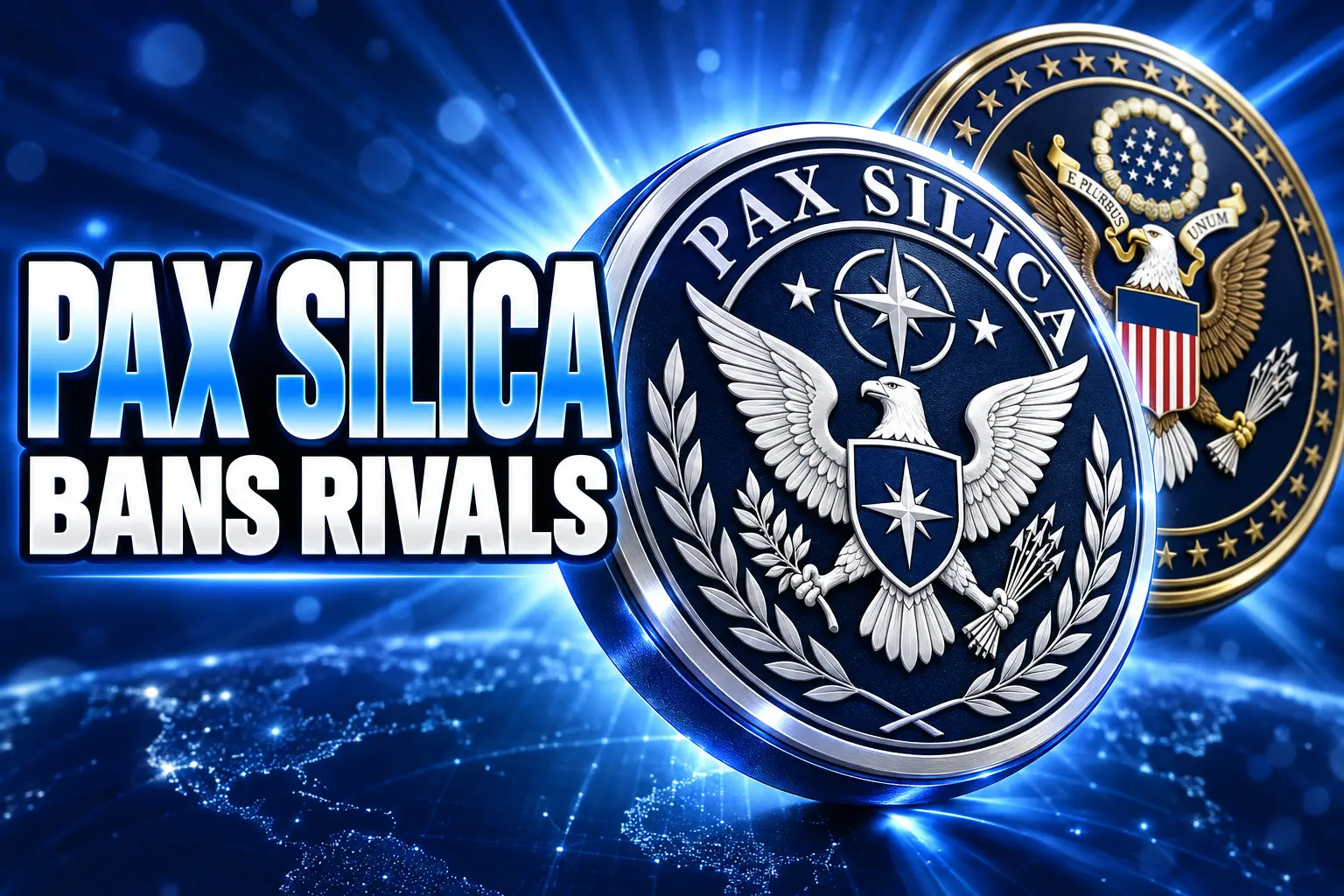
Pax Silica Recruited Kazakhstan for Its Minerals
Pax Silica is not a model club. Helberg has described it as an economic-security grouping that runs from energy and critical minerals through manufacturing, chips, and AI plants. The State Department’s current roster lists 24 signatories, among them Australia, Germany, India, Italy, Japan, Kazakhstan, the Republic of Korea, Singapore, the United Kingdom, and the European Union. Taiwan is listed as a non-signatory participant that endorsed the declaration’s principles through a separate joint statement.
The June statement is wider and thinner. It commits the 35 to a pro-growth rulebook, joint work on minerals and chips, and a “shared vision” with Washington. Members of Pax Silica get a path to shared investment in AI-related projects. Signatories of the Opportunity Statement, the department says, have agreed on a common purpose. That is the paper the draft letter treats as a loyalty test.
THE STACK PAX SILICA SAYS IT IS SECURING
- Minerals and refining: The declaration calls for new ties with suppliers that will cut “excessive dependencies” and process the metals that feed chips and batteries.
- Energy and plants: Partners are asked to line up power, advanced manufacturing, and logistics behind a trusted AI buildout.
- Chips and models: The text reaches compute, semiconductors, foundation models, and the cables and data centers that carry them.
- Export-control alignment: The grouping is meant to push joint projects and controls so members lean less on adversaries for the physical base of AI.
Helberg’s public case has been blunt since winter. If the 20th century ran on oil and steel, he said, the 21st century runs on compute and the minerals that feed it. That is why Kazakhstan was not a courtesy invite.
Washington in June, Shanghai in July
Zhaslan Madiyev, Kazakhstan’s deputy prime minister and minister of artificial intelligence and digital development, signed the Pax Silica accession papers and the AI Opportunity statement at the Washington summit. Helberg welcomed the country on June 26, 2026, and pointed first at geology and geography, not at chatbots.
The State Department’s economic account posted the signing as a minerals-and-route play, with Helberg beside Madiyev and the flags behind them.
We welcome Kazakhstan to Pax Silica. 🇺🇸🇰🇿@UnderSecE Helberg was proud to sign the Pax Silica Declaration alongside Kazakhstan's Deputy Prime Minister @Zhaslan_Madiyev.
Strategic connectivity. Critical minerals. Digital infrastructure and AI. These aren't just capabilities —… pic.twitter.com/Sbn9Gcfjy5
— State Department Economic Affairs (@EconAtState) July 1, 2026
On July 16, 20 days later, Madiyev was in Shanghai. He signed the agreement that created the World Artificial Intelligence Cooperation Organization, an intergovernmental body China seated in that city. Chinese Foreign Minister Wang Yi signed for Beijing. UN Secretary-General António Guterres attended as a guest. Xi spoke at the World Artificial Intelligence Conference the next day.
HOW KAZAKHSTAN LANDED IN BOTH CAMPS
- December 2025: Helberg launches Pax Silica as a US-led AI and supply-chain security effort.
- June 25-26, 2026: Second Pax Silica Summit in Washington. Madiyev signs Kazakhstan onto the declaration and the AI Opportunity statement. Helberg’s June 26 remarks cite rare earths and the Trans-Caspian route.
- July 16, 2026: Twenty-nine countries, Kazakhstan among them, sign the WAICO founding agreement in Shanghai.
- July 17, 2026: Xi addresses the World Artificial Intelligence Conference as the new body is unveiled as a Global South-facing alternative to US tech rules.
- Mid-August 2026: A US official and an internal draft describe a letter telling the 35 they cannot hold both seats. The text is undated.
- Early September 2026: The letter still has not been sent. Kazakhstan remains on both rosters.
Madiyev told partners in Washington that Pax Silica would open investment, technology transfer, and high-tech industry, including semiconductors, batteries, and critical-minerals processing. He has also said Kazakhstan wants to move past raw-ore sales into processing, data centers, and AI talent. The dual signatures are that policy on paper: take the US industrial offer, keep the China-facing governance seat.
What Dual Membership Buys Astana?
It buys time in a minerals market that already runs in two directions. The International Trade Administration’s Kazakhstan mining guide, last updated March 9, 2026, is the US government’s own inventory of why Helberg wanted the country in the room.
KAZAKHSTAN IN THE US MINING GUIDE
| Resource | Figure | Why Pax Silica Cares |
|---|---|---|
| Uranium output | 39% of world production | Largest producer; also 48.8% of natural uranium exports |
| Uranium reserves | 25% of the world total | Long-life fuel for power-hungry AI plants |
| Copper reserves | About 36 million tons | Wiring, motors, and grid kit for data centers |
| Iron ore reserves | 12.5 billion tons, 8th globally | Industrial base behind manufacturing partners |
| Manganese ore | 600 million tons, 2nd globally | Steel and battery chemistry |
| Chromite deposits | 30% of the world total | Alloys and high-heat metals |
| Mining in the economy | 23.3% of GDP | Hard minerals and metals were 18% of 2024 exports |
Refined copper exports alone brought in $2 billion in 2024. The same guide ranks Kazakhstan third in titanium output, seventh in zinc, eighth in lead, and eleventh in gold, and counts more than 230 enterprises that produce or process minerals. It also flags substantial reserves of rare earths, lithium, tungsten, and tantalum, the quieter metals in magnets, chips, and batteries.
Helberg did not hide the ask. Kazakhstan, he said in the June 26 welcome, possesses minerals essential to advanced technology and semiconductor manufacturing, including rare earth elements, and sits on the Trans-Caspian trade route. The ITA notes that Kazakhstan is the world’s largest uranium producer, with 39 percent of global uranium output. That is the partner the draft letter now treats as a dual-membership problem.
Twenty-Nine Governments Signed in Shanghai
WAICO is the body the letter refuses to name. China’s UN mission said 29 countries signed in Shanghai on July 16, founding an independent intergovernmental organization headquartered in that city. The agreement, as Beijing published it, follows the UN Charter, talks of shared benefit, and says the aim is AI cooperation that is beneficial, safe, and fair.
Named signatories at the ceremony included Madiyev, Pakistani Deputy Prime Minister and Foreign Minister Mohammad Ishaq Dar, Russian official Maxim Oreshkin, Indonesian Coordinating Minister for Economic Affairs Airlangga Hartarto, and Lao Deputy Prime Minister Thongsavanh Phomvihane. Other founding members reported at the signing included Brazil, Belarus, Serbia, Cuba, and Venezuela, plus a long African and Asian list. No Western government signed.
THE TWO CLUBS ON PAPER
| Club | Convened | Date | Members | Dual seat |
|---|---|---|---|---|
| Pax Silica | US State Department | December 2025 | 24 signatories on the current list | Kazakhstan |
| AI Opportunity Statement | US, second Pax Silica Summit | June 2026 | 35 governments | Kazakhstan |
| WAICO | China, Wang Yi signed | July 16, 2026 | 29 founding states | Kazakhstan |
Washington reads the Shanghai body as a bid to promote Chinese open-weight models and to pull minerals, chips, and rules away from the US stack. Beijing reads Pax Silica as a bloc that dresses supply-chain security as a values club. The draft letter is how the State Department wants to stop countries from holding both readings at once.
China has also been weighing limits on overseas access to some of its leading models, a reminder that open weights are not the same thing as an open door. China’s five-year AI talent pivot is the domestic half of the same build: train the workforce, then export the club.
The Minerals Do Not Care About the Letter
A membership paper does not reroute ore. Kazakhstan already sells into industrial systems on both sides of this fight, and a letter about “duplicative initiatives” does not change a uranium contract or a copper shipment. Most of the 35 can sign a US text and leave Chinese offtake, construction, and model access in place. That is how dual-track states have treated every prior tech pledge that asked them to pick a camp and then failed to pay them for the privilege.
The same split is visible in capital, not only in ore. Gulf AI deals that still run through China show buyers trying to keep Chinese models inside Western hosting and finance. Pax Silica’s letter is meant to close that gap for the 35. It cannot close it for the mines.
India, Japan, Australia, and South Korea are already inside the US tent and were never going to join WAICO. Brazil, Russia, Pakistan, Indonesia, and a string of African states built the Shanghai roster instead. The letter is not for them. It is for the thin overlap, and for anyone in the 35 who might be tempted to follow Kazakhstan’s path.
Uzbekistan has already asked about a Pax Silica seat of its own, which would put another Central Asian mineral state in the same queue. If Washington starts ejecting dual members, Tashkent will watch Astana before it signs anything exclusive. If Washington blinks, the exclusivity claim leaks.
Exclusion Would Cut the Coalition’s Own Supply
The irony is mechanical. Pax Silica exists to pull critical minerals, energy, and chips into a trusted circle. Helberg sold Kazakhstan’s entry on rare earths and a Caspian route that bypasses Russia. Twenty days later the same minister helped found the Chinese-led body. The draft letter is the hangover from that recruiting choice.
Kazakhstan possesses significant reserves of minerals essential to advanced technology and semiconductor manufacturing, including rare earth elements and so much more. Located at the crossroads of Europe and Asia, Kazakhstan serves as a key transportation and logistics hub on the Caspian on the Trans-Caspian Trade Route.
Jacob Helberg, Under Secretary of State for Economic Affairs, June 26, 2026
Kick Astana out and the coalition loses the Central Asian mineral node it just advertised. Leave Astana in and the “commitment” language is a bluff the other 34 can read. Hold the letter in draft, which is where it still sat in early September, and both camps keep a working fiction: Washington has drawn a line, Kazakhstan has not stepped over it, and the ore keeps moving.
Chinese open-weight models have closed ground on proprietary systems from US labs, which is why Washington wants the physical stack locked before the software stack fragments further. The letter tries to police that lock with a membership rule. The partner it would police is the one Helberg invited for the rocks.
Until the department dates the draft and names a cost that bites, Kazakhstan can keep both signatures. The 35 have been told to choose. The one country that already did both remains on both lists.

Instagram Plus Tests a Read-Only Mode That Cuts Stories

Altman Asks the Public to Accept Some AI Harm

Google Freezes OSS VRP Product Reports After AI Flood

AI Agents Make Payment Rails the Scarce Prize

Turkey’s Crypto Boom Now Runs Through Three Banks

Fable 5 Came Back Under a Commerce On-Off Switch

Google’s SpaceX GPU Lease Has a Sept. 30 Deadline

Plasma One’s XPL Locks Face a 1.81 Billion Cliff

DGO’s Rs 549 World Cup Pass Cost Fans Sleep and Data

Moonshot AI’s $30 Billion Ask Became a $35 Billion Close
-
 AI4 months ago
Fable 5 Came Back Under a Commerce On-Off Switch
-
 AI4 months ago
Google’s SpaceX GPU Lease Has a Sept. 30 Deadline
-
 CRYPTO4 months ago
Plasma One’s XPL Locks Face a 1.81 Billion Cliff
-
 APPS4 months ago
DGO’s Rs 549 World Cup Pass Cost Fans Sleep and Data
-
 AI4 months ago
Moonshot AI’s $30 Billion Ask Became a $35 Billion Close
-

 NEWS4 months ago
ColorOS 17 Device List Spans Oppo, OnePlus and Realme
-

 GAMING4 months ago
Xbox Cuts 3,200 Jobs After Five Years of Thin Returns
-
 GAMING4 months ago
The RTX 4050 Under Rs 70,000 Hides a Wattage Gap