GAMING
BAFTA Launch Marks 007 First Light’s Arrival After 14 Years
The last James Bond video game sat on retail shelves for roughly three months before its publisher lost the franchise licence. That was 007 Legends, released in October 2012. Fourteen years on, IO Interactive took over London’s iconic BAFTA (British Academy of Film and Television Arts) building on Thursday night for the European press preview of 007: First Light, and brought the full picture of Bond’s gaming return with it: a cocktail bar, casino tables, live gameplay sessions, and Irish actor Patrick Gibson on stage as the next 007 for the first time in public.
IO Interactive president and chief executive Hakan Abrak framed the evening as a homecoming after a seven-year development journey. The cast joined the stage. Composer David Arnold appeared alongside them. Omega’s president arrived in person. The game releases in four days.
One Night at BAFTA, a Franchise Announced
Abrak opened the main stage presentation by reflecting on what seven years of development looks like from the inside, the creative pivots the studio made, and the ways its earlier Hitman work ultimately clarified what kind of storytelling 007: First Light needed. He described the project as the natural conclusion of everything IO Interactive had built over two decades, and spoke about the team’s pride in reaching this point with evident emotion.
Cinematic and Narrative Director Martin Emborg drew one of the room’s stronger reactions with a single revelation: Lennie James, the British actor best known for his long run on The Walking Dead, was the first cast member secured for the project. James spoke directly about performing motion capture for the first time after years working in television and film. The technical process is similar, he said, but the set feels almost unrecognisably different.
Priyanga Burford, cast as the new M, described a collaborative filming approach that felt closer to a rehearsal room than the isolated booth work often associated with game voice acting. Her connection to the Bond franchise runs deeper than this game: Burford previously played an MI6 scientist in Daniel Craig’s final film as 007, No Time to Die.
Lead Environmental Artist Hilde Sunde gave the most geographically specific presentation of the evening, walking through three of the game’s key locations. Iceland opens Bond’s story. Slovakia provides one of the more romantically charged sequences in the narrative. Mauritania appears later as one of the more dangerous real-world environments, a location the team researched virtually owing to the genuine risks of visiting in person.
The confirmed principal cast for the game’s launch:
- Patrick Gibson as James Bond
- Lennie James as John Greenway, Bond’s MI6 mentor
- Priyanga Burford as M
- Alastair Mackenzie as Q
- Kiera Lester as Miss Moneypenny
- Gemma Chan as Selina Tan, a psychology and game theory expert
- Lenny Kravitz as Bawma, the principal villain
- Noémie Nakai as Charlotte Roth, a DGSE (France’s foreign intelligence service) agent
Patrick Gibson and the Licence He Has to Earn
The Record He Shares With Lazenby
Gibson told the BAFTA audience he was “pretty stunned” upon learning he had the role. The reaction is understandable: at roughly 29 during the game’s production period, Gibson ties George Lazenby as the youngest actor to portray James Bond in a major franchise production. Lazenby was 29 when he filmed On Her Majesty’s Secret Service in 1969, appearing in only that single entry before departing the role. Gibson turned 30 in April 2026, but most motion capture for First Light was completed before then. Bond himself, as written for this game, is 26 years old, making the character even younger than his actor.
Previous Bond actors debuted the character considerably later in their careers, and the tradition of presenting 007 as an already-accomplished operative had calcified into something approaching an unwritten rule. The table below shows how far Gibson’s version departs from that pattern.
| Actor | Film or Game | Year | Age at First Portrayal |
|---|---|---|---|
| Roger Moore | Live and Let Die | 1973 | 45 |
| Pierce Brosnan | GoldenEye | 1995 | 42 |
| Timothy Dalton | The Living Daylights | 1987 | 41 |
| Daniel Craig | Casino Royale | 2006 | 38 |
| Sean Connery | Dr. No | 1962 | 32 |
| George Lazenby | On Her Majesty’s Secret Service | 1969 | 29 |
| Patrick Gibson | 007: First Light (game) | 2026 | ~29 during production |
A Bond Built Outside Any Film Blueprint
At the BAFTA event, Gibson also spoke about the secrecy surrounding his casting, and the months of pressure involved in keeping a role like this private while the promotional apparatus was being built around him. The creative challenge he described was more substantive than the confidentiality: playing a Bond who has not yet earned his most iconic traits. In First Light, Bond is a 26-year-old naval recruit when MI6 notices him, and the entire game traces his push toward 00 status. He does not begin with a licence to kill.
Emborg said the team designed for what he called “an unearned confidence” in the character, something the player reads as naivety from a reckless young man rather than the polished control of the established spy. That framing separates First Light from the Casino Royale model, the only prior Bond film to explore similar origin territory. Casino Royale compressed Bond’s early career into a prelude. First Light is built to expand it into a full game narrative, and according to Abrak, potentially more than one.
Gibson’s Bond carries no visual resemblance to any prior film actor. IO Interactive made the deliberate decision not to base the character’s likeness on any sitting or past cinematic Bond, making First Light the first Bond game to use a fully original character model unconnected to an existing film lead since James Bond 007: Agent Under Fire in 2001. For a franchise that spent two decades in film-adaptation mode, that choice clears creative ground the studio clearly intends to keep.
David Arnold’s 18-Year Return to 007
Arnold composed five consecutive James Bond film scores between Tomorrow Never Dies (1997) and Quantum of Solace (2008), the longest scoring run for any Bond composer since John Barry. His work on Casino Royale in particular is credited with modernising the franchise’s sonic identity through the transition from Pierce Brosnan to Daniel Craig. Thomas Newman replaced him on Skyfall in 2012, and Arnold was absent for Spectre and No Time to Die. Then, in April 2026, his name appeared on the credits of a video game theme, marking an 18-year return to the franchise.
It’s a joy to watch two extraordinary talents like Lana Del Rey and David Arnold combine forces.
Hakan Abrak, president and chief executive of IO Interactive, speaking at the BAFTA launch event on Thursday.
The path to this collaboration carries its own history. Del Rey submitted a song called “24” for Spectre in 2015, which Eon Productions passed over in favour of Sam Smith’s “Writing’s on the Wall.” That rejected track ended up on Del Rey’s fourth studio album, Honeymoon, that same year. Eleven years later, working with Arnold, she received the slot. The game’s theme was described by Abrak as joining a “long line of genre-defining songs” in the Bond musical tradition.
The gap matters to what First Light is trying to claim. Bringing back the architect of the Craig-era sound for an origin story is not a nostalgic footnote; it signals that IO Interactive and Eon see this game as a legitimate chapter in the franchise’s musical history, not a licensing exercise tacked onto a product launch.
The Fourteen-Year Bond Gaming Silence
How Activision Ended the Era
007 Legends launched in October 2012 as Activision’s attempt to tie a 50th-anniversary celebration to the release of Skyfall. The game failed commercially and critically. Eon Productions revoked Activision’s licence in January 2013, and the franchise went quiet in gaming for fourteen years. No successor licence deal was announced. The platform where Bond had been a fixture since the 1990s simply went dark.
The hiatus was partly about business and partly about creative dissatisfaction. Eon Productions had grown uncomfortable with the direction Bond gaming had taken under Activision, which pushed the franchise toward action-game conventions that stripped out the character’s more distinctive qualities. A stealth-and-social spy game was not what the late Activision releases were delivering. When IO Interactive pitched for the licence, they arrived with a design philosophy directly opposed to that approach.
The Pitch That Opened the Door
Christian Elverdam, IO Interactive’s chief creative officer, later confirmed that the studio’s case to Eon centred on the Hitman series. Agent 47, the protagonist of IO’s primary franchise, thrives when the player avoids violence. The design actively discourages combat. Eon, which had watched multiple studios treat Bond as a generic shooter, was receptive to a pitch built around restraint and social mechanics.
The game was formally announced in November 2020 as Project 007, entered full production after Hitman 3 was completed in 2021, and was revealed under its final title in June 2025. The delay from an originally planned March 2026 release to 27 May came after the studio requested more optimisation time. A wider release window also opened up when Grand Theft Auto 6 continued to push back its own schedule, clearing significant space in the 2026 calendar that First Light now occupies largely on its own.
The Omega Watch at the Centre of the Game
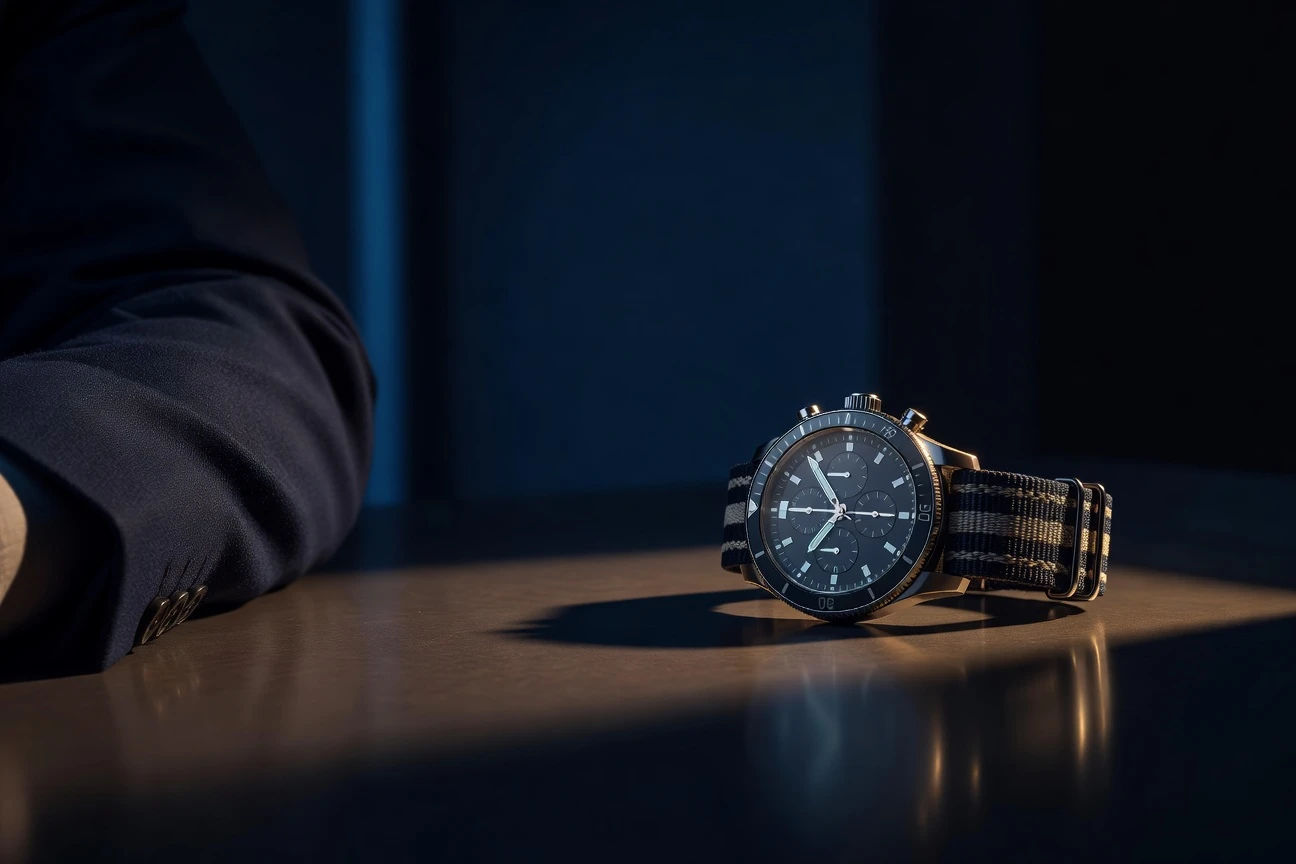
The most distinctive moment of the product presentation came near its close. Abrak described the new Omega Seamaster Diver 300M Chronograph developed as Bond’s primary gadget and player interface, a design choice that goes beyond product placement. In the game, the watch is fitted with a hacking module and a laser strap; it communicates gameplay information to the player in real time rather than sitting as a cosmetic prop. Omega president and chief executive Raynald Aeschlimann then joined Abrak on stage to discuss the partnership, and finished by presenting Abrak with the actual First Light watch. The room’s quiet amusement came from Aeschlimann’s own observation: fortunately for both men, this particular version did not include the in-game spy functions.
Omega became Bond’s official watch with GoldenEye in 1995, a partnership that has run across nine films, two lead actors, and more than three decades of screen time. None of those integrations, however, placed the watch at the centre of a gameplay system, and none resulted in a Seamaster chronograph – the First Light edition is the first Bond Seamaster chronograph in the partnership’s 30-year history. The physical watch, priced at £7,900, ships with a black, grey, and beige NATO strap mirroring strap designs that can be unlocked and worn within the game itself.
IO Interactive’s reasoning for giving the watch this load-bearing role connects to where Bond sits in the story. He is too young and too inexperienced for the full Q-branch arsenal. The watch is the one piece of advanced technology he carries from the opening mission forward, which makes it both the right narrative anchor and the right commercial vehicle for a brand that has built its identity around exactly this kind of on-screen function.
The Trilogy Hakan Abrak Is Betting On
007: First Light releases on 27 May on PlayStation 5, Xbox Series X/S, and PC via Steam and the Epic Games Store. Pre-order holders received 24-hour early access from 26 May at 3 PM BST. A Nintendo Switch 2 port is confirmed for summer 2026, with no firm date set as of the BAFTA event. Pricing sits at $69.99 in the United States and £59.99 in the United Kingdom across all platforms, with a Collector’s Edition at $299.99 or £199.99.
For PC players building or upgrading ahead of launch, the full five-tier PC specification breakdown for First Light covers the range from a 2019 GTX 1660 at the minimum 1080p and 30 frames per second setting through to the RTX 5080 Ultra preset. The game runs on IO Interactive’s proprietary Glacier engine, which held hardware requirements notably lower than comparable titles built on Unreal Engine 5.
Abrak has been explicit about the studio’s wider ambitions. He wants First Light to open a trilogy, with Bond growing across multiple games from the raw recruit of this story into the spy that established franchise audiences would recognise. The studio built the commercial scaffolding for a long run: a Deluxe Edition upgrade pathway, a limited-edition DualSense wireless controller for PlayStation 5, and a cast signed for a character who is supposed to have a future beyond this game.
Whether First Light earns the sequel Abrak has already planned depends almost entirely on what critics say when the review embargo lifts around launch day. The BAFTA sessions were the last hands-on access before the press writes. If the scores land with the momentum the evening suggested, the trilogy becomes an active discussion. If they fracture along the fault lines some preview coverage has already identified, the fourteen-year gap that preceded this game will look considerably harder to close a second time.
GAMING
Deadlock May 22 Patch Overhauls Soul Urn and Nerfs Victor
Valve’s May 22 Deadlock patch replaced the Soul Urn’s two-second pickup channel with a single melee strike and moved every deposit to the center bridge, where opponents now have a live window to steal the objective before souls confirm. The update reached more than 30 heroes, brought a new Tier 1 Vitality item called Grit into the shop, and restructured the upgrade paths for Sharpshooter and Ballistic Enhancement.
The numbers behind the urn changes are not subtle. Carry time before damage kicks in fell from 45 seconds to 35, and the penalty climbed from 0.15% max HP per second to a flat 5% max HP per second, which is lethal at any HP total. Valve wants the urn moving and teams contesting the drop-off, not stringing along a solo courier for the entire back half of a match.
The Soul Urn Overhaul
How Pickup Changed
The old channel demanded two seconds of standing still. An enemy melee or stun reset the timer completely, turning contested spawn points into a war of interrupts on both sides. Under the new system, one light or heavy melee swing collects the urn with no channel and no interrupt risk at the moment of pickup.
A harder cutoff now applies once the urn gets fumbled. If it sits on the ground for 13 seconds without anyone within 25 meters, pickup locks permanently for that spawn and the urn sprints back to its original position automatically. Teams could previously hover near a fumbled urn to set up extended recovery plays; that option is gone.
The Depositing Phase Window
Before this patch, delivery happened deep on the opposite side of the map, in territory the carrying team had to cross while revealed on the minimap. The drop-off now sits at the center bridge, the same location for both teams. Once the courier steps onto the drop-off, the urn enters a “Depositing” phase rather than converting immediately.
The depositing timer scales with game state: three seconds when the delivering team is Favored, five seconds in neutral games, and ten seconds when the Unfavored team delivers in comeback mode. Any enemy player can heavy melee the urn during this window to flip ownership to their team, adding 1.25 seconds to their own deposit counter. The last person to contest before the deposit finalizes earns the +3 Golden Idol buffs; if nobody challenges, the original carrier takes them instead. Souls pay out in full the moment deposit completes.
Carry Conditions Revised
Two carrier-specific protections were stripped. The urn no longer silences the courier, though the disarm and movement silence remain. The passive +30% Bullet and Spirit Resist that made tanky heroes dominant in the courier role is gone entirely. In its place, the team with the stronger position (Favored or Unfavored in comeback mode) now receives +50% Bullet and Spirit Resist in a 60-meter radius around the urn while it is being carried, dropped, or sitting in the depositing phase.
The protection now spreads to any teammate within range rather than locking to the courier alone. Escort compositions benefit directly. Solo fast-runner strategies do not. Bringing your team to the center bridge is no longer optional.
| Mechanic | Before This Patch | After This Patch |
|---|---|---|
| Pickup method | 2-second standing channel | Single light or heavy melee |
| Delivery location | Opposite side of map | Center bridge, same for all teams |
| Carrier silence | Full silence while carrying | Disarm and movement silence only |
| Carrier resist bonus | +30% Bullet/Spirit Resist on courier | Removed; team area bonus applies instead |
| Damage timer onset | 45 seconds aggregate carry time | 35 seconds aggregate carry time |
| Damage rate | 0.15% max HP per second | 5% max HP per second (lethal) |
| Deposit contest window | None at drop-off | 3s/5s/10s phase; heavy melee flips ownership |
Map Pressure and Pacing Shifts
Base HP fell by 10 for every hero, and HP per boon dropped by 3. These are not dramatic numbers in isolation, but combined with the urn’s faster damage onset they narrow the margin on dive trades and nudge sustain itemization earlier. Several objective timers moved alongside those stat cuts, compressing the early game at multiple points simultaneously. The official Deadlock May 22 gameplay update on Steam contains the complete changelist.
- Midboss now spawns at the game’s start, present from minute one rather than entering mid-match.
- Medium neutrals appear one minute earlier, at the five-minute mark instead of six.
- Breakables push back one minute, spawning at three minutes instead of two.
- Shrines are invulnerable until a pair of Base Guardians falls, closing the backdoor until a lane collapses completely.
- Guardian scaling resistance shifted from +75% to -50% over 12 minutes to +50% to -50%, meaning guardians absorb more punishment in the first several minutes.
- Backdoor removal linger cut from 20 seconds to 14, shortening how long protection persists after an ally leaves the area.
Two outward-pointing jump pads near the map’s center were removed, tightening rotation paths between lanes. Sliding no longer resets sprint speed, and wall jumps now impose a 25% stamina regen reduction for five seconds, adding a small but real cost to the aggressive chase-and-disengage loop that dominates mid-game skirmishes.
The pacing shifts in numbers:
- 10 HP removed from every hero’s starting health pool
- 35 seconds of aggregate urn carry time before lethal damage begins (down from 45)
- 5 minutes first medium neutral spawn, one minute earlier than before
- 14 seconds backdoor removal linger, trimmed from 20
Bullet Velocity now stacks additively instead of diminishingly. Heroes building multiple velocity items gain more from each additional source, a quiet mechanical change that strengthens ranged-carry builds relative to short-range fighters who never invest in velocity at all.
Grit and the Item Ladder
The new Tier 1 Vitality item, Grit, enters the shop as an early survivability option. Its active drops a 200 Barrier for four seconds on a 60-second cooldown, and the innate provides one Out of Combat Regen. Grit builds into Weapon Shielding, Spirit Shielding, Reactive Barrier, and Guardian Ward. None of those upgrades inherit the manual active cast from the component, but all gain Out of Combat Regen from it.
Weapon Shielding and Spirit Shielding each picked up an 18% resistance proc for their respective damage type on activation, trading away the old move speed bonus. Both items now function as direct defensive purchases rather than speed-utility hybrids, and Weapon Shielding in particular becomes a sharper answer to bullet-heavy team compositions.
Sharpshooter gained a second upgrade path from High-Velocity Rounds in addition to Long Range, picking up +60% Bullet Velocity and an innate 10% Weapon Damage from components. Ballistic Enhancement now upgrades from Mystic Expansion, rerouting a previously freestanding purchase into a cleaner build flow. Both path changes reshape how weapon-focused heroes plan mid-tier item progression.
Other notable item adjustments from the patch:
- Indomitable received +2 Out of Combat Regen, with both Bullet and Spirit Resist growing from 8% to 10%.
- Golden Goose Egg permanent buff now triggers every 80 souls instead of every 100, making the scaling stat meaningful earlier in a game.
- Magic Carpet innately grants -15% Gravity and +25% Air Control, giving mobile heroes a stronger default utility floor.
- Shadow Weave extended its duration from 10 seconds to 13 and raised all three ambush bonuses (Fire Rate, Spirit Power, Melee Damage) from 20% to 25%.
- Glass Cannon’s max health penalty reduced from -15% to -13%, a modest concession for aggressive compositions running it.
The Weapon, Vitality, and Spirit Investment Bonus schedules each added a new 6,400-soul tier, inserting a breakpoint between the existing 4.8k and 7.2k steps and reducing the gap to the first meaningful power bump in the mid-game.
Heroes Gaining Ground
Graves and Grey Talon received the most extensive mechanical reworks, though Rem’s Tag Along overhaul and a collection of damage-dealer upgrades also shift the tier picture in meaningful ways.
- Graves: Sprint speed raised from 1.6 to 2.2. Grasping Hands now spawns a ghoul in the base ability rather than requiring Tier 3. Seven bug fixes and improved Deadheads movement rounded out the overhaul; bullet damage and growth were cut by 10% to offset the mobility gains.
- Grey Talon: Rain of Arrows cooldown dropped from 30 seconds to 22, cast delay fell from 0.5 to 0.2 seconds, and stamina distance flipped from -9% to +25%. Duration was trimmed from seven seconds to four, but the T1 and T2 tier placements swapped to deliver weapon damage and slow earlier in the upgrade path.
- Rem: Tag Along received eight separate improvements, including 50% faster travel to allies, secondary ally burst healing, veil casting support, friendly aura passthrough, and post-eject lockout reduced from 1 second to 0.3 seconds. Naptime base damage reduction increased to 30%.
- Abrams: Infernal Resilience T2 changed from +200 max health to +18% Melee Lifesteal, a direct upgrade for dive-and-sustain builds.
- Holliday: Base bullet damage raised from 18.8 to 19.7, and health regen doubled from 1 to 2.
- Viscous: Puddle Punch T2 traded +30 damage for +40% Lifesteal, strengthening sustained brawls over burst exchanges.
- Paradox: Time Wall T3 now grants +2 charges instead of +1, with charge delay halved from 4 to 2 seconds. Paradoxical Swap base damage rose from 125 to 150.
Billy, Venator, and Paige also picked up positive adjustments. Paige’s Rallying Charge now runs at half cooldown when it connects with neither allies nor enemies, improving its reliability as a rotation tool in situations where the full team is not present.
Heroes Facing Damage Nerfs
Victor took the sharpest adjustment. Base bullet damage dropped from 13+0.3135 to 12+0.26, reducing both his starting floor and his scaling ceiling. Aura of Suffering now deals 50% of its value against objectives, removing him from the top tier of reliable structure-clearers. His Jumpstart T3 spirit scaling improved from 0.6 to 0.9, but that is a late-game adjustment that does not offset the carry damage reduction in most matches.
Several other high-performing heroes absorbed reductions to their primary scaling:
| Hero | Key Nerf |
|---|---|
| Bebop | Bullet damage per boon 0.139 to 0.115; Exploding Uppercut T2 weapon damage +40% to +30% |
| Seven | Bullet damage growth 0.374 to 0.337; crit reduction raised from 35% to 55% |
| Warden | Bullet damage per boon 0.38 to 0.34; Binding Word T2 loses +12m cast range |
| Shiv | Killing Blow cooldown extended from 105s to 125s; full rage damage bonus reduced from 14% to 12% |
| Kelvin | Arctic Beam DPS spirit scaling 0.5 to 0.38; Frost Grenade spirit scaling 0.7 to 0.6 |
| Dynamo | Kinetic Pulse spirit scaling 1.65 to 1.55; Quantum Entanglement T3 reduces debuffs 50% rather than dispelling them |
Apollo’s Riposte lost its automatic dash on parry. It now grants a sub-ability that lets the player manually target a hero within 25 meters, with a brief window to choose before the ability expires. Players can buffer the target before the parry lands, which raises the mechanical ceiling while keeping the ability competitive for those who adapt.
The center-bridge depositing window is where this patch will be stress-tested. In organized play, five seconds to contest a neutral urn is enough time for a coordinated five-man response. In solo queue, that window will tend to reward the team that happens to be closer and punish whoever sent their roster somewhere else at the wrong moment. If contest rates stay low and deposits go uncontested routinely, Valve has already demonstrated with the carry damage timer that it is willing to apply sharper pressure; the 3s/5s/10s window, the 1.25-second contest bonus, and the lethal carry damage are three independent variables it can tune before the next patch lands.
GAMING
Tales of ARISE: Beyond the Dawn Edition Lands on Nintendo Switch 2
Tales of ARISE: Beyond the Dawn Edition is now available on Nintendo Switch 2, arriving May 22, 2026 as Bandai Namco’s first Nintendo port of the series’ best-selling entry. The complete package delivers the base game, winner of The Game Awards 2021 RPG Game of the Year, alongside the Beyond the Dawn expansion that adds more than 20 hours of additional story on top of the main game’s roughly 60-plus-hour campaign.
ARISE skipped the original Switch entirely for five years while accumulating more than 3 million copies sold on PlayStation, Xbox, and PC. Its Switch 2 debut fits a pattern that hasn’t drawn nearly enough attention: the console is quietly assembling one of the most concentrated JRPG libraries any Nintendo hardware has hosted in a single calendar year.
Everything the Beyond the Dawn Edition Bundles
The Switch 2 release is content-complete. Bandai Namco confirmed the package is identical in content to what’s available on other platforms, with no story cuts, no missing mechanics, and no DLC gated behind separate purchases for the standard edition. Physical and digital options are both available through the Tales of ARISE: Beyond the Dawn Edition Nintendo eShop listing.
| Component | What’s Included |
|---|---|
| Tales of ARISE (base game) | Full main story, six-member playable party, complete action-Arte combat system |
| Beyond the Dawn expansion | Post-game epilogue set one year after the main story, with new quests, dungeons, and boss fights |
| Bonus costumes and items | Additional in-game cosmetics and usable starter items included with all standard editions |
The expansion picks up one year after the main game’s climax. Alphen, Shionne, and their companions encounter Nazamil, the daughter of a Renan Lord and a Dahnan, whose fate becomes entangled with the same curse that shaped the base game’s central conflict. New dungeons and boss encounters extend the narrative without introducing new playable characters or overhauling the combat framework.
A digital Premium Edition is also available for players who want every content layer from the start. It stacks a Premium Upgrade Pack on the standard bundle, adding extra costumes, weapons, character attachments, hairstyles, a starter items boost, and additional in-game currency. A Sword Art Online: Alicization collaboration pack, featuring cosmetics for Alphen and Shionne, is sold as separate downloadable content through the eShop.
Why the Original Switch Never Got It
Tales of ARISE launched on PlayStation 4, PlayStation 5, Xbox One, Xbox Series X|S, and PC in September 2021. The original Switch was absent from that list. The hardware gap was the operative barrier: Nintendo’s previous console architecture made a faithful ARISE port unfeasible without visual and performance compromises that would have been difficult to justify for a game of that production scope.
The Switch 2 changes that equation. Nintendo Wire, in its coverage ahead of the Switch 2 release, observed that ARISE “was never ported to the original Switch as it probably wouldn’t have run well enough,” and that the newer console’s additional horsepower finally made the project viable. The same logic applies to other titles from that period now reaching Nintendo hardware for the first time: Cyberpunk 2077 and Elden Ring Tarnished Edition are both in the Switch 2 library in 2026, games that were equally implausible on the original Switch.
Five years between launch and Nintendo availability also reshapes the value structure. Players who bought ARISE on PlayStation at the original launch paid for the expansion separately when it released in November 2023. Switch 2 buyers receive both in a single transaction from day one. For the large pool of Nintendo-primary players encountering the game fresh, the decision isn’t “base game now, expansion later.” It’s the full run, front-loaded.
The expansion’s existence was, itself, unplanned. Yusuke Tomizawa, producer of Tales of ARISE at Bandai Namco, stated publicly at the 2021 launch that no post-release DLC was coming. The game’s commercial performance overrode that commitment. Switch 2 players are the direct beneficiaries of that reversal, picking up both entries in a single package rather than purchasing them across two separate release windows.
The Switch 2’s 2026 JRPG Surge
ARISE’s Switch 2 debut is one chapter in a much larger library story. The Nintendo Direct Partner Showcase on February 5, 2026 produced a wave of major RPG announcements that caught genre communities off-guard by volume alone. For players who kept Nintendo hardware as their primary console through the previous generation, 2026 is delivering a compressed recovery run on titles that had been unavailable on Nintendo platforms for years.
| Title | Publisher | Status on Switch 2 |
|---|---|---|
| Tales of ARISE: Beyond the Dawn Edition | Bandai Namco | Available May 22, 2026 |
| Final Fantasy VII Rebirth | Square Enix | Confirmed 2026 |
| Xenoblade Chronicles X: Definitive Edition | Nintendo / Monolith Soft | Available early 2026 |
| The Duskbloods | FromSoftware | Switch 2 exclusive, 2026 |
| Fire Emblem: Fortune’s Weave | Nintendo / Intelligent Systems | First-party new release, 2026 |
| Granblue Fantasy: Relink (Endless Ragnarok) | Cygames | Confirmed July 2026 |
ARISE occupies a specific lane in that roster that surrounding titles don’t fill. Final Fantasy VII Rebirth carries Square Enix’s blockbuster production identity; The Duskbloods brings FromSoftware’s punishing action-design sensibility; Xenoblade Chronicles X is a Nintendo-owned franchise. Tales of ARISE is the character-driven, politically grounded action JRPG from the publisher most historically associated with that style, requiring 60-plus hours of investment across a six-member cast. Nintendo fans who stayed platform-loyal through the last five years can now spend those hours without switching hardware.
Alphen, Shionne, and the World Worth Fighting For
Tales of ARISE builds its setup around a colonization premise rather than a generic fantasy conflict. For three centuries, the planet Rena has ruled over Dahna, extracting its resources and pressing its population into forced labor. The story opens with Alphen, a Dahnan with an iron mask fused to his face and no capacity to feel physical pain, and Shionne, a Renan with a curse of thorns that causes agony to anyone she touches. Their involuntary pairing is the structural center of the main game, expanding to a party of six as the liberation arc develops.
Bandai Namco designed the game as a franchise entry point, with no prior series knowledge required. The Rena-Dahna conflict carries the narrative without leaning on the mythology of earlier Tales games, and each party member arrives with a self-contained story arc that feeds into the broader plot. Players meeting the series for the first time get the complete picture without a back-catalog gap to fill.
That accessibility decision carried commercial consequences. More than 3 million copies sold across all platforms as of early 2024, per Bandai Namco’s own reporting, makes ARISE the best-selling entry in a franchise dating to 1995. The setting, characters, and combat system are documented in full on the official Tales of ARISE game page at Bandai Namco’s site, useful context for any Switch 2 player considering this as their first Tales experience.
Port Performance and the 30fps Question
Reviews of the Switch 2 version arrived mostly positive on visual quality and content parity, with one technical limitation drawing consistent attention from outlets that had spent time with the PlayStation 5 or PC releases.
- Handheld mode visual quality held up well against other platform versions, with anti-aliasing and texture fidelity that exceeded reviewer expectations for portable play
- Docked mode runs cleanly, with strong visual consistency across both display configurations
- Pre-rendered cutscenes play at 60 fps throughout the full game and expansion
- Gameplay is capped at 30 fps in both handheld and docked modes
- Content parity is confirmed: all base game mechanics, the full expansion, and existing downloadable content are present on Switch 2
The frame rate limitation matters more for ARISE than it would for a turn-based RPG. The combat system’s Arte-chaining, real-time enemy tracking, and six-character coordination are built for fluid movement, and the 30 fps cap holds in both modes without the performance option most recent console ports offer. Inven Global’s Switch 2 review described the cap as “more than just disappointing” for a game with significant action elements, noting that where recent titles offer players a 60 fps performance mode in docked play, ARISE on Switch 2 does not.
The Switch 2 version of Tales of Arise is a near-perfect port, with the single exception of the 30 FPS cap. With the portability to enjoy it anytime, anywhere, visuals that hold their own against PC and home console versions, and a reasonable price for a complete edition, there has never been a better time to start if you haven’t experienced this game yet.
That summary from Inven Global captures the consensus. The 30 fps ceiling in gameplay, against 60 fps in cutscenes, leaves a technical basis for hoping a future patch addresses the gap, though no update has been announced. Full details on the Switch 2 release are available in the Bandai Namco official launch announcement. Players who’ve held off for five years now have their port, running at the speed Bandai Namco shipped it.
Bandai Namco has not announced a next mainline Tales entry. If the Switch 2 edition builds a meaningful first-time audience among Nintendo players, those buyers represent the natural market for whatever the studio announces next. Delivering a future Tales game without a Switch 2 version from day one would be a harder position to defend than it was in 2021.
GAMING
Animal Crossing Bandai Collab Turns Reruns Into a Test
The Animal Crossing Bandai collab coming in September 2026 is a 10-character Tomodachi Doll Selection from Bandai Candy, Bandai’s confectionery collectibles label, priced at 550 yen per pack in Japan and built around flocked mini figures of Isabelle, Tom Nook, K.K. Slider and seven other villagers, according to Bandai Candy’s official Tomodachi Doll Selection listing.
For fans, the practical question is whether a rerun lineup deserves another hunt. For Nintendo, the Japanese game maker behind the series, the timing lands after a January refresh that pulled New Horizons back into daily play and made cheap shelf items feel less like nostalgia stock.
Bandai’s September Shelf Uses a Rerun Lineup
Bandai Candy labels the product as a Selection version and says it reissues figures from the earlier Tomodachi Doll series. Each pack carries one flocked doll, one display stand and one soda-flavored gum. The sale channel is broad in Japan: mass-market retailers’ confectionery aisles, with store timing allowed to vary.
The character cut is careful, not random filler. Isabelle, Tom Nook, Timmy, Tommy and K.K. Slider cover the franchise mascots. Judy, Dom, Marshal, Raymond and Flurry carry the villager side, the part of New Horizons that turned taste, trading and tiny design differences into a years-long collecting language.
- 10 designs make this a larger rerun set than the first and third Tomodachi Doll waves.
- 550 yen is the tax-included domestic suggested price for one pack.
- 15 and older is the listed target age, which places the line closer to desk collectors than preschool toys.
The Cheap Pack Turns Full Sets Into Probability
One pack is low-commitment; a clean set is not. At the listed price, ten different packs would cost 5,500 yen before duplicates, shipping or reseller markups. That is the neat math. The collector math is messier because single-figure candy toys make the duplicate pile part of the product experience.
- Completion starts at ten packs if every box breaks your way, a best-case floor rather than a likely bill.
- Duplicates become trade stock when enough fans chase the same villagers.
- Import shipping changes the price story for U.S. fans before any reseller premium.
- The age label points toward collectors who can tolerate repeat buys.
That tension is why Bandai’s choice of a Selection label matters. A reissue softens the chase for people who missed earlier waves, while still giving existing fans a reason to trade around the five headliners and five villagers. The format creates activity even when the toy itself is a tiny, static object.
The cost is also small enough to avoid the emotional drama of a premium figure preorder. A parent, office collector or visiting tourist can buy one at the candy aisle. Full-set buyers then carry the risk that the cheap pack becomes a slow drip of duplicate spending.
A January Update Restored the Game Loop
Nintendo did the software work first. On January 15, 2026, the company launched New Horizons for Nintendo Switch 2 and a free update for the original Switch version, with higher-resolution features, mouse controls, a microphone-driven megaphone, online sessions for up to 12 players and CameraPlay listed in the Switch 2 Edition and free update announcement.
The same announcement also put new activity into the base game: a resort hotel run by Kapp’n’s family, Resetti’s cleanup service, three Slumber Islands for Nintendo Switch Online members and collaboration items tied to LEGO, The Legend of Zelda and Splatoon. For a game that had spent years as a finished comfort object, that mattered.
Merchandise works better when the software is warm. A figure of Tom Nook on a desk hits differently when players have a new reason to check storage, visit friends or redo a corner of an island. The September toy window arrives after months of renewed screenshots, guides and social posts.
That same platform rhythm is showing up elsewhere in Nintendo’s calendar. Oton Technology’s report on Nintendo’s Star Fox return showed the company using familiar names to keep the new console conversation alive between larger launches.
Nintendo’s Bigger Asset Is the Installed Fan Base
New Horizons has the rare number that makes a rerun toy rational. Nintendo lists Animal Crossing: New Horizons at 49.91 million worldwide lifetime units as of March 31, 2026 in the top selling Switch software table, second only to Mario Kart 8 Deluxe on that page. A small figure line can make sense when the audience is that wide.
The company also told investors that evergreen titles with new hardware editions, including New Horizons, posted stable sales in the fiscal year ended March 31, and that its intellectual property (IP, owned characters and brands used beyond the game) related business booked 73.5 billion yen, down 9.7 percent from the prior year, in the annual earnings release for fiscal 2026. Hardware costs are part of the same backdrop: Oton’s Sony console price pressure report tracked a similar squeeze on the PlayStation side.
Bandai’s Candy-Toy Ladder Comes in Two Prices
The September doll is not arriving alone. Bandai Candy has an August Animal Crossing CharaMagnets line at 297 yen tax included, with 24 acrylic magnets, 10 memo-card designs and one soda gum per pack, according to the Animal Crossing CharaMagnets listing.
That creates a simple ladder: a cheaper flat collectible first, then a fuzzy desk figure a month later. Both sit in the candy aisle, where the purchase feels casual and repeat visits matter more than a single premium drop.
| Bandai Candy Product | Release Timing | Price With Tax | Collectible Count | Pack Contents |
|---|---|---|---|---|
| Tomodachi Doll Selection | September 2026 | 550 yen | 10 flocked dolls | One doll, stand, soda gum |
| Animal Crossing CharaMagnets | August 2026 | 297 yen | 24 acrylic magnets, 10 memo cards | One magnet, one memo card, soda gum |
| Tomodachi Doll Vol. 3 listing | May 2022 | 550 yen | 7 flocked dolls | One doll, stand, ramune candy |
The table shows why Selection is the sharper product. The price did not climb from the earlier doll wave, while the available figure count did. Bandai can call it a rerun and still give late fans more of the cast in one shelf cycle.
For retailers, the ladder matters because the two products hit different baskets. A magnet can be an impulse buy for a child or a stationery fan. A flocked doll is slower, more display-driven and easier to imagine beside an amiibo, a Switch dock or a work monitor.
For Bandai, the extra month between magnets and dolls keeps the franchise visible without requiring a single expensive box set. It is a candy-toy cadence, and Animal Crossing’s soft character design is unusually suited to it.
The Cast Choice Rewards Old Island Memories
Selection lines live or die by what they omit. This one keeps the government-and-shop core with Isabelle, Tom Nook and the twins, then hands the rest of the shelf to villagers whose popularity grew in the New Horizons era. It is a safer cut than a deep-lore set, but not a lazy one.
Raymond and Marshal are the obvious collector bait, because both became shorthand for high-demand villagers during the game’s hottest years. Judy, Dom and Flurry broaden the texture: bright colors, different silhouettes and enough softness to sell the flocked treatment.
That matters because flocking can flatten detail if the sculpt has no strong shape. K.K. Slider’s guitar pose, Nook’s ears and Raymond’s glasses give the material something to do. A rerun can still feel fresh when the physical finish reminds buyers why the characters worked in the first place.
U.S. Collectors Should Watch the Import Gap
Bandai’s listing points to Japanese retail, not a U.S. launch. That leaves American fans with the usual three routes: wait for authorized import shops, buy through marketplace sellers or ask traveling friends to check convenience stores and hobby aisles after release.
The food component is small, but it still matters. Some shops remove or disclaim candy in imported shokugan, the Japanese category for toys sold with confectionery, while others sell sealed boxes as collectibles. Buyers who care about sealed condition should read shop notes before chasing a full display.
There is also a timing lesson. The dolls arrive after the August magnet line, after the January software refresh and after Nintendo proved that a finished island game can still support a retail tail. Bandai is putting characters back on shelves without waiting for a new mainline Animal Crossing.
If the domestic sticker stays flat and supply is broad, the Selection set gives collectors a gentle second chance at characters that became expensive in older waves. If import supply is thin, the Japanese candy-aisle price becomes only the opening bid.
-
CRYPTO3 weeks agoAndreessen Horowitz Bets $2.2B on Crypto’s Quiet Cycle
-
CRYPTO2 weeks agoCathie Wood Calls SpaceX IPO Demand ‘Voracious’ Ahead Of $1.75T Debut
-
NEWS2 weeks agoGhana CSA Plants Office In Ho As Volta Cybercrime Climbs
-
APPS3 weeks agoGoogle’s Buried Page Reveals 500 Niche Websites Still Making Cash
-
NEWS3 weeks agoHormuud Bets $19 Down Will Finally Pull Somalia Online
-
NEWS2 weeks agoApple Strikes Preliminary Deal For Intel To Make iPhone And Mac Chips
-
NEWS3 weeks agoMetalenz Polar ID Hides Face Unlock Under OLED Smartphone Screens
-
AI2 weeks agoGoogle AI Overviews Adds Subscribed Label, Reddit Quotes Inline