
NEWS
The EU’s Age Verification App Trades One Privacy Risk for Another
The EU age verification app proves a child’s age without sharing identity, yet the same system could normalise constant proof-of-identity checks online.

The EU age verification app is a free, open-source tool the European Commission says can confirm a user is old enough to use a platform without handing over a name, a face, or a date of birth. The Commission wants every member state to make it available by the end of 2026, and Denmark plans to go first this summer.
The engineering is genuinely clever. The worry sits one level above it: the same design that protects a teenager’s identity also asks every adult to prove their age on demand, and privacy researchers warn that the habit could outlast the problem it was built to solve.
How the EU Age Verification App Works
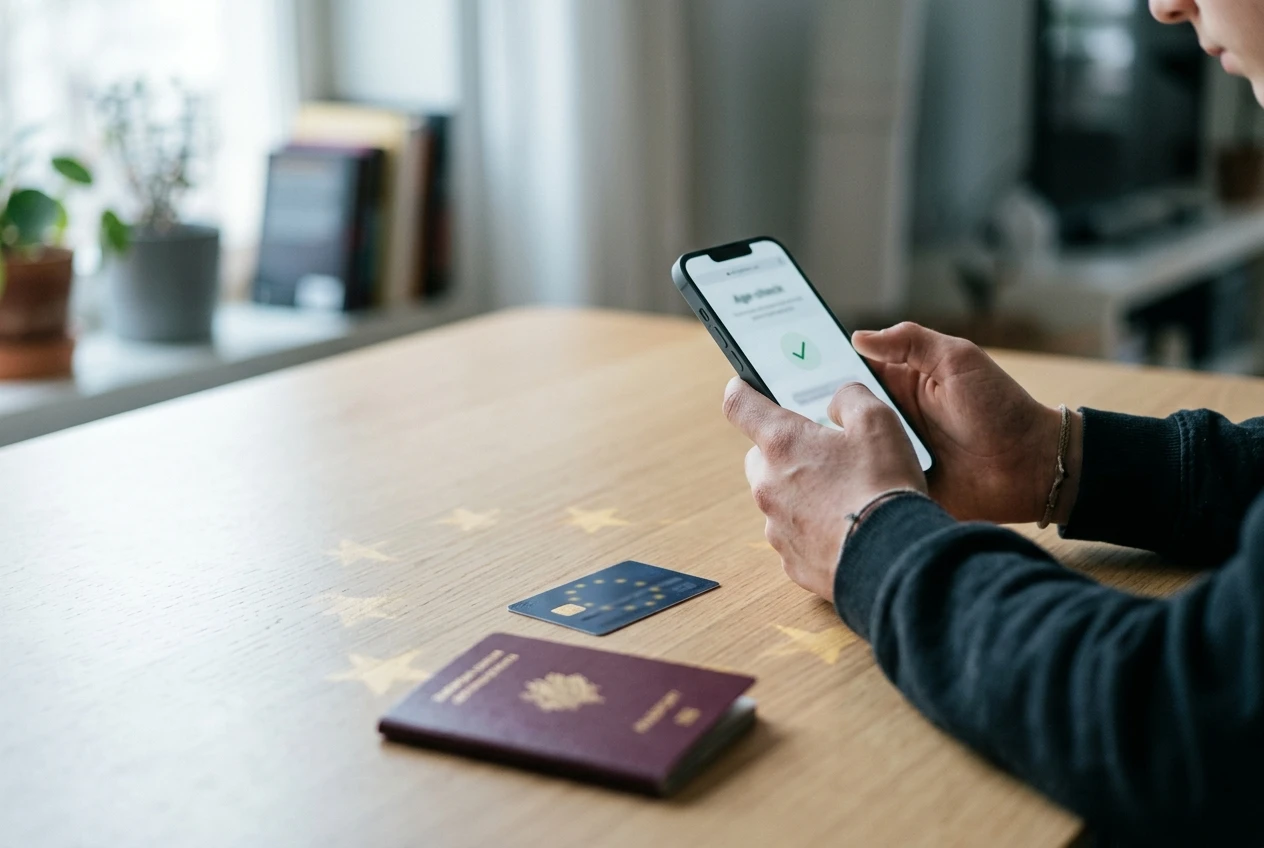
The Commission built the app on the same architecture that powered the EU Digital COVID Certificate, the QR-code system Europeans used to prove vaccination status during the pandemic. A user sets it up once with a passport or national ID card. After that, when a website asks whether the person clears an age bar, the app returns a yes or a no. It does not send the platform a name, an exact age, or the document used to register.
Three features define it, per the Commission’s description of the European age verification app for online child safety:
- Open source, so any member state or private provider can adopt the code and inspect it.
- Device-agnostic, running on phones, tablets and desktops instead of a single national app.
- Threshold-only, returning proof that a user passes an age limit without revealing the birth date behind it.
Member states can ship it as a standalone download or fold it into their national digital identity wallets, which will eventually connect to the bloc-wide European Digital Identity Wallet. Denmark is expected to be first, with a rollout planned for this summer. On 29 April, the Commission issued a recommendation pressing every government to have the tool live by the end of 2026. “The technology is ready and will soon be available,” said Ursula von der Leyen, the European Commission president.
Why the Push Comes Now
Political backing has hardened fast. Von der Leyen has floated what she calls a social media delay, a statutory minimum age below which children could not hold accounts at all. “I believe we must consider a social media delay,” she said. “Depending on the results, we could come forward with a legal proposal this summer.” An expert panel she commissioned is due to report back by July.
The public mood is behind her. A survey by the European Union Agency for Fundamental Rights (FRA, the bloc’s rights watchdog), which polled more than 26,000 people across the EU, found deep public concern about children’s use of social media.
- 89% of respondents worried about children seeing violent content or facing online exploitation.
- 88% were concerned about addictive platform design.
- 74% backed a legal age limit on social media.
- 16 was the most-supported threshold.
Those numbers give Brussels the cover it needs. They also explain why the Commission is moving on two tracks at once, building the verification plumbing while keeping the door open to an outright minimum age.
A Patchwork of National Rules
Brussels is not starting from a blank page. As of 11 May 2026, 23 of the 27 member states were at least considering national legislation on children and social media, and their plans diverge sharply. France’s National Assembly approved a ban on under-15s in January, due to take effect in September 2026. Others are weighing parental-consent rules, youth versions of apps, or feature-level limits rather than hard bans.
The momentum traces back outside Europe. Australia switched on the world’s first nationwide under-16 social media ban in December 2025, a policy whose early enforcement has become a reference point for governments in Asia weighing the same idea. Britain has expanded platform duties under its Online Safety Act, tightening age checks, addictive design and parental controls.
| Jurisdiction | Model | Age focus | Status |
|---|---|---|---|
| EU (proposed) | Verification app plus possible “delay” | 16 likely | Legal proposal possible this summer |
| France | National account ban | Under 15 | Effective September 2026 |
| Australia | National account ban | Under 16 | Live since December 2025 |
| United Kingdom | Platform duties (Online Safety Act) | Under-18 protections | Expanding |
| Spain, Germany, Portugal, Norway | Consent or restriction frameworks | Varies | Under discussion |
That divergence is exactly what the Commission’s app is meant to soften. Without a common scheme, the same platform could face one rulebook in Paris and another in Berlin, leaving companies guessing and children protected unevenly across the bloc.
The Privacy Paradox at the Center
The app’s selling point is that it keeps identity out of the hands of platforms. Privacy researchers do not dispute the engineering. Their worry sits one level up, in what a society does once proving your age becomes routine. The more places that can ask for a proof, the more often people will be asked, and the harder it gets to do anything online without first establishing what you are.
The Over-Asking Problem
Critics of the European Digital Identity Wallet ecosystem have a word for this: over-asking. The vetting of “verifiers”, the sites allowed to request a proof, has been loosened to the point where almost any service could ask a user to confirm an attribute, including ones with no legal reason to. Each request looks harmless on its own. The cumulative effect is a disclosure habit, where handing over proof becomes the price of getting online.
A coalition of security and privacy scientists put the stakes plainly.
It is dangerous and socially unacceptable to introduce a large-scale access control mechanism without a clear understanding of the implications.
That warning carried 438 signatures. The point is not that the app leaks data today, but that it builds the rails for a future where proof of identity is the default condition of participation.
When “Should” Replaces “Must”
The privacy guarantee rests on zero-knowledge proofs (ZKP, cryptography that confirms a fact without revealing the data behind it). The catch is in the legal wording. Under the eIDAS framework governing the wallet, zero-knowledge proofs are something implementations should support, not must. A member state could legally ship a version that is pseudonymous rather than fully anonymous, quietly weakening the protection the app advertises on the box. The technical blueprint for the EU age verification scheme leaves that choice to national developers.
The Enforcement Gaps Nobody Has Closed
Even a flawless app runs into limits that are not technical. Older teenagers can route around an age check with a VPN, a borrowed login, or a service hosted outside the EU. The kids most determined to get past the gate are usually the ones best equipped to do it.
The legal architecture has its own gap. The Digital Services Act (DSA, the EU’s content-moderation rulebook) runs on a “country of origin” principle, which limits how far one government can pile extra obligations on a platform regulated elsewhere in the bloc. A bigger unresolved question is scope, because nobody has agreed what counts as social media. A narrow definition covers the obvious networks. A broad one sweeps in video-sharing sites, messaging apps, gaming platforms, forums and AI chatbots, and the EU’s policy approach to age verification has not settled where the line falls.
Responsibility is also undecided. Verification could land on platforms, on app stores, on third-party providers, or on member states themselves, and each option pushes the cost and the liability somewhere different.
What a Ban Means for Marginalized Kids
The hardest objections come from people who work in child safety, not against it. Social media is now where many young people learn, organise and find peers, and civil society groups argue that a blunt cutoff curtails a child’s right to seek and receive information. A joint statement by children’s safety organisations warned that LGBTQ+ and neurodiverse children in particular use platforms for connection, self-identity and access to trusted advice.
There is a documents problem too. The Electronic Frontier Foundation, a US digital-rights group, has warned that any system built on official ID risks shutting out refugees, unhoused people and the undocumented, who may not have the papers to register in the first place. The trade-offs land unevenly on kids who already have the least, a pattern that the UK’s own under-16 measures exposed among disabled teenagers.
The Commission wants the app available across the bloc by the end of 2026, and von der Leyen’s legal proposal could arrive as soon as this summer. Whether it covers chatbots and messaging or just the mainstream networks is still being decided.
Frequently Asked Questions
Is the EU age verification app mandatory?
No. The app itself is a voluntary tool the Commission has recommended, not required. Its recommendation urges member states to make it available by the end of 2026, but each government decides whether to deploy it, fold it into a national wallet, or pursue its own age check. A separate, binding minimum-age law is still only at the proposal stage.
How does the app protect a user’s privacy?
It returns a simple yes or no on whether a user meets an age threshold, without passing the platform a name, exact age, or the ID used to register. The design relies on zero-knowledge proofs, which confirm a fact without exposing the underlying data. The privacy depends on national versions actually implementing those proofs, which the rules encourage but do not strictly require.
What age is the EU considering for social media?
No bloc-wide figure is fixed yet. In the FRA survey, 16 was the most-supported threshold among adults. France has legislated for under-15s, and Australia’s existing ban applies to under-16s. The expert panel advising von der Leyen is due to report by July, which will shape any EU-level number.
When could an EU social media age limit take effect?
Von der Leyen has said a legal proposal could come this summer, after her expert panel reports in July. A proposal is the start of the process, not the end; EU laws then pass through the Parliament and member states, so any binding limit would take effect later. France’s national ban is the nearest concrete date, set for September 2026.
Can the age verification system be bypassed?
Yes, to a degree. Older teenagers can use a VPN, borrowed credentials, or services hosted outside the EU to get around checks. The DSA’s country-of-origin principle and the unsettled definition of “social media” add further gaps, which is why officials treat verification as one layer rather than a complete fix.
Does the app connect to the EU Digital Identity Wallet?
It is designed to. The app can run on its own or be built into national digital identity wallets, which will link to the future European Digital Identity Wallet. Critics warn that tying age checks to wider identity infrastructure is what risks normalising constant proof-of-identity requests across the internet.


Samsung’s Design Chief Molds the Fold8 Like a Passport

Qualcomm Stretches Snapdragon 8 Elite Gen 5 as Chip Costs Climb

Thailand and the Philippines Force Crypto Exchanges to Hunt Scammers

WhatsApp Adds Adobe-Powered PDF Tools and Hands-Free Car Mode

Samsung’s Smart Glasses Replay Android’s Old Playbook Against Meta

Xbox Backward Compatibility Hits PC After Microsoft Called It Done

A New Nautilus Extension Restores GNOME’s Lost Computer View

Bezos’s Prime Video AI Overhaul Puts Studio Deals at Risk

Samsung’s PCIe 6.0 AI SSD Arrives Five Months Behind Micron

Coinbase Grows Singapore Staff to 200 After Global Cuts

Fable 5 and Mythos 5 Return as US Lifts Anthropic Export Controls

SpaceX’s Google Deal Turns a Rocket Company Into a Cloud Landlord

CD Projekt Red Co-CEO: Redemption Arc Isn’t Done, Witcher 4 in 2027

DGO App Brings Rs 549 Mobile Pass for FIFA World Cup 2026 in Nepal

XPL Rallies 30% Ahead of Plasma One Card Tier Launch

Oracle Cuts 21,000 Jobs in a Year, Cites AI in 10-K Filing

Google Search Profiles Build a Follow Graph Inside Discover

Moonshot AI Targets $30 Billion in China’s Fastest AI Funding Sprint

Microsoft Xbox Layoffs Start in July as Sharma Slams 3% Margin

WhatsApp Meta Business Agent Reaches India, With a New Pricing Meter
-
 AI3 weeks ago
Fable 5 and Mythos 5 Return as US Lifts Anthropic Export Controls
-
 AI2 months ago
SpaceX’s Google Deal Turns a Rocket Company Into a Cloud Landlord
-
 GAMING1 month ago
CD Projekt Red Co-CEO: Redemption Arc Isn’t Done, Witcher 4 in 2027
-
 APPS1 month ago
DGO App Brings Rs 549 Mobile Pass for FIFA World Cup 2026 in Nepal
-
 CRYPTO1 month ago
XPL Rallies 30% Ahead of Plasma One Card Tier Launch
-
 AI1 month ago
Oracle Cuts 21,000 Jobs in a Year, Cites AI in 10-K Filing
-
 NEWS2 months ago
Google Search Profiles Build a Follow Graph Inside Discover
-
 AI2 months ago
Moonshot AI Targets $30 Billion in China’s Fastest AI Funding Sprint