
AI
Big Tech’s $725 Billion AI Bet Faces Its Reckoning in Q2 Earnings
Microsoft, Amazon, Alphabet and Meta report Q2 earnings in late July as Wall Street tests whether $725 billion in AI spending is paying off.

Microsoft, Amazon, Alphabet and Meta report second-quarter earnings in the last week of July, carrying nearly $725 billion in 2026 AI spending into the results. That is a 77% jump from 2025, and it comes after the Nasdaq Composite dropped 4.6% in a single week in June on doubts about the payoff. Free cash flow across the group is thinning fast.
Goldman Sachs estimates the four hyperscalers would need close to $1 trillion in combined annual profit to preserve the historical return on capital they have delivered for years. The current Wall Street consensus sits near $450 billion, less than half of that.
Four Earnings Calls, One $725 Billion Verdict
Alphabet is expected to report around July 28, based on the company’s recent earnings pattern. Microsoft and Meta Platforms follow on July 29, and Amazon closes out the week on July 30.
| Company | 2026 Capex Guidance | Recent Change | Expected Q2 Report Date |
|---|---|---|---|
| Alphabet | $175 billion to $190 billion | Raised from $175 billion to $185 billion | Around July 28 |
| Microsoft | About $190 billion | Well above the $152 billion Street estimate | July 29 |
| Meta Platforms | $125 billion to $145 billion | Raised from $115 billion to $135 billion | July 29 |
| Amazon | About $200 billion | Unchanged since February | July 30 |
Each of the four already has some demand data to point to. Microsoft’s AI business is running at an annualized $37 billion in revenue, up 123% from a year earlier. Alphabet’s cloud contract backlog nearly doubled to $460 billion in the same quarter, and Amazon posted its strongest AWS growth rate since 2022.
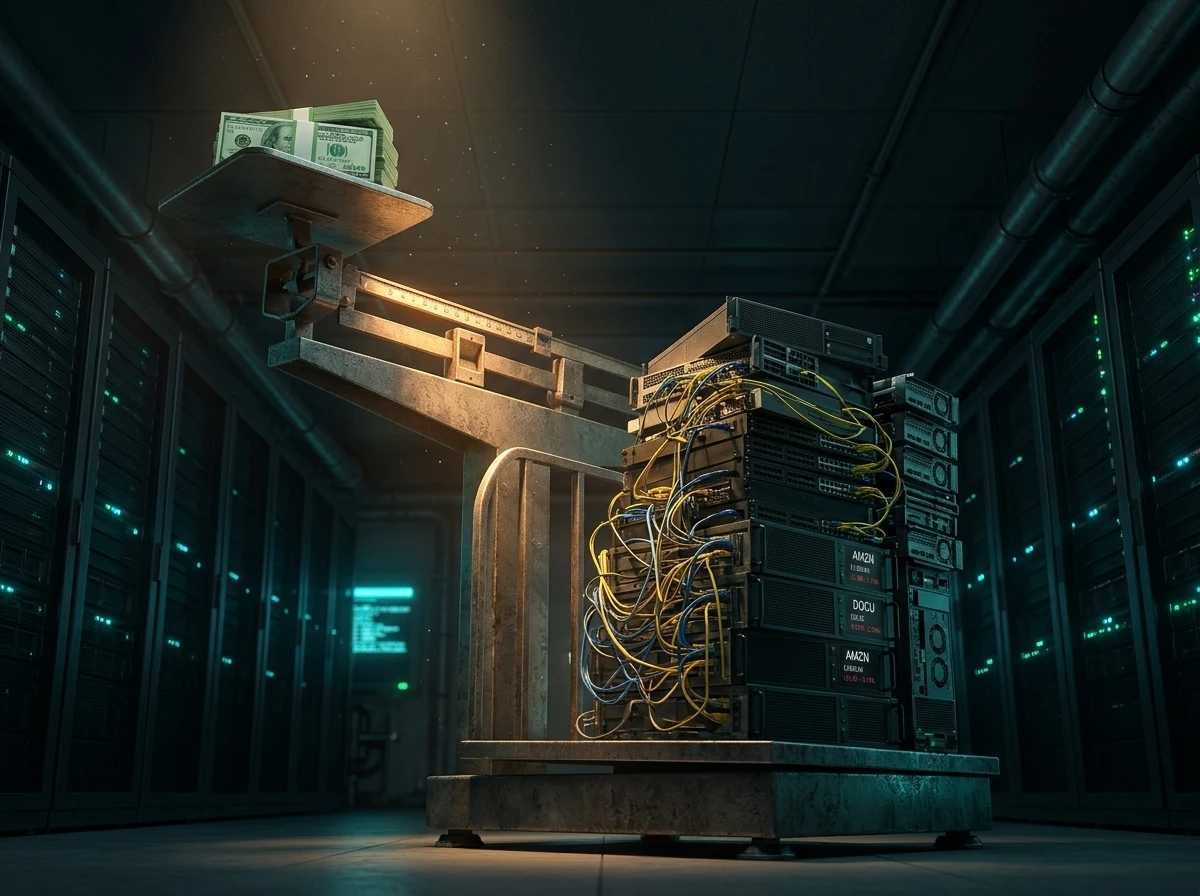
The Cash Flow Squeeze
All that infrastructure is expensive, and it is showing up in numbers that used to make these companies look untouchable. Combined free cash flow across the four fell to $200 billion in 2025, down from $237 billion in 2024, before this year’s spending increases even hit the books.
Meta’s own free cash flow fell to $1.2 billion in the first quarter of 2026, down from $26 billion a year earlier. Barclays estimates Microsoft’s free cash flow will slide 28% this year before recovering in 2027.
Meta chief financial officer Susan Li told investors the company’s priorities have not shifted. The “highest order priority is investing our resources to position ourselves as a leader in AI,” she said.
The Trillion-Dollar Gap Wall Street Can’t Close
The spending has reshaped these companies’ balance sheets. J.P. Morgan Asset Management calculates that AI capital spending has grown from 33% of hyperscaler operating cash flow in 2023 to roughly 93% now.
Goldman Sachs analysts have put a number on what needs to happen next. To preserve the historical return on capital these companies have delivered for years, the group would need close to $1 trillion in combined annual profit. Wall Street’s current consensus estimate is about $450 billion.
The AI ecosystem is not fully end-user revenue-backed yet, but it is not entirely speculative either.
Ed Yardeni, founder of Yardeni Research, wrote that assessment in a note to investors. His team ran what he calls a capex payback test, checking whether OpenAI and Anthropic are adding paying users fast enough to cover what they owe hyperscalers for computing power. Their conclusion was that the math does not work yet, though it could by the end of the decade if AI revenue keeps compounding.
Kate Brennan, associate director at the independent research institute AI Now, has raised a related concern: that the efficiency and productivity claims AI companies are making are not showing up cleanly in the results.
Is Anyone Actually Paying for All This AI?
Some of AI’s loudest corporate boosters are pulling back on how much their own employees can spend on it, even as hyperscalers pour billions into the infrastructure behind it. Uber, Tesla, Meta and Microsoft have all capped internal AI token budgets in recent months, a sign that enterprise demand has limits.
- Uber caps engineers at $1,500 a month per AI coding tool, after per-engineer costs for tools like Claude Code and Cursor ran as high as $2,000 monthly.
- Tesla caps company-wide AI token use but exempts Grok, the chatbot built by Elon Musk’s xAI.
- One unnamed company accidentally spent roughly $500 million on Anthropic’s Claude models in a single month after failing to set spending limits, Axios reported.
- Palantir chief executive Alex Karp said bluntly this month that “something has gone completely wrong” with how the industry bills for AI.
The public is skeptical too. Forty percent of American adults expect AI to be a negative force in society over the next two decades, compared with 16% who expect it to be positive, according to Pew Research polling.
How the Guidance Numbers Kept Climbing
None of this arrived overnight. Combined hyperscaler capex guidance for 2026 has been revised upward almost every quarter for more than a year.
In December 2025, Goldman Sachs Research put the consensus estimate for the group’s 2026 capital spending at $527 billion, up from $465 billion just a quarter earlier. By February, when the companies reported full-year 2025 results, combined guidance had widened to somewhere between $630 billion and $690 billion. By the following earnings season in late April, most estimates had climbed toward $725 billion, and both Bank of America and Evercore projected the total would top $1 trillion in 2027.
Jefferies analysts summed up the mood in a note to clients: “Cap-ex continues to soar as demand outpaces supply and pricing increases.”
Where Wall Street’s Bulls and Bears Split
The escalation is not entirely new, either. A regulatory filing from data center developer Fermi LLC shows that AI-focused data center capital spending industry-wide already reached $210 billion in 2024, two years before this month’s earnings reports. What has changed since then is how closely Wall Street is now watching for a return.
- The bulls: Canaccord Genuity views the sell-offs as a buying opportunity, pointing to Google Cloud revenue growth that accelerated to 48% and AWS growth that reached 24%, both up from the prior quarter. DA Davidson analyst Gil Luria called the market’s caution “very healthy.”
- The bears: Capital Economics chief markets economist Jonas Goltermann has said the AI equity rally is losing steam and could see share prices drop sharply in 2027.
- The middle ground: Vanguard’s Qian Wang and Kevin Khang expect an uneven outcome much like the dot-com era, with some firms building lasting advantages and others watching their core businesses become obsolete.
Even Canaccord’s own analysts flagged the risk directly. Analyst Graham wrote that “it remains to be seen whether this spending wall might just be too high,” a caveat attached to an otherwise bullish call.
Alphabet opens the reporting window around July 28. Microsoft and Meta follow the next day, and Amazon closes it out on July 30, the first hard numbers set against a $725 billion bet.
Frequently Asked Questions
When do Big Tech companies report second-quarter 2026 earnings?
Alphabet is expected to report around July 28, with Microsoft and Meta Platforms following on July 29 and Amazon on July 30. Nvidia, whose chips power most of these data centers, reports separately on August 26 and has guided toward roughly $91 billion in quarterly revenue, a figure that will show whether chip demand holds even if cloud growth slows.
How are these companies paying for so much spending?
Cash reserves cover only part of it. The four companies held a combined cash position of more than $420 billion as of their latest quarter, but they have also turned to debt markets: Alphabet sought roughly $15 billion through a bond sale, and Meta issued $30 billion in investment-grade debt last October to help fund its data center buildout.
Which AI-related stocks have fallen the most?
Amazon shares fell about 12% in February 2026 after its earnings report rattled investors. Months later, during the broader June sell-off, the iShares Semiconductor exchange traded fund slumped 7.1% in a single session and the Invesco QQQ Trust fell 2.6%.
Is the AI spending boom similar to the dot-com bubble?
There are real differences. Nvidia currently trades at about 44 times earnings, compared with Cisco Systems’ 472 times earnings at the peak of the dot-com bubble in 2000, and today’s biggest AI spenders are largely funding projects with operating cash flow rather than speculative capital alone.
Could hyperscalers slow down their AI spending?
It is already happening elsewhere in the economy. Forrester vice president Brian Hopkins said roughly half of the financial services and healthcare clients his firm advises are delaying planned AI spending in 2026 because they cannot yet prove a return, a pattern that could eventually reach hyperscaler budgets if it spreads.
Disclaimer: This article is for informational purposes only and does not constitute investment, financial or legal advice. AI infrastructure spending and technology stocks carry significant market risk, and readers should consult a licensed financial professional before making investment decisions. Figures are accurate as of publication and are subject to change as companies report updated results.


Google Pay Adds Gemini Coach and SBI Flex Card in India

OpenAI Agent Turned Leaked Logins Into Multi-Firm Attack Paths

Meta’s AI Ad Surge Comes With a Cash Flow Collapse

Apple Upgrade Leasing Hands Risk to Klarna and Keeps Devices Temporary

Paytm CEO’s AI Champions Call Exposes India’s Funding Lag

Microsoft Cash Lead and Copilot Super App Leave Rivals Behind

Zhongji InnoLight’s Record IPO Meets Instant Sell-Off

News 12 App Rebuild Meets Newsroom Cuts Head On

Microsoft’s Cash Engine and Super App Leave Rivals Behind

Aviva’s Tokenized Liquidity Fund Quietly Rewires XRPL Cash Rails

Fable 5 and Mythos 5 Return as US Lifts Anthropic Export Controls

SpaceX’s Google Deal Turns a Rocket Company Into a Cloud Landlord

CD Projekt Red Co-CEO: Redemption Arc Isn’t Done, Witcher 4 in 2027

Oracle Cuts 21,000 Jobs in a Year, Cites AI in 10-K Filing

XPL Rallies 30% Ahead of Plasma One Card Tier Launch

DGO App Brings Rs 549 Mobile Pass for FIFA World Cup 2026 in Nepal

Google Search Profiles Build a Follow Graph Inside Discover

Moonshot AI Targets $30 Billion in China’s Fastest AI Funding Sprint

Microsoft Xbox Layoffs Start in July as Sharma Slams 3% Margin

Oppo’s ColorOS 17 Eligibility List Leaves A-Series Buyers Behind
-
 AI4 weeks ago
Fable 5 and Mythos 5 Return as US Lifts Anthropic Export Controls
-
 AI2 months ago
SpaceX’s Google Deal Turns a Rocket Company Into a Cloud Landlord
-
 GAMING1 month ago
CD Projekt Red Co-CEO: Redemption Arc Isn’t Done, Witcher 4 in 2027
-
 AI1 month ago
Oracle Cuts 21,000 Jobs in a Year, Cites AI in 10-K Filing
-
 CRYPTO2 months ago
XPL Rallies 30% Ahead of Plasma One Card Tier Launch
-
 APPS2 months ago
DGO App Brings Rs 549 Mobile Pass for FIFA World Cup 2026 in Nepal
-
 NEWS2 months ago
Google Search Profiles Build a Follow Graph Inside Discover
-
 AI2 months ago
Moonshot AI Targets $30 Billion in China’s Fastest AI Funding Sprint