
AI
Carmakers Learn Where Auto AI Actually Pays
Cabin AI is already booking software fees at GM and Ford, while plants, quality checks, and crash liability still depend on human judgment.

Carmakers are putting AI in dashboards and phone apps, while plants and steering wheels still depend on people. General Motors and Ford are already booking software fees from those cabin tools. The harder jobs, from paint defects to crash blame, keep bouncing back to human judgment.
A Sept. 8 industry assessment put that split in plain terms: hype built for years, and auto companies are now sorting where the tech is useful. The useful pile is smaller than the pitch decks.
Cabin Assistants Are the Part That Pays
The money that is landing is not a robot driver. It is a voice in the dash that already knows the car, and a subscription that outlives the sale.
GM’s Q2 materials show OnStar deferred revenue of $6.3 billion, up nearly 50% from a year earlier. Booked revenue in the quarter was $800 million, up over 20%. The first half came in around $1.6 billion, and the company said it remains on track for more than $3 billion of realized OnStar revenue in 2026, with deferred revenue approaching $7.5 billion by year end.
CFO Paul Jacobson called OnStar, including Super Cruise, a “growing margin accretive asset.” He also said that strength “provides the foundation for everything else we are building.” GM expects about 1 million new OnStar subscribers in 2026, a base approaching 13 million. Super Cruise added about 70,000 subscribers in the quarter and is on track to exceed 850,000 by year end. After the three-year prepaid term, the attach rate has stayed in the 30-40% range.
Chair and CEO Mary Barra said GM expects those subscriptions to support more than $3 billion in recognized software and services revenue this year. Beginning with the 2027 model year, Super Cruise becomes standard on High Country Silverado and Denali Sierra trims, a change she said should add about 160,000 Super Cruise units a year. About 22 million GM vehicles can take certain over-the-air updates, which is the installed base those cabin tools will keep milking.
Ford is running the same play with a thinner public scoreboard. On the Q2 call, the company said it now has over 14 million connected vehicles. CEO Jim Farley told analysts paid BlueCruise subscriptions grew 20% in the quarter and that BlueCruise now makes up 50% of retail Integrated Services revenue. Total paid subscriptions grew about 50%, including more than 900,000 Ford Pro Intelligence paid subscriptions.
Ford President of Integrated Services Mike Aragon said an AI assistant in the FordPass and Lincoln Way apps is expanding to an estimated 8 million eligible retail vehicles, after tests in the first half of 2026. The in-car side is Google Gemini as an opt-in on the latest Ford and Lincoln Digital Experience, while the phone assistant reads VIN-specific manuals, live telemetry, and warning lights. GM began putting Gemini into vehicles this year, a plan that in April pointed at roughly 4 million U.S. Cadillac, Chevrolet, Buick, and GMC vehicles, and it is training a separate in-house assistant on OnStar data.
Paul Waatti, AutoPacific’s director of industry analysis, drew the line carmakers want buyers to feel. “A generic chatbot knows information,” he said. “A properly integrated automotive assistant can know the state of the vehicle, its state of charge, tire pressure, route, HVAC settings, maintenance status, Super Cruise availability and eventually a much deeper set of vehicle functions.”
Stephanie Brinley of Mobility Global put the commercial motive next to that warmth. “The root of this is trying to create services that customers will buy,” she said. Friendlier talk, in that view, is a sales channel.
DETROIT’S SOFTWARE LEDGER IN Q2 2026
| Metric | General Motors | Ford |
|---|---|---|
| Booked digital revenue | $800 million OnStar in Q2, up over 20% | BlueCruise is 50% of retail Integrated Services revenue |
| Balance-sheet or fleet base | $6.3 billion deferred; OnStar heading toward 13 million subscribers | More than 14 million connected vehicles |
| Hands-free attach | Super Cruise 30-40% after the prepaid term; 850,000 year-end target | Paid BlueCruise subscriptions up 20% in the quarter |
| Assistant reach | Gemini rolling through GM brands; a house model in training | FordPass and Lincoln Way assistant on 8 million eligible retail vehicles |
That table is the part of automotive AI that already looks like a business. It is also the part that does not have to decide whether a child is about to step off a curb.
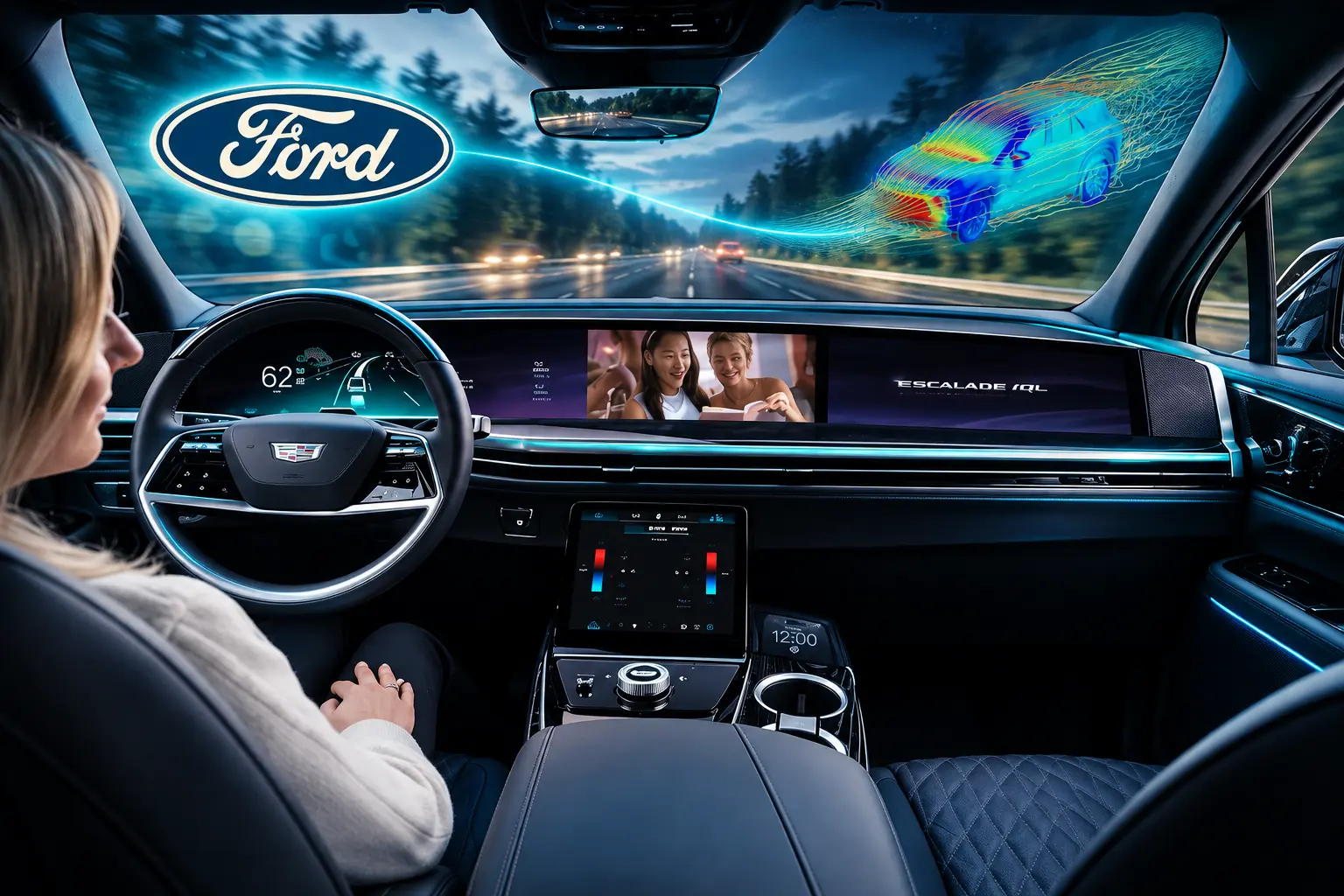
The 350 Engineers Ford Had to Hire Back
Ford learned the other half of the ledger in quality, not in the infotainment menu. Over three years it hired, promoted, or brought back 350 experienced engineers, many of them former staff, after automated checks missed problems veterans used to catch by feel.
Chief Operating Officer Kumar Galhotra had told investors the company rolled out 900 AI-powered cameras in plants to spot defects at the source. Charles Poon, vice president of vehicle hardware engineering, told reporters in late June that the cameras and models were only as sharp as the people who had already left.
Mistakenly, we thought that by just introducing artificial intelligence and ingesting the design requirements that we had, that would produce a high-quality product.
Charles Poon, vice president of vehicle hardware engineering, Ford
“Artificial intelligence is a fantastic tool, but it’s only as good as the information you use to train it,” Poon said. The veterans now retrain those tools, sit in meetings that hunt failure points before parts hit the line, and mentor younger staff. Internally they are the “gray beard” engineers.
The briefing sat next to a brighter quality print. Ford celebrated a No. 1 finish among mainstream brands in the latest J.D. Power Initial Quality Study, after a stretch when it led the industry in recalls and sat below average. The company is still using the cameras. It is no longer pretending the cameras replace the people who know how a door should shut.
The same correction keeps showing up as a punchline because it is so blunt: the specialists walked back in to teach the models that were supposed to replace them. That is not a vibe from a comment thread. It is Ford’s own account of why the tools failed, and it is the cleanest proof yet that plant AI without inherited judgment just encodes the gaps.
China’s Humanoids Still Lose to Ordinary Factory Arms
The same gap is wider on two legs. Chinese carmakers have pushed humanoid robots into EV plants the way they once pushed battery lines, and the demo reels still outrun the shift work.
Xiaomi’s Beijing EV plant already runs with 91% of assembly automated. The body shop uses more than 700 industrial robots for spot welding, riveting, and adhesive bonding. Those arms keep a 76-second takt. Humanoids are the interns on the edge of that line.
President Lu Weibing said earlier in 2026 that two humanoids could finish 90% of a nut-install and material-move job in three hours, and that they were “more like the interns.” By July, Xiaomi said the success rate on a self-tapping nut station had risen from 90.2% to about 98%, one point under a person. Geely’s Zeekr brand tested UBTech humanoids on sorting and box moves at Ningbo. Geely still said robotic arms and automated vehicles “handle all key tasks on the active assembly line.”
A Liuzhou training center showed the speed problem in cruder form. Staff there said the machines did simple tasks at about 20% of a person’s pace. Tang Wenbin, co-founder and CEO of robotics firm Yuanli Lingji, was blunter: “The robots’ IQ is too low.” He also said, “A lot of what we see is dancing disguised as working.”
The spend is not waiting on that verdict. A review of nearly 1,000 government tenders found national, provincial, and local authorities spent at least $230 million on humanoids and related gear in the first half of 2026, against $62 million a year earlier and $6 million in 2024. China’s National Development and Reform Commission has counted more than 150 humanoid-robot companies. The Ministry of Industry and Information Technology said in June that obstacles remain, while still targeting 10,000 units of deployment capacity and more than 100 high-value uses by the end of 2026.
WHERE THE FACTORY ROBOTS ACTUALLY STAND
- Conventional arms: Xiaomi’s body shop already welds, rivets, and bonds with more than 700 industrial robots inside a 91% automated assembly process.
- Humanoid trials: Nut-station success at Xiaomi reached about 98%, one point under a person, after months of coaching on a 76-second line.
- Active assembly: Geely says arms and automated vehicles still do every key task on the live Zeekr line, even after UBTech trials.
- Work rate: Trainers in Liuzhou clocked simple humanoid jobs at about 20% of human speed or output.
- Public money: Government tenders for humanoids hit at least $230 million in the first half of 2026, up from $62 million a year earlier.
Carmakers that want bodies able to work a full shift are now shopping chips, sensors, and plant software as a bundle, including full-stack physical AI factory deals. The stack is not the bottleneck that matters on Monday morning. Keeping up with a 76-second car is.
Why Most Buyers Say Cars Already Have Too Much Tech
The cabin assistant is being sold into a market that is already tired. Ipsos, in the 2026 Global Mobility Report drawn from nearly 24,000 people across 31 countries, found a split that should worry anyone pitching a chatty car as the next must-have.
WHAT BUYERS TOLD IPSOS IN 2026
- Tech load: 55 percent say cars are oversaturated with technology, 27% are neutral, and only 18% think the current load is the sweet spot.
- Self-driving trust: 36 percent would feel safe riding in a self-driving car, and 36% would not.
- Ownership interest: 38% say they want to own one, almost even with the 37% who do not.
- New-feature appetite: 55% look forward to new in-vehicle tech, including 78% in China, the only market that would rather buy a new car from a tech firm than from an established automaker.
Mike VanNieuwkuyk, Ipsos’s global head of vehicle quality in the U.S., wrote that the roadblock is not the sensor suite. It is trust. “Unlike asking a virtual assistant for the weather, autonomous vehicles demand we surrender control over our personal safety,” he said.
The trust map is lopsided. Thailand (66%), India (62%), and Malaysia (61%) are the most willing to call self-driving safe. France sits at 18%, with Belgium and Hungary at 20%. Only 31% of people in North America and 34% in Europe trust automakers to protect personal data as cars get smarter, against 50% in Asia-Pacific. Indonesia, Türkiye, and Mexico are among the markets where more than two-thirds already feel overwhelmed by in-car tech.
That is a cold room for a strategy that needs drivers to talk to the car often enough to buy oil changes, Super Cruise months, and whatever else the assistant suggests. A friendly voice can still be a fee. It cannot talk 55% of buyers out of the sense that the dashboard is already too loud.
Crash Rules Still Put a Human on the Hook
Liability is why the steering wheel has not followed the chatbot. SAE Level 2 systems steer and pace the car and still require a person who is fully in the driving task. Automated driving systems at Levels 3 through 5 aim to take the dynamic driving task inside a defined domain. Most consumer metal on the road is still in the first bucket, which is also the bucket that keeps the driver on the hook.
NHTSA’s Standing General Order makes firms report certain automated-driving crashes when the system was in use within 30 seconds of the incident. ADS crashes are pulled in on a wider set of harm, including some property damage. Level 2 ADAS crashes are reportable when a vulnerable road user is struck, or when there is a death, an air bag deployment, or a hospital transport. The public dashboards on that order run through July 15, 2026. NHTSA also warns that Level 2 cars are mostly privately owned, so makers may never hear about a crash unless an owner calls.
A Dykema auto survey for 2026 found the industry has moved from arguing about blame to writing it into contracts. Concern over where to put liability for AI-driven vehicle decisions fell from 78% to 48%. Compliance with new AI rules, at 49%, now edges it. The EU AI Act treats most automotive AI as high-risk, which piles logging, human oversight, and post-market monitoring on top of existing vehicle rules.
Explainability is trying to catch up with that paper trail. On Sept. 2, researchers writing in Nature described CW-Net, a wrapper that grounds a black-box planner in concepts a person can read, then showed those explanations drivers can actually use on a real car, including public-road data from Las Vegas and an online study of 100 people. The point of the work is not that the car is done. It is that a driver who cannot tell a real hazard from a hallucination does not know whether to grab the wheel.
SAE’s J3329 information report, issued April 13, 2026, had already listed the same pile as technical, operational, and regulatory problems for AI in ground vehicles. McKinsey’s auto practice has been blunt about the commercial path that follows: Level 2+ systems scale faster than full autonomy because the human still carries supervision, which lowers the burden of proving the system is safe on its own.
THE DATES THAT KEEP A PERSON IN THE LOOP
- April 13, 2026: SAE issues J3329 on technical, operational, and regulatory challenges for AI in ground vehicles.
- June 25, 2026: Ford’s Poon briefing makes the quality failure public and ties the 350-engineer return to gaps in training data.
- July 15, 2026: NHTSA’s ADS and Level 2 crash dashboards run through this date, with different reporting bars for each class.
- July 21, 2026: GM’s Q2 call books the OnStar and Super Cruise figures that show cabin software paying now.
- September 2, 2026: Nature publishes the CW-Net work on making a self-driving planner’s choices readable to a person.
Until those rules shift blame in a way a CFO will sign, “eyes off” stays a premium experiment and “eyes on” stays the product you can sell with a straight face.
Quiet Wins Sit in the Wind Tunnel and on the Line
The useful middle is less cinematic than a robotaxi and more like a better inspection station. GM has been showing an AI virtual wind tunnel that gives designers live feedback on aerodynamics, a job that used to wait on a physical model and a queue. Vision systems on a paint line, if a veteran has labeled the defects, catch repeats a new hire would miss. Those are bounded tasks. They fail in ways a supervisor can see.
Barra said on the Q1 call that nearly 90% of the code written by GM’s autonomy team is now generated by AI, for a next-generation Super Cruise aimed at the Cadillac Escalade IQ in 2028, with supervised road testing in California and Michigan. That is a striking number for software production. It is still a Level 2 promise with a launch date two years out, not a car that owns the crash.
Gartner VP analyst Pedro Pacheco warned in December 2025 that the sector was in “AI euphoria,” with firms chasing disruptive value before they had data and software foundations. He forecast that only 5% of automakers would keep strong AI investment growth by 2029. The cabin ledgers at GM and Ford are the counter to that warning. The 350 engineers, the intern humanoids, and the 36% trust ceiling are the proof he was not guessing.
Andrew Watchorn, a lecturer at Kettering University, told an industry panel that payback may still sit on the wrong side of a hype curve, and that the gap that shows up in real work is between a person with judgment using the tools and a team that treats the model as finished. Ford already ran that experiment. Xiaomi is running a slower version on two legs. The assistants in FordPass and OnStar are the version that bills monthly.
The next cars will talk more, and some of them will steer more. The companies collecting the software checks are the same ones putting veterans back on the line and leaving a human in the driver’s seat when the bill for a mistake would be a life, not a missed nut.

Instagram Plus Tests a Read-Only Mode That Cuts Stories

Altman Asks the Public to Accept Some AI Harm

Google Freezes OSS VRP Product Reports After AI Flood

AI Agents Make Payment Rails the Scarce Prize

Turkey’s Crypto Boom Now Runs Through Three Banks

Fable 5 Came Back Under a Commerce On-Off Switch

Google’s SpaceX GPU Lease Has a Sept. 30 Deadline

Plasma One’s XPL Locks Face a 1.81 Billion Cliff

DGO’s Rs 549 World Cup Pass Cost Fans Sleep and Data

Moonshot AI’s $30 Billion Ask Became a $35 Billion Close
-
 AI4 months ago
Fable 5 Came Back Under a Commerce On-Off Switch
-
 AI5 months ago
Google’s SpaceX GPU Lease Has a Sept. 30 Deadline
-
 CRYPTO4 months ago
Plasma One’s XPL Locks Face a 1.81 Billion Cliff
-
 APPS4 months ago
DGO’s Rs 549 World Cup Pass Cost Fans Sleep and Data
-
 AI5 months ago
Moonshot AI’s $30 Billion Ask Became a $35 Billion Close
-

 NEWS5 months ago
ColorOS 17 Device List Spans Oppo, OnePlus and Realme
-

 GAMING4 months ago
Xbox Cuts 3,200 Jobs After Five Years of Thin Returns
-

 GAMING4 months ago
The RTX 4050 Under Rs 70,000 Hides a Wattage Gap