
AI
Decentralized AI’s 2026 Boom Recycles the Same Concentration
x402, Bittensor, and Akash posted huge 2026 counts, yet screened agent spend, subnet cash, and GPU rent still cluster in a few hands.

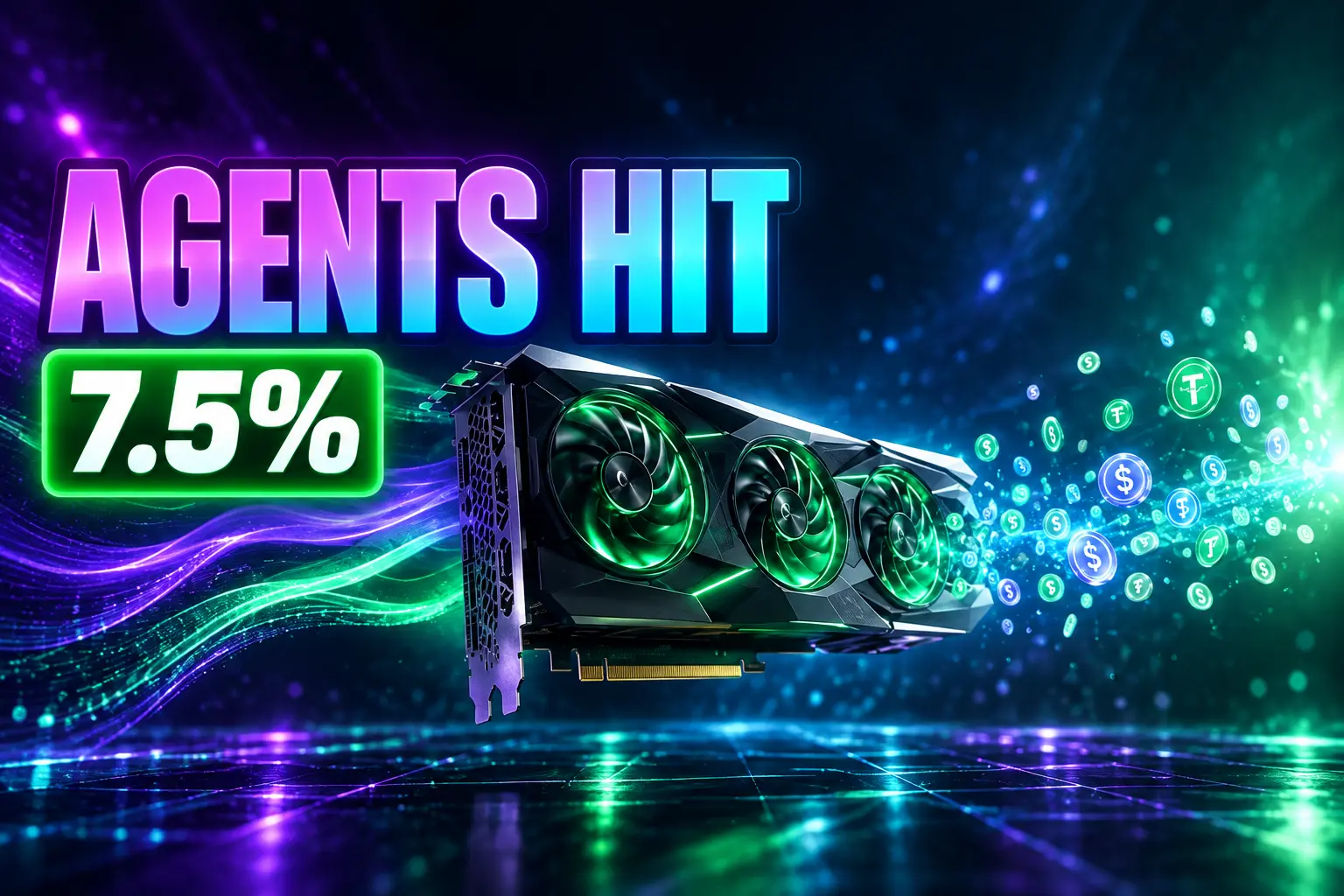
TRM Labs counted 198.9 million x402 settlements since May 2025, then found that 0.6% to 7.5% of screened volume looks agentic.
The protocol was sold as the settlement layer for software that buys inference, data, and tools without a human at checkout. The on-chain record is a busy rail with a thin agent economy sitting on top of it.
Decentralized AI in 2026 still answers scarce GPUs, closed labs, outputs nobody can audit, and data that is getting harder to crawl. A layer-by-layer map of that stack already walks those rungs. The ledgers underneath it sort winners the way the labs do: a few payment contracts, a few subnets, a few GPU landlords.
Most x402 Payments Are Not Agents
x402 revives the idle HTTP 402 code as a paywall for machines. A client asks for a resource, the server answers 402 with a price, the client retries with a signed authorization, and a facilitator posts the settlement on-chain and eats the gas. Stripe’s live guide walks a seller through that loop on Base and even shows how to charge $0.01 USDC per request, recorded as a PaymentIntent under Stripe-Version 2026-05-27.preview. The feature is open to businesses in every U.S. state except New York, and in more than 30 countries. Tempo USDC and Solana USDC sit on the same docs page as a second rail, Stripe’s Machine Payments Protocol, for people who also want cards.
That plumbing is real. The census is the problem. In a September 9, 2026 analysis, TRM Labs analyst Noah Hodge totaled about $52.7 million across 198.9 million settlements through known facilitators on Base, Solana, and Polygon since May 2025. Nothing in the spec requires an agent. A cron job, a load test, and a wallet paying itself leave the same trace.
THE X402 SCREEN
- Gross rail: About $52.7 million moved through 198.9 million settlements since May 2025.
- After filters: Self-pays, bulk flows, and thin-buyer shops fall away, leaving $25.62 million of screened x402 commerce on public rails.
- Agent volume: Addresses that look like agents still move only about $5,000 to $11,000 a month.
- The asset: $52.47 million of $52.68 million, or 99.6%, settled in USDC.
TRM’s permissive test kept any payer with sub-dollar, varying prices. The strict test also wanted months of the pattern plus an ERC-8004 registration or more than one seller. The band that survived both tests is the one in the lede.
x402 is the most widely used agent-payment rail, but most of its volume is not agentic, and much of it isn’t commerce
Noah Hodge, TRM Labs, September 9, 2026 analysis
Late 2025 mixed speculative token mints with a burst at one AI shop. Through the first half of 2026 the dollars sat in a single payment contract rather than a broad merchant set. By mid-year, AI services returned through an agent-payment router. The mix moved. The agent cash did not.
June 2026, measured later by agent economy’s public dataset, still looked small in dollars even when the clicker was busy: 4,778,845 x402 transactions and $272,293 of stablecoin volume, with Tempo’s Machine Payments Protocol adding 2,679 channel events. Counts can print like an economy. Receipts still print like a beta.
Builder chat on X has already left the “can it pay?” demo behind. The live argument is where a run must stop, because a receipt can record an unwanted debit and still say nothing about whether the debit should have fired. Virtuals Protocol, which hosts a large agent launchpad on Base, is now shipping crash recovery so a restarted agent tracks pending transfers instead of paying twice.
Crash recovery for agent payments is here. Raxol helps restarted agents track pending transfers instead of sending funds twice, a foundation for agentic trading. https://t.co/H5zJnEi7qR
— Virtuals Protocol (@virtuals_io) September 14, 2026
Teneo Protocol put the same limit in one line on September 7, 2026: “A receipt can record an unwanted action perfectly. It cannot decide whether that action should run.” Capability is no longer the product. The product is the off switch.
Bittensor Now Chokes Losing Subnets Toward Zero
If x402 is a rail with few riders, Bittensor is a market that fires the stalls that do not draw a bid. The chain still mints TAO every block. After the first halving in December 2025, that mint is 0.5 TAO, or about 3,600 TAO a day, down from 7,200, against a 21 million cap. The fight is over who gets the flow.
THE BITTENSOR EMISSION CALENDAR
- February 2025: Dynamic TAO goes live, giving each subnet an alpha token and an AMM pool against TAO.
- November 2025: TaoFlow starts routing emissions by net staking flow rather than price.
- December 2025: The first halving cuts daily issuance from 7,200 TAO to 3,600 TAO.
- June 23, 2026: Price-based shares and a miner-burn penalty replace TaoFlow.
- July 27, 2026: Spec 440 turns demand into an input for an emission gate, not a pro-rata split.
Taostats documents the Hill-function gate on subnet emissions in plain language. Demand is moving price times one minus miner-burn, normalized across subnets. A quantile bar then keeps almost all of the share for names above the line, chokes the tail toward zero, and sends the leftover to the winners. Any APY sheet that still treats emission as proportional to price is, as of spec 440, wrong.
That is Darwinism as a product, and it shows up in cash. SubConnect’s first Bittensor Revenue Index, published September 1, 2026, put outside-customer billings at $28 million to $35 million a year across 24 subnets. Fifteen of those 24 lines carry a high-confidence tag, meaning a public dashboard, on-chain data, or a company disclosure. Three subnets produce close to half of the verified total. Two already out-earn their own miner emissions. Fourteen of the 24 fund alpha buybacks from that cash. Lium (SN51) sits at the top at $8 million to $10 million annualized, selling GPU credits that buy and burn SN51 alpha with customer money rather than treasury TAO. SubConnect also named PwC France, Dropbox, and an NYSE-listed REIT on the customer list.
So the open intelligence market does have invoices. It has a few of them. The rest of the subnet long tail now lives under a gate that is designed to starve it.
More Akash Leases, Thinner Rent
Akash sells the other scarce thing, raw compute, as a reverse auction. Providers bid down to win the job. The 2026 pitch is that this auction is the cheap, permissionless answer when data-center GPUs are sold out. Messari’s Q1 2026 state of the network is the cleanest public tape, and it splits that pitch in half.
AKASH Q1 2026 ON-CHAIN
| Metric | Q1 2026 | Change |
|---|---|---|
| New leases | 43,540 | +27.1% from 34,250 in Q4 2025; -5.5% vs 46,080 in Q1 2025 |
| Lease revenue | $253,250 | -45% from $460,510 |
| Average active leases | 583 | -4.4% from 610; -32.9% vs 868 in Q1 2025 |
| Average active providers | 58 | -8.4%, the lowest recent quarterly count |
Lease revenue was 98% of $257,580 in total network fees. Tenants kept signing, then ran cheaper, smaller jobs. Messari’s same-quarter tape also put average GPUs in active use at 84, down 57% quarter over quarter. A marketplace that needs many independent bidders to keep prices honest is doing that work with 58 active providers.
Two March 2026 upgrades tried to change the shape of demand. Burn-Mint Equilibrium went live on March 23, so each on-chain deployment triggers an AKT market buy. The Akash Agents platform launched on March 26 for one-click AI deploys, and daily leases jumped late in the quarter. The quarter as a whole still paid less rent. Lease count is not cloud revenue. On this network they moved in opposite directions.
Aethir’s Next Capacity Looks Like a Normal Cloud
Aethir is the DePIN GPU network that already looks like a vendor. Token Terminal’s calendar-2025 read of on-chain service fees is about $118 million, which still dwarfs Akash’s quarterly rent. The company’s own blog describes more than 430,000 GPU containers across 94 countries, matched continuously to inference demand rather than reserved against a forecast.
The next capacity add is not another permissionless garage GPU. ACCELERATE locks 10 mid-sized data center sites totaling up to 20 MW in the United States and Europe, aimed at B300 and GB300 clusters of 64 to 256 chips, with an expected build measured in months. Aethir talks about up to $700 million in contracts by the end of 2026 and more than $2 billion at full buildout. Those are pipeline figures, not recognized revenue, and they are tied to named demand rather than a token emission schedule.
The winners in this market won’t be whoever plans the biggest campus, they’ll be whoever delivers working capacity first, and the network tells the team where demand is before the first foundation gets poured.
Mark Rydon, co-founder and chief strategy officer, Aethir
Read that against the Akash provider count. The network with the invoices is adding ordinary rooms with power and cooling. The network with the lease spike is collecting less USD. Decentralized compute did not abolish the data center. The one that bills like a cloud is building more of them.
How Many AI Agents Are On-Chain?
As of September 13, 2026, agent economy’s floor count of registered on-chain identities is 628,326: 569,949 in ERC-8004 registries across 24 chains, plus 58,377 agents launched on Virtuals Protocol, 44,052 of them listed for ACP commerce. The floor ignores agents that never mint an ID. It also double-counts operators who register many names, and it says nothing about whether those names ever spend.
June 2026, the same dataset logged 24,167 new ERC-8004 registrations and 4,375 Virtuals ACP commerce memos. Identity is cheap. A memo that looks like commerce is rarer. That gap is why ERC-8004 exists, and why it does not finish the job.
The draft, titled Trustless Agents, went onto Ethereum mainnet on January 29, 2026. Authors include Marco De Rossi at MetaMask, Davide Crapis at the Ethereum Foundation, Jordan Ellis at Google, and Erik Reppel at Coinbase. It specifies three on-chain agent registries and leaves payments to someone else.
THE ERC-8004 REGISTRIES
- Identity: An ERC-721 handle with URI storage, so each agent gets a portable agentId and a registration file for name, services, and wallet.
- Reputation: A standard interface for posting and fetching feedback after a job, meant to follow the agent across chains.
- Validation: A slot for third-party checks of work, including stake-backed re-execution, zkML proofs, and TEE attestations.
The standard is still a draft. Reference contracts are already live, which is how the September census can count hundreds of thousands of passports. Registration does not prove a callable service, a human approval path, or a spend cap. Google’s AP2, OpenAI and Stripe’s ACP, and CrowdStrike’s scoped permissions in the Claude Marketplace are all chasing that missing control from the other side of the industry. The open stack minted IDs first. The labs are minting brakes.
The Token Explosion Still Lands at the Labs
Goldman Sachs Research’s May 2026 agent note is the demand case every decentralized pitch now borrows. The bank projects a 24-fold rise in token consumption by 2030, driven by agents that loop, tool, check, and retry instead of answering once. Inference already eats more than 70% of AI operating cost in the outlook that circulated with this stack. If that multiplier arrives, someone has to own the GPUs, the power, and the bill.
The open networks want that someone to be a miner, a home node, a subnet, or an agent wallet paying $0.01 a call. The 2026 tape says the call volume can be huge while the agent share stays a rounding error, the subnet invoices fit on two dozen lines, and the permissionless cloud’s rent falls as its lease count rises. Token incentives still do the staffing. Customers still show up late, and when they do, they show up at Lium, at Aethir, at one payment contract, at a router, not as a flat field of peers.
ChatGPT, Gemini, Grok, and Claude remain the systems people actually open. The bet behind Bittensor, x402, Akash, and ERC-8004 is that those labs cannot also own verification, identity, and machine settlement once agents start to spend. The rail for that spend exists. Stripe will book it. Base will settle it in USDC. The emission gate will keep paying the subnets that still have a bid.
What the ledgers do not show, in September 2026, is a broad set of agents that pay for work, collect a reputation someone else will honor, and replace a lab invoice. They show a mint, a stamp, and a gate. Those three already know how to concentrate.
Disclaimer: This article is news reporting and analysis of public network data, protocol docs, and company statements. It is informational only and is not investment, trading, or financial advice, and it is not a recommendation to buy or sell TAO, AKT, USDC, agent tokens, GPU-network tokens, or any other digital asset. Readers should consult a licensed financial adviser or crypto-asset specialist who understands their own risk tolerance before acting on any figure or project named here. Counts, revenues, run-rates, and protocol rules reflect the cited sources as of their stated dates and can change with the next upgrade, index, or settlement batch.

Instagram Plus Tests a Read-Only Mode That Cuts Stories

Altman Asks the Public to Accept Some AI Harm

Google Freezes OSS VRP Product Reports After AI Flood

AI Agents Make Payment Rails the Scarce Prize

Turkey’s Crypto Boom Now Runs Through Three Banks

Fable 5 Came Back Under a Commerce On-Off Switch

Google’s SpaceX GPU Lease Has a Sept. 30 Deadline

Plasma One’s XPL Locks Face a 1.81 Billion Cliff

DGO’s Rs 549 World Cup Pass Cost Fans Sleep and Data

Moonshot AI’s $30 Billion Ask Became a $35 Billion Close
-
 AI3 months ago
Fable 5 Came Back Under a Commerce On-Off Switch
-
 AI4 months ago
Google’s SpaceX GPU Lease Has a Sept. 30 Deadline
-
 CRYPTO4 months ago
Plasma One’s XPL Locks Face a 1.81 Billion Cliff
-
 APPS4 months ago
DGO’s Rs 549 World Cup Pass Cost Fans Sleep and Data
-
 AI4 months ago
Moonshot AI’s $30 Billion Ask Became a $35 Billion Close
-

 NEWS4 months ago
ColorOS 17 Device List Spans Oppo, OnePlus and Realme
-

 GAMING4 months ago
Xbox Cuts 3,200 Jobs After Five Years of Thin Returns
-
 GAMING4 months ago
The RTX 4050 Under Rs 70,000 Hides a Wattage Gap