
NEWS
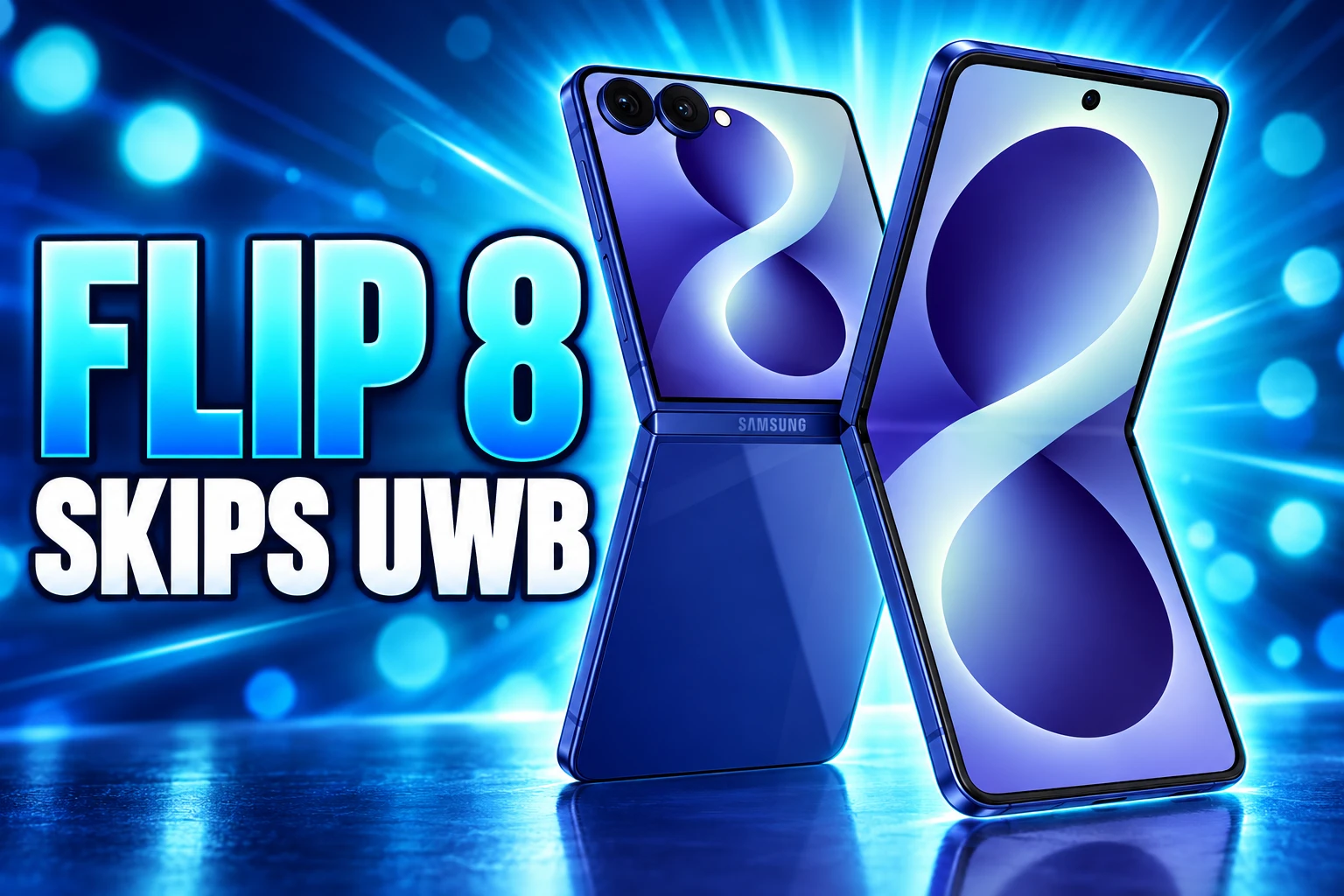
The Galaxy Z Flip 8 Ships Satellite Without UWB
The US Galaxy Z Flip 8 shipped with NB-NTN satellite band B255 and no UWB, so SmartTag2 precision finding stays off the clamshell.

The US Galaxy Z Flip 8 cleared the FCC in June with satellite band NB-NTN B255 and no ultra-wideband chip.
Samsung unveiled the phone in London on July 22 and put it on sale August 7, starting at $1,199 for 256 GB. The filing was not a teaser. It was the radio list that shipped.
The June FCC Filing Became the Shipping Radio List
The US unit is SM-F776U, FCC ID A3LSMF776U, granted June 8. That U suffix is the carrier-locked American model, and it is the one whose radios were public weeks before Unpacked.
The documents listed Wi-Fi 7 including the 6 GHz channel, Bluetooth, NFC, wireless charging, and wireless PowerShare. They also listed DisplayPort. The 5G modem added NB-NTN B255, the narrowband non-terrestrial band used to talk to a satellite network.
Ultra-wideband did not appear. That gap survived launch. Samsung’s published spec sheets still leave UWB off the sensor list and off the connectivity list, including the India sheet for the SM-F776 series.
THE RADIO CALENDAR
- June 8, 2026: The FCC grants A3LSMF776U for the US Galaxy Z Flip 8, with NB-NTN B255 listed and UWB absent.
- July 22, 2026: Samsung unveils the phone at Unpacked in London with the Fold 8 family and the Watch Ultra 2.
- August 7, 2026: US sale begins at $1,199 for 256 GB and $1,399 for 512 GB.
Samsung now sells it as the lightest and thinnest Flip yet, at 180 g and 6.1 mm unfolded, down from the Flip 7’s 187 g. The radio argument did not travel with that pitch. The company spent Unpacked on FlexWindow, Super Steady, and the Snapdragon 8 Elite Gen 5 for Galaxy in the US, not on tags or car keys.
Carriers Turned Band 255 Into Emergency Text
NB-NTN B255 is a modem feature, not a consumer brand name. It lets the phone register with a non-terrestrial network when towers and Wi-Fi are gone, then send a short message through a partner satellite system. The Flip 7 already had a version of this, limited to a few regions that included the US.
On the Flip 8 the same band is in the US filing, and carriers have started putting a label on it. T-Mobile lists the phone as compatible with T-Satellite with Starlink, and as satellite data capable. Telstra in Australia lists satellite messaging and select satellite apps as compatible. Those are carrier products sitting on top of the same class of radio.
This device is compatible with T-Satellite, so you can stay connected in places never thought possible with the only mobile + satellite network powering messaging and apps.
T-Mobile, Galaxy Z Flip8 product listing
That US pitch is broader than the emergency-only path described in other markets, where a failed 911 (or local emergency) call can surface an Emergency text via Satellite option or a green satellite icon. In those setups you share details with emergency services. You do not get ordinary calls, chats with friends, or a browser session over space.
Google’s Pixel 10 series supports B255 and B266. The Flip 8 filing names B255 only. The extra band on Pixel is a second satellite channel, not proof that Samsung’s radio is weaker in the field, but it is the cleaner apples-to-apples note in the paperwork.
The practical limit is the carrier switch. Wi-Fi 7 works once you join a network. Satellite stays dark until a mobile operator provisions it, and menus in One UI 9 can show the feature as unavailable while you still have terrestrial service. The June filing confirmed the modem can do NTN. It did not promise coverage on every plan.
Why the Flip 8 Still Lacks UWB
UWB is a short-range radio that times pulses across a wide band so a phone can estimate direction and distance to a few centimeters. Samsung has shipped it on Note, S Plus and Ultra, and Fold phones for years. The Flip line mostly skipped it.
The Flip 7 broke that pattern in one country. The Korean model, SM-F766N, listed UWB on Samsung’s domestic spec sheet, appeared in Google’s UWB device catalog, and showed an Ultra-wideband toggle under Settings, Connections, on a Korean unit in Samsung’s Remote Test Lab. US, European, and Chinese Flip 7 phones did not get the chip. The Fold 7 shipped with UWB worldwide.
The Flip 8 US filing repeats the non-Korean Flip 7 choice. Samsung’s own launch tables do not repair it. The Canadian newsroom spec block for Flip 8 names 5G, LTE, Wi-Fi 7 and Bluetooth 5.4 and stops there. No UWB line. No satellite line either, which is how a carrier extra can ship in silicon and still miss the marketing table.
UWB AND SATELLITE ACROSS FLIP MODELS
| Radio | Flip 8 US (SM-F776U) | Flip 7 US | Flip 7 Korea (SM-F766N) |
|---|---|---|---|
| Ultra-wideband | Not listed | Not listed | Yes |
| Satellite NTN | NB-NTN B255 | Yes, limited regions including the US | Not stated in public spec sheets |
| Wi-Fi 7 | Yes, including 6 GHz | Yes | Yes |
| Wireless PowerShare | Yes | Yes | Yes |
Space in a 6.1 mm clamshell is the usual excuse, and it is a real constraint next to a Fold. Certification cost is the other guess people reach for, because UWB rules differ by market. Samsung has not said which one decided the Flip 8. The paperwork only shows the outcome: the long-range emergency modem made the US grant, and the indoor finding chip did not.
SmartTag2 Precision Finding Stops at This Phone
That outcome lands on accessories, not on a spec footnote. A Galaxy SmartTag2 can still ping over Bluetooth from a Flip 8, which is enough to say a tag is nearby. UWB is what draws the arrow and the distance, the trick that stops you hunting under the sofa in a circle. Fold 7 owners got that trick in every region. Flip 8 owners in the US do not.
Car keys split the same way. Samsung Wallet Digital Key can unlock a car with NFC or UWB. The Flip 8 is on the supported phone list, so NFC tap-to-unlock remains in play. The UWB version, where the door unlocks as you walk up, wants the chip the FCC document never listed. Nearby Share’s point-and-send cue is the third casualty, the on-screen hint that tells you where to aim the phone.
WHAT THE MISSING CHIP COSTS
- SmartTag2 arrows: Bluetooth still finds a tag in a room; UWB is what draws direction and distance on screen.
- Hands-free car unlock: NFC Digital Key can still tap; the walk-up UWB door unlock is the path that needs the chip.
- Point-to-share: File handoff still works over other radios; the visual “point here” cue is the UWB piece.
Tracker buyers felt that cut as soon as the filing leaked, and nothing at Unpacked walked it back. Satellite SOS is the feature you hope you never use. A tag in a coat pocket is the feature you use on a Tuesday. Samsung put the rare radio in the modem and left the daily radio off the board.
The rest of the wireless package is intact. Wi-Fi 7, NFC payments, 15 W wireless charging, and 4.5 W reverse wireless all made the same grant. The Flip 8 is not a thin radio. It is a selective one.
US Units Run Snapdragon, Most Others Run Exynos
The US page is blunt about silicon. The American Flip 8 runs Qualcomm’s Snapdragon 8 Elite Gen 5 for Galaxy. Samsung says that chip is 41 percent faster on CPU, 11 percent faster on GPU, and 43 percent faster on NPU than the Flip 7, in its own lab comparisons. Storage is 12 GB of RAM with 256 GB or 512 GB, a $200 step between those two US prices.
Outside North America and China, the same clamshell is sold with Samsung’s Exynos 2600, a 2 nm 10-core chip. That split was a rumor in June and a store fact in August. T-Mobile’s US listing matches the Snapdragon page. European and Australian listings match Exynos. The satellite story does not automatically follow the CPU brand. NTN lives in the modem, and both flagship platforms have been built to host it, but the carrier still has to turn it on.
Design numbers are now fixed too. Unfolded, the phone is 166.9 x 75.4 x 6.1 mm. Folded, it is 85.7 x 75.4 x 13.1 mm. The main screen is a 6.9-inch 2520×1080 panel at 120 Hz, with Samsung quoting 2600 nits peak on the US site. The cover FlexWindow is 4.1 inches at 948×1048, also 120 Hz. The battery is a 4,300 mAh pack Samsung rates for up to 31 hours of video playback, with 25 W wired charging. IP48, Armor Aluminum, Gorilla Glass Victus 2 on the cover, Android 17 with One UI 9, and up to 7 major OS updates complete the card. Colors are Graphite, Cream, Pink, and online-only Mint.
Those are the upgrades Samsung wanted in the window. The company also used the London stage for the wider Fold 8 for everyday use, which is the other half of the foldable bet: a roomier inner sheet against a pocket clamshell. Trade-in credit on the US Flip 8 page runs up to $400, and a six-month Google AI Pro trial with 5 TB of cloud storage is bundled on that same storefront.
None of that puts UWB in the chassis. The US grant, the India sensor list, and the newsroom connectivity table all describe the same phone: satellite in the modem, no ultra-wideband chip, Wi-Fi 7 and NFC still on. If you bought the Flip 8 for a tag that draws an arrow, the filing from June already told you the answer, and the phone that went on sale August 7 did not change it.
Frequently Asked Questions
Can a Software Update Add UWB to the Galaxy Z Flip 8?
No. Ultra-wideband needs its own radio hardware and antenna, so a One UI patch cannot add the chip the US FCC grant omitted. If a later regional model ever lists UWB, that would be a different SKU, not an update to SM-F776U.
Did Any Galaxy Z Flip 7 Version Include UWB?
Yes, the Korean Flip 7, model SM-F766N. It listed UWB on Samsung’s domestic spec sheet, showed up in Google’s UWB device catalog, and exposed an Ultra-wideband toggle under Settings, Connections, on a Korean lab unit. US, European, and Chinese Flip 7 phones shipped without that chip.
Does Galaxy Z Flip 8 Digital Key Still Work Without UWB?
NFC Digital Key still works on supported cars, because Samsung’s Wallet key can use NFC or UWB and the Flip 8 is on the supported-phone list. The walk-up unlock that fires when you approach the door is the UWB path, and that path is the one this chassis does not advertise.
How Does the Flip 8 Satellite Band Compare With Pixel 10?
The Flip 8 US filing lists NB-NTN B255 only. The Pixel 10 series supports B255 and B266, which is a second satellite channel in the same NTN family. Extra bands do not by themselves mean better emergency texting; they mean Google certified one more path than Samsung showed for SM-F776U.

Instagram Plus Tests a Read-Only Mode That Cuts Stories

Altman Asks the Public to Accept Some AI Harm

Google Freezes OSS VRP Product Reports After AI Flood

AI Agents Make Payment Rails the Scarce Prize

Turkey’s Crypto Boom Now Runs Through Three Banks

Fable 5 Came Back Under a Commerce On-Off Switch

Google’s SpaceX GPU Lease Has a Sept. 30 Deadline

Plasma One’s XPL Locks Face a 1.81 Billion Cliff

DGO’s Rs 549 World Cup Pass Cost Fans Sleep and Data

Moonshot AI’s $30 Billion Ask Became a $35 Billion Close
-
 AI3 months ago
Fable 5 Came Back Under a Commerce On-Off Switch
-
 AI4 months ago
Google’s SpaceX GPU Lease Has a Sept. 30 Deadline
-
 CRYPTO4 months ago
Plasma One’s XPL Locks Face a 1.81 Billion Cliff
-
 APPS4 months ago
DGO’s Rs 549 World Cup Pass Cost Fans Sleep and Data
-
 AI4 months ago
Moonshot AI’s $30 Billion Ask Became a $35 Billion Close
-
 NEWS4 months ago
ColorOS 17 Device List Spans Oppo, OnePlus and Realme
-

 GAMING4 months ago
Xbox Cuts 3,200 Jobs After Five Years of Thin Returns
-
 GAMING4 months ago
The RTX 4050 Under Rs 70,000 Hides a Wattage Gap