
NEWS
Taliban Smartphone Ban Exposes the WhatsApp Problem
Taliban smartphone ban reports say members and officials face military courts, even as past records show the administration uses WhatsApp for work.

The Taliban smartphone ban reported on June 8 reaches members of the group and government employees. Afghanistan International said the document-based smartphone ban report showed Hibatullah Akhundzada, the Taliban leader, issued a verbal order barring smartphones, with violators facing possible military court proceedings. KabulNow separately said a video circulated after the order showed a Taliban member destroying his phone.
The same phones appear in older reporting on how the Taliban works. An account reprinted by Caliber said government departments used WhatsApp groups to share information among employees, officials used groups to distribute statements to journalists and ministries sent official messages through the app.
The Ban Reaches Into Military Courts
The current reports describe a ban aimed inward at people working for or inside Taliban authority. The enforcement route in those reports runs through courts, commanders, intelligence chiefs and oversight forms. That is a different record from a clip of a smashed device.
Afghanistan International said the document describes violators as offenders who could face military court proceedings. KabulNow said the directive was sent by the Taliban’s Department for Monitoring and Following Up on Decrees and Orders to the group’s military courts. The two accounts place the reported order inside a chain of command rather than a public consumer rule.
- Issued by: Akhundzada, described by Afghanistan International as giving a verbal order.
- Sent to: heads of military courts across eight zones, with police commanders and intelligence chiefs also informed.
- Tracked by: a monitoring list recording name, position, place of service, mobile network and phone number.
- Reported back to: Akhundzada’s office through forms that KabulNow said were sent to military courts.
The order is verbal in Afghanistan International’s account. The paperwork around it is the circulation and monitoring system described by the two Afghan news outlets.
Phone-Smashing Put the Order on Camera
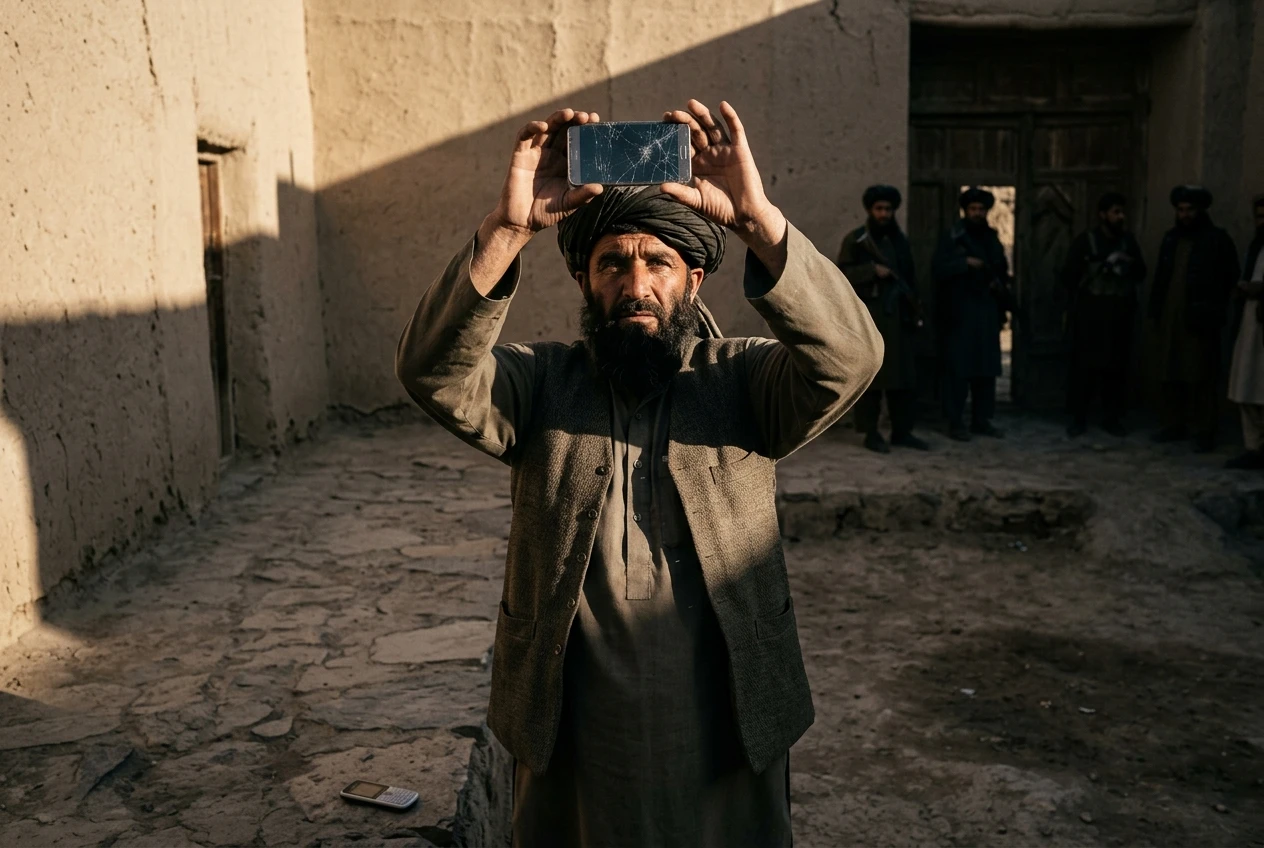
Phone-smashing is now the image attached to the order. In the report on destroyed phones, KabulNow said a video circulated showing a Taliban member destroying his smartphone. The same report said the police chief of Barmal district in Paktika province and 14 personnel under his command had destroyed their smartphones.
The two reports cover different pieces of the same episode. Afghanistan International lays out the document, the military court chain and the monitoring list. KabulNow names the circulating video and the Barmal phone destruction.
The Messaging Habit Predates the Ban
A former restriction on Taliban accounts already showed how much of the administration had moved to messaging apps. KabulNow reported in 2023 that Meta, the parent company of WhatsApp, had blocked or temporarily deactivated numerous WhatsApp accounts belonging to Taliban officials and soldiers because of US sanctions. It said those officials and soldiers used WhatsApp and Telegram for communication and coordination.
The details in a New York Times account reprinted by Caliber were more granular. The account said departments used WhatsApp groups to disseminate information among employees. It also said officials used other groups to distribute statements to journalists and transmit official messages between ministries through the group-chat system behind official work.
Security forces, the same account said, planned and coordinated raids on Islamic State cells, criminal networks and resistance fighters from phones on the app. Shir Ahmad Burhani, a police spokesman for the Taliban administration in Baghlan Province, said all of his work depended on WhatsApp and said administrative and nonadministrative work would be paralyzed without it.
AP’s October 2025 outage story showed the practice reaching outside Afghanistan’s borders. It said the Taliban sometimes communicate with Pakistani journalists through an official WhatsApp group, and it later confirmed with group administrators that the group’s response saying cellphone services were gradually being restored was genuine.
Afghanistan’s Mobile Baseline Gives the Order Reach
DataReportal said its Digital 2026 figures use the latest available data in October 2025. Its Afghanistan’s mobile and internet figures put the network in concrete terms. The numbers do not say how many Taliban employees own smartphones.
- 22.4 million cellular mobile connections were active in Afghanistan in late 2025, equivalent to 50.7 percent of the population.
- 11.3 million individuals used the internet in Afghanistan at the end of 2025, when online penetration stood at 25.5 percent.
- 5.00 million social media user identities were active in Afghanistan in October 2025, equivalent to 11.3 percent of the population.
- 84.1 percent of mobile connections in Afghanistan were considered broadband, meaning 3G, 4G or 5G mobile networks.
DataReportal added cautions that matter here. Some mobile connections may include only voice and SMS, and broadband mobile connections should not be treated as a proxy for mobile internet use. The reported Taliban order covers smartphone use inside Taliban and government ranks, not every mobile connection in Afghanistan.
Earlier Restrictions Moved Through Workplaces and Networks
The June order is part of a sequence of device, platform and connection controls reported since 2025. The records move from Akhundzada’s residence to campuses, social platforms, fibre lines and government workers. Each measure draws a different boundary around technology use.
The timeline below uses the publication dates printed on the reports. It includes reports that cite Taliban documents, officials, sources or affected residents. It also separates orders from restrictions that Taliban authorities had not publicly commented on in the source account.
- September 22, 2025: Afghanistan International said Akhundzada had banned smartphones and regular mobile phones around his residence in Kandahar and relied on radio communication instead of mobile or internet services.
- October 4, 2025: Afghanistan International said the Taliban’s Ministry of Higher Education had banned professors and administrative staff below grade four from using smartphones at universities and banned students from using smartphones inside universities.
- October 8, 2025: Afghanistan International said access to Facebook, Instagram and TikTok had been restricted across several provinces, while residents said WhatsApp and YouTube remained accessible.
- May 11, 2026: Afghanistan International said sources at fibre-optic internet companies in Kabul reported an order for regulators to cut residential fibre internet services across the capital.
- June 8, 2026: Afghanistan International said it obtained a document showing the new verbal order barring smartphone use by Taliban members and government employees.
AP reported another version of the same technology squeeze in Balkh province. In the Balkh fibre ban explanation, a provincial government spokesman said the Taliban leader had banned fibre optic internet to prevent immorality. AP said the ban left government offices, the private sector, public institutions and homes in northern Balkh without Wi-Fi, while mobile internet remained functional.
Afghanistan International also reported that Akhundzada ordered a nationwide telecommunications and internet shutdown on 29 September 2025. It said the blackout cut Afghanistan off for more than 48 hours, disrupting banking, customs, airports and money transfer services before access was restored on 1 October.
Who Is Covered, and Who Still Depends on Phones
The reported June order has a narrow named target: group members and government employees. It is described as a verbal order. It is enforced, according to the reports, through military courts, monitoring lists and follow-up forms.
The communications record around it is wider. Older reports place WhatsApp in government departments, media distribution, security coordination and press communications. They also show the Taliban trying to limit internet access by user, platform and connection type.
That leaves a simple line in the record: the phone can be smashed on camera, while the administration’s older communications record still points back to phones.


South Korea Retail Investors Face Reckoning After KOSPI AI Rally Collapses

Surrey AI Maps Three Heart Attack Paths and Their Molecular Roots

Germany Locks Neutral Apple ATT Prompts Across Most of Europe

Apple’s 5% EU Fee Quietly Rewrites Alternative App Store Math

Apple’s EU Fee Truce Cuts Complexity but Leaves Rivals Fuming

Pixel 11 Pro Fold Trades Thinness for Durability and Seven-Year Stay

Mayo AI Flags HCM Obstruction From Everyday Ultrasound Videos

Indian Brands Quietly Scale Landmark Screens and Home Tech

Navin Vatsa Turns Grief Into a Lifetime of Quiet Seeing

Google Bets Pixel 11 Agentic AI Will Redefine Phones

Oracle Cuts 21,000 Jobs in a Year, Cites AI in 10-K Filing

Fable 5 and Mythos 5 Return as US Lifts Anthropic Export Controls

SpaceX’s Google Deal Turns a Rocket Company Into a Cloud Landlord

CD Projekt Red Co-CEO: Redemption Arc Isn’t Done, Witcher 4 in 2027

XPL Rallies 30% Ahead of Plasma One Card Tier Launch

Google Search Profiles Build a Follow Graph Inside Discover

DGO App Brings Rs 549 Mobile Pass for FIFA World Cup 2026 in Nepal

Moonshot AI Targets $30 Billion in China’s Fastest AI Funding Sprint

Oppo’s ColorOS 17 Eligibility List Leaves A-Series Buyers Behind

Microsoft Xbox Layoffs Start in July as Sharma Slams 3% Margin
-
 AI2 months ago
Oracle Cuts 21,000 Jobs in a Year, Cites AI in 10-K Filing
-
 AI2 months ago
Fable 5 and Mythos 5 Return as US Lifts Anthropic Export Controls
-
 AI2 months ago
SpaceX’s Google Deal Turns a Rocket Company Into a Cloud Landlord
-
 GAMING2 months ago
CD Projekt Red Co-CEO: Redemption Arc Isn’t Done, Witcher 4 in 2027
-
 CRYPTO2 months ago
XPL Rallies 30% Ahead of Plasma One Card Tier Launch
-
 NEWS2 months ago
Google Search Profiles Build a Follow Graph Inside Discover
-
 APPS2 months ago
DGO App Brings Rs 549 Mobile Pass for FIFA World Cup 2026 in Nepal
-
 AI2 months ago
Moonshot AI Targets $30 Billion in China’s Fastest AI Funding Sprint