
AI
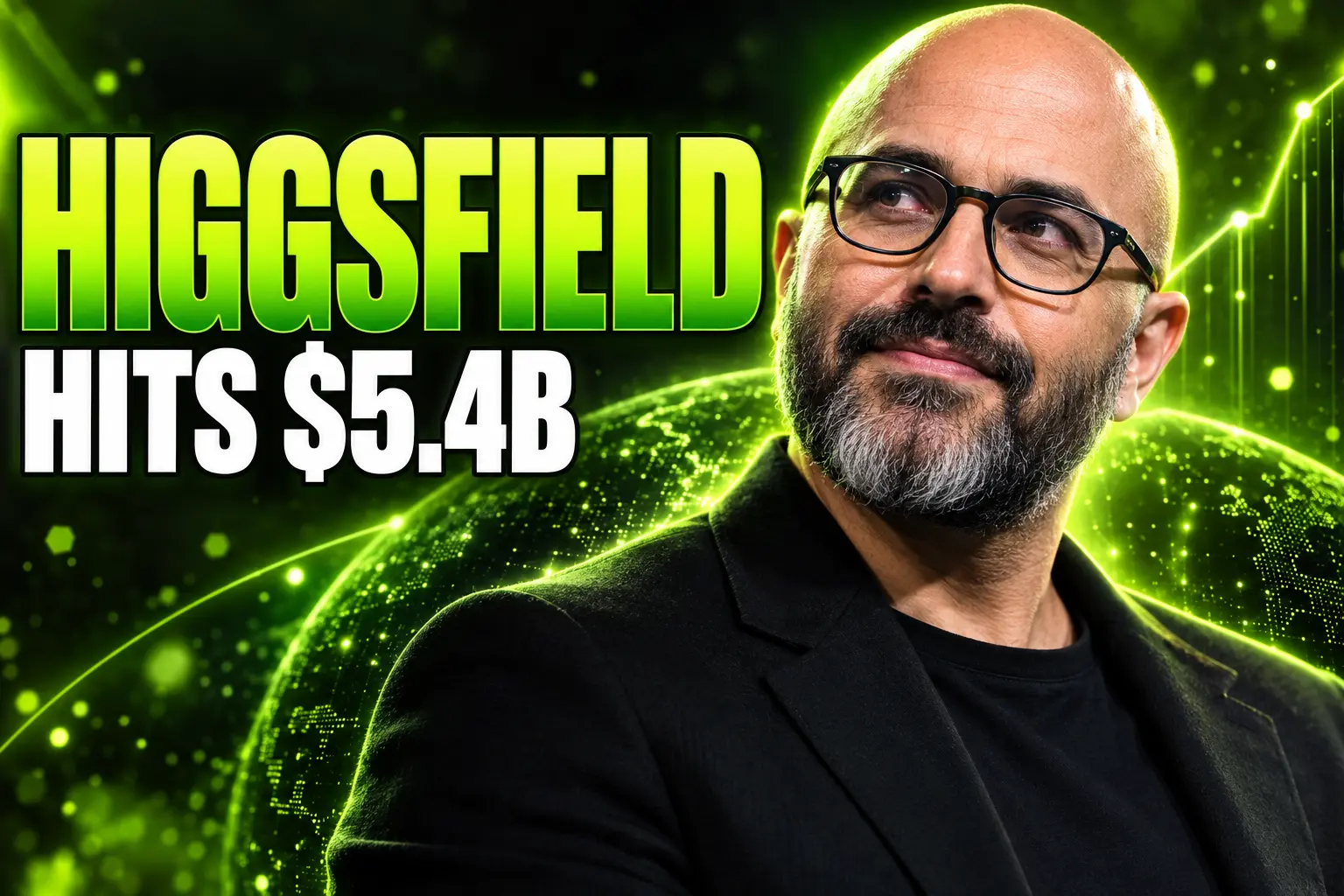
Intel and Goldman Buy Higgsfield at $5.4 Billion
Higgsfield’s $5.4 billion Series B pulled Intel and Goldman into a video routing layer whose real cost is scarce compute, not a single model.

Higgsfield closed a $400 million Series B at a $5.4 billion valuation on August 17, with Intel Capital and Goldman Sachs among the new names on the list. DST Global led. The San Francisco company, founded in 2023 by former Snap generative-AI chief Alex Mashrabov, now posts a $700 million yearly run rate.
The price more than quadrupled the $1.3 billion mark from January. The buyers did not show up for a single video model. They showed up for the layer that routes many of them, and for the power bill that layer runs.
The Cap Table Reads Like a Supply Contract
Higgsfield’s own release listed a 400 million Series B financing and then said the quiet part: strategic checks came from compute, connectivity, distribution, media, and advertising. That is a shopping list, not a fan club.
WHO BOUGHT THE PIPES
- Intel Capital: The chipmaker’s fund joined as the compute name on a platform whose founder says power is already scarce.
- Liberty Global Tech Ventures: The cable group’s venture arm buys connectivity into the same video pipe.
- NTT DOCOMO Ventures: The mobile carrier’s fund adds a distribution route in Asia.
- Smash Capital: Kevin Mayer, the former Disney executive who chairs the firm, put media on the register.
- Goldman Sachs Alternatives: Growth Equity at the bank wrote a late-stage check, not a seed bet on a demo.
Tribe Capital, Fifth Wall, Valor Capital, and Mirae Asset Capital joined. Accel, Menlo Ventures, GFT Ventures, AI Capital Partners, Capra Ventures, BAM Corner Point, and BroadLight Capital followed on from earlier rounds. Natalia Vodianova Arnault, the model and impact investor, came in as an investor and adviser.
Seed money was $8 million in April 2024, led by Menlo Ventures. A $50 million Series A landed in September 2025, then an $80 million extension in January 2026. Add the new $400 million and the stack is $538 million. Yuri Milner’s DST Global sat at the front of this round. Mayer used his line to talk about a new creative medium, which is the Hollywood gloss on a cap table that is mostly pipes and chips.
Intel Is Paying for the Routing Layer
Intel Capital published its note on August 19, under Avi Bharadwaj, Alexandra Farmer, and Erica Van. The fund did not describe Higgsfield as another app on top of someone else’s weights. It described a switchboard.
We don’t think of the company as simply another application sitting on top of video models. Higgsfield is building what we think of as AI harnesses for video.
Avi Bharadwaj, Alexandra Farmer and Erica Van, Intel Capital
The same note is blunt about why that harness matters. Dozens of video models are good at different jobs, photorealism in one, camera control in another, lip sync in a third, and the winner this month may not be the winner in six. Higgsfield, they wrote, can fold in AI harnesses for video without betting which model lasts. “Higgsfield doesn’t have to predict which video model ultimately wins.”
That sentence is the Intel interest. Training clusters already ran away to Nvidia. Inference on short, messy, multi-model video jobs is the load Intel still wants. A platform that stitches models, retries, and edits on behalf of a brand is a customer for that load, whether the underlying chip is Intel’s or not. The investment buys a front-row seat on the demand.
390 of the Fortune 500 Are Already Inside
Mashrabov told interviewers the mix flipped this year. “Today, most of our revenue comes from businesses, which is a significant change from January, when business customers accounted for less than 25 per cent of revenue.” The United States is the largest of 238 countries and territories on the user map.
THE SCALE BEHIND THE PRICE
- Yearly run rate: $700 million in August 2026, up from about $20 million a year earlier.
- Reach: More than 30 million users, with the United States the largest market.
- Accounts: Higgsfield says it already powers visual work for 390 of the Fortune 500.
- Agents: Users of its agent products rose 42-fold in the three months after Supercomputer shipped in May, to more than 20 million generations a month.
Those figures are the company’s. They are also why a growth-equity desk and a chip fund could clear $5.4 billion on a firm that launched its browser product in 2025. Goldman Sachs Research has put the creator economy’s addressable market on a path from $250 billion in 2023 to $480 billion by 2027. Higgsfield is trying to bill the brands that feed that market, not the hobbyists who used to fill the timeline.
Dollar Shave Club is one named example from the company’s own telling: daily video, not a once-a-quarter spot. Social teams use the same tools to keep up with post cadence and to cut the agency line. Mashrabov’s upmarket line is the same motion in plainer words. The new cash, he said, is for enterprise products, security, and computing power.
What Supercomputer Changed After May
Supercomputer is the agent layer, not another filter pack. Higgsfield’s own help page describes a chat-driven Supercomputer agent that breaks a brief into steps, picks a model for each step, and runs the chain. That is the harness Intel wrote about, shipped as a product.
The 42-fold jump in agent users is the adoption curve the cap table paid for. It is also a compute curve. Every extra retry, every extra model in the chain, lands on a GPU somewhere. Mashrabov has already said the quiet constraint out loud.
After the round closed, the company kept wiring the same agent into other people’s tools. On September 11 it launched Higgsfield AI Motion Designer as a ChatGPT plugin that writes After Effects expressions inside live projects. That is not a consumer toy. It is the routing layer reaching into the seats agencies already occupy.
A $2 Million Film With the Files Left Open
A week before the round, Higgsfield posted The Cully Hill Boys, a 110-minute feature it says it made on the platform for $2 million, with a real cast, on Seedance. Israel Adesanya, Quinton “Rampage” Jackson, and the streamer N3on are in it. The company open-sourced the lot and said the prompts and assets are public.
We made the first 110-minute AI feature film with a real cast, The Cully Hill Boys, on Higgsfield for $2,000,000.
Starring @N3onOnYT, @stylebender, @RampageJackson, and @MKIATPIS
It's 100% open-sourced on Higgsfield: all prompts and assets are public now.
Made with Seedance… pic.twitter.com/FqW5EKihKP
— Higgsfield AI 🧩 (@higgsfield_ai) August 10, 2026
The production notes are more useful than the trailer. Shots were text-to-video only, no start frame, except one Cadillac fight that would not generate: limbs fused, the gun jumped hands. The crew filmed stunt performers on an iPhone and used that plate as motion reference. Character sheets were three panels with the faces cut off the wide shots so the model could not copy a soft, tiny head. The voice block was pasted unchanged every time, down to the phonetic accent, because a synonym made the voice drift.
The first replies called a $2 million picture slop. That insult skips the mechanical point. A cheap AI feature still needed a day of phone footage when two bodies met in a car. The harness does not erase physics. It hides the retries until physics wins, and then a human walks onto a lot with a phone.
Compute Reservations Eat the New Cash
“Compute is scarce and the funding will enable us to make substantial compute reservations so that we can offer a best-in-class service,” Mashrabov said. That is the use of proceeds that matches Intel’s presence. Research, hiring, and global sales are on the list too. The scarce item is the one he named first.
Video generation already costs more to run than text or stills. Higgsfield’s product makes that worse on purpose, because a good clip is several models, several retries, and an edit pass. The company sells that chain as a simple product. Someone still pays for the chain.
Some production shops have started moving work off the platform onto local and open models, to cut the monthly inference bill and to dodge outages. That is the other side of a $700 million run rate. Credits scale with use. Use scales with retries. Retries scale with quality. The same loop that mints revenue mints a power invoice, and the new money is earmarked to pre-book the capacity so the invoice does not become a queue.
The Other $5.3 Billion Went to World Models
Runway, the older dedicated video lab, raised $315 million in February at $5.3 billion and said the cash was for world models, the systems meant for robotics, medicine, and games as much as for ads. Nvidia and AMD sat on that round. Higgsfield, six months later, printed a price $100 million higher and pointed at brands, agencies, and the Fortune 500.
THE TWO VIDEO CHECKS
| Company | Round | Amount | Valuation | Stated aim |
|---|---|---|---|---|
| Runway | Series E, February 2026 | $315 million | $5.3 billion | World models beyond commercial video |
| Higgsfield | Series B, August 2026 | $400 million | $5.4 billion | Route many models for brands and studios |
Almost the same price bought two different companies. One is leaving the commercial-video lane it helped open. The other is trying to own that lane as a switchboard, with a chip fund, a bank, a cable group, and a Disney veteran on the same term sheet.
Mashrabov previously co-founded AI Factory, the computer-vision shop behind Snapchat Cameos and face filters, which Snap bought in 2019. He knows the consumer toy cycle. This raise is the opposite trade: lock in the buyers who already have a media budget, then reserve the chips those buyers will burn.
Frequently Asked Questions
Who Founded Higgsfield AI?
Alex Mashrabov is co-founder and chief executive, Yerzat Dulat is co-founder and chief technology officer, and Mahi de Silva is co-founder and chief strategy officer. Mashrabov ran generative AI at Snap after selling it AI Factory. Dulat is also running a STEM program in eight rural schools in Central Asia as part of the company’s education push.
How Does Higgsfield Supercomputer Pick Models?
The agent can auto-route each step or let a user pin a chat model from Anthropic, OpenAI, Google, xAI, DeepSeek, and others, then call Higgsfield’s own image, video, and audio models for the creative pass. Connectors already publish to X, Threads, and Instagram, 32 tools across those three, so a finished clip can leave the workspace without a separate upload grind.
How Does Higgsfield Charge for Video?
It sells credits and monthly bundles rather than charging mainly by seat, so the bill moves with how many generations a team runs. Sacra, the private-company research shop, has described a credit pack around $30 covering work that used to cost about $10,000 and weeks of traditional production, with Team and Enterprise shared workspaces added in November 2025 for agencies and in-house studios.
Does Higgsfield Train One Video Model?
No. The enterprise workspace lists 50-plus models in one login, including Higgsfield’s Soul image model, its Cinema Studio and DoP camera tools, ByteDance’s Seedance, and Google’s Veo, with plugins that drop generations into Adobe Premiere Pro, After Effects, Photoshop, DaVinci Resolve, and Figma. The product is the routing and the workspace, which is why Intel Capital framed the company as a harness rather than as a lab racing one set of weights.
Mashrabov said the new money will buy compute reservations so the service holds up. That reservation is the asset Intel just paid to sit beside.
Disclaimer: This article is news reporting and analysis of a private financing, and it is for information only. It is not investment advice, a solicitation to buy or sell any security, or a recommendation of Higgsfield, Intel, Goldman Sachs, or any other name mentioned. Readers who are considering an investment in private or public technology companies should consult a licensed financial adviser who can review their own facts. Valuation, revenue, and customer figures here reflect company statements and investor notes as published around the August 17, 2026 round and may change in later filings or updates.

Instagram Plus Tests a Read-Only Mode That Cuts Stories

Altman Asks the Public to Accept Some AI Harm

Google Freezes OSS VRP Product Reports After AI Flood

AI Agents Make Payment Rails the Scarce Prize

Turkey’s Crypto Boom Now Runs Through Three Banks

Fable 5 Came Back Under a Commerce On-Off Switch

Google’s SpaceX GPU Lease Has a Sept. 30 Deadline

Plasma One’s XPL Locks Face a 1.81 Billion Cliff

DGO’s Rs 549 World Cup Pass Cost Fans Sleep and Data

Moonshot AI’s $30 Billion Ask Became a $35 Billion Close
-
 AI4 months ago
Fable 5 Came Back Under a Commerce On-Off Switch
-
 AI4 months ago
Google’s SpaceX GPU Lease Has a Sept. 30 Deadline
-
 CRYPTO4 months ago
Plasma One’s XPL Locks Face a 1.81 Billion Cliff
-
 APPS4 months ago
DGO’s Rs 549 World Cup Pass Cost Fans Sleep and Data
-
 AI4 months ago
Moonshot AI’s $30 Billion Ask Became a $35 Billion Close
-

 NEWS4 months ago
ColorOS 17 Device List Spans Oppo, OnePlus and Realme
-

 GAMING4 months ago
Xbox Cuts 3,200 Jobs After Five Years of Thin Returns
-
 GAMING4 months ago
The RTX 4050 Under Rs 70,000 Hides a Wattage Gap