
AI
Sterlite’s $1.11 Billion AI Award Still Has to Ship
Sterlite Technologies prints a 52-week high near ₹897 after a $1.11 billion US hyperscaler award whose cash still sits in purchase orders through March 2029.

Sterlite Technologies closed at ₹897.40 in mid-September, a 52-week high, after a $1.11 billion U.S. hyperscaler award that still has to become purchase orders through March 2029. The Vedanta Group optical-fiber maker had already rallied more than 530% by early June. On June 8 the stock hit the 5% lower circuit at ₹588.30 when global AI names sold off. It then ran to ₹897.45.
Data-center work is no longer a footnote. In the quarter ended June 30 it was 21% of sales, up from 1% in FY26, and North America was 54%. The award is real. So is the wait.
A $1.11 Billion Award That Is Still Mostly Paper
On May 22 a subsidiary received a multi-year Product Award Letter from a hyperscale partner for optical connectivity used in U.S. AI data centers. STL put the potential value at $1.11 billion (more than ₹10,000 crore) on prevailing selling prices, with supply allocated across FY27 to FY29 and execution running to March 2029. Purchase orders are to be released along the way, not as one invoice.
WHAT THE AWARD LETTER ACTUALLY SAYS
- The value: About $1.11 billion of optical connectivity products, priced at current selling rates, not a fixed take-or-pay cheque.
- The calendar: Product is allocated from FY27 through FY29, and the work is scheduled through March 2029.
- The orders: Purchase orders will be issued in pieces during the contract period rather than booked in full on day one.
- The risk clause: Both sides accepted capped liabilities if demand falls short or if supply capacity runs short.
- The job: The kit is for AI data-center build-outs in the United States, not BharatNet.
Managing Director Ankit Agarwal tied the letter to U.S. campuses, not to a software story.
Under this agreement, STL, through its optical solutions, will support building AI data center infrastructure in the US for this hyperscaler. We are enabling connectivity backbone for the AI data centers.
Ankit Agarwal, Managing Director, STL, May 22, 2026 award statement
Nomura analysts led by Akash Gupta had already described a two-to-four year wait for some data-center parts, with orders taken now showing up as revenue between 2027 and 2029. The PAL fits that clock. It also writes down what happens if the hyperscaler slows.
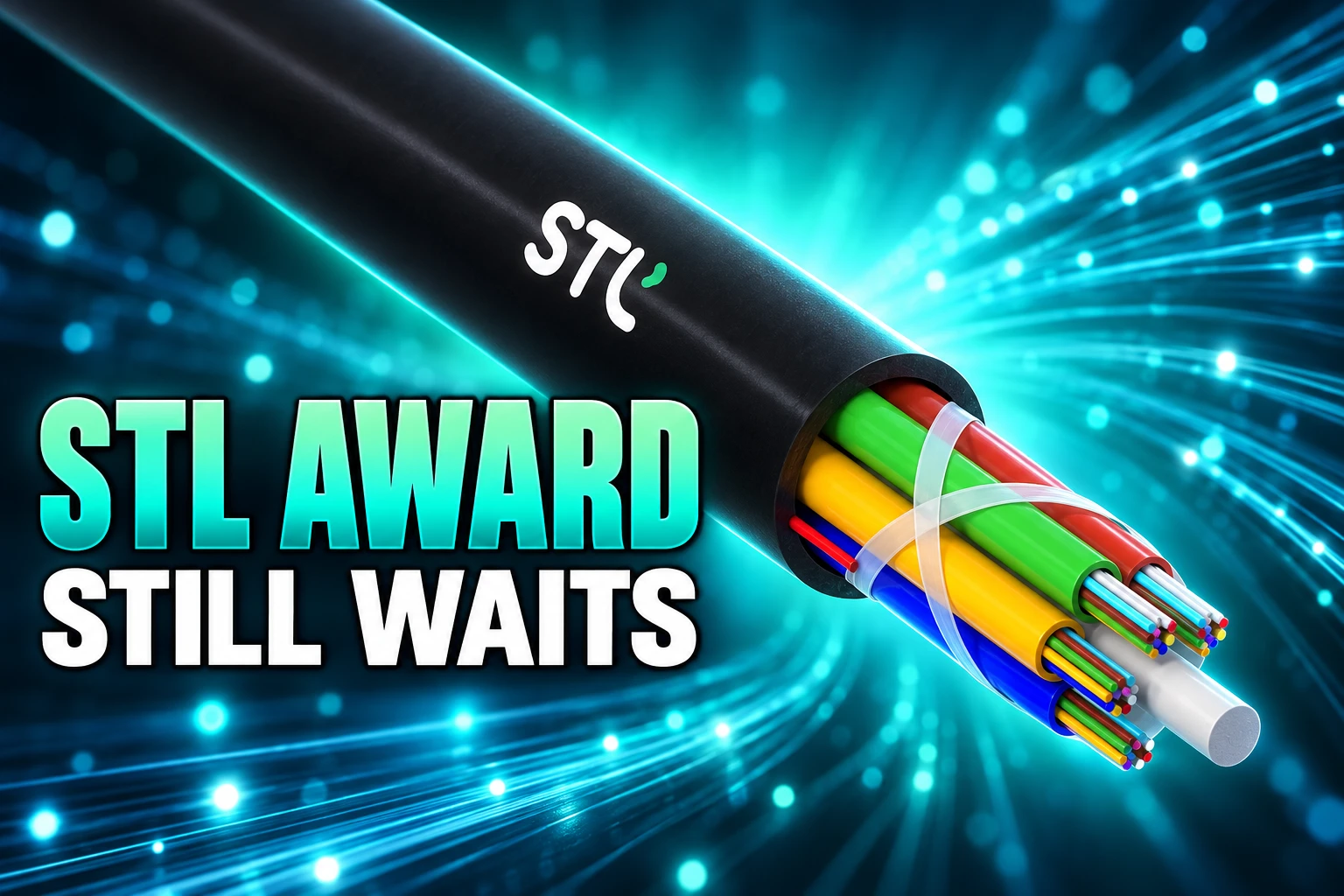
Data Centers Went From 1% of Sales to 21%
The June quarter was the first full look at whether the mix was moving. STL posted its highest-ever quarterly revenue and EBITDA from continued operations: ₹1,910 crore of sales, up 87% from ₹1,019 crore a year earlier and 33% from ₹1,441 crore in the March quarter. EBITDA was ₹397 crore, up 184% from ₹140 crore, at a 20.8% margin, the best in nearly 20 quarters. Profit after tax was ₹197 crore, against ₹10 crore a year earlier and ₹59 crore in Q4.
Q1 FY27 IN FOUR FIGURES
- Order intake: ₹13,100 crore in the quarter, 1.7 times the ₹7,687 crore won in all of FY26.
- Open book: ₹18,618 crore, which the company called 2.4 times the prior quarter’s ₹7,309 crore.
- Near-term work: ₹2,228 crore marked for Q2 FY27, with ₹16,390 crore sitting in Q3 and later.
- Balance sheet: Net cash of ₹483 crore after a ₹1,500 crore qualified institutions placement that was subscribed more than 2.5 times.
Group CFO Ajay Jhanjhari told the July 24 earnings call that data centers contributed 21% of quarterly revenue, up from 1% in FY26, and that the combined data-center and enterprise slice should reach 50% of FY27 sales, above the 30% guide given last quarter. North America rose to 54% from 39% in FY26. Europe was 25%. The rest of the world was 22%. CRISIL moved its outlook to Stable. ICRA lifted the rating to AA Stable.
The product sitting under those numbers is the Neuralis AI data-center portfolio, including Celesta intermittently bonded ribbon cables with up to 6,912 fibers and MMC pre-terminated trunks that US Conec certified at three times the density of older MPO connectors. STL’s own page says a single AI cluster can need 50,000 to 100,000 optical connections. Beside the $1.11 billion PAL, the company booked more than $100 million of extra hyperscaler orders for Neuralis.
Agarwal called Q1 the strongest quarter in STL’s history and raised full-year EBITDA-margin guidance to 23%. On television he said data-center EBITDA margins can run 25% to 30%, against about 20% in telecom, and that the firm will put about ₹1,500 crore of capex to work over three years, roughly ₹500 crore a year, to debottleneck glass, fiber, cable, and connectivity lines. Capacity, he said, is already tight enough that new orders are being taken selectively.
The June Circuit Did Not End the Trade
By early June the stock was already up more than 530% for the year and had become the poster child for what Mumbai desks were calling the AI capex trade. R. Sivakumar, chief investment officer at Axis Mutual Fund, put the split in one line: India might be on the wrong end of the AI software trade and still on the right side of the capex chain. Then the global AI sell-off arrived.
THE PATH FROM THE AWARD TO THE HIGH
- May 22, 2026: Subsidiary receives the $1.11 billion Product Award Letter for U.S. AI data-center connectivity through March 2029.
- June 8, 2026: STL locks the 5% lower circuit at ₹588.30. HFCL hits ₹177.85. MTAR Technologies falls more than 8%.
- July 24, 2026: Q1 FY27 results land, with ₹1,910 crore of sales, a ₹18,618 crore book, and a 21% data-center mix.
- September 9-13, 2026: The stock prints a 52-week high of ₹897.45 and last traded at ₹897.40, with a 52-week low of ₹84.6. One-year return: 679.60%. Six-month return: 370.88%. Market cap: ₹46,132 crore.
From the June 8 close at ₹588.30 to ₹897.40 is a 52.5% rebound. Trailing earnings still look thin against that price: Arihant’s multiple on September 13 was 154.78 times. Forward earnings are a different quantity, 38.39 times on the September 11 quote, after the profit jump. Foreign holders were 18.2% as of June, with promoters at 44.5%, domestic institutions at 11.4%, and the public at 25.8%. In early June, Angel One had already warned that rallies left little room for missed execution. That warning aged into a higher high.
Who Else Is Collecting on the Same Build-Out
STL is the loud name. It is not the only one. HFCL last traded at ₹233.69, up 232.51% over 12 months, with a trailing multiple of 75.31 and a ₹35,769 crore market cap. MTAR, which sells precision cooling and power parts, last traded at ₹7,312.50, up 377.29% over 12 months, at 168.82 times trailing earnings and a ₹22,493 crore cap. Anant Raj, the listed data-center landlord, last traded at ₹608.70 on September 10, up 15.2% over 12 months, with a ₹21,910 crore cap. The operator of the buildings lagged the people who sell fiber, cable, and cooling into them.
HOW THE AI-CAPEX NAMES COMPARE
| Company | Last price | 1-year return | Market cap (₹ crore) |
|---|---|---|---|
| Sterlite Technologies | ₹897.40 | 679.60% | 46,132 |
| HFCL | ₹233.69 | 232.51% | 35,769 |
| MTAR Technologies | ₹7,312.50 | 377.29% | 22,493 |
| Anant Raj | ₹608.70 | 15.2% | 21,910 |
By early June an equal-weighted basket of 28 Indian data-center suppliers had added about $47 billion of market value, a rise of nearly 50%, while the NSE Nifty 500 had lost more than $300 billion in 2026. Foreign funds’ stake in industrials had risen to 14% by end-March, the highest in two years, even as global funds were heavy sellers of Indian equities overall. Many of the winners, STL and MTAR among them, still sit outside the broadest domestic indexes, so the move does not show up in headline Nifty math. That is the same split already mapped in the industrial stocks in the AI capex trade: the capex chain rerated while the listed landlord barely moved.
The name-hunt on trading desks has already left STL and HFCL behind as the obvious pair. Cooling and heat-exchange names, transformer makers, and chip-packaging lines are the next tickets. Fiber is being treated as a second bottleneck after power, which is why a plenum rating now moves the stock.
Cummins Now Gets 14% of Sales From Data Centers
Agarwal told investors that Indian installed data-center capacity is set to grow from 1.6 gigawatts to almost 10 gigawatts by 2031, citing Morgan Stanley, and that Meta and Reliance had sketched 3 gigawatt plans while AirTrunk had talked about close to 5 gigawatts in Maharashtra and Andhra Pradesh. Jefferies has put a $45 billion capex tag on a five-year run toward 10 gigawatts. CRU, the metals and cable researcher, projects 63% growth in optical-cable demand from data centers in 2026 alone. North American installed capacity is expected to double from 63 gigawatts in 2025 to 126 gigawatts by 2030. Morgan Stanley lifted its hyperscaler capex forecast from $765 billion to $805 billion.
The campuses themselves are no longer slideware. Google Cloud CEO Thomas Kurian announced a $15 billion Visakhapatnam AI hub for 2026-2030, a gigawatt-scale campus plus a new eastern subsea gateway. On April 28 Google, AdaniConneX, and Nxtra by Airtel broke ground on the Vizag campus at Tarluvada, on 601 acres set aside for three data-center sites. Jeet Adani, a director of the Adani Group, said the site is nearly 1 GW in a single location. On June 25 Amazon added $13 billion for AI and cloud kit in India through 2030, taking its 2026-30 plan to $48 billion, aimed at AWS capacity in Mumbai and Hyderabad. Microsoft has a $17.5 billion India cloud-and-AI pledge. Reliance had already signed an $11 billion local data-center joint venture.
WHERE THE OTHER BILLS GO
- Backup power: Cummins India took 14% of FY26 revenue from data centers, up from less than 2% seven years earlier. That is a different cut from the 30% to 35% share of its domestic power-generation sales, which Mint’s math put at up to ₹1,665 crore. As of June it had 55% of generator sets sold into Indian data centers.
- Grid kit: Hitachi Energy India’s order backlog hit ₹322 billion in the June quarter, with data centers among the largest sources of fresh work.
- Cables: Finolex Cables CEO Mahesh Viswanathan told an earnings call in the spring that it was the right time to be in the industry; the stock was up nearly 36% year to date as of early June.
Nomura’s June note still stands as the industrial frame: the attractive exposure is the supply chain that builds, powers, and cools the halls, and the cycle is larger than the global 4G rollout, the post-2008 LNG build, or the early-2010s shale boom. The binding constraint is no longer whether hyperscalers will spend. It is whether the grid, transformers, and water show up on time, the same power limits on India data-center stocks that already sit on the operator names.
Lakshya Wants Four Times FY26 Revenue
FY26 sales were ₹4,745 crore, with EBITDA of ₹628 crore and a 13.2% margin. Under Project Lakshya the company is aiming for ₹20,000 crore of revenue by FY29, about 4.2 times that FY26 base, and for EBITDA margins above 27%. That is the number the multiple is now underwriting. Q1 annualised is still a long way from ₹20,000 crore. The ₹18,618 crore book, if executed cleanly, is the bridge.
STL also said it has more than 785 patents and that it won a European patent fight with Fujikura over the Celesta cable family. In September it added a U.S. Optical Fiber Nonconductive Plenum certification for 48-fiber to 576-fiber IBR pre-terminated trunks, the fire rating needed to run cable in air-handling spaces inside American halls. That certificate does not create demand. It removes a door that U.S. campuses can shut. On September 11 the company account put the product claim in one line: every extra GPU adds connectivity complexity, and Neuralis is the attempt to simplify high-density whitespace.
Every additional GPU creates more connectivity complexity.
STL Neuralis helps simplify high-density whitespace connectivity through integrated cable and connectivity architectures engineered for AI environments.Yotta 2026 pic.twitter.com/49gF499vJk
— STL – Sterlite Technologies Limited (@STL_Tech) September 11, 2026
Rahul Puri, chief executive of the optical networking business, said the US Conec MMC certification was a response to customers who want density, speed of install, and a vendor that can run from glass to the rack. The science is no longer the gap. Utilisation of the new capex is.
What the Award Letter Leaves Open
The PAL is not take-or-pay. Purchase orders still have to be cut, and both sides capped what they owe if demand or supply slips. Helium, germanium, and polyethylene costs were already eating gross margin on the July call. A 50% U.S. tariff on Indian optical-fiber imports had been flagged before the print as a drag; management did not restate a number in the Q1 release. Europe, Agarwal said, is still slow. Capacity is tight enough that the firm is choosing orders, which is a seller’s market until the ₹1,500 crore of new kit is in and utilised.
CLSA has kept an outperform view and a 50-times multiple on one-year forward earnings, with a ₹1,250 target on some September quotes, implying more upside from ₹897.40 if the book converts. Ravi Singh, chief research officer at Master Capital Services, said valuations look stretched and that a healthy correction would still leave a three-to-five-year structural case. Santosh Meena, head of research at Swastika Investmart, said trailing multiples leave little room if AI or telecom capex slows. Those are the same two books: a 2027-2029 revenue story, and a 2026 price.
STL hosts a Fierce Network session on September 15 with Tom Boswell of STL and Sudipta Bhaumik of ITU-T SG15. The next earnings date on the September 11 quote sheet is October 30. Between those dates the stock will trade as if the $1.11 billion is already in the till. The letter says the till fills when the purchase orders do.
Disclaimer: This article is news reporting and analysis of listed companies and market prices, and it is for information only. It is not investment advice, a recommendation to buy or sell any share, or a research report under Indian securities rules. Readers should consult a SEBI-registered investment adviser or a qualified financial planner before acting on any figure or view here. Prices, multiples, order books, and contract values reflect the company filings, exchange quotes, and statements cited above as of the dates given, and they can change with the next print, the next purchase order, or the next session.

Instagram Plus Tests a Read-Only Mode That Cuts Stories

Altman Asks the Public to Accept Some AI Harm

Google Freezes OSS VRP Product Reports After AI Flood

AI Agents Make Payment Rails the Scarce Prize

Turkey’s Crypto Boom Now Runs Through Three Banks

Fable 5 Came Back Under a Commerce On-Off Switch

Google’s SpaceX GPU Lease Has a Sept. 30 Deadline

Plasma One’s XPL Locks Face a 1.81 Billion Cliff

DGO’s Rs 549 World Cup Pass Cost Fans Sleep and Data

Moonshot AI’s $30 Billion Ask Became a $35 Billion Close
-
 AI4 months ago
Fable 5 Came Back Under a Commerce On-Off Switch
-
 AI4 months ago
Google’s SpaceX GPU Lease Has a Sept. 30 Deadline
-
 CRYPTO4 months ago
Plasma One’s XPL Locks Face a 1.81 Billion Cliff
-
 APPS4 months ago
DGO’s Rs 549 World Cup Pass Cost Fans Sleep and Data
-
 AI4 months ago
Moonshot AI’s $30 Billion Ask Became a $35 Billion Close
-

 NEWS4 months ago
ColorOS 17 Device List Spans Oppo, OnePlus and Realme
-

 GAMING4 months ago
Xbox Cuts 3,200 Jobs After Five Years of Thin Returns
-
 GAMING4 months ago
The RTX 4050 Under Rs 70,000 Hides a Wattage Gap