
AI
Three Indian AI Stocks Diverged in July. Here’s What Each One Actually Owns.
KPIT Technologies fell 15% on July 1, 2026. How Netweb Technologies India and Tata Elxsi compare as Indian AI stocks tied to enterprise software.

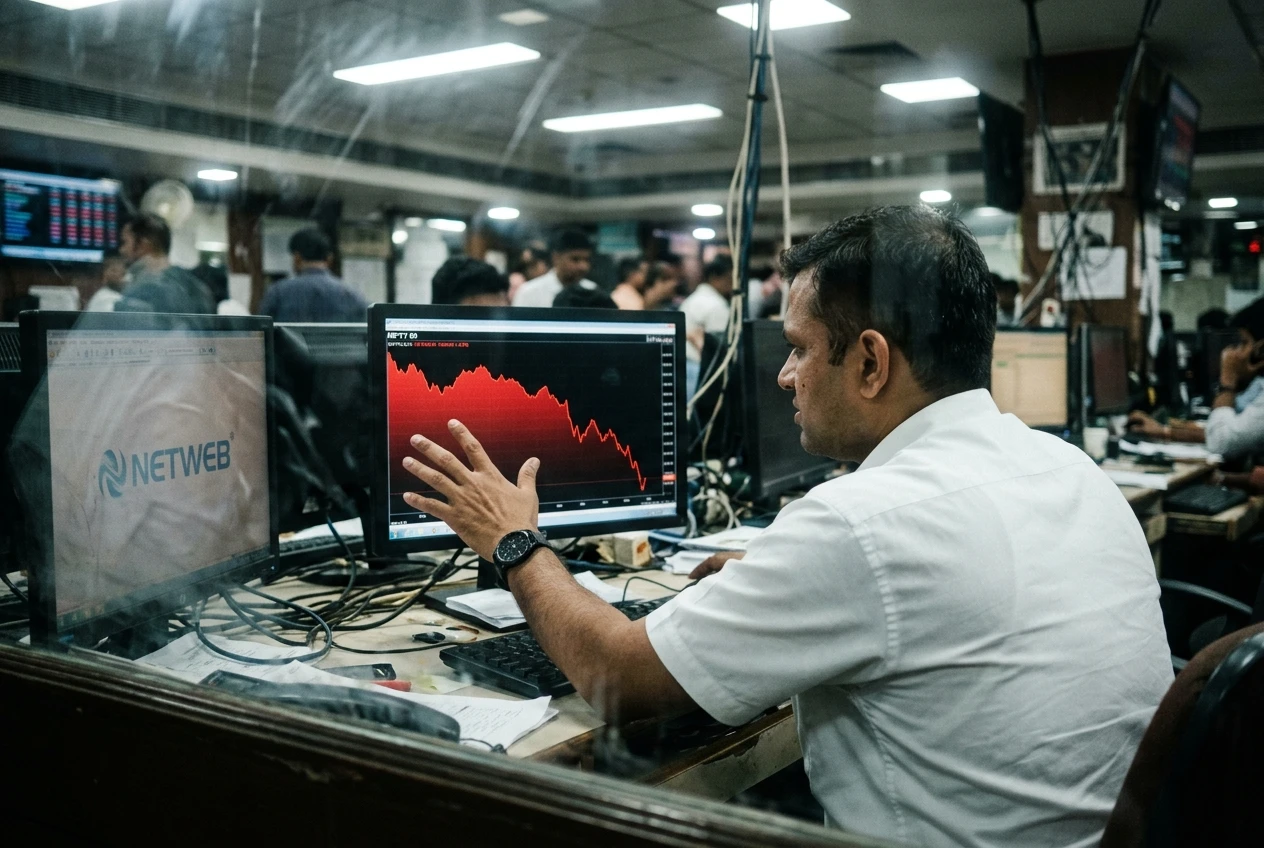
KPIT Technologies shares fell 15% in a single session on Wednesday, July 1, 2026. The drop took the stock to a fresh 52-week low of ₹570.75 on the BSE, leaving it down 57% from its September 18, 2025 high of ₹1,328.80. Business Standard reported that the selloff was triggered by KPIT’s own outlook for the first quarter of FY27, which flagged a roughly 1% decline in USD-reported revenue versus the same quarter a year earlier, with the shortfall blamed on sudden spending pullbacks by some European automakers.
For investors who treat KPIT, Netweb Technologies India, and Tata Elxsi as a single “Indian AI stocks” basket, the crash is a reason to look at each company on its own terms. All three sit in the same Simply Wall St AI screener because each has a defensible claim on the AI enterprise software shift. But the gap between the AI label and the actual revenue source is very different at each one, and that gap is what KPIT’s single-day wipeout just made visible.
The KPIT Wake-Up
KPIT’s warning came late and hit hard. According to the company’s exchange filing, the revenue shortfall in Q1FY27 reflects “sudden actions by some European OEMs triggered by their recent profit warnings/ adverse business outlook.” Moneycontrol reported that BMW alone contributes around 12% of KPIT’s revenue, which makes any pause in BMW’s technology programs a measurable drag on the company’s top line.
The collapse also broke a long streak. Nishchal Jain, a quant researcher at Share.Market by PhonePe, told Moneycontrol that the European cuts ended a 23-quarter streak of sequential revenue growth at KPIT. Operating profitability and net profit for Q1FY27 will decline sequentially by more than the revenue drop, the company said, because costs cannot be cut inside the quarter. JPMorgan responded by downgrading the stock to Underweight with a target price of ₹550, and JM Financial cut its rating to Reduce with a target of ₹620.
KPIT is not an AI outsider. In its Q1 FY26 release, the company reported total contract value of new engagements at $241 million, and CEO Kishor Patil pointed to “mobility infused AI solutions” as a strategic differentiator. Co-founder and Joint MD Sachin Tikekar said KPIT is building “mobility specific AI ‘Specialized Learning Models.'” Neither claim is in dispute. What the July 1 collapse shows is that the AI work runs through customer budgets that can be paused overnight, and when those budgets pause, the AI label does not protect the share price.
The mobility industry is going through a lot of fluctuations with geopolitical and tariff led uncertainties. We believe these will settle down in a quarter.
Kishor Patil, co-founder, CEO and managing director of KPIT, in the company’s Q1 FY26 results statement on July 30, 2025.
Netweb Sits on a Pipeline, Not a Quarter
Netweb Technologies India is the other end of the trade. Where KPIT faces cyclical customer budgets, Netweb is leveraged to a multi-year government program with a defined funding line. The IndiaAI Mission carries an outlay of Rs 10,371.92 crore over five years, according to a Lok Sabha answer from the government, and Netweb is one of the principal suppliers of compute infrastructure to that program.
In September 2025, Netweb secured a ₹1,734 crore order under the IndiaAI Mission for AI servers, The Hindu Business Line reported, plus a separate ₹450 crore AI order the same month, expected to be completed by FY26. By the end of Q3 FY26, Netweb had an order book of over ₹800 crore, with a ₹4,270 crore pipeline, the company’s investor disclosures show. Management has guided to a 30-40% revenue CAGR over the next two to three years, with an organic revenue CAGR of roughly 39% over FY25-28E according to research reports cited in Netweb’s investor materials.
The investment question is valuation. Yahoo Finance lists Netweb’s trailing P/E at 124.18 as of July 1, 2026, against a market capitalization of roughly ₹252.10 billion. The 1y Target Estimate on the same page is ₹4,674.67, close to the ₹4,427.40 closing price on July 3. The bull case rests on a steady drip of IndiaAI orders converting into revenue. The bear case is simpler: if the government’s GPU procurement pace slows, the second-largest source of orders in the queue gets pushed out, and that multiple compresses.
Tata Elxsi Looks Defensive, Until You Look Closer
Tata Elxsi delivered the cleanest FY26 print of the three. Operating revenue for Q4 FY26 came in at Rs 993.8 crore, with full-year revenue at Rs 3,757.4 crore, the company reported on April 21, 2026. Profit before tax grew 10.7% sequentially and 20.9% year over year at Rs 267.8 crore, with PBT margin at 25.6%. The board recommended a final dividend of 750%, or Rs 75 per share, for FY26.
The mix is more diversified than the AI label suggests. Media and Communications was 32.7% of Q4 revenue, the company’s own filing says, and grew 5.6% sequentially in constant currency. Transportation was the largest vertical overall, with OEM business representing 77% of transportation revenue. The US, which delivered 7.9% sequential growth in Q2 FY26, is the single biggest growth engine in the current quarter.
What the FY26 numbers underplay is that AI at Tata Elxsi is a productivity layer more than a product line. CEO Manoj Raghavan pointed to the launch of DevStudio.ai and “enterprise-wide GenAI adoption” in the Q4 release, but the company sells design and engineering services to automakers, broadcasters, and medical device firms, and uses AI to do those services faster. That model is far less exposed to a single European OEM pulling back, but it is also far less exposed to a sudden AI capex windfall. The stock has corrected to around ₹3,679 as of July 3, 2026 per Economic Times data, well below its August 2024 high of ₹9,080, which suggests the market has already priced some of that limit.
As we enter the next financial year, we remain focused on scaling our differentiated design-led and AI-enabled offerings, strengthening operational leverage, and driving sustainable growth and healthy margins.
Manoj Raghavan, CEO and managing director of Tata Elxsi, in the company’s Q4 FY26 results statement on April 21, 2026.
The Three Risk Loops, Side by Side
Each company runs on a different engine, and a different shock would break each one. The table below lines up where the AI revenue comes from, what kind of customer is on the other end, and what a quarter of bad news looks like at each company.
| Company | Primary AI revenue source | Customer loop | Most recent quarterly trigger |
|---|---|---|---|
| KPIT Technologies | Software for software-defined vehicles and ADAS | European OEMs including BMW, VW | Q1 FY27 profit warning, 15% one-day fall on July 1, 2026 |
| Netweb Technologies India | High-performance computing systems and AI servers | IndiaAI Mission and enterprise data center buyers | Order book of ₹800 crore at Q3 FY26, ₹4,270 crore pipeline |
| Tata Elxsi | Design and engineering services with embedded GenAI productivity | Automotive, media, medical device OEMs in the US and Europe | Q4 FY26 operating revenue Rs 993.8 crore, PBT margin 25.6% |
Read across the rows, the AI trade is not one trade. KPIT is a software services company whose customers can pause programs on a Tuesday. Netweb is a systems integrator whose order book depends on a small number of very large government decisions. Tata Elxsi is a design-led engineering firm whose AI exposure is mostly internal productivity passed on to clients, which is a quieter story but also a smaller one.
Where Each One Stands Heading Into Q2 FY27
- KPIT Technologies: JP Morgan target ₹550 (Underweight); JM Financial target ₹620 (Reduce); trailing 23-quarter growth streak broken on July 1, 2026.
- Netweb Technologies India: Trailing P/E 124.18 per Yahoo Finance as of July 1, 2026; market cap about ₹252.10 billion; ₹1,734 crore IndiaAI order secured in September 2025.
- Tata Elxsi: Full year FY26 operating revenue Rs 3,757.4 crore; PBT margin 23.4% for FY26; final dividend of 750% (Rs 75 per share) recommended.
The wider context matters too. India is in the early innings of a hyperscaler-driven capex cycle that has pulled optical fiber, transformer, and fuel cell suppliers far more than the named AI software names. An Indian 28-firm supply chain cohort tracked by Bloomberg has added roughly $47 billion in combined market value this year on Sterlite Technologies, MTAR Technologies, and HFCL, with much of that rally driven by hard orders from US hyperscalers rather than AI software thesis. The data center industrial trade has front-run the AI software trade for most of 2026.
What Would Actually Move Each One
KPIT needs a quarter where European OEMs re-up technology programs after the Q1 FY27 reset, or a meaningful shift of mix toward US and Asian clients before BMW’s next budget cycle. KPIT’s FY26 revenue was $724.8 million, with OEM revenue growing 9% for the year, so the underlying business has not stopped working; the market is discounting how long the pause lasts.
Netweb needs the next IndiaAI procurement tranche to land inside FY27, and ideally another order in the ₹1,000 crore range. The government has onboarded more than 38,000 GPUs under the mission, the IndiaAI Compute Capacity portal shows, but only a small share of the allocated ₹10,371.92 crore has been deployed so far. Each tranche that converts into a Netweb order is the thing that keeps the multiple from re-rating down to peer levels.
Tata Elxsi needs the US growth engine to keep printing. Revenue from the US grew 7.9% sequentially in Q2 FY26, and the company is also betting on Healthcare and Lifesciences as a third leg, with new centers opened for Terumo and Bayer during FY26. If those verticals scale as guided, the stock re-rates back toward its August 2024 high; if the US pipeline stalls, the trade becomes a slow-grind compounder at a price that already discounts some disappointment.
None of these stocks is a clean AI play. The shared label helped the basket get bought, and the divergence in share prices since KPIT’s warning is the market starting to price each company against the customer that actually signs its checks.
Frequently Asked Questions
What happened to KPIT Technologies on July 1, 2026?
KPIT Technologies shares fell 15% in a single session on July 1, 2026, hitting a 52-week low of ₹570.75 on the BSE, after the company warned that Q1 FY27 revenue would decline around 1% year over year in USD. The weakness was attributed to sudden spending pullbacks at some European automotive customers, including BMW, which contributes around 12% of KPIT revenue per a Moneycontrol report.
Is Netweb Technologies India a government AI stock?
A meaningful slice of Netweb’s near-term order book comes from the IndiaAI Mission, which carries an outlay of ₹10,371.92 crore over five years. Netweb secured a ₹1,734 crore order under the mission in September 2025, and the company also has a separate ₹450 crore AI order from the same period, per The Hindu Business Line.
What was Tata Elxsi’s FY26 revenue?
Tata Elxsi reported full year FY26 operating revenue of Rs 3,757.4 crore, with Q4 FY26 operating revenue at Rs 993.8 crore. Profit before tax margin for Q4 FY26 was 25.6%, and the board recommended a final dividend of 750%, or Rs 75 per share.
Which of the three stocks has the highest P/E?
Netweb Technologies India carries the richest trailing P/E of the three, at 124.18 according to Yahoo Finance as of July 1, 2026. KPIT Technologies and Tata Elxsi trade at multiples closer to Indian IT services peers, although exact multiples shift with each quarterly print.
How is AI actually used inside Tata Elxsi?
Tata Elxsi describes AI as an internal productivity layer embedded in engineering and design services. The Q4 FY26 release highlights the launch of DevStudio.ai and “enterprise-wide GenAI adoption” for faster time-to-market and improved customer outcomes, rather than a separate product line sold on an AI label.
Why did JPMorgan cut KPIT to Underweight?
JPMorgan downgraded KPIT Technologies to Underweight with a target price of ₹550 after the Q1 FY27 outlook, citing spending cuts at European OEMs and the prospect that dollar revenue could decline 1% year over year in constant currency for the quarter. JM Financial also cut the stock to Reduce with a ₹620 target.
Disclaimer: This article is for informational purposes only and is not financial advice. Investing in equities carries risk, including the loss of principal. Figures cited are accurate as of the publication date, July 4, 2026, based on company filings and contemporaneous reporting; share prices and analyst targets may have changed since. Readers should consult a SEBI-registered investment adviser before acting on any analysis in this piece.


South Korea Retail Investors Face Reckoning After KOSPI AI Rally Collapses

Surrey AI Maps Three Heart Attack Paths and Their Molecular Roots

Germany Locks Neutral Apple ATT Prompts Across Most of Europe

Apple’s 5% EU Fee Quietly Rewrites Alternative App Store Math

Apple’s EU Fee Truce Cuts Complexity but Leaves Rivals Fuming

Pixel 11 Pro Fold Trades Thinness for Durability and Seven-Year Stay

Mayo AI Flags HCM Obstruction From Everyday Ultrasound Videos

Indian Brands Quietly Scale Landmark Screens and Home Tech

Navin Vatsa Turns Grief Into a Lifetime of Quiet Seeing

Google Bets Pixel 11 Agentic AI Will Redefine Phones

Oracle Cuts 21,000 Jobs in a Year, Cites AI in 10-K Filing

Fable 5 and Mythos 5 Return as US Lifts Anthropic Export Controls

SpaceX’s Google Deal Turns a Rocket Company Into a Cloud Landlord

CD Projekt Red Co-CEO: Redemption Arc Isn’t Done, Witcher 4 in 2027

XPL Rallies 30% Ahead of Plasma One Card Tier Launch

Google Search Profiles Build a Follow Graph Inside Discover

DGO App Brings Rs 549 Mobile Pass for FIFA World Cup 2026 in Nepal

Moonshot AI Targets $30 Billion in China’s Fastest AI Funding Sprint

Oppo’s ColorOS 17 Eligibility List Leaves A-Series Buyers Behind

Microsoft Xbox Layoffs Start in July as Sharma Slams 3% Margin
-
 AI2 months ago
Oracle Cuts 21,000 Jobs in a Year, Cites AI in 10-K Filing
-
 AI2 months ago
Fable 5 and Mythos 5 Return as US Lifts Anthropic Export Controls
-
 AI2 months ago
SpaceX’s Google Deal Turns a Rocket Company Into a Cloud Landlord
-
 GAMING2 months ago
CD Projekt Red Co-CEO: Redemption Arc Isn’t Done, Witcher 4 in 2027
-
 CRYPTO2 months ago
XPL Rallies 30% Ahead of Plasma One Card Tier Launch
-
 NEWS2 months ago
Google Search Profiles Build a Follow Graph Inside Discover
-
 APPS2 months ago
DGO App Brings Rs 549 Mobile Pass for FIFA World Cup 2026 in Nepal
-
 AI2 months ago
Moonshot AI Targets $30 Billion in China’s Fastest AI Funding Sprint