
AI
How Nvidia Became the World’s Most Valuable Company
From a 1993 Denny’s meeting to a $4.71 trillion market cap, here is how Nvidia became the world’s most valuable company through CUDA, AlexNet, and the DGX-1 to OpenAI.

On August 27, 2008, in a packed hall at the San Jose Convention Center, Adam Savage and Jamie Hyneman of MythBusters stood beside two machines that looked nothing like computers. The first, nicknamed Leonardo, carried a single paintball gun on a robotic arm and fired one shot at a time, drawing a pixelated face dot by dot on a canvas. The second sat under a tarp. When Savage pulled it off, the audience saw 1,100 paintball barrels lined up in a grid, each one independently addressable. He smiled. “Each of those paintballs will fly across seven feet of space and, in 80 milliseconds, reach its target,” he said, as reported in the MythBusters paintball demonstration at NVISION 08.
A countdown. Three. Two. One. All 80 milliseconds later, a giant pixelated Mona Lisa appeared on the canvas, painted in a single synchronized burst. “Ladies and gentlemen,” Savage declared, “science class is now over.” The keynote crowd clapped. Most read it as spectacle. Nvidia was demonstrating something else: the core idea behind its graphics chip, the one that would, within fifteen years, make the company the most valuable on Earth. A central processing unit does one task at a time. A graphics processing unit does thousands at once.
Three Engineers and a Denny’s Booth
Fifteen years before the paintball keynote, in 1993, three engineers sat in a booth at a Denny’s in East San Jose and sketched out a chip on a paper napkin. Jensen Huang was 30. Chris Malachowsky and Curtis Priem joined him. Personal computers were starting to run 3D games, but the CPU alone could not render the graphics the trio thought were coming. They wanted a dedicated processor for graphics. Huang later recalled the appeal of the venue in an interview with Denny’s CEO Kelli Valade, as covered in Jensen Huang’s plaque unveiling at the original Denny’s: “It had all the coffee you could drink and no one could chase you out.”
Huang had worked at a Denny’s himself at 15, washing dishes, busing tables, waiting on customers. That early restaurant job, he told Valade, taught him humility, hard work, and hospitality. The diner habits stuck. Decades later, he still defaults to “we” when talking about the menu.
The original thesis was narrow. PCs running 3D games needed realistic graphics. The three co-founders believed those graphics deserved their own processor rather than living as a side job for the CPU. That conversation inside the roadside diner became the foundation of Nvidia. The company incorporated that year, with Huang as the surviving president and CEO, a position he still holds.
The GeForce 256 and the Word ‘GPU’
Six years after the Denny’s meeting, Nvidia put a name to the chip it had been building. In October 1999, the company launched the GeForce 256 and marketed it as the world’s first GPU, according to the 25-year retrospective on the GeForce 256. The product moved hardware transform and lighting, two of the heaviest jobs in a 3D scene, off the CPU and onto the graphics card. Quake III Arena, Unreal Tournament, and a generation of PC games ran faster and looked sharper because of it.
What mattered more than the silicon was the category the company named. A CPU and a GPU do different kinds of work. The table below sketches the split:
| Dimension | CPU | GPU |
|---|---|---|
| Workload pattern | One task at a time | Thousands of tasks in parallel |
| Designed for | General-purpose compute | Graphics first, then general compute |
| Strength | Branching logic and serial code | Identical operations across large datasets |
| Example use | Running an operating system | Rendering a 3D scene |
At the time, “GPU” meant a graphics-only chip. The GeForce 256 did not yet know it would one day train the largest AI models on Earth. It just made games look better, and that was enough to put Nvidia on the map.
CUDA, the Bet Nobody Asked For
In November 2006, Nvidia released a software platform called CUDA, Compute Unified Device Architecture, alongside the GeForce 8800 GTX. CUDA let developers program an Nvidia GPU for tasks that had nothing to do with graphics: simulations, scientific computing, weather modeling, molecular analysis. The hardware was ready. The customers, as far as Nvidia could tell, were not.
“When I launched CUDA, the audience was in complete silence. Nobody wanted it. Nobody asked for it. Nobody understood it,” Nvidia CEO Jensen Huang later recalled in an interview with The Closer.
When I launched CUDA, the audience was in complete silence. Nobody wanted it. Nobody asked for it. Nobody understood it.
Huang, founder and CEO of Nvidia, attributed the quote to his recollection in a conversation with The Closer, as reported by India Today Tech. The market reaction matched the silence. Wall Street treated CUDA as a costly side project. Other chipmakers kept their roadmaps pointed at faster graphics. Nvidia alone kept building.
AlexNet and the Day GPUs Became AI Hardware
Six years after CUDA shipped, the silence broke. In 2012, Alex Krizhevsky, a researcher at the University of Toronto, trained a neural network called AlexNet on Nvidia GPUs and entered it in the ImageNet image recognition competition. The model, trained on a million images, won the contest by a wide margin against handcrafted software written by vision experts. The result is now treated as the founding moment of modern deep learning.
What changed for Nvidia was not just the win. It was the workload. AlexNet and the wave of models that followed did not need a chip that could draw triangles. They needed a chip that could multiply millions of small numbers at once, the exact job a GPU is built for. Researchers at Google, Stanford, and New York University had already been running AI experiments on Nvidia hardware. ImageNet 2012 turned the experiment into a market.
A few numbers put the journey in proportion:
- 1,100 paintball barrels fired simultaneously at NVISION 08.
- $129,000 list price for the DGX-1 in 2016.
- 8 P100 GPUs in each DGX-1.
- 170 teraflops (FP16) per DGX-1.
- $4,714.89 billion market cap as of July 2, 2026.
The Hand-Delivered Supercomputer
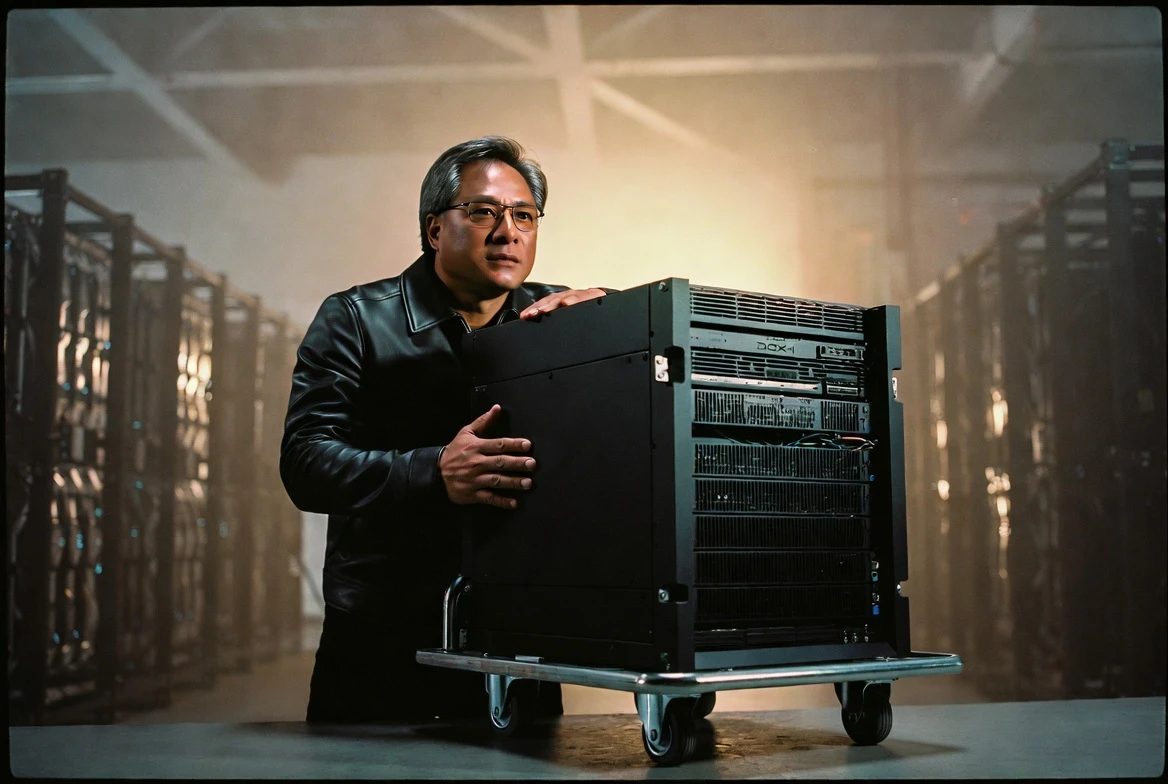
In 2016, Nvidia put all eight of its most powerful training GPUs into one machine and called it the DGX-1. It was, in the company’s framing, a supercomputer in a box. The price was $129,000. Each server carried eight Tesla P100 GPUs linked by Nvidia’s NVLink interconnect, yielding 170 teraflops of half-precision performance, according to Top500’s report on the first DGX-1 delivery to OpenAI. The market for a $129,000 AI training machine was, at the time, almost theoretical.
Then Elon Musk called. Musk was helping set up a non-profit AI research lab called OpenAI. He wanted one of the first DGX-1 units. Huang did not arrange a shipment. He loaded the first system into his car and drove it to OpenAI’s office in San Francisco.
Musk posted his thanks on Twitter. “Would like to thank @Nvidia and Jensen (Huang) for donating the first DGX-1 AI supercomputer to @OpenAI in support of democratising AI technology.” Inside that small office, among the early researchers who would receive the machine, was a young Ilya Sutskever, later one of the principal architects of ChatGPT.
The Roads, Not the Cars
A decade later, when ChatGPT launched and the world discovered generative AI, Nvidia was not catching up. It had been building toward that moment for nearly twenty years. The chips, the software, the developer tools, and the networking stack were already in place. Today, every major model family, including OpenAI’s ChatGPT, Google’s Gemini, Anthropic’s Claude, and Meta’s Llama, is trained on Nvidia GPUs running CUDA.
The company’s lead sits in the ecosystem more than in any single chip. “During almost two decades, Nvidia has been building a complete AI ecosystem based on its hardware: CUDA, software libraries, developer tools, networking technology and AI framework optimisations,” Devroop Dhar, Co-Founder and India CEO of Primus Partners, told India Today Tech. “This provided an obvious ecosystem advantage as it is easier to build and cheaper to move to Nvidia’s platform compared to anything else.” Atul Arya, Founder and CEO of Blackstraw, made the same point from a different angle. “Nvidia’s real advantage isn’t just the GPU,” he said. “It’s the ecosystem it has built over nearly two decades: the software, the developer tools and the infrastructure that everything else now assumes is there.”
The arc, in seven dates:
| Year | Milestone |
|---|---|
| 1993 | Huang, Malachowsky, and Priem sketch Nvidia at a Denny’s booth in East San Jose |
| 1999 | GeForce 256 launches and is marketed as the world’s first GPU |
| 2006 | CUDA ships with the GeForce 8800 GTX, opening the GPU to general compute |
| 2008 | 1,100 paintball barrels fire in 80 milliseconds at NVISION 08 in San Jose |
| 2012 | AlexNet, trained on Nvidia GPUs, wins ImageNet |
| 2016 | Huang hand-delivers the first DGX-1 to OpenAI in San Francisco |
| 2026 | Nvidia market cap reaches $4,714.89 billion as of July 2, 2026 |
Each row is the same company, doing the same thing it has always done, building infrastructure for whoever is computing at the largest scale.
Who Is Building an Alternative, and How Far They Have to Climb
Nvidia’s grip is not unchallenged. The same customers who buy the most Nvidia hardware are also the ones working hardest to design around it. Jalapeño, OpenAI’s first custom-built inference processor, developed with Broadcom, was unveiled on June 24, 2026, according to reporting on OpenAI’s first custom-built inference processor Jalapeño. OpenAI’s earlier collaboration with Broadcom, announced on October 13, 2025, commits the two companies to 10 gigawatts of custom AI accelerators.
The wider customer-side build-out now looks like this:
| Player | Custom silicon program |
|---|---|
| AMD | Expanding AI chip portfolio |
| Intel | Expanding AI chip portfolio |
| Tensor Processing Units (TPUs), in-house | |
| Amazon | Trainium and Inferentia processors |
| Microsoft | Investing in Maia AI chips |
| Groq | Specialised AI hardware for inference |
| Cerebras | Specialised AI hardware for inference |
| OpenAI | Jalapeño inference processor, with Broadcom, unveiled June 24, 2026 |
Atul Arya, the Blackstraw CEO, framed the scale of the replacement job in plain terms. “If Nvidia disappeared tomorrow, innovation would not stop, but it would slow down significantly. Other major players have viable alternatives, but no single player could immediately replace the scale and maturity Nvidia has built.” Two related reads on this build-out sit at how inference economics are reshaping Nvidia’s grip and at Anthropic’s Samsung chip talks and the foundry race. The pattern is consistent. The biggest buyers of Nvidia silicon are also the biggest funders of Nvidia alternatives.
The GPU as the Modern Oil Field
Sachin Dev Duggal, Founder and CEO of SekondBrain, put the stakes in one line. “Nvidia is arguably the most important infrastructure company in AI today,” he told India Today Tech. “Almost every major breakthrough in modern AI has, directly or indirectly, been accelerated by access to Nvidia’s hardware, software stack and developer ecosystem.” On market capitalisation alone, Nvidia is the world’s most valuable company, at $4,714.89 billion as of July 2, 2026, per Macrotrends data.
Duggal pushed the framing further. “In many ways, the GPU has become the modern equivalent of an oil field. AI is no longer just a software discussion, it is increasingly a geopolitical one.” Nvidia set out to build better graphics for video games. Three decades later, the chips it sells for that purpose are the substrate under the largest technology build-out of the decade. The roads are now what matters, and almost everyone is still driving on Nvidia’s.
Frequently Asked Questions
When was Nvidia founded?
Nvidia was founded in 1993 by Jensen Huang, Chris Malachowsky, and Curtis Priem. The three co-founders sketched the company’s first business plan at a Denny’s booth in East San Jose, with Huang as the surviving president and CEO from day one.
What was the GeForce 256?
The GeForce 256 was the graphics card Nvidia released in 1999 and marketed as the world’s first GPU. It moved hardware transform and lighting off the CPU and onto the graphics chip, and it gave the category its name.
What is CUDA?
CUDA, Compute Unified Device Architecture, is a software platform Nvidia launched in November 2006 alongside the GeForce 8800 GTX. It lets developers program Nvidia GPUs for tasks beyond graphics, from scientific simulations to deep learning.
Why is Nvidia the world’s most valuable company?
Nvidia’s market cap reached $4,714.89 billion as of July 2, 2026, according to Macrotrends data, making it the largest publicly traded company in the world by that measure. The valuation rests on its position as the dominant supplier of GPUs and the CUDA software platform used to train the major AI models.
Will Nvidia stay on top?
Industry voices quoted in the India Today Tech feature see Nvidia’s lead persisting for the foreseeable future, with OpenAI, Google, Amazon, Microsoft, AMD, and Intel all building alternatives that have not yet matched Nvidia’s scale. Atul Arya of Blackstraw said a sudden Nvidia exit would slow innovation rather than stop it.


Google Opens Gmail to Voice and Gates Docs Live

Lenovo Prices the IdeaPad Vibe Against Apple’s $699 Neo

Xbox Caps Game Pass Cloud Gaming at 15 Hours

GTA 6 DualSense Controllers Follow Sony’s Usual $84.99 Script

South Korea Retail Investors Face Reckoning After KOSPI AI Rally Collapses

Surrey AI Maps Three Heart Attack Paths and Their Molecular Roots

Germany Locks Neutral Apple ATT Prompts Across Most of Europe

Apple’s 5% EU Fee Quietly Rewrites Alternative App Store Math

Apple’s EU Fee Truce Cuts Complexity but Leaves Rivals Fuming

Pixel 11 Pro Fold Trades Thinness for Durability and Seven-Year Stay

Oracle Cuts 21,000 Jobs in a Year, Cites AI in 10-K Filing

Fable 5 and Mythos 5 Return as US Lifts Anthropic Export Controls

SpaceX’s Google Deal Turns a Rocket Company Into a Cloud Landlord

CD Projekt Red Co-CEO: Redemption Arc Isn’t Done, Witcher 4 in 2027

XPL Rallies 30% Ahead of Plasma One Card Tier Launch

Google Search Profiles Build a Follow Graph Inside Discover

DGO App Brings Rs 549 Mobile Pass for FIFA World Cup 2026 in Nepal

Moonshot AI Targets $30 Billion in China’s Fastest AI Funding Sprint

Oppo’s ColorOS 17 Eligibility List Leaves A-Series Buyers Behind

Microsoft Xbox Layoffs Start in July as Sharma Slams 3% Margin
-
 AI2 months ago
Oracle Cuts 21,000 Jobs in a Year, Cites AI in 10-K Filing
-
 AI2 months ago
Fable 5 and Mythos 5 Return as US Lifts Anthropic Export Controls
-
 AI3 months ago
SpaceX’s Google Deal Turns a Rocket Company Into a Cloud Landlord
-
 GAMING2 months ago
CD Projekt Red Co-CEO: Redemption Arc Isn’t Done, Witcher 4 in 2027
-
 CRYPTO3 months ago
XPL Rallies 30% Ahead of Plasma One Card Tier Launch
-
 NEWS3 months ago
Google Search Profiles Build a Follow Graph Inside Discover
-
 APPS3 months ago
DGO App Brings Rs 549 Mobile Pass for FIFA World Cup 2026 in Nepal
-
 AI3 months ago
Moonshot AI Targets $30 Billion in China’s Fastest AI Funding Sprint