
NEWS
Sadiq Khan’s £7m Plan to Counter Online ‘Lies’ About London
Sadiq Khan’s £7m campaign targets online disinformation about London, citing a 150-200% rise in ‘decline’ posts. Critics say it sidesteps real crime data.

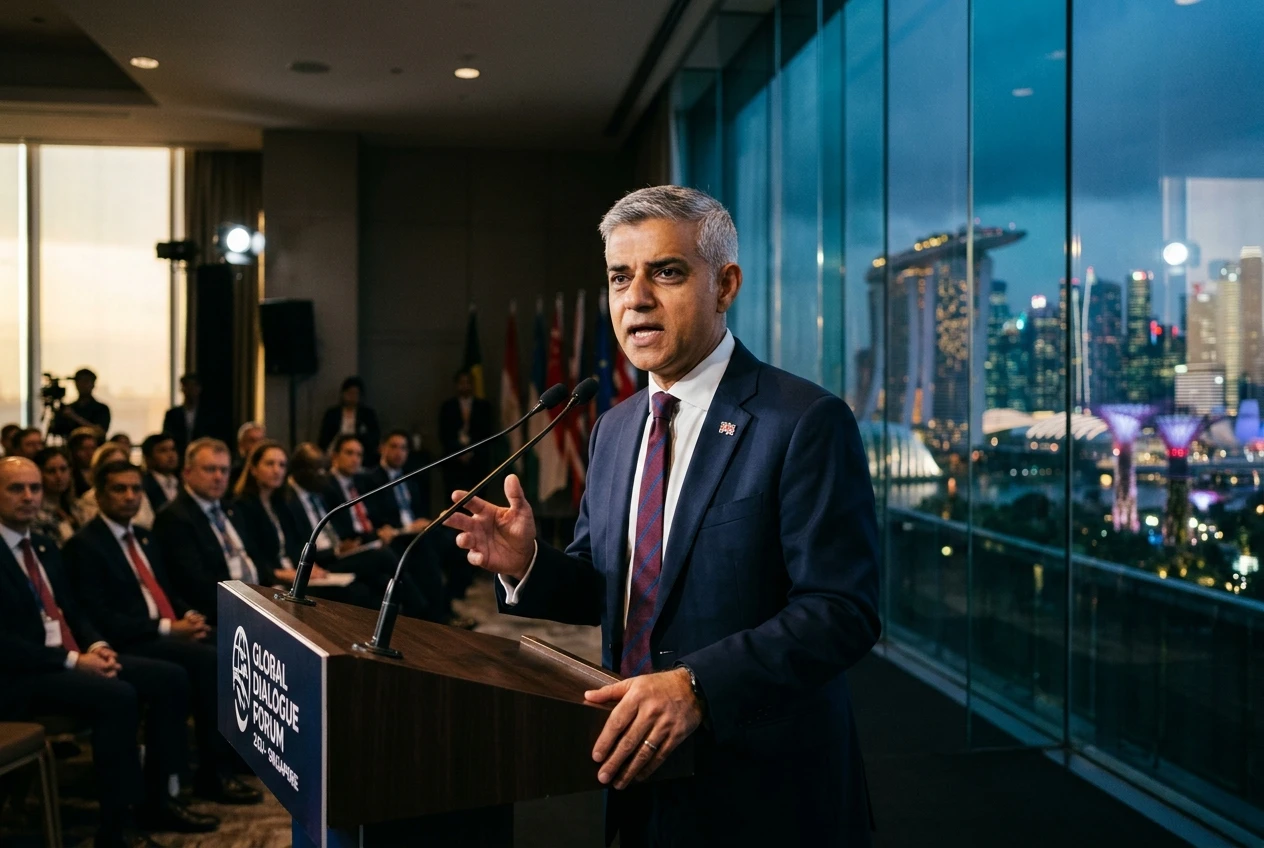
The Mayor of London is putting £7 million behind a global counter-disinformation campaign to be delivered by London & Partners, the capital’s growth agency, launching in September and aimed at audiences in Europe, the United States, and Asia. The campaign will celebrate London’s heritage, culture, creativity, and role as a centre for innovation and trade. Sir Sadiq Khan announced the plan from Singapore, where the World Cities Summit runs this week.
The trigger is a Greater London Authority report that found a 150 to 200 per cent rise in social media posts describing the capital as a dangerous city in decline between March 2024 and March 2026. Critics in Susan Hall’s City Hall Conservatives and Laila Cunningham’s Reform UK say the money should target crime, not perception. The platforms Khan wants held to account have answered his letters in their own terms.
A £7m Global Counter-Campaign Launching in September
Sir Sadiq Khan has set aside £7m for a global counter-disinformation campaign to be delivered by London & Partners, the capital’s growth agency. The campaign will launch in September and target audiences across Europe, the United States, and Asia. The announcement came on Monday from Singapore, where Khan met Prime Minister Lawrence Wong at the World Cities Summit, the £7m campaign Khan announced in Singapore.
We are facing a relentless and unprecedented attack of lies and hatred from those wanting to damage our capital’s standing and our hugely important tourism industry. Disinformation about London has become a truly global scourge. It’s a money-making industry pushing lies about our capital and preying on people’s fears around the world, so we must fight back on a global scale.
That was Sir Sadiq Khan, the Mayor of London, speaking in Singapore on Monday. The campaign’s stated focus is the capital’s heritage, world-class experiences, culture, creativity, and role as a centre for innovation and trade. Behind the launch is a new report from the Greater London Authority (GLA) that documents a sharp rise in negative social media posts about the capital. Critics in Hall’s City Hall Conservatives and Reform UK want the money spent on crime, not on perception.
| Field | Detail |
|---|---|
| Budget | £7m |
| Delivery body | London & Partners |
| Launch | September 2026 |
| Target audiences | Europe, United States, Asia |
| Stated focus | Heritage, culture, creativity, innovation, trade |
What the GLA Report Actually Found
The figures under the campaign come from a rapid evidence review by GLA City Intelligence, the mayor’s research unit. Between March 2024 and March 2026, online activity describing London as a dangerous city in decline rose by between 150 and 200 per cent, the report found, while migration-related narratives referencing the capital surged by more than 350 per cent. Those jumps sit on top of a baseline rise of around seven per cent in overall London-related posting activity in the same window, a comparison that makes the specific narratives stand out. The findings are indicative rather than comprehensive, the report’s authors noted, citing limited access to platform data and reduced transparency around algorithms and moderation systems.
In some months, more than 15,000 posts in Japanese have appeared on X claiming the capital is lawless and under the influence of Islamic governance. The GLA report also documents a Vietnam-based Facebook network of at least 42 pages with a combined following of around 1.25 million, posting repeated AI-generated imagery and impersonating local media outlets. Other identified clusters include a Sri Lanka-based content farm producing monetised AI posts and a Nigeria-based cluster impersonating UK media.
The report points to coordinated efforts by UK-based extreme right-wing groups, accounts aligned with Russian or Chinese state interests, and US-related political movements. Encrypted messaging apps such as Telegram are identified as a key channel where disinformation can originate before spreading to mainstream platforms. The networks identified in the GLA report mix state-aligned and commercial motivations, with monetised AI content sitting alongside political amplification. Khan has called the wider pattern an “outrage economy” that “is eating away at the basic bonds of trust that hold our societies together”. The platforms have argued, in their responses to the BBC, that the GLA’s research drew on a limited slice of the picture.
- Between 150 and 200 per cent: rise in “London in decline” narratives, March 2024 to March 2026
- More than 350 per cent: surge in migration-related narratives referencing London
- Around 7 per cent: overall rise in London-related posting activity in the same window
- More than 15,000: posts in Japanese on X in some months claiming London is lawless
- At least 42 pages, around 1.25 million followers: the Vietnam-based Facebook network identified in the GLA report
The Networks Behind the Posts
The clearest picture of the pattern sits in the AI-generated content the GLA report catalogues. A Vietnam-based Facebook network of at least 42 pages used AI imagery and the impersonation of local media outlets to spread emotive content to more than one million followers, the GLA report found, the GLA report findings Khan cited. The combined following of those pages sits at around 1.25 million, the Vietnam-based network with 1.25 million followers in a separate count of the same network.
The BBC reported in February 2026 on a wave of AI-generated videos falsely depicting a taxpayer-funded water park in Croydon, part of the wider trend portraying London as a city in decline. One TikTok page’s fake videos portrayed grimy Croydon waterparks and an arcade machine filled with knives. The GLA report also documents a case in which one account used AI imagery to falsely claim that millions of people attended the 2025 Unite The Kingdom rally, when attendance was estimated by police at around 150,000. The real-world cost Khan has named is a retiree who blew up a Ulez camera with explosives after spending time in social media groups where conspiracy theories were being spread.
Hall Says ‘La La La La La’; Cunningham Calls It Censorship
Susan Hall, the leader of the City Hall Conservatives, said Khan “should spend more time trying to fix things as opposed to saying la la la la la, I’m not listening, everything’s fine”. In a longer statement to the BBC, Hall said Khan’s pushback against the ballooning negative online commentary surrounding London was a “handy trend to stifle any criticism of his failures as mayor of London, and bury his head in the sand whilst Londoners see crime go unchallenged”.
If the Mayor of London wants to encourage more tourism, he should deal with the crime he has allowed to spiral out of control instead of suggesting that victims of crime are liars.
That was Laila Cunningham, Reform UK’s candidate for mayor of London, in a statement on Sunday. In a separate statement to the BBC, Cunningham said: “Misinformation is now just code for censorship. Khan spent a decade making London dangerous. Now he wants to make it illegal to say so. He’s not trying to make London safer he’s trying to make it look safer.” Both lines run alongside Hall’s “la la la la la” attack and arrive on the same day as Khan’s Singapore announcement.
Luke Taylor, the Liberal Democrats’ London spokesperson and MP for Sutton and Cheam, conceded that “homicide has come down” in the capital. “If we don’t have enough police on the streets then nothing will change,” Taylor added, picking up the same crime-pressure critique without echoing Cunningham’s “censorship” framing. Caroline Russell, the leader of the City Hall Greens, took the opposite view, saying Londoners do not recognise the divisive way the city is being shown on social media and that the mayor is right to correct the record on declining homicide and to highlight the real-world damage caused by online disinformation and AI-generated imagery.
Hall, Cunningham, and Taylor all press the crime line; Russell is the only party leader in the responses logged so far who backs the campaign. Both sides are drawing on the same Metropolitan Police data, with Khan pointing to the homicide low and his critics pointing to phone theft and personal robbery.
The Crime Picture That Won’t Go Away
The data Khan’s critics point to sits in plain sight. Between 2017 and 27 February 2024, a total of 587,498 phones were stolen in London, excluding the City, 13,998 of which were recovered, and 573,500 were not. The Metropolitan Police has said phone theft is a “significant” problem and that the force has some of the highest rates per thousand people of personal robbery and theft from the person in England and Wales. The same force said in January 2026 that the homicide rate in London dropped to its lowest level in 11 years in 2025. US President Donald Trump has separately accused Khan of doing a “terrible job” and said “crime in London is through the roof,” in a long-running war of words that is now echoing through the campaign’s reception.
The two pictures sit in tension, and Khan’s critics are using the phone-theft and robbery data to make their case that the GLA’s “London in decline” framing is not purely manufactured. Khan’s own response, in his Cambridge Disinformation Summit speech in April, was to concede that misinformation is one driver of public concern while insisting the data shows homicide falling. The GLA report’s authors say the data they used was indicative rather than comprehensive, a caveat the platforms have leaned on in their own responses. The £7m campaign is the spend; the question of whether it dents the picture Khan has named is the bet.
- 587,498: phones stolen in London between 2017 and 27 February 2024
- 13,998: of those phones recovered by police
- 573,500: of those phones not returned to their owners
- Lowest in 11 years: London homicide rate in 2025, per the Metropolitan Police
What Khan Wants From Big Tech and the Government
Khan has written to the heads of TikTok, Meta, Google, and X, calling for greater transparency and an end to “opaque algorithms designed to maximise engagement at any cost”. The mayor’s two main asks are a new central body to protect democracy and the power for Ofcom to “hit companies where it hurts” if they fail to act. He also wants tech firms to give vetted independent researchers access to their data so coordinated disinformation can be monitored.
The four companies have answered in their own terms. TikTok said it has a “longstanding and collaborative relationship” with City Hall, that the GLA’s research did not include data from its platform, and that content under #LondonTok is a “joyful celebration” of the city’s diversity. Meta said it is “constantly working to disrupt” coordinated inauthentic behaviour, that it has removed more than 200 networks globally, and that it does not allow fake accounts or the artificial boosting of content. Telegram told the BBC it supports “peaceful free speech” and that calls to violence are “forbidden and are removed whenever discovered”. A Department for Science, Innovation and Technology spokesperson said platforms are required under the Online Safety Act to remove illegal misinformation and that Ofcom has strong enforcement powers it can use where platforms fail to comply.
Khan has set a line in the same Cambridge speech: “I haven’t come here today to ask anyone to take down content which criticises me.” Cunningham’s “code for censorship” framing and Hall’s “handy trend to stifle any criticism” line sit on the same boundary. The unresolved question is whether Ofcom will use the powers the government says it already has against the networks the GLA report names. In other jurisdictions, regulators have moved further: in May 2026, Malaysia’s statutory demand against TikTok over royal AI content is the sharpest test yet of whether a regulator can stretch pre-smartphone-era law to cover synthetic media and platform moderation failures. The same logic is being tested in US courts, where four US lawsuits reshaping platform liability rules are now in active litigation.
London as the ‘Canary in the Coalmine’
Khan has framed the stakes in a sentence. “In a few years’ time, I think we’ll look back on London as the canary in the coalmine,” he told the Cambridge Disinformation Summit in April. “But I hope we’ll also see it as the place where the fightback began,” he added. The same networks, he has said, are already targeting other cities around the world.
The campaign, to be delivered by London & Partners, launches in September. It targets Europe, the United States, and Asia. The GLA report has named the networks it says are driving the “London in decline” narratives, and the platforms have answered Khan’s letters on the record in their own terms. Khan’s ask of Westminster is a new central body to protect democracy and stronger Ofcom powers to “hit companies where it hurts”. The campaign reaches the public in September; the regulatory fight continues in parallel.


Lenovo Prices the IdeaPad Vibe Against Apple’s $699 Neo

Xbox Caps Game Pass Cloud Gaming at 15 Hours

GTA 6 DualSense Controllers Follow Sony’s Usual $84.99 Script

South Korea Retail Investors Face Reckoning After KOSPI AI Rally Collapses

Surrey AI Maps Three Heart Attack Paths and Their Molecular Roots

Germany Locks Neutral Apple ATT Prompts Across Most of Europe

Apple’s 5% EU Fee Quietly Rewrites Alternative App Store Math

Apple’s EU Fee Truce Cuts Complexity but Leaves Rivals Fuming

Pixel 11 Pro Fold Trades Thinness for Durability and Seven-Year Stay

Mayo AI Flags HCM Obstruction From Everyday Ultrasound Videos

Oracle Cuts 21,000 Jobs in a Year, Cites AI in 10-K Filing

Fable 5 and Mythos 5 Return as US Lifts Anthropic Export Controls

SpaceX’s Google Deal Turns a Rocket Company Into a Cloud Landlord

CD Projekt Red Co-CEO: Redemption Arc Isn’t Done, Witcher 4 in 2027

XPL Rallies 30% Ahead of Plasma One Card Tier Launch

Google Search Profiles Build a Follow Graph Inside Discover

DGO App Brings Rs 549 Mobile Pass for FIFA World Cup 2026 in Nepal

Moonshot AI Targets $30 Billion in China’s Fastest AI Funding Sprint

Oppo’s ColorOS 17 Eligibility List Leaves A-Series Buyers Behind

Microsoft Xbox Layoffs Start in July as Sharma Slams 3% Margin
-
 AI2 months ago
Oracle Cuts 21,000 Jobs in a Year, Cites AI in 10-K Filing
-
 AI2 months ago
Fable 5 and Mythos 5 Return as US Lifts Anthropic Export Controls
-
 AI3 months ago
SpaceX’s Google Deal Turns a Rocket Company Into a Cloud Landlord
-
 GAMING2 months ago
CD Projekt Red Co-CEO: Redemption Arc Isn’t Done, Witcher 4 in 2027
-
 CRYPTO3 months ago
XPL Rallies 30% Ahead of Plasma One Card Tier Launch
-
 NEWS3 months ago
Google Search Profiles Build a Follow Graph Inside Discover
-
 APPS3 months ago
DGO App Brings Rs 549 Mobile Pass for FIFA World Cup 2026 in Nepal
-
 AI3 months ago
Moonshot AI Targets $30 Billion in China’s Fastest AI Funding Sprint