
AI
‘Made By AI’ Ads Still Need a Director, an Editor, and a Colorist
Higgsfield’s Hell Grind cost $500K and ran on 3,000-word prompts. India’s top AI ad directors say the camera is gone but the crew has not left.

‘Made By AI’ has become advertising’s favorite label. The pitch is clean: no camera, no crew, no shoot day, just prompts. The label covers a real crew that still does the work.
Higgsfield’s “Hell Grind” set the loudest version of the template when a 95-minute AI feature screened at an industry event in Cannes on May 16, 2026, on a budget of $500,000. The makers of a fully AI-generated ad for Tata Simply Better built in India tell a different story. The camera may have disappeared, but the director, editor, colorist and sound designer have reconstituted behind the screen.
The ‘No Camera, No Crew’ Pitch Started at Cannes
Hell Grind is the proof of concept everyone keeps quoting. The film was generated end to end on Higgsfield’s tools by a team of 15 people in a 14-day sprint, according to the filmography, budget breakdown, and Cannes screening for Hell Grind. The budget split is the part marketers tend to skip: $400,000 of the $500,000 went to AI compute, not cameras or talent.
Higgsfield’s platform combined its own Soul Cinema and Soul Cast products with ByteDance’s Dreamina Seedance 2.0 video generator. Each 15-second clip was generated and re-generated until the team judged it usable, a loop that Higgsfield CEO Alex Mashrabov described as “a feeling of a slot machine.” Prompts averaged about 3,000 words apiece to keep shots consistent and steer the model away from a telltale AI sheen. To reach the 95-minute cut, the team had to generate and discard the overwhelming majority of what the model produced.
Read the production numbers as a film-industry yardstick. The numbers say a generative model can produce feature-length video cheaply, slowly, and with a human crew at the console deciding what survives.
- 95 minutes: running time of Hell Grind
- $500,000: total budget
- $400,000: AI compute spend
- 3,000 words: average prompt length
The Lookbook Has Replaced Pre-Production
For a regular ad film, an approved script lands in an inbox and the director starts with a treatment note, then storyboards, then casting, costumes and a shoot plan. For an AI ad film, the inbox part is the same and almost everything else is gone. Akshay Srivastava, a director who has spent the past year building ad films entirely on generative tools, told BestMediaInfo that the recce, the location scout and the pre-shoot logistics have all dropped out. What replaces pre-production now is a lookbook.
“What’s in the lookbook? How my costumes will be. How my AI characters will be. What will my production design be like?” Srivastava said, describing the new first step. The first round of generation typically starts in large language models like ChatGPT or Gemini, which help draft the prompts that then go into image generators like Higgsfield and DALL-E. The same pipeline feeds the video generators, with longer and more elaborate prompts for moving shots. Srivastava’s discipline rule is plain: “The clearer your vision the better AI will understand things and do it for you.” For a train scene, the prompt has to spell out the mid-shot, the hesitance of the man hopping on, whether the camera holds still, and how many people are climbing aboard versus stepping off. The same granular direction that used to live on a physical set now lives in a prompt. The market signal here is the 90% AI-made ad films forecast for 2027, a projection that depends on this kind of pre-production shift becoming standard.
The Director Still Directs, and Now Matters More
Moonshot, the creative studio co-founded by Devaiah Bopanna, released its first fully AI-generated ad film for Tata Consumer Products with Anirudh More directing. Writers on the project included Tanmay Bhat, Puneet Chadha, Deep Joshi, Manish Badlani and Bopanna himself. The credits list reads like a normal Indian ad film, because the job is closer to a normal Indian ad film than the marketing suggests.
The skill set of a director has not changed, Bopanna told BestMediaInfo:
It’s exactly the skill set of a director that you need while directing a regular film. Knowing which shot needs to be a close-up, knowing which shot needs to be a wide, knowing the rhythm of the edit of the film, the pace of the edit – knowing all that and creating each generation that suits that vision.
That is Moonshot co-founder Devaiah Bopanna speaking to BestMediaInfo about the Tata film. He went further: direction is now worth more, not less, because the barrier to producing something watchable has collapsed. “Because everyone can make these things, so only people who can direct well will be able to direct much better AI films,” he said. Bopanna was previously head writer at All India Bakchod and has built campaigns for CRED, Swiggy Instamart, Lenskart and OYO.
Why Moonshot Brought Back the Cinematographer
The Tata film nearly came apart in post. Bopanna told BestMediaInfo that Moonshot had generated every shot and lined it up in the edit before realizing some sequences did not work because the lighting did not match across cuts. The fix was not a better prompt. The fix was a person. Moonshot brought in a cinematographer to rework the color scheme of each frame so the film stopped reading as AI and started reading as a normal shoot.
“The cinematographer made sure that the color scheme of each frame worked well so it looked more real,” Bopanna said. “We had to redo a lot of sequences from scratch, regenerate and recreate them based on new lighting, new clothing, and new colors for the walls.” The same dynamic plays out at feature length, per the breakdown of Hell Grind’s 3,000-word prompts and reported acceptance rate, a 14-day sprint in which over 98% of generated clips were rejected before the cut held together. What looks like a slot-machine output is, in practice, a hand-curated assembly.
The Crew Sits Behind the Screen Now
The assumption going in is that AI removes post-production load the way it removes the shoot. In practice the opposite happens. Srivastava treats the editor’s seat at the generation console as a hard rule rather than a preference. “While you’re generating the video, your editor needs to be sitting with you,” he told BestMediaInfo. The two processes run in parallel because generation alone cannot tell you what is usable. A decent editor still costs Rs 25,000 to Rs 30,000 a project, Srivastava said, and the line item looks the way it did on a film that was actually shot.
Sound and music resist automation almost entirely. “In AI the coherence of visual and audio is still a little bit off in terms of sound design and music,” Srivastava said. The technology to generate a full score exists, but the result still does not hold together on its own. The sound designer and the sound engineer stay on the budget.
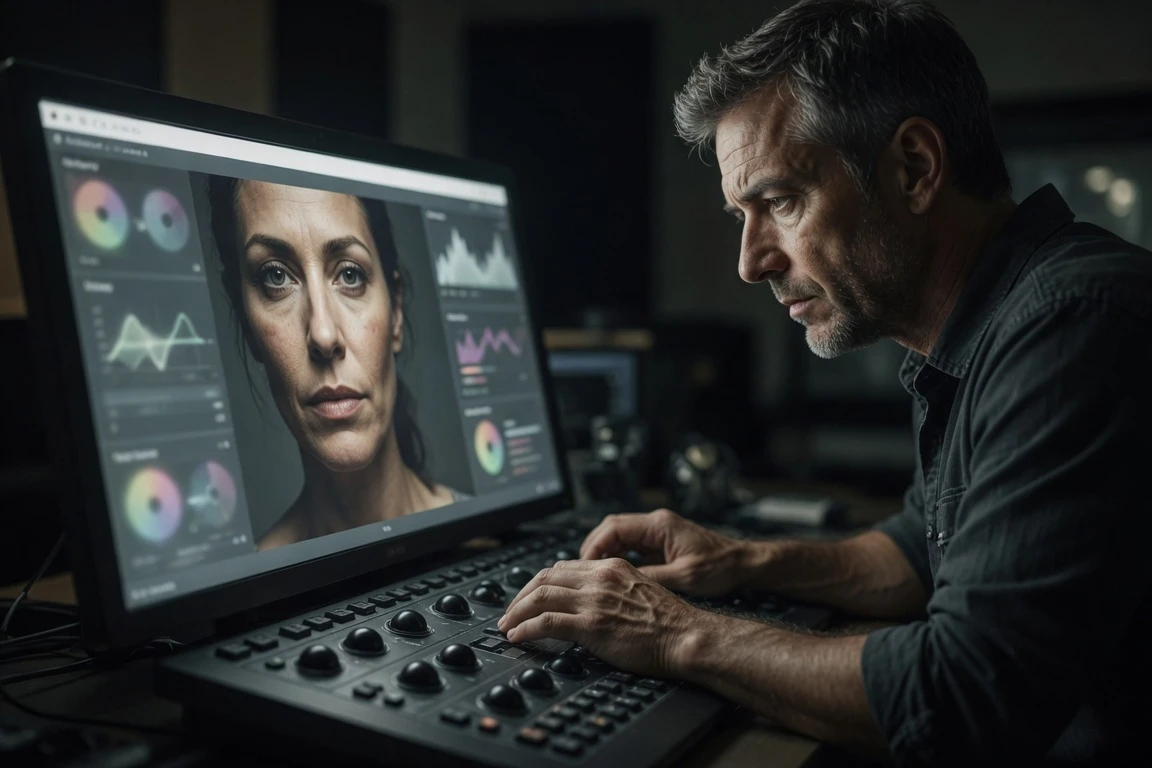
Grading, more than any other department, exists to undo what the model just produced. Bopanna’s team ran into this on the realism front. “In AI footage, everything is sharp and there is no focus. But when you actually shoot, you have certain points in focus and the background is slightly blurry and off-focus,” he said. Srivastava’s version of the same problem shows up on skin. “In certain scenes you can see the characters’ blemishes, in others you can’t. Sometimes the characters’ skin tone doesn’t match. I take the help of a colorist to fix these things.” The colorist has not gone away. The work has moved behind the screen.
Srivastava’s rule for crew size is that it depends on the brand’s deadline. “How many people sit behind that single screen depends entirely on the clock,” he said. A solo director-prompter can run the whole process alone, but the moment a brand wants delivery in a week the math changes. “You’ll need two more AI prompters… you have to work in layers.” One prompter handles the world the film lives in, another the cast, mirroring the way ADs split a physical set. “How do your ADs work on set? One handles the casting, one handles production design. The breakdown of AI prompters can be similar.” The pitch that AI collapses the team is, on a real job, the pitch that the same team is doing the same work on a different surface. The trade-press version of that tension is the Cannes warning about AI pitch-maxxing in adland.
- Editor: sits in parallel with generation, costing Rs 25,000 to Rs 30,000 per project
- Sound designer and sound engineer: score and audio coherence still off in AI output
- Colorist: fixes skin-tone mismatches and the AI model’s hyper-sharp default
- Cinematographer: Moonshot had to re-bring one in for lighting on the Tata film
- Director: decides the close-up versus wide, the edit rhythm, the pacing of every generation
The Big B and What AI Films Actually Cost
Perhaps the biggest misconception around AI filmmaking is that it is cheap. Both Srivastava and Bopanna separate “cheap” from “cheaper.” Bopanna’s framing is blunt: “It’s possible to make an AI film that costs probably 5 or 10% of what it would cost to shoot, but the film will also end up looking just 5 or 10% as good as it would have looked if you had shot it.” For him, AI’s value lies in convenience and flexibility, not in brute cost reduction.
“If saving money is the only motive, then your film will look like it has saved a lot of money to the person watching it,” Bopanna said. Srivastava puts the compute bill in hard rupees. “Just for one minute of a film, the cost of AI credits alone can be Rs 40,000 to Rs 100,000,” he said. Add a director-prompter, an editor, a sound designer, a sound engineer and a colorist, and the post-production line on an AI ad film starts to look like the line on a film that was actually shot.
Srivastava’s rule of thumb for translating a conventional budget is plain. “You read the script and do a real-life budgeting of it, and cut that budgeting to a third.” The worked example he offers: a Rs 30 Lakh traditional film maps to roughly Rs 10 Lakh through AI. That is a meaningful reduction. It is not the 80% to 90% cut that floats through trade chatter.
The single published datapoint for a feature-length project, Hell Grind at $500,000 total with $400,000 on compute, sits inside the same band. The 80% compute share is unusually high for an ad film because Hell Grind is unusually prompt-heavy. For an ad of two to three minutes, compute drops to a slice of the total and crew costs rise to a larger share. The cost conversation is real. The crewless version of it is not.
| Element | Traditional shoot | AI ad film |
|---|---|---|
| Compute or stage cost | Camera, lighting, location, talent | AI credits, roughly Rs 40,000 to Rs 100,000 per finished minute |
| Editor | Editor joins in post | Editor sits with generation from day one |
| Colorist | Final grading pass | Pulled in to undo the AI model’s hyper-sharp default |
| Sound design | Post-production | Score and design still hand-built |
So What Does ‘Made By AI’ Actually Mean?
The label survives because it sells a story that brands want to tell. The work, on the evidence of the people doing it, has not changed as much as the label suggests. A director still decides the close-up versus the wide. An editor still sits at the cut. A colorist still chases the imperfection that makes the image look real. A cinematographer still fixes lighting when the AI defaults the room to a single mood. A sound designer still builds a score because the model’s music does not hold together on its own. Hell Grind screened in Cannes, but the festival itself confirmed the film was not part of the official selection.
Bopanna, asked to define what an AI ad film is, offers the simplest answer to BestMediaInfo:
You can’t talk to an actor like you would do on a regular set, you can’t physically go and move the planter hindering the frame; you’re reliant on AI to do it. So, patience is what you need to learn when making an ad film with AI.
That is Moonshot co-founder Devaiah Bopanna. Studio Blo has forecast that 90% of ad films will be AI-made by 2027, a projection that depends on this crew reconstituting, not disappearing, behind the screen.
Frequently Asked Questions
What does the Made By AI label actually mean in advertising?
A Made By AI ad film is generated end to end with generative video tools, but in practice it still runs through a director, an editor, a colorist and a sound designer who decide what survives the model’s output. The label is a production claim, not a definition of who made the work.
Is Made By AI cheaper than traditional filmmaking?
It is cheaper, but not by the 80% to 90% that circulates in trade chatter. Srivastava’s rule is to budget a conventional script as usual, then cut that budget to a third. Moonshot co-founder Devaiah Bopanna frames the trade as 5% to 10% of a traditional shoot’s cost, with a 5% to 10% share of the look.
Does AI filmmaking mean there is no crew?
No. Moonshot’s Tata film brought a cinematographer back in after generation to fix lighting across sequences. Srivastava sits an editor at the generation console from day one, and pulls in a colorist to fix skin tones and the model’s hyper-sharp default.
What is an AI prompter or prompt technician?
An AI prompter writes the long, detailed text prompts that drive image and video generators, often 3,000 words per shot for a feature like Hell Grind. On tight deadlines, the role splits into specialists who handle the world the film lives in and specialists who handle the cast.
Who directs an AI-generated ad film?
A human director. Moonshot’s Tata Consumer Products film was directed by Anirudh More. Devaiah Bopanna, Moonshot’s co-founder, told BestMediaInfo that direction as a skill set is now more valuable, because everyone can produce something watchable, and only a real director can shape it into a film.


South Korea Retail Investors Face Reckoning After KOSPI AI Rally Collapses

Surrey AI Maps Three Heart Attack Paths and Their Molecular Roots

Germany Locks Neutral Apple ATT Prompts Across Most of Europe

Apple’s 5% EU Fee Quietly Rewrites Alternative App Store Math

Apple’s EU Fee Truce Cuts Complexity but Leaves Rivals Fuming

Pixel 11 Pro Fold Trades Thinness for Durability and Seven-Year Stay

Mayo AI Flags HCM Obstruction From Everyday Ultrasound Videos

Indian Brands Quietly Scale Landmark Screens and Home Tech

Navin Vatsa Turns Grief Into a Lifetime of Quiet Seeing

Google Bets Pixel 11 Agentic AI Will Redefine Phones

Oracle Cuts 21,000 Jobs in a Year, Cites AI in 10-K Filing

Fable 5 and Mythos 5 Return as US Lifts Anthropic Export Controls

SpaceX’s Google Deal Turns a Rocket Company Into a Cloud Landlord

CD Projekt Red Co-CEO: Redemption Arc Isn’t Done, Witcher 4 in 2027

XPL Rallies 30% Ahead of Plasma One Card Tier Launch

Google Search Profiles Build a Follow Graph Inside Discover

DGO App Brings Rs 549 Mobile Pass for FIFA World Cup 2026 in Nepal

Moonshot AI Targets $30 Billion in China’s Fastest AI Funding Sprint

Oppo’s ColorOS 17 Eligibility List Leaves A-Series Buyers Behind

Microsoft Xbox Layoffs Start in July as Sharma Slams 3% Margin
-
 AI2 months ago
Oracle Cuts 21,000 Jobs in a Year, Cites AI in 10-K Filing
-
 AI2 months ago
Fable 5 and Mythos 5 Return as US Lifts Anthropic Export Controls
-
 AI3 months ago
SpaceX’s Google Deal Turns a Rocket Company Into a Cloud Landlord
-
 GAMING2 months ago
CD Projekt Red Co-CEO: Redemption Arc Isn’t Done, Witcher 4 in 2027
-
 CRYPTO3 months ago
XPL Rallies 30% Ahead of Plasma One Card Tier Launch
-
 NEWS3 months ago
Google Search Profiles Build a Follow Graph Inside Discover
-
 APPS3 months ago
DGO App Brings Rs 549 Mobile Pass for FIFA World Cup 2026 in Nepal
-
 AI3 months ago
Moonshot AI Targets $30 Billion in China’s Fastest AI Funding Sprint