
NEWS
The Radio Program Director Role Now Covers YouTube and Social Media
WJR 760’s Ann Thomas on what a program director does in 2026, why the job now covers apps and YouTube too, and where the Barrett Audio Summit fits.

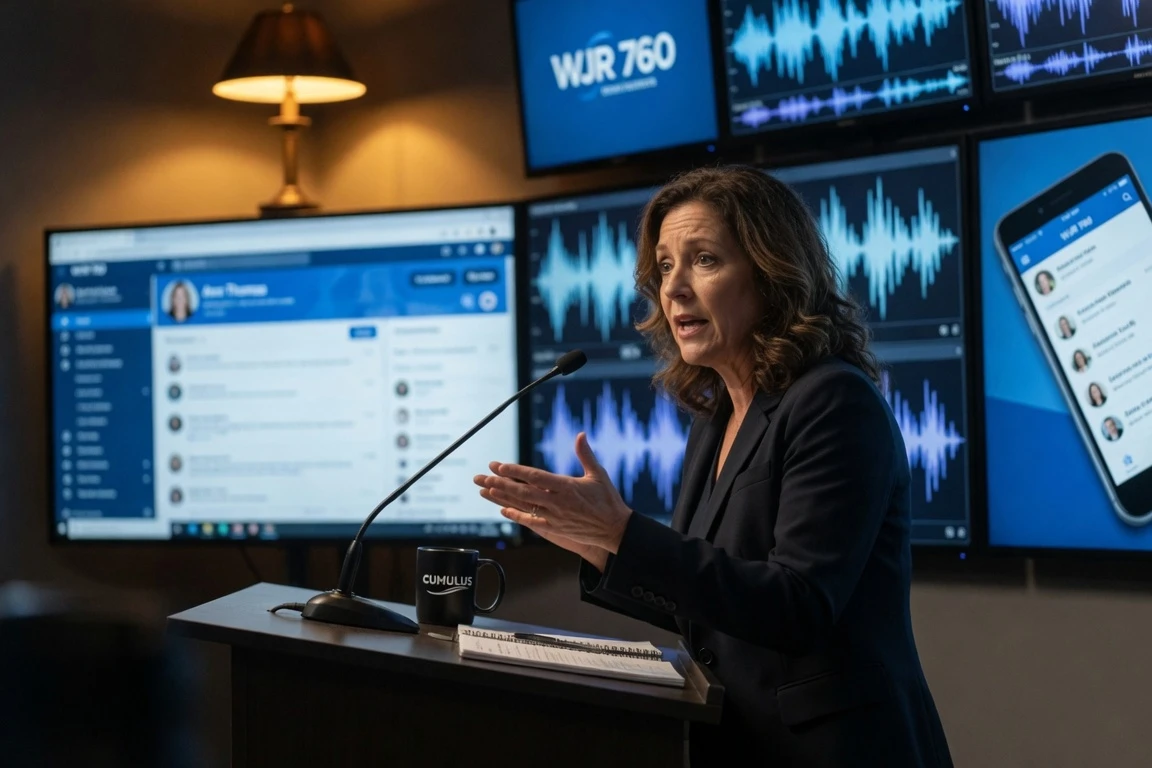
Ann Thomas runs WJR 760, the 50,000-watt news/talk station broadcasting from Detroit’s Fisher Building, and the program director role she has held since 2023 now extends well past the on-air product. In a new interview with Barrett Media, she said a program director is “basically responsible for all of the programming that you would hear on a radio station. From early morning throughout the night and into the next morning, 24/7.” The same job now covers the station’s app, website, YouTube channel, Facebook page, and every social feed, and she will preview those themes on a Tuesday morning panel at the 2026 Barrett Media Audio Summit, which runs June 30 through July 2 at the SVA Theatre in New York City.
The Program Director’s Old Job, Redrawn
The program director role at a heritage news/talk station used to fit a fairly clean outline: hire the on-air talent, set the clock, run the breaks, repeat. At WJR 760, that outline still exists, but it now lives inside a larger frame that includes the station’s app, its YouTube feed, and its presence on every social platform the Detroit audience uses. The on-air product and the digital product are no longer separate jobs at the station, and the person running them is the same person.
Thomas’s own description in the Barrett Media interview is the clearest marker. “A program director is basically responsible for all of the programming that you would hear on a radio station. From early morning throughout the night and into the next morning, 24/7,” she said. “Here at WJR, I’m responsible for what goes out onto the airwaves. That includes our local programming, our network programming, our news and information, our traffic, our weather, our sounders, our promos.” The list, by design, ends at the studio wall, but the wall has moved. What used to be a contained on-air role now sits next to a digital operation that publishes the same interviews, the same breaking news, and the same commentary in a dozen other places at the same time.
The on-air job is still the spine. What has changed is everything that runs alongside it, and the people a PD now has to coordinate with to keep the on-air product consistent with the on-screen product. The next sections follow the reordering in the order Thomas laid it out: what a WJR day actually contains, who runs the digital side, and how talent management now stretches across two generations of hosts.
- 1922: WJR’s first broadcast, originally as WCX
- 1982: Thomas joins the station as an intern
- 2023: Cumulus Media names her WJR’s Program Director
- 40+: years Thomas has worked in broadcasting, all at WJR
From WJR Intern to First Female Program Director
The July 20, 2023 promotion announcement framed Thomas’s move into the role as a step up inside the same building where she had worked for more than four decades. The promotion made her the first female Program Director in WJR’s 101-year history, and she rose into the role from Assistant Program Director and Executive Producer of the Paul W. Smith Show. Mike Wheeler, the previous PD, moved sideways into a new Operations Manager role covering Cumulus’s four Detroit and four Ann Arbor stations in the same announcement.
Her résumé at the station is unusually long for the job she now runs. She started as an intern in 1982, was hired full-time as a producer of a WJR program called “The Other Side of the News,” and went on to serve as a WJR news reporter and anchor, winning Associated Press, United Press International, and Detroit Press Club awards for breaking news and auto negotiations. In 1999 she became Executive Producer of the Paul W. Smith Show, a post she held for more than two decades, including Michigan Association of Broadcasters “Best Morning Show” awards in 2022 and 2023.
What 24/7 Programming Actually Looks Like Now
The shape of a WJR day, in Thomas’s telling, is broader than the dial. A program director is on the hook for the on-air product, every hour, every day, plus the digital footprint that runs next to it. The list below is the part she recites in the Barrett Media interview, in her own order, and it is the working definition of a WJR weekday.
- Local programming
- Network programming
- News and information
- Traffic and weather
- Sounders and promos
- Social media, the website, the app, Facebook, and YouTube
That last item is the one she spent the most time on in the conversation, and the one she said is now the harder half of the job. “While we’re doing it, and I think we’re doing a really great job at it, it’s challenging because you have to make sure that you’re getting the local content out properly and to all of the right channels,” Thomas said. She added that the same question follows her home: how to take what WJR is doing on the air and make sure it shows up on the social platforms, on Facebook, and on YouTube. The list of channels is also the list of places where a story can break before the next newscast, and the program director’s job is to make sure all of them carry the same version of it.
The challenge is also where she sees the upside, and she does not hold the two apart. “It’s been challenging. But honestly, it’s been a lot of fun, too,” she told Barrett Media. The same expansion that adds work also gives the station more places to put the local interviews its hosts record from 5:00 a.m. to 7:00 p.m. every weekday, the kind of content that used to live only on a tape machine in the studio. The WJR app is updated every day, she said, because the immediacy of radio is one of the few things that has not changed, and multimedia platforms are the new way to deliver it.
The Digital Department as Co-Pilot
The partner Thomas leans on for the digital half of the job sits at the next desk over. The contact page listing the digital team names Curtis Paul as the station’s Digital Media Director, the role that handles the day-to-day of posting, distributing, and shaping the station’s content for the platforms Thomas describes. “I do have a great team. We have an incredible digital department. The head of our digital department, Curtis Paul, does a wonderful job,” she said. The way she described it, the digital director is not a report running a separate track; he is the second pair of hands on the same product.
the role of a program director has definitely expanded because you have to pay attention to what’s on all of your social media sites and your website to make sure it matches the on-air product.
Ann Thomas, Program Director of WJR 760, in an interview with Barrett Media’s Krystina Carroll previewing the 2026 Barrett Media Audio Summit. The pairing with Curtis Paul, she said, is what makes the broader role workable: the digital department owns the channels, and the program director owns the editorial match between what airs and what posts.
The work is collaborative rather than supervisory. “He’s in tune with what I think, so we’re working together constantly,” Thomas said of Paul. The phrase is small, and the implication is large: the digital director is the editorial partner, not a vendor. That kind of structure, in which the program director sets the line and the digital director executes it across platforms, is the working answer to the question of how a radio station scales beyond its signal without diluting its brand.
Seasoned Hosts, Newer Hosts, Different Playbooks
The talent side of the role has shifted in step with the platform side, and Thomas treats the two as a single management problem. A program director’s job is no longer just to put a host on the air; it is to manage the host’s reach across the air and the feed at the same time. The hosts who grew up on radio are not the hosts who grew up on feeds, and the playbook is different for each.
Her framework splits the roster into two cohorts. Seasoned talent, she said, may not lean heavily on social media, and that is fine, because their audience is already built around the radio show. Newer or younger talent, by contrast, is the cohort where a program director pushes the most on social media, treating it as a brand-building tool that funnels listeners back to the station. The newer host, in her telling, is also the host for whom social media is part of the audition, not an afterthought.
The bar for the hire has not moved, in her telling. “You want somebody who is entertaining and stands for something, who’s able to relate to the audience and develop a relationship with them,” Thomas said. “You want a talent who is fun, engaging, and just really interesting to a listener, and they’re going to do that both on their social media channels and on the air.” The part she added is the local one: she is always looking for talent that can relate to the Detroit area and Michigan audiences, because that is the relationship the station is selling, and it has to read the same on the radio and on the phone.
The Next Five Years, and Why She’s Headed to New York
The summary Thomas offered of where the role is going, when Barrett Media asked about the next five years, did not hedge. “Absolutely. I think it’s something that we all need to be talking about all the time,” she said. The bigger question has moved past whether a program director owns the digital side. The active question is how much of the day that side now consumes, and how a station staffs for it without burning out the people who are doing both jobs at once.
The Barrett Media Audio Summit, where she will make the case in person, is the 2026 edition of an annual gathering that Barrett Media has been running for more than a decade. The 2026 Summit runs June 30 through July 2 at the SVA Theatre in New York City, and the speaker list, posted on the 2026 Audio Summit’s program page, includes Thomas alongside other News/Talk program directors from major market stations.
we’re no longer just radio stations. Now we’re basically multimedia platforms where we’re taking all this great local content that we have throughout the day and making sure it can be seen on other platforms.
Ann Thomas, Program Director of WJR 760, in an interview with Barrett Media. The panel itself is scheduled for Tuesday morning, June 30, the opening day of the 2026 Barrett Media Audio Summit. She told Barrett Media this will be her third year attending the Summit, and she called the gathering “invaluable” for sitting with other program directors, hearing what they are doing, and bringing ideas back to Detroit. The reason she keeps coming back, in her own framing, is that “the information you get out of that Summit is invaluable.” Thomas was confirmed for the 2026 lineup in the June 4 lineup addition for the 2026 Audio Summit, which also added Stephen A. Smith, 1010 WINS’ Ben Mevorach, and Hubbard Minneapolis’ Dan Seeman.
Frequently Asked Questions
What does a radio program director actually do?
A program director owns the full on-air product of a radio station across every hour of the day and every day of the week. At WJR 760, Ann Thomas describes the role as covering local programming, network programming, news and information, traffic, weather, sounders, and promos, with the same job now also extending to the station’s app, website, YouTube, Facebook, and other social channels. The role is editorial, operational, and increasingly digital at the same time.
How has the program director role changed with digital and social media?
The on-air responsibilities are still the spine of the job, but the digital footprint is now treated as part of the same product. Thomas said the program director role has expanded to cover all of the station’s social media sites and its website, with the match to the on-air product as the new yardstick. At WJR, that coordination runs through Digital Media Director Curtis Paul and his team, with the program director setting the editorial line and the digital director executing it across platforms.
Who is Ann Thomas at WJR 760?
Ann Thomas is the Program Director of WJR 760, a 50,000-watt news/talk station in Detroit owned by Cumulus Media and broadcasting from the Fisher Building. Cumulus promoted her into the role on July 20, 2023, making her the first female Program Director in the station’s 101-year history. She joined WJR as an intern in 1982 and has spent her entire 40-plus-year broadcasting career at the station.
What is the Barrett Media Audio Summit 2026, and when does it run?
The Barrett Media Audio Summit is an annual industry gathering for radio programmers, on-air talent, and audio executives, organized by Barrett Media. The 2026 edition runs June 30 through July 2 at the SVA Theatre in New York City. Ann Thomas is on the speaker lineup and will appear on a Tuesday morning panel, June 30, the opening day of the Summit.
How do radio stations approach on-air talent across different generations?
Thomas splits the approach into two cohorts. Seasoned talent, she said, may not lean heavily on social media, and that is fine because their audience is already built around the radio show. Younger or newer talent is where the program director pushes the most on social media, treating it as a brand-building tool that funnels listeners back to the station. The hiring bar, in her telling, has not changed: she still wants a host who is entertaining, takes a stance, and can connect with a Detroit and Michigan audience across both the radio dial and the social feed.


Workers Still Trust Judgment Over the AI Tools They Use

DigitalOcean’s $894 Million Backlog Rewrites the Old Cloud

Companies Froze Job Design and Called AI a People Problem

AI Capex Looks Unique Because the Chips Wear Out

Samsung Medison’s HERA Z10 Aims at the Sonographer Shortage

GPT-6 Astra Ships as OpenAI’s First Critical Cyber Model

Palms Sells Clean Air Without Ending Casino Smoking

OnlyFans Promo Bots on X Now Pass the Humanity Tests

Datamaran Drops the ESG Label After Winning the Argument

Xiaomi’s Own Chip Lands While Apple Argues Over Color

Oracle Cuts 21,000 Jobs in a Year, Cites AI in 10-K Filing

Fable 5 and Mythos 5 Return as US Lifts Anthropic Export Controls

SpaceX’s Google Deal Turns a Rocket Company Into a Cloud Landlord

CD Projekt Red Co-CEO: Redemption Arc Isn’t Done, Witcher 4 in 2027

XPL Rallies 30% Ahead of Plasma One Card Tier Launch

Google Search Profiles Build a Follow Graph Inside Discover

DGO App Brings Rs 549 Mobile Pass for FIFA World Cup 2026 in Nepal

Moonshot AI Targets $30 Billion in China’s Fastest AI Funding Sprint

Oppo’s ColorOS 17 Eligibility List Leaves A-Series Buyers Behind

Microsoft Xbox Layoffs Start in July as Sharma Slams 3% Margin
-
 AI3 months ago
Oracle Cuts 21,000 Jobs in a Year, Cites AI in 10-K Filing
-
 AI2 months ago
Fable 5 and Mythos 5 Return as US Lifts Anthropic Export Controls
-
 AI3 months ago
SpaceX’s Google Deal Turns a Rocket Company Into a Cloud Landlord
-
 GAMING3 months ago
CD Projekt Red Co-CEO: Redemption Arc Isn’t Done, Witcher 4 in 2027
-
 CRYPTO3 months ago
XPL Rallies 30% Ahead of Plasma One Card Tier Launch
-
 NEWS3 months ago
Google Search Profiles Build a Follow Graph Inside Discover
-
 APPS3 months ago
DGO App Brings Rs 549 Mobile Pass for FIFA World Cup 2026 in Nepal
-
 AI3 months ago
Moonshot AI Targets $30 Billion in China’s Fastest AI Funding Sprint