
NEWS
Australia’s Teen Social Media Ban Hasn’t Slowed Most Under-16s
BMJ study: 85% of Australian under-16s still use banned social media six months in, with more than half on accounts age checks failed to stop.

Six months after Australia’s world-first social media ban for under-16s took effect, a peer-reviewed study published in The BMJ has found that 85% of Australian adolescents under 16 still use platforms the law was supposed to keep them off. More than half of those teens log in through accounts of their own. The study, by the University of Newcastle and published on June 24, 2026, offers the first empirical look at whether the December 2025 law has changed how teenagers actually scroll. The researchers concluded that the Social Media Minimum Age Act has so far produced only “limited implementation, incomplete compliance, and substantial circumvention.”
With the United Kingdom preparing its own under-16 ban for 2027 and a growing roster of countries weighing similar laws, the Australian data lands at a moment when the policy is being read as a model. The Newcastle team, which followed 408 adolescents aged 12 to 17, told The BMJ that age verification on the affected platforms is uneven, and that teens are working around it with familiar tools: borrowed accounts, fake birthdays, and VPNs. Australia’s regulators have been tracking the same pattern, and have moved to formal investigation. Communications Minister Anika Wells, who has championed the law since it passed, is now pointing the finger at the platforms. She says the law is sound, and that compliance is the missing piece.
What 408 Australian Teens Told Researchers
The Newcastle team surveyed the same cohort twice, once immediately before the ban took effect on December 10, 2025, and again three months later, asking how often the teens opened restricted apps and what checks the platforms put in their way. The cohort was drawn from New South Wales. The follow-up produced a flat line for the law’s target group. Among 12- to 13-year-olds, daily use barely moved; among 14- to 15-year-olds, it slipped from 78% to 69%; among 16- and 17-year-olds, who were never covered by the ban, it climbed from 80% to 89%.
Time spent per day held steady for the youngest and oldest groups, and dipped for the 14-to-15 cohort. The full Newcastle dataset is detailed in how Australian teens are still logging on three months in, with the early-effects study of Australia’s minimum age Act sitting behind it. Time spent per day was not asked at every point of the survey, which the authors flag as a limit on what the three-month numbers can say about total use.
The Newcastle researchers frame their finding as “early signals” rather than a verdict. Legislative changes often take more than a quarter to produce measurable shifts, they note. But the BMJ’s editorialist Dr Amrit Kaur Purba argues the question is what shifts are visible, and how to read them. The deeper issue, she writes, is that widespread circumvention and weak compliance make it hard to judge the policy itself. The line between a policy that does not work and a policy that has not yet been implemented is the line the Australian data has now put on the table.
| Age group | Baseline daily use | Three-month follow-up |
|---|---|---|
| 12 to 13 | Stable | Stable |
| 14 to 15 | 78% | 69% |
| 16 and 17 | 80% | 89% |
How Age Checks Let Teens Slip Through
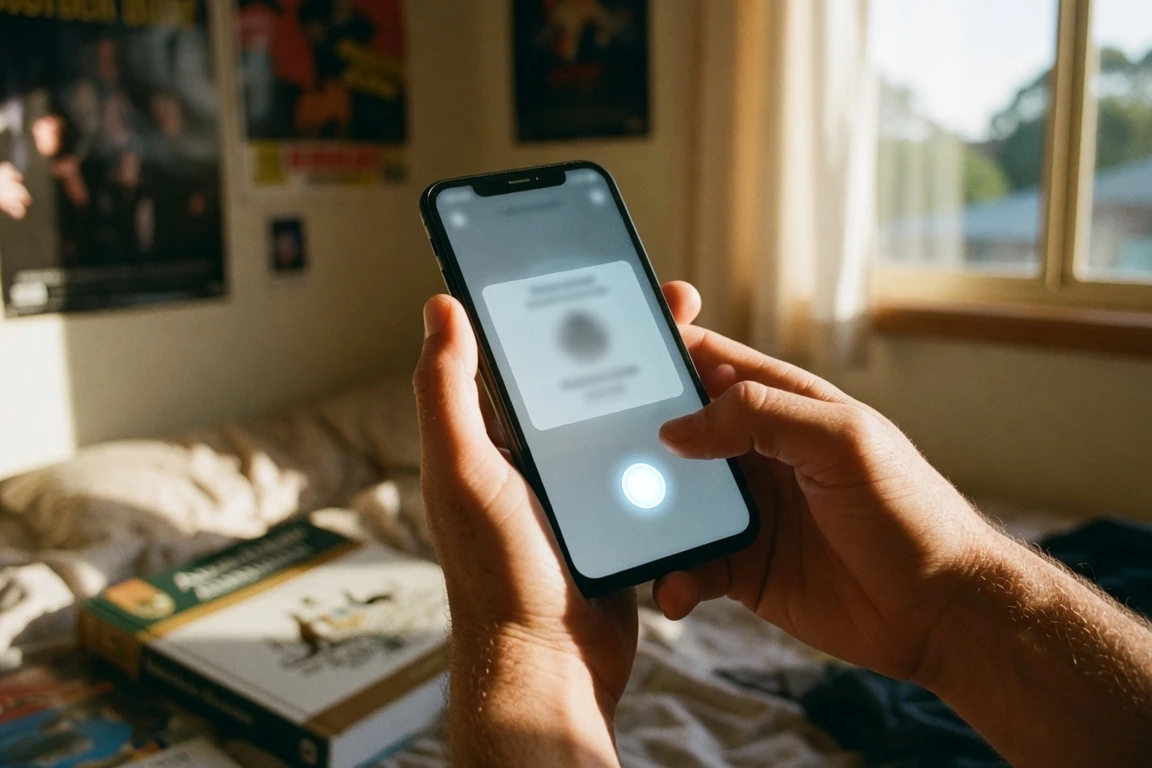
Two-thirds of the teens surveyed said they hit some kind of age check at sign-up. That number sounds reassuring until the kind of check is named. The two most common prompts, by the researchers’ count, were a self-declared age field and a selfie upload. Photo ID, the most rigorous method available, was demanded from only 5% of 12- to 13-year-olds and 11% of 14- to 15-year-olds.
The remaining checks were easy to bypass. About 15% of the 12- to 13-year-olds and 19% of the 14- to 15-year-olds surveyed told the researchers they used a fake account. Another slice logged in through private or incognito browsers. A small minority used a virtual private network. The pattern matches what Australia’s eSafety Commissioner, Julie Inman Grant, said in March about platforms allowing underage users to retry age assurance until they passed, and failing to stop teenagers from opening new accounts after being kicked off.
- A fake or borrowed account on a restricted platform
- Self-declared age at sign-up, where the platform took the word of the user
- Selfie-based age estimation, which misfires on teenagers close to the cutoff
- A private or incognito browser session on a shared family device
- A virtual private network, used by roughly 3% of teens
What the Government’s Own Numbers Show
Australia’s regulators were not waiting on the BMJ to see the problem. In the first two days after the December 10 cutoff, 4.7 million accounts were deactivated across the in-scope platforms, a number the government pointed to as evidence of “meaningful attempts” to clear underage users. By the start of March, another 310,000 accounts had been blocked.
The harder number came from the eSafety Commission’s own parent survey. Conducted at the tail end of January with 898 Australian parents, it found that about a third of children still had a social media account, down from half before the ban kicked in. Among under-16s who had accounts before the cutoff, between 60% and 70% had managed to stay on Facebook, Instagram, Snapchat and TikTok; just under 50% still had an account with YouTube. The under-16s in the BMJ sample were more likely than that to keep their access: more than 85% reported using a platform covered by the Act three months in, mostly via their own accounts. The gap between the regulator’s parent survey and the BMJ’s teen survey is itself part of the story, and parents in Australia appear to have underestimated how often their children were still online.
Three months is a short window. The Newcastle authors, along with the BMJ’s editorialist Dr Amrit Kaur Purba, caution that policy outcomes often lag implementation, and that the more interesting test may be over a year, not a quarter. But the pattern is consistent across two independent surveys, one regulator-supervised and one academic. The breakdown of the announcement that five platforms are under formal investigation lays out the regulator’s view of why.
Both surveys point in the same direction. The pattern is that the law was passed, the platforms did some initial work, and the teenagers kept logging on through the gaps that the work left open.
Australia’s teen social media ban, by the numbers
- 85% – under-16s still on a restricted platform three months after the law took effect (University of Newcastle, BMJ)
- 4.7 million – underage accounts deactivated in the first two days of enforcement (eSafety Commission)
- 310,000 – further accounts blocked by the start of March 2026 (eSafety Commission)
- A$49.5 million – maximum fine for platforms that fail the “reasonable steps” test
- 898 – Australian parents surveyed by eSafety in late January
Where Australia Points the Finger
Communications Minister Anika Wells has refused to accept the ban as the weak link. “Australia’s world-leading social media laws are not failing,” she said in March. “But big tech is failing to obey the laws.” In the same briefing, she accused the platforms of “taking the piss.” Five of them, Facebook, Instagram, Snapchat, TikTok and YouTube, are now under formal investigation by the eSafety Commission for “potential noncompliance” with the law, with Wells saying the agency was moving from investigation to enforcement and that the maximum penalty for a breach is A$49.5 million.
These platforms can comply today, and we certainly expect companies operating in Australia to comply with our safety laws. They can choose to do so or face escalating consequences, including profound reputational erosion with governments and consumers globally.
Meta, which owns Facebook and Instagram, said age determination remained “a challenge for the whole industry” and pushed back on where the fix should sit. Its preferred answer was to require “robust age verification and parental approval at the app store and operating system level before a teen can download an app or create an account.” Ten platforms are now in scope of the law under the official update on which platforms fall under the ban: Facebook, Instagram, Snapchat, Threads, TikTok, X, Reddit, YouTube, Kick and Twitch.
Why the UK’s 2027 Ban Is Now on Notice
The BMJ findings landed in the middle of a wider push. The United Kingdom has said it will block under-16s from Snapchat, TikTok, YouTube, Instagram, X and Facebook starting in 2027, with restrictions also covering livestreaming and communication with strangers on gaming sites such as Roblox. Indonesia, the United Arab Emirates and New Zealand are weighing comparable measures.
Campaigners who have backed the bans say the Australian evidence is a warning, not a refutation. Andy Burrows, chief executive of the Molly Rose Foundation, a UK charity set up after the death of 14-year-old Molly Russell, said social media bans alone do not keep under-16s off restricted platforms or cut the time teenagers spend using high-risk sites. “Unless ministers have a coherent plan to urgently learn lessons, the UK’s ban will similarly unravel,” he said. “Parents will be left with false hope and a misplaced sense of their children’s safety.” For a sense of what the UK’s under-16 ban rollout is up against, the Australian data is now the closest reference point.
A UK government spokesperson defended the country’s approach as “underpinned by stronger, more effective age verification checks” and framed the policy as much about resetting social norms as about today’s teenagers. Rachel de Souza, the children’s commissioner for England, called for a wider frame. “A ban should not be seen as a silver bullet,” she said, pointing to all online services with harmful features and not just social media platforms.
What Researchers Want Measured Instead
The Newcastle authors argue that a ban’s value cannot be read off social media use alone. The law’s stated aims run through mental health, exposure to harmful content, sleep and time spent elsewhere. Their study could only point at the first of those. A separate review of where the heaviest teen mental-health risk sits argues the ban’s deepest gap is the cohort it was sold to protect.
“We shouldn’t only be asking whether teenagers are using social media less,” said Professor Bridianne O’Dea, who leads the South Australian arm of the policy’s evaluation. O’Dea’s team at Flinders University has been pressing the same case in The Lancet Regional Health, Western Pacific. “Are they sleeping better?” O’Dea asked. The BMJ editorial by Dr Purba draws the same line: the test for the law is whether the policy improves outcomes for adolescents, not whether it removes accounts. The Newcastle team’s own data suggest the Act may be more effective in preventing or delaying access in children under eight than in policing the teenagers it was sold to.
Frequently Asked Questions
What is Australia’s social media ban?
Australia’s Social Media Minimum Age Act, which came into force on December 10, 2025, requires platforms including TikTok, X, Facebook, Instagram, YouTube and Snapchat to take reasonable steps to prevent Australians under 16 from holding accounts. Ten platforms have been assessed as in scope, including Threads, Reddit, Kick and Twitch. Discord, WhatsApp, Google Classroom and Roblox are excluded.
How many under-16s in Australia are still using social media?
A peer-reviewed University of Newcastle study of 408 adolescents aged 12 to 17, published in The BMJ on June 24, 2026, found that more than 85% of under-16s reported using a restricted social media platform three months after the ban began, and that more than half were still using their own accounts.
What age verification methods do platforms use?
According to the Newcastle study, the two most common checks were a self-declared age field and a selfie upload. Photo ID was required of only 5% of 12- to 13-year-olds and 11% of 14- to 15-year-olds who faced any check.
What happens to platforms that don’t comply?
Five platforms, Facebook, Instagram, Snapchat, TikTok and YouTube, are under formal investigation by Australia’s eSafety Commissioner for potential noncompliance with the law. The maximum civil penalty for a breach is A$49.5 million. There is no penalty for parents or teens who bypass the restrictions.
Which other countries are introducing similar bans?
The United Kingdom has said it will block under-16s from Snapchat, TikTok, YouTube, Instagram, X and Facebook starting in 2027, with the rules also covering some functions on gaming platforms such as Roblox. Indonesia, the United Arab Emirates and New Zealand are weighing comparable measures.


Lenovo Prices the IdeaPad Vibe Against Apple’s $699 Neo

Xbox Caps Game Pass Cloud Gaming at 15 Hours

GTA 6 DualSense Controllers Follow Sony’s Usual $84.99 Script

South Korea Retail Investors Face Reckoning After KOSPI AI Rally Collapses

Surrey AI Maps Three Heart Attack Paths and Their Molecular Roots

Germany Locks Neutral Apple ATT Prompts Across Most of Europe

Apple’s 5% EU Fee Quietly Rewrites Alternative App Store Math

Apple’s EU Fee Truce Cuts Complexity but Leaves Rivals Fuming

Pixel 11 Pro Fold Trades Thinness for Durability and Seven-Year Stay

Mayo AI Flags HCM Obstruction From Everyday Ultrasound Videos

Oracle Cuts 21,000 Jobs in a Year, Cites AI in 10-K Filing

Fable 5 and Mythos 5 Return as US Lifts Anthropic Export Controls

SpaceX’s Google Deal Turns a Rocket Company Into a Cloud Landlord

CD Projekt Red Co-CEO: Redemption Arc Isn’t Done, Witcher 4 in 2027

XPL Rallies 30% Ahead of Plasma One Card Tier Launch

Google Search Profiles Build a Follow Graph Inside Discover

DGO App Brings Rs 549 Mobile Pass for FIFA World Cup 2026 in Nepal

Moonshot AI Targets $30 Billion in China’s Fastest AI Funding Sprint

Oppo’s ColorOS 17 Eligibility List Leaves A-Series Buyers Behind

Microsoft Xbox Layoffs Start in July as Sharma Slams 3% Margin
-
 AI2 months ago
Oracle Cuts 21,000 Jobs in a Year, Cites AI in 10-K Filing
-
 AI2 months ago
Fable 5 and Mythos 5 Return as US Lifts Anthropic Export Controls
-
 AI3 months ago
SpaceX’s Google Deal Turns a Rocket Company Into a Cloud Landlord
-
 GAMING2 months ago
CD Projekt Red Co-CEO: Redemption Arc Isn’t Done, Witcher 4 in 2027
-
 CRYPTO3 months ago
XPL Rallies 30% Ahead of Plasma One Card Tier Launch
-
 NEWS3 months ago
Google Search Profiles Build a Follow Graph Inside Discover
-
 APPS3 months ago
DGO App Brings Rs 549 Mobile Pass for FIFA World Cup 2026 in Nepal
-
 AI3 months ago
Moonshot AI Targets $30 Billion in China’s Fastest AI Funding Sprint