
AI
Hassabis Told Cannes Lions That True Creativity Still Eludes AGI
A day after Project Genie won at Cannes Lions, Demis Hassabis said AGI still lacks true creativity and that near-term AI is overhyped.

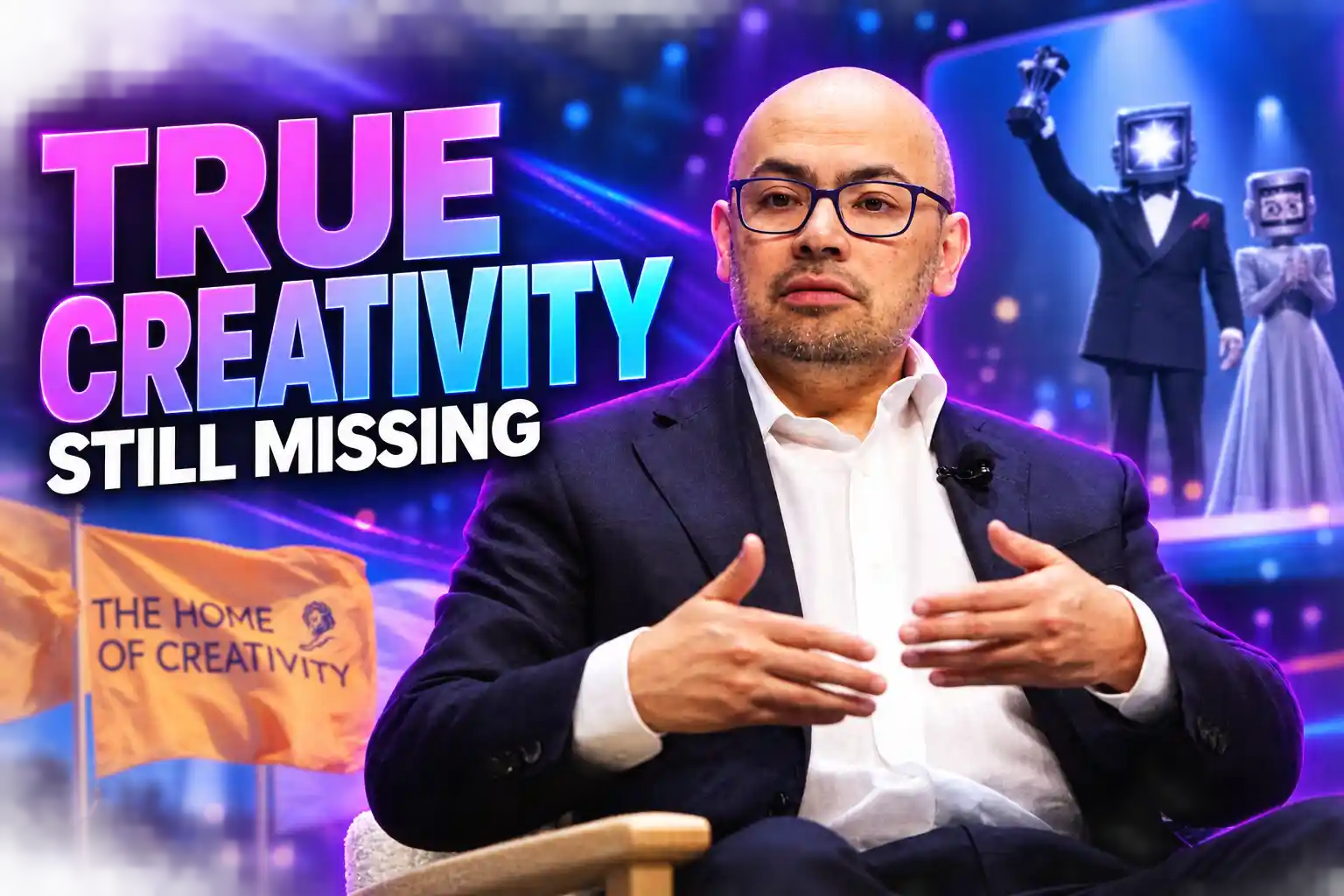
Google DeepMind co-founder Demis Hassabis told Cannes Lions on June 24 that AGI still lacks true creativity, a day after Project Genie won the Digital Craft Grand Prix. He also named long-term reasoning and planning as the other gap, and said near-term AI is a bit overhyped.
The line landed at the advertising industry’s own creativity festival, in a room that had just rewarded his lab for a prompt-built world. He was there to talk about tools. He used the time to say the leap still belongs to people.
What Is Still Missing From AGI, Hassabis Says?
The warning came in a 30-minute Lumière Theatre session titled The Future of Creativity, with Francine Lacqua moderating. Hassabis, then Google DeepMind’s CEO, told the audience the lab has long defined AGI as “being a system that exhibits all the cognitive capabilities humans are capable of.” Then he listed what current systems still cannot do.
I think there’s still a couple of really big pieces missing from what I would call AGI. One is long-term reasoning planning, and another is what you could call true creativity.
Demis Hassabis, co-founder and CEO of Google DeepMind, Cannes Lions Lumière Theatre
He defined the creative gap in the next breath. It is “not just iterating on a known idea or remixing existing things, but actually coming up with something novel or new.” He drew on his neuroscience work to say the human brain remains a hard comparison, including emotions, creativity, and dreaming. He also called the past decade of AI progress “relentless.”
Those two missing pieces were the load-bearing claim. Everything else in the session was a description of tools that, on his own terms, still sit below that bar.
Project Genie Took Digital Craft the Day Before
The booking was not a neutral keynote. Google DeepMind had already taken the festival’s top Digital Craft honour for Project Genie, a public experiment built on the lab’s Genie 3 world model. Google’s own recap of the week described Genie as a research prototype that lets people generate interactive, playable 2D worlds from a single text prompt or image.
THE WEEK DEEPMIND ARRIVED IN CANNES
- June 22, 2026: Google DeepMind and A24 announce a research partnership, and Google says it has also invested in the studio.
- June 23, 2026: Project Genie wins the Digital Craft Grand Prix. Hassabis talks provenance and SynthID on Google Beach.
- June 24, 2026: The Future of Creativity runs from 14:30 to 15:00 in the Lumière Theatre.
- June 26, 2026: The festival closes after five days on the Palais stages.
The prize lives in Digital Craft, where Cannes this year added an AI Craft subcategory inside Digital Craft for work that could only exist because of AI. The official brief asks for outcomes that would be “fundamentally unattainable through traditional methods alone.”
That is a high claim for a generator that, in Hassabis’s own vocabulary, still remixes. A walkable world from a prompt is a craft result the jury could score. On the AGI checklist he read out 24 hours later, it is still iteration on known ideas, not a leap into the new.
The Director’s Chair, in Plain Language
He spent the useful part of the talk describing a director’s workflow, not an autonomous artist. The value, he said, is steering outputs in ordinary language, the way a director guides a collaborator, without needing deep technical skill.
THE TOOLS HE WALKED THROUGH AT CANNES
| Tool | What he said it is for |
|---|---|
| Nano Banana | Change one part of an image in natural language without regenerating the whole frame |
| Omni | Take sound, video, or text as input and, later, output any of those forms, with fine-grain edits |
| Project Genie | Build interactive, playable worlds from a text prompt or image |
Google’s recap of the same week also listed Veo and Flow beside Nano Banana as tools that lower the cost of high-end production. Hassabis’s own examples stayed on control. “One reason Nano Banana became so popular was because it produced great images,” he said. “But then if you had some other iterative idea you wanted to pursue, which always happens with the creative flow, then you could just describe in natural language what bit you wanted changed, without it regenerating the whole image.”
Omni, he said, is named for taking “any type of modality input, whether it’s sound or video or text,” and eventually outputting any modality as well. The point was not only quality. It was “the fact that you can fine-grain edit those outputs.” Under those products, he said, are world models with some grasp of language and of physical space, which is why an edit can land on one object without wrecking the rest of the frame.
He told professional directors they will do 10X more things than they used to, try more extreme ideas, and iterate faster, because the tries are cheaper. He also said a new tool used the wrong way takes away from the creative process. Used in an innovative way, “it should add to the creative process.”
The access argument sat next to that speed claim. “AI will democratize creative tools, so more people try out their ideas, relatively quickly and easily,” he said. That is “double-edged though, because it also produces a lot more things that maybe are not very creatively valuable.” The other edge, in his view, is less gatekeeping and more routes in for new professional creators, wherever they live.
Remixing Is the Ceiling He Drew for Machines
After the product tour, he pulled the credit back. “I’m a huge believer in human ingenuity, human creativity,” he said. “I think we’re an unbelievably adaptable species. If you think about what we’ve built, modern civilisation with basically hunter-gatherer brains.” He was sure this generation and the next will work out how to use the new stack “to express even more human creativity.”
The limit was just as plain. The tools, he said, will let creators “more quickly iterate and brainstorm things they’ve thought of so far and then get to those ideas that are at the edge of what humans can imagine, and then push them forward.” Then the clause the room could not spend: “But at least for the foreseeable future, I think the craft and the soul of the creative piece still has to come from the humans. I don’t think that’s going to change anytime soon, and I imagine that’s what audiences want too.”
He applied the same split to science. “I think it’s actually creativity that separates the great scientists from the good scientists.” His hope was that the systems will assist the best scientists and help open “a new kind of golden age of scientific discovery.” That is a research bet, not a claim that the model on stage could form a new hypothesis about how the world works.
The Cannes programme had already written his origin story into the billing. The fusion of technology and art, it said, began in the early 1990s while he was designing best-selling simulation games such as Theme Park, and continues in the artist collaborations DeepMind now runs across film, games, and music. A man who once built amusement parks in software was now telling media buyers that generating a park from a prompt is still not the same as inventing the park.
Agencies in that room have spent two years staffing for prompt craft, because that is the work the current models reward. Hassabis gave them a production upgrade and withheld the word that would have turned the Grand Prix into an AGI event. The machines, on his scorecard, still cannot make the leap. The people who can still originate the idea are the ones the tools are supposed to serve.
A24’s Scott Belsky and a Room Already Split
Scott Belsky, founder of A24 Labs and a partner at A24, joined later in the discussion. Two days earlier, on June 22, Google DeepMind and A24 had announced a first-of-its-kind research partnership pairing the lab with the studio so filmmakers can help shape tools rather than receive them. Google also said it had made an investment in A24. Belsky’s walk-on was the public face of Google’s research partnership with A24, the deal that put a filmmaker-led studio inside DeepMind’s tool-building loop.
Offering a creator’s view, Belsky said the industry’s response is still mixed. Some artists are experimenting. Others stay wary. He still argued the technology could eventually produce new forms of entertainment and storytelling, including more personalised and interactive work. On jobs, he fell back on an old pattern: past technical shifts created categories of work that were hard to picture in advance, and this one may do the same.
Hassabis, for his part, said the lab’s habit in science and in creative work is to find people who are world-class in a domain “and then go and partner with them to understand what do they need from the tools, but also what kinds of problems are they trying to address, the really deep problems.” He said he has “the deepest respect for the creative process, which I learned from the games industry,” and that film is the main thing he loves doing in his spare time.
DeepMind’s wider brief, he said, is aimed at “maximum human flourishing.” The line was a caution as much as a slogan: business growth from AI is not the same thing as human growth, and he did not want the first to crowd out the second in a festival built on billings.
He Called the Next 10 to 15 Years Underappreciated
The time comment was the other half of the bottleneck. “I think AI is perhaps a bit overhyped in the very near term,” Hassabis said. “But then over the medium long term, over the next 10 to 15 years, it is still underappreciated how much transformation AI is going to create.” He added that the technology could lead to “almost a new human era.”
That is a long clock for a week of AI Craft entries. It is also how he kept the Grand Prix and the AGI claim in separate boxes. The near-term stack can already iterate, edit, and generate worlds. The transformation he is willing to underwrite waits on the two missing pieces, including the creative leap he said the models still cannot make.
He closed the Lumière conversation on trust. As generated media gets harder to spot, he said, provenance has to travel with the file. “We developed watermarking technology,” he said, and generated content should be traceable through common industry standards.
The day before, on Google Beach, he had named the system and the distribution plan.
We need to deal with misinformation and deep fakes. That’s something we were cognisant of when we first started building these generative models. We foresaw that we would be in a world where these systems would be really good and they’d eventually be almost photorealistic. Therefore, we’d need a digital watermarking system, which we created and called SynthID, that was robust, unhackable and would be embedded imperceptibly in an image so that anyone could detect if that image was generated by an AI or not. All of our models that generate anything from music, to images, to videos, come with SynthID embedded. We’ve also opensourced it and given it to the rest of the industry to use so a lot of our industry colleagues have now adopted that standard, OpenAI, Nvidia and many other big ones. If you’re creating generative media, it should come with provenance detection.
Demis Hassabis, Google Beach conversation, Cannes, June 23, 2026
WHAT HE LEFT ON THE TABLE
- The production win: Directors can try cheaper, faster, and in plain language, including 10X more attempts on a given idea.
- The AGI gap: Long-term reasoning and planning, plus true creativity as a leap, not a remix.
- The human remainder: Craft and soul stay with people for the foreseeable future, which he said audiences still want.
- The trust rule: Generated media should carry a watermark, and he wants that to be an industry standard.
Cannes gave DeepMind a craft trophy for worlds built from prompts. Hassabis told the same audience those worlds are still not invention. The clock he asked them to watch was the 10 to 15 year one, and the missing piece on that clock was the leap the prize did not require.

Instagram Plus Tests a Read-Only Mode That Cuts Stories

Altman Asks the Public to Accept Some AI Harm

Google Freezes OSS VRP Product Reports After AI Flood

AI Agents Make Payment Rails the Scarce Prize

Turkey’s Crypto Boom Now Runs Through Three Banks

Fable 5 Came Back Under a Commerce On-Off Switch

Google’s SpaceX GPU Lease Has a Sept. 30 Deadline

Plasma One’s XPL Locks Face a 1.81 Billion Cliff

DGO’s Rs 549 World Cup Pass Cost Fans Sleep and Data

Moonshot AI’s $30 Billion Ask Became a $35 Billion Close
-
 AI4 months ago
Fable 5 Came Back Under a Commerce On-Off Switch
-
 AI4 months ago
Google’s SpaceX GPU Lease Has a Sept. 30 Deadline
-
 CRYPTO4 months ago
Plasma One’s XPL Locks Face a 1.81 Billion Cliff
-
 APPS4 months ago
DGO’s Rs 549 World Cup Pass Cost Fans Sleep and Data
-
 AI4 months ago
Moonshot AI’s $30 Billion Ask Became a $35 Billion Close
-

 NEWS4 months ago
ColorOS 17 Device List Spans Oppo, OnePlus and Realme
-

 GAMING4 months ago
Xbox Cuts 3,200 Jobs After Five Years of Thin Returns
-

 GAMING4 months ago
The RTX 4050 Under Rs 70,000 Hides a Wattage Gap