
GAMING
Sony to End Physical PlayStation Disc Production in January 2028
Sony will stop producing physical discs for new PlayStation games in January 2028. What changes for players, who benefits, and who is left behind.

Sony Interactive Entertainment will stop producing physical discs for new PlayStation games starting in January 2028, the company confirmed on the PlayStation Blog on Wednesday. The announcement lands a year and a half before the deadline, leaving a runway for publishers that still press discs but drawing a hard line under a format Sony says no longer fits how most of its customers buy games.
The decision folds in two pieces of news Sony dropped on the same day. Disc manufacturing ends in 2028, and the PlayStation Store on the PS3 and PlayStation Vita will roll shut in stages, starting with three Latin American countries in August 2026 and ending with a global closure in July 2027.
What Sony Announced, And What It Leaves Untouched
Sony Interactive Entertainment posted the news in a brief post titled “Physical disc production ending in January 2028 for new games releasing on PlayStation consoles,” with the full January 2028 physical disc announcement committing to a date and a scope. “Physical game disc production for all new games releasing on PlayStation consoles will be discontinued starting January 2028,” Sony wrote. “Following this date, new games will be available on PlayStation Store and at retailers in digital formats only.” The rest of the post is framing about why.
What survives is just as important. “This transition has no impact on games that already released, or will be releasing, prior to January 2028 in disc format,” the post says. A disc copy of any PS5 game shipping this fall still ships on disc. The shelves get one final generation of boxed software from Sony’s pressing line, then nothing new. Third-party publishers can still press their own discs after January 2028, though no major studio has publicly committed to keeping the format alive past the cutoff.
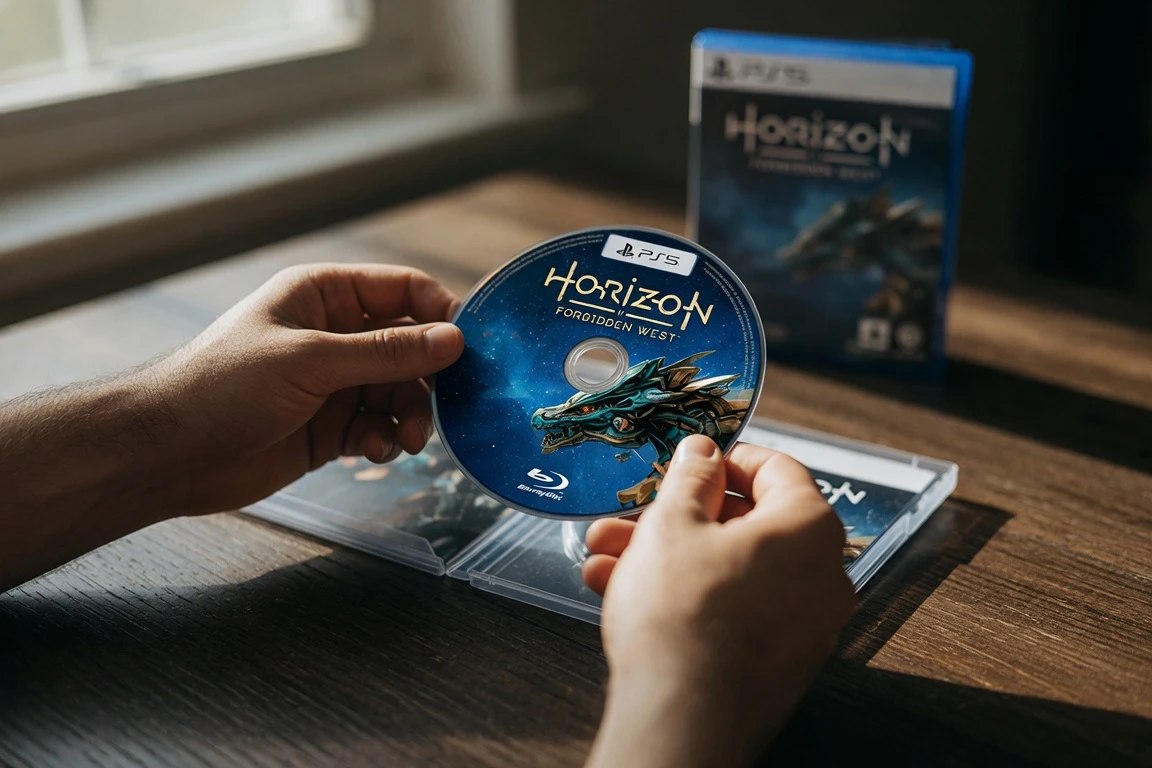
The Numbers Had Already Decided
Sony’s case for the move leans on a single line: digital “significantly outpaces physical discs.” The data behind that line now sits on Sony’s own books. In the quarter ending March 31, 2026, 85% of PS5 and PS4 full-game sales were digital downloads, while physical copies accounted for just 15% of total software sales, per the 85% digital share on PlayStation.
- 85% digital share of PS5 and PS4 full-game sales in Q4 FY2025
- 15% physical share of PS5 and PS4 full-game sales in Q4 FY2025
- $1.5 billion US spending on new physical games in 2025, the lowest tracked since 1995
- $11.6 billion US peak spending on physical games in 2008
- January 2028 Sony’s cutoff for new disc production
The US picture is bleaker still. According to games industry analyst Mat Piscatella, spending on new physical video games in the United States fell 11% in 2025 to $1.5 billion, the lowest figure tracked since 1995. At the 2008 peak, US physical game spending hit $11.6 billion, meaning the physical business has shrunk to roughly an eighth of its size at the height of the disc era. The pandemic pushed the digital share to 65% by 2020. Sony’s latest figure of 85% in a single quarter is the high-water mark so far, and Sony is following the buyer into digital.
This is a natural direction for Sony Interactive Entertainment to adapt to consumer trends as the general preference for digital media significantly outpaces physical discs.
Sony Interactive Entertainment, the PlayStation hardware maker and publisher, made the case on the PlayStation Blog on July 1, 2026, the same outlet where the company announced the January 2028 cutoff and the PS3 and Vita store closures.
GTA 6 Already Showed the Future
The second shoe in this story dropped earlier in June with Grand Theft Auto VI. Rockstar’s launch, set for November 2026, will be digital-only on day one, with the boxed edition shipping a download code rather than a disc, per GTA 6 pre-orders and the December disc rumor and Vice reporting. The Hollywood Reporter reported that Rockstar has no plans to make GTA 6 physical discs, a claim that followed a Rockstar Support email telling customers a physical copy would be available in the “following months.” Rockstar has not clarified whether a physical disc edition will ever ship.
For Sony, GTA 6 is a proof-of-concept at the largest possible scale. If the publisher with the most anticipated release of the decade can sell boxed editions without discs and keep its audience, the broader industry argument writes itself. Sony’s blog post lands in the same news cycle, and the framing is the same: digital is the default. From January 2028, every new PS5 game will go to market the way GTA 6 does now, by download. Sony has not framed any future for the disc format after that date.
Who Pays the Price
The winners are easy to name. Sony, Microsoft, Steam, and subscription services like PS Plus and Xbox Game Pass all collect recurring revenue from players who would once have bought a used copy at chains like GameStop. The losers are more dispersed across the value chain.
Retailers that built floor space around the boxed-software trade face a smaller total pie every year. The used-game resale market, a long-standing business for chains like GameStop, depends on the disc as a physical object that changes hands. Take away the disc, take away the resale. Collectors lose the tactile product and the ability to lend a game to a friend on a long flight. Players on slow, capped, or metered connections lose a way to install games without waiting on a long download.
The proof of concept for that last concern is already on the record. In the days before Sony’s disc announcement, the company notified certain users that hundreds of purchased StudioCanal movies and TV shows were being removed from their digital libraries because of expiring content licensing agreements, Game Informer reports. Those delistings reminded buyers that digital purchases can be revoked. The same architecture applies to games.
The friction is now showing up in courts. Sony is currently facing the £2 billion UK class action against PlayStation over an alleged unlawful digital monopoly on game sales. Closing arguments in that case landed this week at the Competition Appeal Tribunal in London, the same week Sony made its disc decision permanent.
Sony’s Three Wins From the Digital Pivot
The economics cut in Sony’s favor on three fronts. The cut the PlayStation Store takes on digital transactions stays in Sony’s pocket on every PS5 game sold, where it would have gone to retailers, distributors, and disc-manufacturing partners on a boxed sale. Every digital sale is also telemetry Sony can see in real time, which is itself the product Sony sells to publishers who pay for storefront placement and promotional slots.
The format lock-in is the third and largest effect. A player who has built a digital library over six years is unlikely to walk away from it for a competitor’s hardware. Sony’s own blog post says the move will “enable us to align more closely with how most of our community prefers to access and play games today,” a description that also captures a business that wants its customers inside its own walls. The disc was the last escape hatch for the player who refused to live inside a license. From January 2028, that hatch closes.
The Calendar That Runs Before January 2028
The PS3 and Vita store closures are the smaller news, but they set the schedule for what comes next. Sony’s PS3 and Vita store closure update lays out a three-tier rollout that begins in three Latin American countries in August 2026 and ends with a global shutdown in July 2027.
| Date | Region | What closes |
|---|---|---|
| August 2026 | Mexico, Honduras, Nicaragua | PlayStation Store on PS3 |
| Late 2026 | Additional Latin American and Middle Eastern countries | PlayStation Store on PS3 |
| July 2027 | All other countries | PlayStation Store on PS3 and PS Vita |
Sony’s stated reason is technical. “As the PlayStation Store continues to evolve to support modern commerce systems, including updated payment processing standards, PS3 and PS Vita are no longer able to support these updates at the level required,” the post reads. Whatever the cause, the effect is the same for the player. Sony says “players will still be able to download previously purchased content after the closing date for the foreseeable future.” New purchases stop on each region’s listed date. Existing libraries stay accessible, but only until Sony’s servers say otherwise.
The rollout is the prelude to the disc announcement. By January 2028, only the PS4, the PS5, and whatever comes next will still have an active PlayStation Store. New PlayStation games will have nowhere else to go but digital.
Frequently Asked Questions
When does Sony stop producing physical discs for new PlayStation games?
Sony has set January 2028 as the cutoff. After that date, new games will be available on the PlayStation Store and at retailers in digital formats only, per the company’s PlayStation Blog post on July 1, 2026.
Does the announcement affect PlayStation games I already bought or games releasing before January 2028?
No. Sony’s post says “this transition has no impact on games that already released, or will be releasing, prior to January 2028 in disc format.” Discs already on shelves or pressing in the queue stay valid and sell as usual.
When does the PlayStation Store close on PS3 and PS Vita?
Sony will close the PS3 store in Mexico, Honduras, and Nicaragua starting August 2026, expand to additional Latin American and Middle Eastern countries in late 2026, and shut down globally on both consoles in July 2027.
Can players still download PS3 and Vita games they bought after the stores close?
Yes. Sony’s update says “players will still be able to download previously purchased content after the closing date for the foreseeable future.” New purchases stop on each region’s listed date. Existing libraries remain accessible.
Has Sony described the disc decision as permanent?
Sony frames the move as “a natural direction for Sony Interactive Entertainment to adapt to consumer trends as the general preference for digital media significantly outpaces physical discs.” The blog post does not include a clause restoring disc production, and Sony has not announced a parallel path for third-party publishers to continue pressing PlayStation discs after January 2028.


Pixel 11 Trails Galaxy Phones That Last as Long

OpenAI’s Research Intern Arrives With a Warning Attached

Robinhood Prices XRP Into a Two-Cent 9 a.m. Bet

Sony’s 10 Percent Disc Drop Leaves the 2028 Cutoff Intact

Chip Allocation Sidelines the Base iPhone 18 This Fall

Miami-Dade Fights the Vice City Brand It Already Wears

IFA 2026 Awards Put Tecno Ahead of Flagship Phones

USB-C Gadgets Made the Junk Drawer Rechargeable

Pixel 11 Pro Asks $1,099 for a Light Google Locked

The iPhone Ultra Sells Two Retired Minis as One Foldable

Oracle Cuts 21,000 Jobs in a Year, Cites AI in 10-K Filing

Fable 5 and Mythos 5 Return as US Lifts Anthropic Export Controls

SpaceX’s Google Deal Turns a Rocket Company Into a Cloud Landlord

CD Projekt Red Co-CEO: Redemption Arc Isn’t Done, Witcher 4 in 2027

XPL Rallies 30% Ahead of Plasma One Card Tier Launch

Google Search Profiles Build a Follow Graph Inside Discover

DGO App Brings Rs 549 Mobile Pass for FIFA World Cup 2026 in Nepal

Moonshot AI Targets $30 Billion in China’s Fastest AI Funding Sprint

Oppo’s ColorOS 17 Eligibility List Leaves A-Series Buyers Behind

Microsoft Xbox Layoffs Start in July as Sharma Slams 3% Margin
-
 AI3 months ago
Oracle Cuts 21,000 Jobs in a Year, Cites AI in 10-K Filing
-
 AI2 months ago
Fable 5 and Mythos 5 Return as US Lifts Anthropic Export Controls
-
 AI3 months ago
SpaceX’s Google Deal Turns a Rocket Company Into a Cloud Landlord
-
 GAMING3 months ago
CD Projekt Red Co-CEO: Redemption Arc Isn’t Done, Witcher 4 in 2027
-
 CRYPTO3 months ago
XPL Rallies 30% Ahead of Plasma One Card Tier Launch
-
 NEWS3 months ago
Google Search Profiles Build a Follow Graph Inside Discover
-
 APPS3 months ago
DGO App Brings Rs 549 Mobile Pass for FIFA World Cup 2026 in Nepal
-
 AI3 months ago
Moonshot AI Targets $30 Billion in China’s Fastest AI Funding Sprint