
APPS
The Trump Accounts App Puts Child Savings on Robinhood Rails
The Trump Accounts app is live, but BNY and Robinhood hold the first years of each child IRA, and the $1,000 seed skips most kids who sign up.

The Trump Accounts app is live, and BNY and Robinhood hold the first years of each child’s account. Any child under 18 with a Social Security number can get one. Only U.S. citizens born from January 1, 2025 to December 31, 2028 get the $1,000 Treasury seed.
Parents still file a tax election before the app will fully open. Treasury Secretary Scott Bessent said on Sept. 8 that enrollment had passed over 7 million children, up from about 7 million in late July. The product on the phone is a section 530A IRA, not a piggy bank you can tap for diapers.
How to Open a Trump Account After the July Launch
Download the official app and you still have paperwork behind it. The IRS treats the account as a traditional IRA for a minor, owned by the child and run by an adult until age 18. You elect it on IRS Form 4547 Trump Account Election, through TrumpAccounts.gov, an IRS Individual Account, or a tax return. The $1,000 box is separate from the box that opens the account, and it is not checked for you.
Treasury began sending activation mail on May 28, 2026 to families who had already filed. The first messages come only from no-reply@TrumpAccounts.Treasury.gov. Later notes may arrive inside the app or from addresses ending in @trumpaccount.com, which is also the web version at trumpaccount.com if you do not have a phone.
SIGNUP STEPS THAT STILL APPLY
- File the election: Submit Form 4547 for each child who will be under 18 at year-end and already has a Social Security number.
- Claim the seed: If the child is a U.S. citizen born from 2025 through 2028, elect the $1,000 pilot on the same form.
- Wait for activation: Use the email on the form, then finish setup in the app or on trumpaccount.com after the Treasury message arrives.
- Fund after July 4: Family, employers, and other allowed givers can send money, subject to the yearly cap, once the account is open.
There is no charge to open an account. Customer help is the in-app channel or 1-866-USA-4547. Treasury says it will not ask for passwords or one-time codes by email, text, or phone. Skip random “support” numbers from a search page.
Under the Treasury Logo, a Brokerage Stack
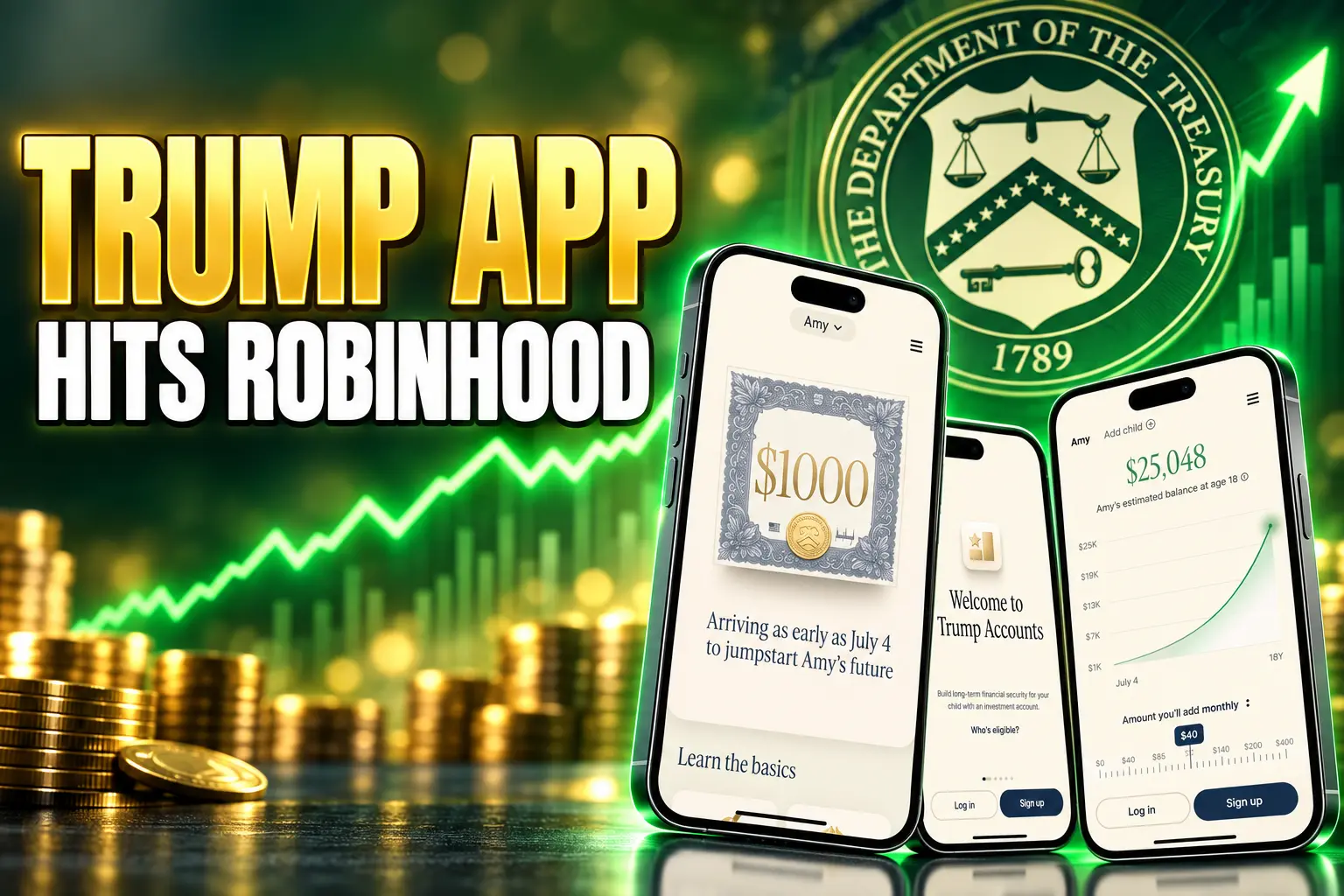
The app looks like a government product because Treasury kept control of it. The plumbing is private. On April 6, 2026, Treasury designated BNY as financial agent to manage the initial accounts and help build the app. BNY partnered with Robinhood, which Treasury named as brokerage and initial trustee.
The app is a white-label build for Treasury. The National Design Studio, a White House design shop, worked with Robinhood on the interface. Vice President JD Vance wrote in May that the early download was also a test of Treasury’s digital back end before the money moved. That is a fair read of what shipped: a signup funnel first, a funded IRA second.
We are proud to power Trump Accounts with Robinhood’s technology and to work alongside a historic and trusted institution like BNY. Our task is clear: to provide the next generation of Americans with a world-class, intuitive platform to jumpstart their financial future.
Vlad Tenev, Chairman and CEO of Robinhood, BNY announcement
BNY CEO Robin Vince called the work a way to widen access to markets. Both firms also pledged to match the federal $1,000 for eligible newborns of their own U.S. workers, so they sit on both sides of the cash flow. They run the national pipe, and they write checks into it for staff.
The live app is simpler than a retail brokerage. It breaks into account balance, contribute, and learn. Relatives can be invited with a QR code and pay with Apple Pay or a debit card. Some funded accounts still showed the $1,000 as pending in early July, so the growth charts did not include the seed. That pending state is why a parent can finish signup and still feel like nothing happened.
🇺🇸 THE AMERICAN DREAM STARTS NOW.
You can officially start investing in your child's future with Trump Accounts and help build the next generation's financial future.
Download the official Trump Accounts app & get started today at https://t.co/71tyohZL8S. pic.twitter.com/4XyP21VdE9
— The White House (@WhiteHouse) July 5, 2026
Most Enrolled Kids Never See the $1,000
On July 4, 2026, the full Trump Accounts app went live nationwide. Bessent said families could start funding that day, and children could track holdings beginning Monday, July 6. The app added 15 financial education modules on saving, investing, and U.S. markets.
The seed is the marketing hook, and it is narrower than the signup. IRS figures from March 31 showed more than 4 million children elected, with more than 1 million claiming the pilot. By early July, about 1.4 million of the signed-up children were in the seed window. In a 5.5 million-account snapshot from that week, 86% of those accounts were from families earning under $200,000. President Trump said more than 500,000 children received the seed on July 4 itself.
Older children can still open an account through the year they turn 17. They do not get the Treasury $1,000. That split is easy to miss in an app store listing that leads with the gift. Rep. Thomas Massie argued the money would have been found without a polished download. “You could hide a new handout like this under a rock in Alaska and people will still find it,” he wrote. The app still matters for the other 5 million-plus children who get a brokerage IRA and no federal check.
MONEY THAT CAN ENTER A TRUMP ACCOUNT
| Source | Limit | Toward the $5,000 cap | Tax on the way out |
|---|---|---|---|
| Treasury seed | $1,000, one time | No | Taxable, with earnings |
| Family and other adults | Up to $5,000 a year combined | Yes | After-tax in; principal not taxed again; earnings taxed |
| Employer | Up to $2,500 per employee a year | Yes | Pre-tax in; taxed on withdrawal |
| Charities, states, local governments | No extra statutory cap in the family limit | No | Taxable on withdrawal |
Individual gifts are after-tax, with no earned-income test on the child. Combined family, friend, and employer money shares one $5,000 pot per child for 2026 and 2027, then the cap indexes. Keep records. The source of each dollar decides which slice is taxable later.
A Pre-Tax Channel for Employers
Treasury said on July 4 that over 50 companies had committed to contribute for employees’ children, including kids who miss the federal seed. That is the second hidden book of money: workplace dollars that never show up in a birth-year chart.
An employer may put in up to $2,500 per employee a year and split it among that worker’s children. Staff can also divert pay pre-tax through a benefits plan. Employer money plus that salary reduction still counts toward the child’s $5,000. A worker with two children and a $2,500 company gift split in half could add $3,750 of after-tax cash to each child and fill both accounts.
The Labor Department has treated most of these programs as outside ERISA pension rules, with a narrow exception when the child is also an employee. That makes the match easier for a benefits team to turn on, and it is why HR portals will start sitting next to the Treasury app. Small firms can use the same channel. Treasury asked companies that want in to write TrumpAccounts@treasury.gov.
Friends and grandparents who send cash had a separate worry: gift-tax paperwork on a $5,000 birthday transfer. In Revenue Procedure 2026-25, the IRS set a safe harbor so many of those gifts do not need a gift-tax filing for that year if the stated tests are met. That is a back-office fix for a product that wants relatives to tap Apple Pay.
Growth Stays Inside a Cheap Index Box
Until the child ages out of the growth period, the menu is not a brokerage supermarket. On Aug. 20, 2026, Treasury and the IRS proposed rules for what a Trump Account may hold. During the growth period, which ends on December 31 of the year the beneficiary turns 17, the money goes into a mutual fund or ETF that tracks a broad equity index of mostly U.S. companies, does not use leverage, and charges no more than 0.1% a year.
RULES FOR THE GROWTH YEARS
- Index only: A qualified index is the S&P 500 or another broad U.S. equity gauge; a 90% U.S.-company weighting is the safe harbor in the proposal.
- No leverage: Borrowed money cannot juice the fund.
- Fee ceiling: Combined annual fund fees and expenses may not exceed 0.1% of the invested balance. Separate trustee custody charges sit outside that cap.
- Trustee default: If nobody picks a fund, the trustee chooses an eligible one.
After that growth period, the extra investment limits fall away and ordinary IRA investment rules take over. Actively managed funds and funds that try to copy several indexes at once are out of the proposed growth-period box. So are sector screens. The proposal also treats ESG screens as too close to a sector bet. IRS Chief Executive Officer Frank J. Bisignano said the accounts are meant to let children invest now and use compound earnings later for college, retirement, and other needs.
That box is why Robinhood’s usual options chain is beside the point here. The firm is the trustee of a cheap index sleeve, not a teen day-trading login. For a child holding for decades, the 0.1% lid is the whole product: almost all of the market return stays in the account, and almost none of the usual brokerage catalog is allowed in.
Fidelity Is Waiting on the Rollover Window
Treasury sets up the first account. Other firms want the second one. Fidelity’s explainer tells families they will be able to roll the account to another provider that offers a Trump Account product, and that Fidelity will take transfers later in 2026 once Treasury publishes the rest of the rules. That sentence is the quiet fight. BNY and Robinhood get the default years. Everyone else is bidding for the rollover.
The earlier Trump Accounts app rollout already treated the download as a tech launch. The next chapter is custody. A parent who leaves the money in the Treasury app is still in the BNY-Robinhood stack. A parent who moves it is choosing a retail IRA shop, with the same 530A wrapper until the child ages out.
On January 1 of the year the child turns 18, the special minor rules can give way to ordinary traditional IRA terms, depending on the trustee’s agreement. It may not flip by itself. Early withdrawals after that still face tax and a 10% penalty before age 59½, with the usual IRA exceptions, including certain school costs, a first-home slice up to $10,000, and birth or adoption costs up to $5,000. Required minimum distributions apply. A Roth conversion may be possible later; Fidelity notes that more IRS detail is still due.
Bessent said on Sept. 8 that automatic enrollment was coming and that families would still have to activate. Treat that as a plan, not a finished switch. Until it is in IRS instructions, Form 4547 is still the door.
A Social Security Glitch at the Door
The launch week was not clean for every newborn. Parents of some 2026 babies with freshly issued Social Security numbers got error screens. Treasury said the problem was limited and tied to how new numbers move through enrollment, and that there were no system-wide activation delays. Identity checks can differ by person, the department said.
Seed timing is a second queue. Treasury compared it to a tax refund and said most parents wait one or two days after the account is open. Some families were told it could take up to four weeks. IRS language is looser still: the $1,000 goes in as soon as practicable after the election is processed and the trustee confirms the account exists. July 4 was the first legal day for those deposits, not a promise that every eligible child was paid that afternoon.
In September, at least one parent still found Form 4547 inside the app with a Continue button that would not enable when the address lookup failed. That is a small bug with a large cost if it blocks the election. The $1,000 also does not land in time for a hospital bill. Withdrawals before 18 are tightly limited, so the seed is a long-hold index position, not cash for the nursery.
THE ROLL FROM APP STORE TO FUNDED IRA
- May 28, 2026: Treasury puts the Trump Accounts app in major stores and starts phased activation emails.
- July 4, 2026: Full app functions go live, contributions open, and seed deposits may begin.
- July 6, 2026: Children can start tracking holdings in the app.
- July 27, 2026: Bessent says about 7 million children are signed up and calls it the most successful launch in government history.
- August 20, 2026: Treasury and the IRS propose the 0.1% index-fund rules for the growth years.
- September 8, 2026: Bessent says enrollment is over 7 million and that automatic enrollment is coming, with activation still required.
Scams followed the two official domains. Treasury told families the first activation mail would come only from the treasury.gov address, then said later mail could come from @trumpaccount.com. That is a real pair of channels, and it is also a gift to copycats. If a message asks for a password or a code, it is not the program. Open the app or type TrumpAccounts.gov yourself.
The child who gets an account this year is a shareholder in a cheap U.S. equity fund with a government name on the icon. The firms under that icon already have the assets. The parent who wants a different shop will have to wait for the rollover window and then move.
Frequently Asked Questions
Who qualifies for the $1,000 Treasury seed in a Trump Account?
The child must be a U.S. citizen born from January 1, 2025 to December 31, 2028, with a valid Social Security number, and someone authorized must elect the pilot on Form 4547. The seed does not count toward the $5,000 yearly cap. A state, territorial, or tribal child-welfare agency that opens an account as legal guardian cannot elect the $1,000; a parent or other person who expects to claim the child under the tax code’s qualifying-child test may still elect the seed if the birth-year rules are met.
Who is allowed to open the account if a parent cannot file?
The IRS order of authorized individuals is legal guardian, then parent, then adult sibling, then grandparent. For children in the 2025 to 2028 window who are claiming the $1,000, the person who files should be someone who expects to claim the child on a tax return. Each child may have only one funded Trump Account.
When can a child take money out of a Trump Account?
Before age 18, distributions are generally blocked except for limited rollovers. The growth-period investment limits end on December 31 of the year the child turns 17. On January 1 of the year the child turns 18, ordinary traditional IRA distribution rules can apply under the trustee’s agreement, including tax and a 10% penalty on many withdrawals before 59½. The account may not convert on its own; the family may need to roll it to a traditional IRA or, if later guidance allows, convert to a Roth.
Do you need earned income to contribute?
No. Unlike a typical IRA for a working teen, a Trump Account accepts individual contributions without an earned-income test on the child. That is why a grandparent can fund an infant’s account up to the yearly cap. Employer deferrals still run through a workplace plan and share the $5,000 limit with those individual gifts.
Do gifts to a Trump Account require a gift-tax return?
Not in every case. Revenue Procedure 2026-25 gives individual donors a gift-tax reporting safe harbor for the year if the stated tests are met, which the IRS said was meant to cut paperwork for friends and family who want to contribute. The safe harbor is a reporting rule, not a change to the $5,000 contribution cap or to income tax on later withdrawals.
Disclaimer: This article is news reporting and analysis of the Trump Accounts program and the official app, and it is for information only. It is not tax, investment, legal, or financial-planning advice, and it is not a recommendation to open, fund, roll over, or withdraw from any account. Speak with a qualified tax professional, fiduciary adviser, or benefits administrator who can review your child’s eligibility, your employer’s plan, and the tax treatment of each contribution before you act. Figures, enrollment counts, app features, and IRS rules reflect the Treasury, IRS, and firm materials cited here as of the dates on those documents and may change as rollovers, automatic enrollment, and final regulations move.

Instagram Plus Tests a Read-Only Mode That Cuts Stories

Altman Asks the Public to Accept Some AI Harm

Google Freezes OSS VRP Product Reports After AI Flood

AI Agents Make Payment Rails the Scarce Prize

Turkey’s Crypto Boom Now Runs Through Three Banks

Fable 5 Came Back Under a Commerce On-Off Switch

Google’s SpaceX GPU Lease Has a Sept. 30 Deadline

Plasma One’s XPL Locks Face a 1.81 Billion Cliff

DGO’s Rs 549 World Cup Pass Cost Fans Sleep and Data

Moonshot AI’s $30 Billion Ask Became a $35 Billion Close
-
 AI4 months ago
Fable 5 Came Back Under a Commerce On-Off Switch
-
 AI4 months ago
Google’s SpaceX GPU Lease Has a Sept. 30 Deadline
-
 CRYPTO4 months ago
Plasma One’s XPL Locks Face a 1.81 Billion Cliff
-
 APPS4 months ago
DGO’s Rs 549 World Cup Pass Cost Fans Sleep and Data
-
 AI4 months ago
Moonshot AI’s $30 Billion Ask Became a $35 Billion Close
-

 NEWS4 months ago
ColorOS 17 Device List Spans Oppo, OnePlus and Realme
-

 GAMING4 months ago
Xbox Cuts 3,200 Jobs After Five Years of Thin Returns
-

 GAMING4 months ago
The RTX 4050 Under Rs 70,000 Hides a Wattage Gap