
AI
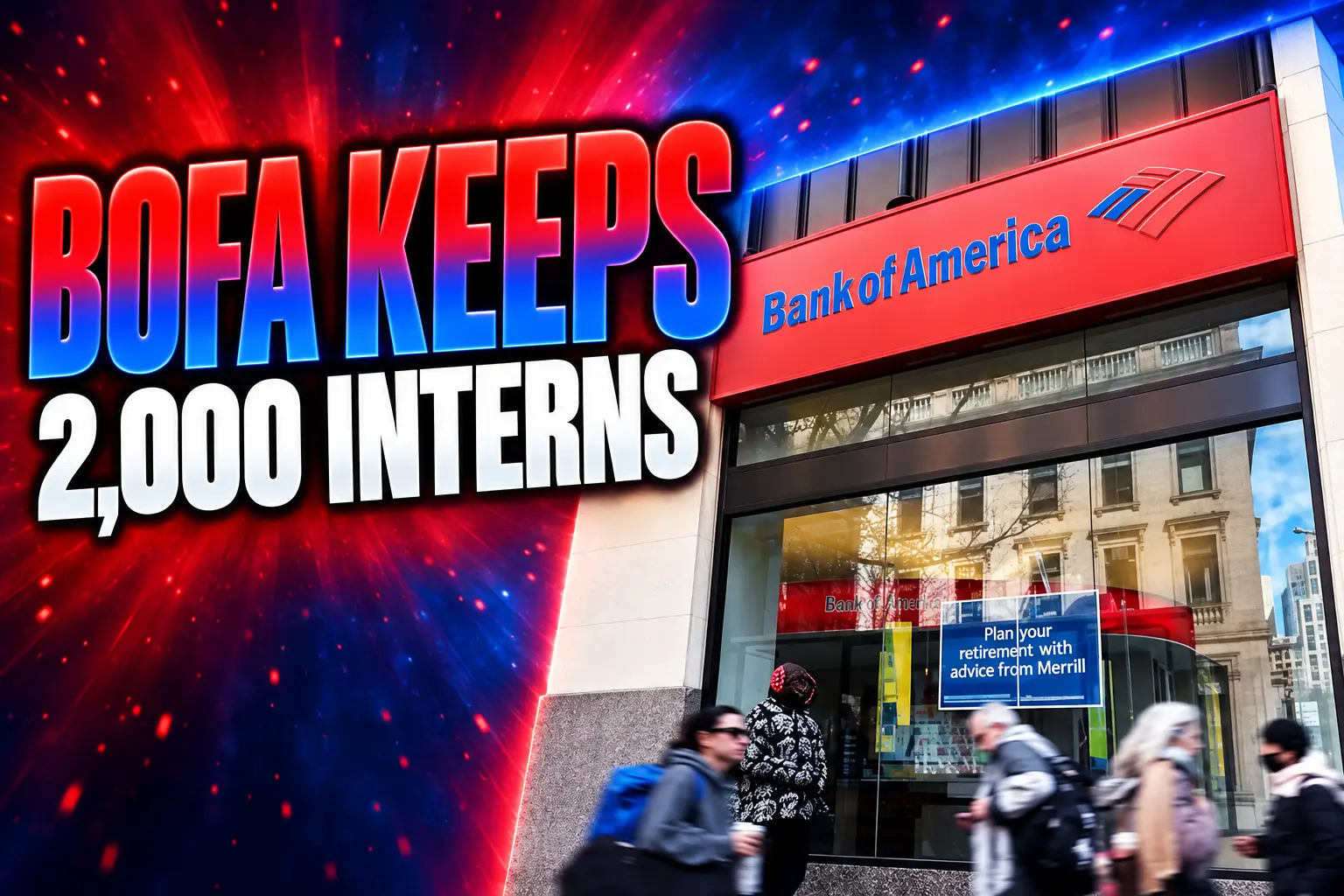
Bank of America Keeps 2,000 Interns as Headcount Falls
Bank of America kept its 2,000-intern class while headcount fell to 211,304, even as its own AI tools absorbed junior-level work.

Bank of America brought in 2,000 summer interns in 2026, matching its 2025 campus class, while payroll fell to 211,304. Another 2,000 full-time college hires arrived with them.
Josh Bronstein, the bank’s head of global talent, said the leadership pipeline still needs that campus class even as the work changes. The June 30 supplement still showed fewer people on the books than at the start of the year.
The Same 2,000 Seats as Last Year
On June 3, 2026, the bank said it would welcome nearly 4,000 summer interns and campus recruits from more than 500 colleges and universities. Bronstein split that intake evenly: 2,000 interns and 2,000 full-time campus hires, starting the following week across eight lines of business, including consumer, investment, and corporate banking.
That is the same shape he described for 2025, when he said the bank had brought in about 2,000 young adults from college campuses and another 2,000 summer interns. He later told interviewers the 2026 class was roughly the same. CEO Brian Moynihan put it more bluntly on Sept. 10, 2026: the bank hires about 2,000 summer interns a year, plus 2,000 from schools, and “we haven’t changed it.”
Sheri Bronstein, chief people officer, framed the intake as a long bet, not a one-summer splash. The press release also pointed to the Military Veteran Program, which has produced more than 20,000 hires to date, and to community-college and other early-career routes.
Our approach to hiring is intentional and long term. We focus on attracting the best talent with the right skills, potential, and a strong career mindset, and we invest in growing that talent through long-term careers that meet the needs of our clients and drive responsible growth.
Sheri Bronstein, Chief People Officer, Bank of America press release, June 3, 2026
The statement never claimed the intern class had grown. It claimed the bank still wants juniors. Those are different claims, and the second one is doing most of the public work.
Payroll Fell While the Interns Arrived
Moynihan has told investors to work headcount through operational excellence and new technology, including AI. The bank has not announced a single mass layoff for 2026. The supplement still shows a slow leak.
HEADCOUNT AT PERIOD END
| Period end | Headcount |
|---|---|
| June 30, 2025 | 213,388 |
| Sept. 30, 2025 | 213,384 |
| Dec. 31, 2025 | 213,207 |
| March 31, 2026 | 212,134 |
| June 30, 2026 | 211,304 |
The headcount of 211,304 at June 30 is 1,903 below year-end 2025 and 2,084 below June 30, 2025. From March to June, a window that included the campus arrival, the total still dropped 830. Interns may or may not sit in that line the way full-time staff do. The 2,000 full-time campus hires should. Either way, the filing did not rise.
Moynihan has used a longer tape. On a July 2025 earnings call he said the company had about 300,000 people 15 years earlier and about 212,000 then. Digital self-service, branch thinning, and now AI have all been part of that grind. The intern photo does not reverse it.
Erica Already Covers 11,000 People’s Work
The labor the bank no longer needs to staff shows up first in tools that already run at scale. Company leaders told an investor day that Erica, the virtual assistant, is doing the work of 11,000 people. That figure is a labor equivalent, not a stack of pink slips. It is still the size of several intern classes.
WHERE THE BANK SAYS AI TAKES WORK
- Erica for clients: Holly O’Neill, president of consumer, retail, and preferred, said the bot has 20 million regular users and two million interactions a day, with 42 million consumers and 40,000 business customers on it.
- Erica for Employees: About 95% of a 213,000-person workforce was using the internal version for IT and HR questions, and calls to the help desk had fallen 55%.
- Coding: Moynihan said 18,000 people on the payroll who code had taken 30% out of the coding part of the product-change stream, which “saves us about 2,000 people.”
- Daily use: On the second-quarter 2026 call he said associates were generating more than 400,000 prompts a day, with more than 300 AI use cases approved, 114 of them live generative AI, and 34 fully implemented.
Hari Gopalkrishnan, chief technology and information officer, has been blunt about why the customer-facing bot is not a free-form chat model. Banking answers have to be right. The bank still uses large language models inside the firm, including to draft client meeting prep. Moynihan said relationship managers now automate research and presentation materials, the exact first-draft pile that used to train juniors.
The coding save is the rhyme that makes the intern headline sting. GitHub, whose Copilot tool the bank put in front of those developers, has published research in which users completed a coding task 55% faster than a control group. Moynihan’s “about 2,000 people” is a productivity equivalent, not 2,000 developers walked out. It is also the same integer as the intern class the bank is using as proof that junior hiring lives.
The annual technology budget sits at $13 billion, with $4 billion of that aimed at new technology, of which Erica is a part. The intern class is a recruiting cost. The tools are a substitution machine.
240,000 People Chased Those Intern Slots
If the class size did not shrink, the gate still narrowed from the applicant side. Bronstein said around 240,000 people applied for fewer than 2,000 internships, an acceptance rate of around 0.8%. He said applications ticked up, in part because AI tools make it easier to fire off forms, and in part because the contest got harder.
THE 2026 CAMPUS GATE
- Intern seats: Fewer than 2,000, against 240,000 applications.
- Return path: Bronstein said the vast majority of interns typically get a return offer.
- Schools: More than 500 colleges and universities, per the June 3 release.
Full-time campus seats: About 2,000 more, for a combined class near 4,000.
Relief that “Wall Street is still hiring interns” skips that math. Two thousand seats against 240,000 forms is a lottery with a brand. It is not a labor-market thaw.
This is an important leadership pipeline for us, where we bring in a broad group of talent who can come and grow long-term careers with us. While certainly some of the work changes as a result of technology, that doesn’t mean our aggregate campus-class needs change.
Josh Bronstein, Head of Global Talent, Bank of America
He is describing a farm system for future managers, not a promise that the old analyst grind still exists in the same volume. The vast majority typically convert. He did not publish a 2026 conversion rate, and he said he has no crystal ball for whether the young-hire number will eventually move.
What the Interns Do After the Spreadsheets
Bank of America says internships typically last for ten weeks and are aimed at students in their penultimate year who want a full-time seat the next year. The work sits in banking, markets, and finance; corporate functions such as audit and digital solutions; and technology and operations, including information security.
Bronstein said this class would get AI training specific to each line of business from the first week. The firm is trying to train people who will no longer do much of the manual, fundamental work that once defined early years on the Street. Moynihan told Jim Cramer that AI techniques in investment banking already make the analyst more effective, and that management’s job is to move people around, a practice the bank calls redeployment, into the thousands of other jobs talented staff can still do.
A 10-week intern class can look like a bet on humans. It can also look like the last place the bank still pays juniors to produce first drafts that Erica, Copilot, and the meeting-prep models now draft in seconds. Keeping the headcount of the class steady does not keep the job inside the class steady. The spreadsheet kid who used to learn the file by building it now learns the file by checking what the model built.
That is why a flat intern number is a weak reply to job-loss fear. The fear was never only that the photo of 2,000 new badges would vanish. It was that the bottom rung would stop teaching anything a person still needs to know, or stop existing as paid work for long enough to matter. Bank of America is trying to rebuild the rung as oversight, client contact, and curiosity. Moynihan, on a June morning-show turn, said he wants intellectual rigor and curiosity, the habit of studying one thing deeply and then looking sideways.
The Next Recruits Already Speak AI
By the time Moynihan sat with Cramer on Sept. 10, 2026, the summer class was over. He did not use the appearance to raise the intern target. He used it to say the number had not moved, and that the next recruiting class has had AI through all of college. “When we talk about AI as a change for them, they’re saying, I’ve been using it.”
THE 2026 CAMPUS CLOCK
- June 3, 2026: The bank announces nearly 4,000 summer interns and full-time campus recruits.
- Week of June 8, 2026: About 2,000 interns and 2,000 campus hires are due in offices.
- June 30, 2026: The supplement lists 211,304 people, 830 below March 31.
- July 2026 earnings: Moynihan cites more than 400,000 AI prompts a day and more than 300 approved use cases.
- Sept. 10, 2026: Moynihan says the intern class is still about 2,000 and has not been cut for AI.
The public conversation around the June announcement treated 2,000 badges as a mood shift, a sign the junior market might be “back.” The filings never showed a rebound. They showed a bank that still wants a leadership pipeline, still converts most interns as a matter of practice, and still lets the rest of the payroll drift down as tools take the repetitive layer. A separate skills-first stream with Year Up United is even more explicit about conversion: in 2024, 80% converted to full-time employment after internships at the bank, which has hosted more than 4,000 people from that program and hired 3,100-plus of its graduates.
The 2,000-person campus intern class is the prestige door. Erica’s 11,000-person labor equivalent is the quieter one. Copilot’s 2,000-person coding save is the joke the intern headline writes on itself. Moynihan can keep both doors in the story. Only one of them shows up in the summer photos.
Frequently Asked Questions
How Many Summer Interns Did Bank of America Hire in 2026?
About 2,000 summer interns, plus about 2,000 full-time campus recruits, for a combined class the bank described as nearly 4,000. The June 3, 2026 release also restated the Military Veteran Program’s more than 20,000 hires to date and said community-college and other early-career hiring continues alongside the campus machine.
What Is Bank of America’s Intern Acceptance Rate?
Josh Bronstein, head of global talent, put 2026 internship applications at around 240,000 for fewer than 2,000 seats, or around 0.8%. He said the application pile grew both because more students competed and because AI tools made it easier to submit, which means the 0.8% figure mixes genuine demand with cheaper spray-and-pray applying.
How Long Is a Bank of America Internship?
Internships typically run ten weeks and are for students in their penultimate year of university who want to start full-time the following year. Applicants may apply to one office and one division per year, student internships are not on the full benefits package that analysts and associates get, and a candidate declined for summer can reapply for the full-time program the next year.
Do Bank of America Interns Receive Return Offers?
Bronstein said the vast majority of campus interns typically get a return offer, without publishing a counted 2026 rate. A separate measured stream is Year Up United, where the bank has hosted about 480 interns a year on average and converted 80% to full-time jobs in 2024, a skills-first path that sits beside the 2,000-person college summer class rather than inside it.

Instagram Plus Tests a Read-Only Mode That Cuts Stories

Altman Asks the Public to Accept Some AI Harm

Google Freezes OSS VRP Product Reports After AI Flood

AI Agents Make Payment Rails the Scarce Prize

Turkey’s Crypto Boom Now Runs Through Three Banks

Fable 5 Came Back Under a Commerce On-Off Switch

Google’s SpaceX GPU Lease Has a Sept. 30 Deadline

Plasma One’s XPL Locks Face a 1.81 Billion Cliff

DGO’s Rs 549 World Cup Pass Cost Fans Sleep and Data

Moonshot AI’s $30 Billion Ask Became a $35 Billion Close
-
 AI4 months ago
Fable 5 Came Back Under a Commerce On-Off Switch
-
 AI4 months ago
Google’s SpaceX GPU Lease Has a Sept. 30 Deadline
-
 CRYPTO4 months ago
Plasma One’s XPL Locks Face a 1.81 Billion Cliff
-
 APPS4 months ago
DGO’s Rs 549 World Cup Pass Cost Fans Sleep and Data
-
 AI4 months ago
Moonshot AI’s $30 Billion Ask Became a $35 Billion Close
-

 NEWS4 months ago
ColorOS 17 Device List Spans Oppo, OnePlus and Realme
-

 GAMING4 months ago
Xbox Cuts 3,200 Jobs After Five Years of Thin Returns
-

 GAMING4 months ago
The RTX 4050 Under Rs 70,000 Hides a Wattage Gap