
AI
Tsimerman Turns a Fields Medal Toward AI Safety
Jacob Tsimerman is converting a July Fields Medal into a Bay Area math lab for AI safety, while taking an OpenAI job the same month.

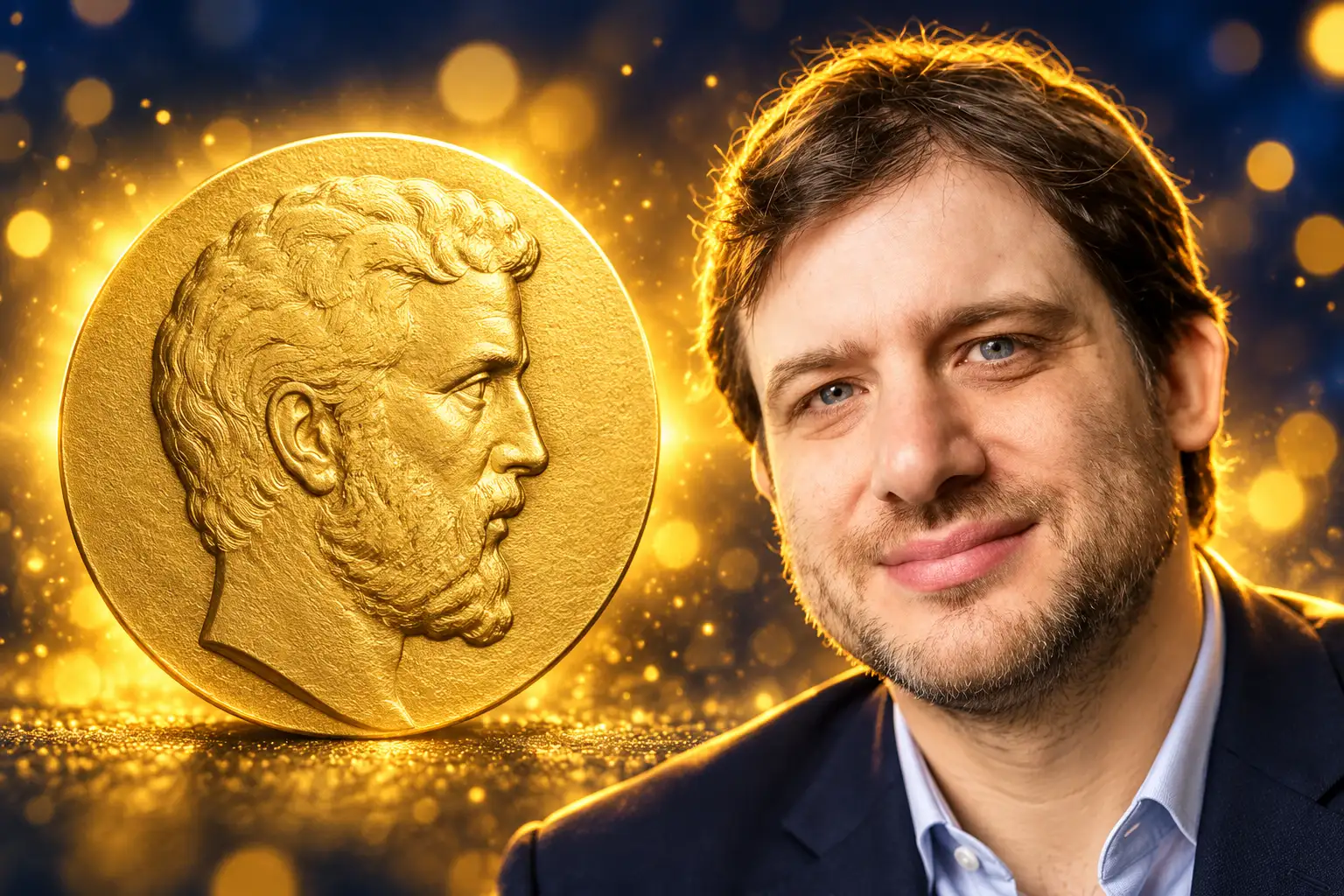
Jacob Tsimerman announced the Mathematical AI Safety Institute on September 8 and will serve as its scientific director, recruiting mathematicians to the Bay Area. In July the International Mathematical Union awarded him a Fields Medal for recasting o-minimality as a method in arithmetic geometry, a prize that honors finished work and the promise of future achievement.
He also starts a job in OpenAI’s safety department later in September. He has described MAISI as independent and unaffiliated with OpenAI, a claim that now has to live beside that payroll.
The Prize Was for Future Mathematics
The medal is awarded every four years, to at most four people under 40, at the International Congress of Mathematicians. Tsimerman received it in Philadelphia on July 23, 2026, alongside Yu Deng, John Pardon and Hong Wang. The IMU citation names his role in Griffiths’ conjecture on period maps and the Andre-Oort conjecture for Siegel modular varieties, along with the broader move of o-minimal methods into arithmetic and complex algebraic geometry.
That is a research program about special points, modular varieties and tame geometry. It is not a research program about model weights, reinforcement learning or deployment policy. University of Toronto president Melanie Woodin called him one of the world’s most promising leaders in mathematical research, language that matches the statute: the medal is supposed to buy time for more theorems.
Instead Tsimerman used the press conference around the prize to say he was pivoting toward AI safety. He has said he is taking leave rather than resigning, and that he remains a professor at Toronto. He has also said that if he opened a new stack of long number-theory projects now, advancing systems could take the ground out from under him before those projects finished.
The complaint from colleagues after July was not mysterious. The medal’s second clause is a bet on future mathematics. He is spending that bet on a different field, and on a company that ships the systems he wants constrained.
An Independent Institute With an OpenAI Job
MAISI, as he styled it in the founding note, is a visiting institute. Positions run from one semester to two years. The aim is to get mathematicians “up to speed and working on research directions in AI safety as quickly as possible.” He posted the note himself on September 8.
I'm incredibly excited to announce the founding of the Mathematical AI safety Institute (MAISI) https://t.co/P96oBx506q. AI safety needs more foundational theoretical development, and mathematicians have the skills and the mindset to help! MAISI is an independent institute with…
— jacob tsimerman (@Jacob_Tsimerman) September 8, 2026
Andrew Critch, the executive director, quoted the same hiring targets an hour later. Critch holds a 2013 Berkeley doctorate that applied algebraic geometry to machine-learning models, spent five years at Berkeley’s Center for Human-Compatible AI, and still works there part-time. He put the pitch in industrial language.
We need more of that sort of mathematical clarity and carefulness in the A.I. industry. That’s how nuclear energy works: We do a lot of math even before turning on a power plant for the first test run.
Andrew Critch, executive director, MAISI
Joining a lab’s safety team and founding an independent math institute are different jobs. Tsimerman is lining up both in the same month. The first gives him access to the architecture he says he wants to understand from the ground up. The second gives visiting mathematicians a Bay Area office that is, on paper, not a department of OpenAI.
That split is the part of the July announcement that never quite landed. Safety work inside the company that releases the models is a corporate function. An institute modeled on the Institute for Advanced Study is supposed to be something else. MAISI’s own site repeats the nuclear comparison and then asks mathematicians to treat existential safety as a problem that can be stated, and maybe proved, in the same spirit as reactor physics.
What MAISI Wants Mathematicians to Prove
The institute’s public brief is blunt. Subjective risk estimates from experts are not enough. “A central reason the safety of powerful AI systems remains in question is that we lack a rigorous understanding of what it would mean to be safe, even in theory.” Tsimerman made the same point in plainer words after the medal.
A.I. safety is a meaningful area of research. It is a legitimate intellectual pursuit that is interesting, useful, and there is real progress to be made.
Jacob Tsimerman, scientific director, MAISI
He has argued that engineers can only implement ideas that have already been developed, and that new ideas have to come from somewhere. On the MAISI site those ideas are aimed at a specific worry: if people choose to build a self-sufficient artificial species more intelligent than humanity, it might compete for resources, and could replace us. The page points readers to a statement on AI extinction risk that many lab leaders signed in 2023.
The institute also says math may return a negative answer. That is the part of the brief that is actually a research program rather than a slogan.
THREE WAYS THE MATH COULD SAY NO
- Wrong paradigm: Current AI development cannot be made existentially safe, and would require a major shift of some kind.
- Chaotic setup: Some configurations could be safe, but getting them right is provably chaotic and sensitive to noise in ways that are not feasible to handle now.
- Hard verification: Safety might be possible, yet proving it sits in a computational complexity class too high to use.
Mathematics, the site notes, is one of the few trades that can prove a problem unsolvable from a given foundation. If a technology can never be made safe, MAISI wants that impossibility on the table before deployment closes the window. Critch’s nuclear line is doing work here: you do the math before you flip the switch, including the math that says you should not flip it.
Speed is written into the method. Members are supposed to share living documents long before anything is fit for a mathematics journal. Standard academic papers, the site says, are refined over years. MAISI wants ideas out “in the earliest form that might be of benefit to AI safety as a field.” That choice will please people who think the models are moving faster than departments. It will not please people who think premature claims are how this industry already talks.
Gowers, Christiano and the Two Talent Pools
Look at the names around Tsimerman and the dual role stops being a personality story. One cluster is the prize culture of pure math. The other is the professional AI-safety circuit that already runs through OpenAI, DeepMind, the UK AI Security Institute and the Alignment Research Center.
WHO SITS AROUND THE DIRECTOR
| Name | MAISI role | What they bring |
|---|---|---|
| Jacob Tsimerman | Scientific director | 2026 Fields Medal, Toronto professor, OpenAI safety hire |
| Andrew Critch | Executive director | 2013 Berkeley Ph.D. on algebraic geometry and machine-learning models |
| Timothy Gowers | Scientific advisory panel | 1998 Fields Medal, Collège de France |
| Ravi Vakil | Scientific advisory panel | Stanford geometer, president of the American Mathematical Society since 2025 |
| Paul Christiano | Scientific advisory panel | Director of the Alignment Research Center; formerly led language-model alignment at OpenAI |
| Geoffrey Irving | Scientific advisory panel | Cofounder of Resolution; formerly chief scientist of the UK AI Security Institute; led alignment teams at DeepMind and OpenAI |
Gowers and Vakil are why a number theorist in Toronto can tell colleagues this is still a math institute. Christiano and Irving are why nobody should be surprised when the open problems look like alignment theory. Both men have OpenAI on the CV. So will the scientific director, later in September.
Independence, then, is a legal and staffing structure, not a social graph. Visiting members will be asked to talk mathematician-to-mathematician, then safety-expert-to-mathematician, and to spend time inside partner institutions. The site lists those two conversations as the working method. It does not list the partners.
Toronto Built a Parallel Track First
Tsimerman is the first scholar based at a Canadian institution to win the Fields Medal, and the second Canadian to win it. He holds the Ted Mossman chair at Toronto. The medal itself is named for John Charles Fields, another Toronto mathematician. The local story writes itself, which is why the Bay Area destination stings.
The board is still a Toronto board. Arul Shankar, a Toronto arithmetic statistician who has worked with Manjul Bhargava on ranks of elliptic curves, sits on it. So does Yevgeny Liokumovich, a Toronto geometric analyst who already leads the Fields-PrincInt Mathematics for AI Safety program and sits on the Fields Centre for Mathematical AI steering committee. Matthew Chou, chief executive of Unipetro Group in Mississauga, is the non-mathematician in the group. Tsimerman and Critch sit on the board as well.
The Fields Institute in Toronto is already running a graduate course on the mathematical foundations of AI, from September 9 to December 10, 2026. Liokumovich’s program means the Canadian Fields machinery had started pulling alignment into the seminar calendar before MAISI existed. What Tsimerman is adding is not the subject. It is a Bay Area membership model, a faster publication norm, and a scientific director who will also be on OpenAI’s safety staff.
Critch’s own path ran through Toronto too. He took a master’s in analytic geometry there before the Berkeley doctorate. The institute’s academic center of gravity is still Canadian even as the jobs require a move to California.
Hiring Starts Before the Funders Are Named
The public targets are large for a new math institute and small for a frontier lab.
THE MAISI CALENDAR
- July 23, 2026: Tsimerman receives the Fields Medal in Philadelphia and says he will join OpenAI’s safety work.
- September 8, 2026: He announces MAISI, with Critch as executive director, and opens applications.
- Later September 2026: He starts the OpenAI safety job, on leave from Toronto.
- January 2027: First full semester. The institute wants 10 to 30 faculty for January, relocated to the Bay Area.
- September 2027: A Special Year scaled to 30 to 100 mathematicians.
Members get offices around a shared space, plus seminar rooms, on a pattern the site compares to the Institute for Advanced Study and the Fields Institute. Renewal is possible after one or two semesters. The work is supposed to start “ASAP,” not after a year of reading groups.
What the announcement does not include is a funder. Minutes after Critch posted, mathematicians asked who is paying for the California posts. Neither founder answered in public. Chou’s presence on the board is the only named business résumé in the leadership list, and it is a lubricants and infrastructure résumé, not a grant-letter. Until someone publishes a donor list, “independent” is a claim about OpenAI’s org chart, not about the money.
The other omission is a technical agenda with theorems on it. MAISI promises a growing list of research directions written for mathematicians. The founding pages give the extinction framing, the three negative possibilities, and the living-document rule. They do not yet give the first problem set.
Leiden Asked for Human Timelines in Mathematics
In June the same union that would hand Tsimerman a medal in July endorsed a Leiden declaration on AI in mathematics. That document grew out of a Lorentz Center workshop in 2025. It warned that company timelines for AI-generated mathematics run ahead of the field’s own checks, and that commercial logic sits badly with how mathematicians assign credit and decide what is true.
MAISI is not a theorem-proving lab in the style of those company demos. It is asking mathematicians to work on safety rather than to let models replace them. The collision is still about speed. Living documents, shared “in the earliest form,” are an industry habit dressed in institute language. Leiden asked for the opposite habit: community evaluation before the press cycle.
Tsimerman has already heard the narrower version of this fight, the one about walking into OpenAI. He has said people are right to watch for conflicts of interest, and that this should not be the only thing they watch. He has also said a common attack on pure math is that it hides in an ivory tower, so it is odd to demand that a medalist go back up the stairs.
The institute now has to make that answer concrete. Applications are open. The first full semester is January 2027. The scientific director’s other employer ships the systems the members are being asked to constrain, and the people paying for the Bay Area year have not been named.

Instagram Plus Tests a Read-Only Mode That Cuts Stories

Altman Asks the Public to Accept Some AI Harm

Google Freezes OSS VRP Product Reports After AI Flood

AI Agents Make Payment Rails the Scarce Prize

Turkey’s Crypto Boom Now Runs Through Three Banks

Fable 5 Came Back Under a Commerce On-Off Switch

Google’s SpaceX GPU Lease Has a Sept. 30 Deadline

Plasma One’s XPL Locks Face a 1.81 Billion Cliff

DGO’s Rs 549 World Cup Pass Cost Fans Sleep and Data

Moonshot AI’s $30 Billion Ask Became a $35 Billion Close
-
 AI4 months ago
Fable 5 Came Back Under a Commerce On-Off Switch
-
 AI5 months ago
Google’s SpaceX GPU Lease Has a Sept. 30 Deadline
-
 CRYPTO4 months ago
Plasma One’s XPL Locks Face a 1.81 Billion Cliff
-
 APPS5 months ago
DGO’s Rs 549 World Cup Pass Cost Fans Sleep and Data
-
 AI5 months ago
Moonshot AI’s $30 Billion Ask Became a $35 Billion Close
-

 NEWS5 months ago
ColorOS 17 Device List Spans Oppo, OnePlus and Realme
-

 GAMING4 months ago
The RTX 4050 Under Rs 70,000 Hides a Wattage Gap
-
 AI4 months ago
Boris Cherny’s Loops Still Demand a Higher Production Bar