
NEWS
YouTube’s Teen Settlement Now Faces Meta’s $5.3 Billion Lever
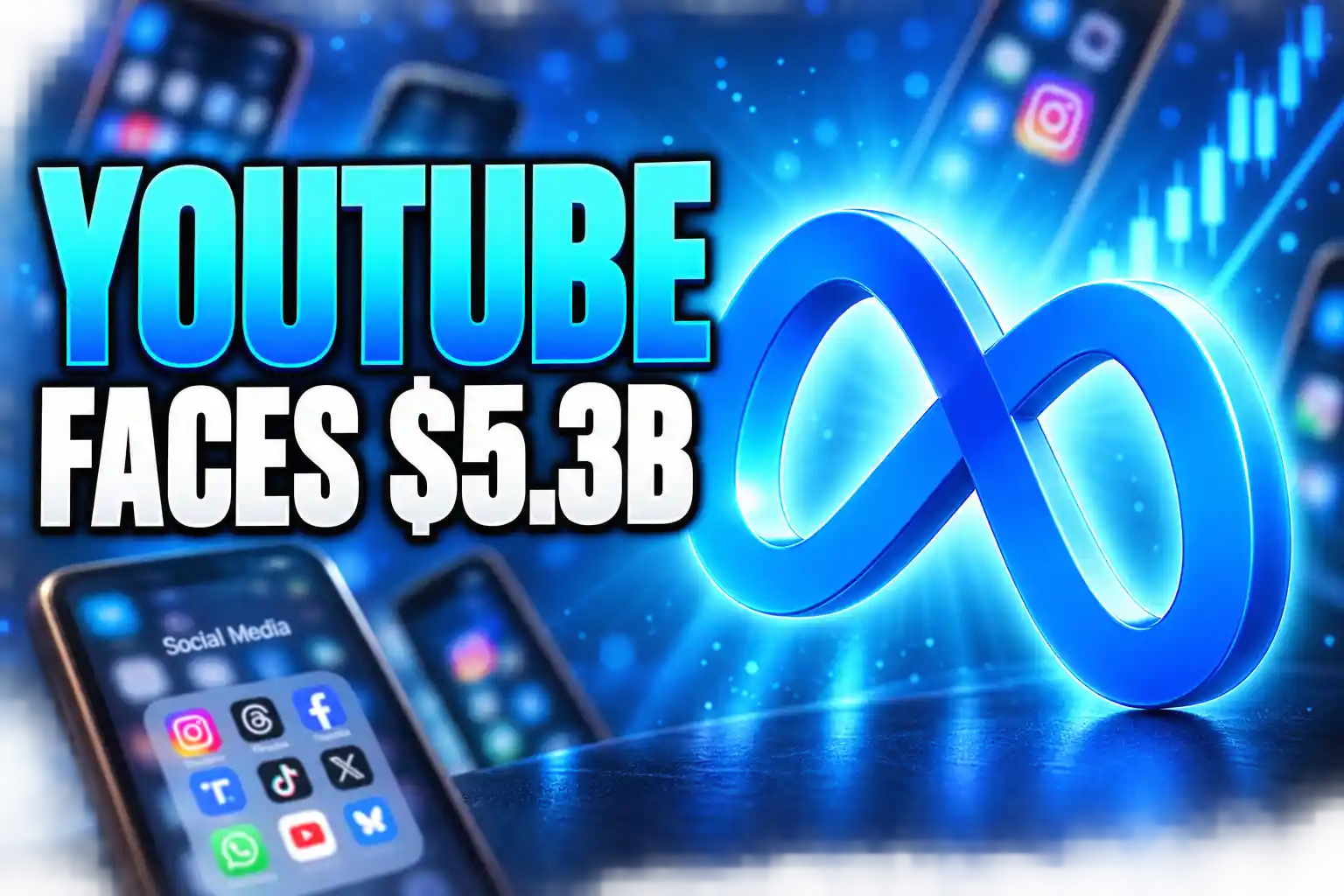
YouTube’s June teen settlement left Google exposed to Meta’s $18 billion deal, which pays extra only if YouTube copies Instagram’s teen caps.

YouTube confidentially settled a Florida teenager’s social media addiction case on June 23, 2026, weeks before a Los Angeles trial. The 15-year-old, known in filings as R.K.C., had named YouTube with Instagram, TikTok, and Snapchat for product designs he said hooked him from about age eight.
Google called the matter amicably resolved and pointed back to age filters and parental controls. Two months later Meta’s state deal left about $5.3 billion hanging on whether YouTube copies Instagram’s new teen time limits.
YouTube Paid to Leave the Florida Teen’s Case
YouTube’s June settlement with the Florida teen took the video platform out of a July 27, 2026, bellwether in Los Angeles County Superior Court. Terms stayed confidential. The suit was the second individual test case in California state court over claims that autoplay, infinite scroll, and related design choices drove compulsive use in children.
R.K.C. said he lost sleep and developed depression and anxiety after years on the apps. His lawyers, John Morgan and Emily Jeffcott of Morgan & Morgan, treated the YouTube exit as a signal, not a truce.
YouTube’s decision to resolve this case before having to face a jury speaks for itself. We will continue fighting on behalf of all those affected by social media addiction to bring these companies to justice and compel them to prioritize the safety of their young users over their bottom lines.
John Morgan and Emily Jeffcott, attorneys for R.K.C.
Google spokesperson José Castañeda told reporters the lawsuit had been amicably resolved. “Our focus remains on building age-appropriate products and parental controls that deliver on that promise,” he said. He added that YouTube had worked with families for more than a decade to give young people safer experiences online.
That is the same defense Google used after the first bellwether. After the March verdict, Castañeda said the case misunderstood YouTube as a social media site rather than a streaming platform the company says it built responsibly. Settling R.K.C. let Google skip a second jury while keeping that line intact.
TikTok and Snap Followed, Then the Plaintiff Walked
YouTube’s check did not end the case. It started a peel-off. TikTok reached its own confidential deal with R.K.C. on June 30, 2026. Snap reached a tentative agreement on July 20. By then Meta was the last defendant still listed for the July 27 trial, and Snap chief Evan Spiegel was back in range as a possible witness after being dropped from the first bellwether’s list.
THE R.K.C. PEEL-OFF
- June 23, 2026: YouTube settles with R.K.C. on confidential terms.
- June 30, 2026: TikTok reaches a confidential settlement with the same plaintiff.
- July 20, 2026: Snap reaches a tentative agreement, leaving Meta alone on the caption.
- July 22, 2026: R.K.C. withdraws the remaining claim against Meta. The July 27 trial never opens.
Jeffcott and co-counsel Rahul Ravipudi said the teenager was done. “In light of the overall successful result of the litigation and his concerns about enduring a grueling weekslong trial, he has elected to withdraw his claims against Meta,” they said. “He’s ready to close this chapter and focus on his recovery and engage in therapy as he aspires to have a normal life.”
Meta paid nothing in that file. Spokesperson Andy Stone said the claims never held up and that the outcome showed the company would not back away from what it called baseless lawsuits. Judge Carolyn B. Kuhl, who had run the first bellwether, never seated a second jury. YouTube’s quiet June payment, followed by two more settlements, is what emptied the courtroom.
The $1.8 Million Verdict Google Will Not Accept
Google still has a public loss on the books. On March 25, 2026, a Los Angeles jury found Meta and YouTube negligent in the case of a 20-year-old woman identified as Kaley, or K.G.M., who said she became addicted to Instagram and YouTube as a child. Jurors awarded $6 million, split as $3 million in compensatory damages and $3 million in punitive damages. Meta was ordered to pay $4.2 million. YouTube was ordered to pay $1.8 million.
On June 9, 2026, Judge Kuhl denied the companies’ bid to throw out that verdict. She found evidence to support both the negligence finding and the punitive award, and she rejected the argument that the First Amendment or Section 230 of the Communications Decency Act blocked the claims. Meta filed a notice of appeal on July 8. YouTube followed on July 13, three weeks after it had already paid to keep R.K.C. away from a jury.
That pairing is the working method. Contest the one verdict that created a written finding of negligent design, and buy out the next caption before a second jury can repeat it. TikTok and Snap used the same exit in the first bellwether, settling with K.G.M. before opening statements. YouTube stayed, lost, and then declined to stay for round two.
A New Mexico jury had already hit Meta on March 24, 2026, with $375 million for misleading users about child safety. A later order in that case added $567 million, bringing the state total to $942 million, a judgment Meta has said it will appeal. New Mexico stayed out of the later 50-state deal. Google was not in that courtroom. Its live appellate problem is the $1.8 million Los Angeles finding that YouTube’s design was a substantial factor in harm.
A $5.3 Billion Clause Points Straight at YouTube
The larger bill arrived on August 26, 2026. Meta agreed with a bipartisan group of 52 attorneys general, covering 48 states plus Washington, D.C., and U.S. territories, to pay about $18 billion over ten years and to change default settings for users under 18 on Facebook and Instagram. U.S. District Judge Yvonne Gonzalez Rogers approved the main consent judgment the same day, eight days after the Oakland trial had opened on August 18. Instagram head Adam Mosseri had begun to testify. Mark Zuckerberg was on the list and never took the stand.
About $12.7 billion is guaranteed to the states. About $5.3 billion moves only if YouTube and TikTok put in matching teen protections, including a one-hour daily cap, a night block, and age-assurance steps, and pay matching sums. Meta’s own newsroom described a default two-hour daily time limit that a teen can lift only with a parent’s permission, counted across Facebook and Instagram together. If the rivals sign on, that cap drops to one hour.
The filed consent judgment names YouTube as a core industry member with Snap and TikTok. That definition is how a deal Meta signed becomes a problem on Google’s calendar. The same day, Meta posted an open letter aimed at YouTube and TikTok, arguing that teens blocked on one app simply open another.
These protections will only be truly effective if we work with our peers, TikTok and YouTube, to put the same measures in place. All platforms should empower parents and support teens in these ways because we know that when teens are restricted on one app, they simply move to another.
Meta, open letter, August 26, 2026
If YouTube stays out, Meta keeps the $5.3 billion and keeps a two-hour cap instead of a one-hour cap, while YouTube remains an uncapped video feed. That is a gift to whichever app still has no clock, and it is also the competitive complaint Meta is now making in public. Google did not answer requests for comment when the state deal was announced.
HOW THE 2026 PAYOUTS COMPARE
| Case | Outcome | Money |
|---|---|---|
| K.G.M., Los Angeles jury | Negligence verdict, on appeal | $6 million total; YouTube $1.8 million |
| Breathitt County, Kentucky schools | Four-platform settlement by June 1, 2026 | $27 million combined |
| R.K.C., Florida teen | YouTube, TikTok, and Snap settled; plaintiff dropped Meta | Confidential; Meta paid $0 |
| States and territories v. Meta | Consent judgment, Aug. 26, 2026 | About $12.7 billion guaranteed; about $5.3 billion contingent |
California Attorney General Rob Bonta, a lead plaintiff in the Oakland trial, said California’s $1.5 billion to $2.1 billion share would ride on court approval and that the product changes would land within months. Colorado Attorney General Phil Weiser said the relief went “well beyond what any court has ordered or is likely to order.” Judge Gonzalez Rogers called the deal “a good step forward” and told counsel she was “quite happy to not have to finish up this trial.”
Four states at trial, California, Colorado, Kentucky, and New Jersey, had been expected to seek close to $200 billion in civil penalties. Meta denied wrongdoing. Florida Attorney General James Uthmeier refused the deal and said the payouts were “peanuts” next to the harm. “We’ll see them at trial,” he said. New Mexico, already holding the $942 million judgment, stayed on its own track.
What Teen Limits Meta Accepted for Instagram
The product terms are the part that actually changes a teenager’s phone, and they apply to Facebook and Instagram, not to YouTube. Meta will not have to drop personalized recommendations or targeted ads. Direct messages are carved out of the time, night, and school limits so teens can still reach friends. James Speta, a Northwestern University law professor, said the restrictions “are designed to reduce engagement.”
DEFAULTS FOR USERS UNDER 18
- Daily clock: A two-hour combined limit on Facebook and Instagram that a parent must approve to lift, dropping to one hour if YouTube and TikTok join.
- Night block: Apps locked from midnight to 6 a.m. unless a parent overrides, with a tighter window if rivals match the terms.
- School mute: Most push notifications off from 8 a.m. to 3 p.m. on school days.
- Break prompts: Notices after 15 minutes of continuous use, and again at later marks.
- Feed controls: A non-personalized feed option, hidden like and reaction counts, and a parent tool to block an algorithmic feed and autoplay.
- Age checks: Stronger steps to find and remove users under 13, plus an independent auditor reporting to the states.
Those defaults are the standard Meta now wants treated as industry-wide. YouTube already sells supervised accounts and parental controls, which is the toolkit Castañeda cited in June. It has not announced a mandatory one-hour cap, a hard night lock, or a matching payment that would release the $5.3 billion. Until it does, a teen who hits Instagram’s two-hour wall can open YouTube and keep watching with no court-ordered clock.
Personal Injury Suits Were Carved Out of the State Deal
The $18 billion goes to states and territories, not to the families in the wider social media lawsuit docket. In June, when YouTube settled with R.K.C., more than 3,300 addiction cases sat in California state court and another 2,600 cases brought by people, school districts, municipalities, and states sat in California federal court. The August consent judgment leaves those personal-injury and school-district tracks open on purpose.
The four platforms had already paid a combined $27 million by June 1, 2026, to resolve a Kentucky school-district bellwether in the federal multidistrict litigation. Further school-district trials are still on the calendar into 2027. Tennessee’s separate Nashville trial against Meta ended the same day as the Oakland deal, when the state joined the national agreement. Google was a defendant in the Kentucky school settlement. It is not a party to Meta’s $18 billion state package, which is why the core-industry clause exists.
WHAT WE KNOW
- YouTube’s R.K.C. exit: Confidential settlement on June 23, 2026; no public dollar figure and no admission of liability.
- The second jury: R.K.C. dropped Meta on July 22, 2026, so the July 27 trial did not run.
- The live verdict: YouTube still owes $1.8 million of the $6 million K.G.M. judgment unless an appeals court undoes it.
WHAT IS UNCONFIRMED
- Matching caps: Google has not said whether YouTube will take a one-hour default, a night block, or a payment that unlocks the $5.3 billion.
- R.K.C. dollars: The amounts YouTube, TikTok, and Snap paid the Florida teenager have not been disclosed.
- Next individual trials: Additional California bellwethers remain scheduled, with dates that can move as more plaintiffs settle or drop defendants.
Google has not said whether YouTube will adopt the one-hour cap, the night block, or the matching payment that would send about $5.3 billion to the states. The $1.8 million Los Angeles finding is still on appeal, and the personal-injury files that the state deal left behind are still open.
Disclaimer: This article is news reporting and analysis of public court outcomes, company statements, and settlement papers. It is informational only and is not legal advice, medical advice, or a prediction of how any remaining case will end. Readers who think they have a claim, or who are deciding whether to change a child’s account settings because of these cases, should consult a qualified attorney licensed in the relevant state, and a clinician if health is at issue, before acting. Dollar figures, docket counts, product rules, and case statuses reflect the filings and statements described here and can change as appeals, consent judgments, and later trials move.

Instagram Plus Tests a Read-Only Mode That Cuts Stories

Altman Asks the Public to Accept Some AI Harm

Google Freezes OSS VRP Product Reports After AI Flood

AI Agents Make Payment Rails the Scarce Prize

Turkey’s Crypto Boom Now Runs Through Three Banks

Fable 5 Came Back Under a Commerce On-Off Switch

Google’s SpaceX GPU Lease Has a Sept. 30 Deadline

Plasma One’s XPL Locks Face a 1.81 Billion Cliff

DGO’s Rs 549 World Cup Pass Cost Fans Sleep and Data

Moonshot AI’s $30 Billion Ask Became a $35 Billion Close
-
 AI4 months ago
Fable 5 Came Back Under a Commerce On-Off Switch
-
 AI4 months ago
Google’s SpaceX GPU Lease Has a Sept. 30 Deadline
-
 CRYPTO4 months ago
Plasma One’s XPL Locks Face a 1.81 Billion Cliff
-
 APPS4 months ago
DGO’s Rs 549 World Cup Pass Cost Fans Sleep and Data
-
 AI4 months ago
Moonshot AI’s $30 Billion Ask Became a $35 Billion Close
-

 NEWS4 months ago
ColorOS 17 Device List Spans Oppo, OnePlus and Realme
-
 GAMING4 months ago
Xbox Cuts 3,200 Jobs After Five Years of Thin Returns
-

 GAMING4 months ago
The RTX 4050 Under Rs 70,000 Hides a Wattage Gap