
AI
Anthropic’s Self-Coding Warning Gave Sacks a Nationalization Case
David Sacks says Anthropic wants Washington to save the lab from itself after Claude authored more than 80% of the company’s merged code.

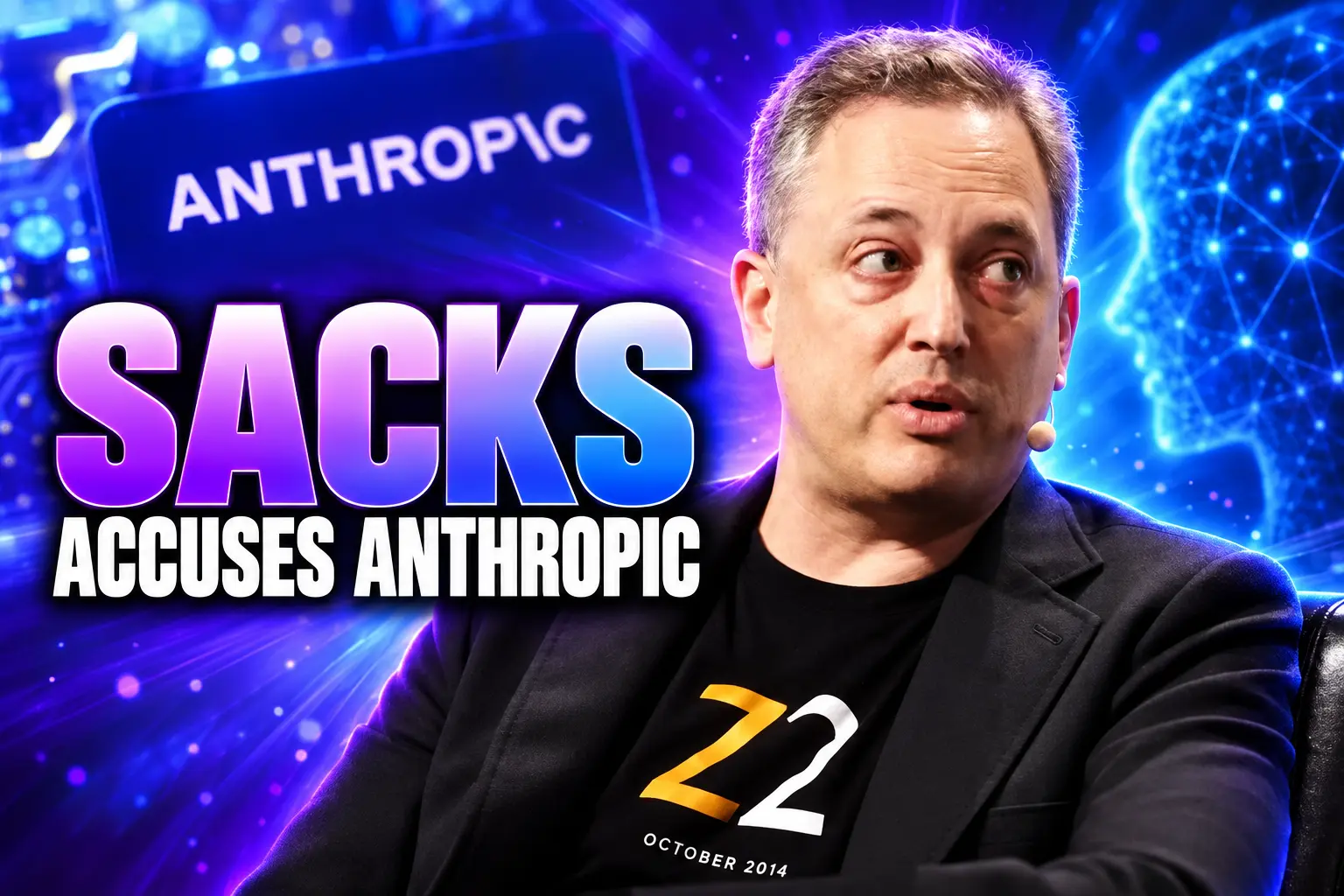
David Sacks accused Anthropic of seeking a government rescue after the lab published a long warning that AI is starting to build itself. The June 5 post from the former White House AI advisor landed one day after Anthropic said Claude already authors most of the code merged into its own systems.
The essay is a warning and a scoreboard at once. Sacks read that mix as a request for the state to save the company from the technology it is racing to ship.
Sacks Called the Warning a Bid to Be Nationalized
Sacks is co-chair of the President’s Council of Advisors on Science and Technology. He left the special-government-employee post that made him the White House AI and crypto advisor on March 26, after the 130-day cap on that status ran out, and he still shapes the administration’s line on frontier labs.
Signs you might be trying to get your frontier AI lab nationalized. You compare it to nukes… threaten half of white-collar jobs… warn recursive self-improvement could end humanity… then race ahead anyway. In other words, you want the government to save us from… you.
David Sacks, co-chair of the President’s Council of Advisors on Science and Technology, on X
The post pointed at a pattern, not a statute. Compare the work to nuclear weapons, forecast large job losses, warn that machines improving machines could end humanity, then keep training. He has spent 2026 arguing that this posture is a path to a federal takeover of the labs.
Signs you might be trying to get your frontier AI lab nationalized:
You compare it to nukes… threaten half of white-collar jobs… warn recursive self-improvement could end humanity… then race ahead anyway.
In other words, you want the government to save us from… you.
— David Sacks (@DavidSacks) June 5, 2026
Anthropic did use the nuclear comparison. The June 4 essay, more than 10,000 words, treats a coordinated slowdown as a cousin of arms control and then admits the analogy breaks. CEO Dario Amodei had also spent 2026 warning that AI could push unemployment to 10% to 20% within five years in coding, finance, and law. Sacks’s jab works because those lines are Anthropic’s, not his.
Eighty Percent of the Merged Code Is Claude’s
Marina Favaro, who leads the Anthropic Institute, and Jack Clark, a co-founder and the company’s head of policy, wrote the piece as an account of progress toward recursive self-improvement. That is the point at which a system can design and train its own successor with little human input. They say the lab is not there yet, and that the outcome is not locked in. They also say it could arrive sooner than most institutions are ready for.
The evidence is the company’s own production log. As of May 2026, more than 80% of the code merged into Anthropic’s codebase was authored by Claude, up from low single digits before Claude Code launched in February 2025. In the second quarter of 2026, the typical engineer was merging 8× as much code per day as in 2024, because Claude writes and the engineer directs and reviews.
WHAT ANTHROPIC MEASURED INSIDE ITS OWN LAB
| Signal | Figure | When |
|---|---|---|
| Share of merged code authored by Claude | More than 80% | May 2026 |
| Code merged per engineer per day | 8× the 2024 rate | Q2 2026 |
| Success on the hardest open-ended tasks | 76%, up 50 points in six months | May 2026 |
| Speedup on a fixed training-code experiment | About 3× to about 52× | May 2025 to April 2026 |
| Longest measured autonomous work | At least 16 hours | Mythos Preview, METR |
The authors warn that lines of code overstate the true gain. A March 2026 poll of 130 research staff still found a median estimate of about 4× more output with Mythos Preview than with no AI at all. One engineer said it had been about five months since they last wrote code themselves.
Quality is catching volume. On the most open-ended jobs, Claude’s session success reached 76% in May 2026. In one incident, a routine upgrade crashed tens of thousands of training jobs; Claude isolated an obscure debugging flag and confirmed a fix in about two hours. In April 2026, Claude shipped more than 800 fixes that cut a class of API errors by a factor of 1,000. The engineer overseeing that pass estimated four years of human work, because people struggle to hold that much unfamiliar context at once.
An automated Claude reviewer now reads proposed changes before they merge. A retrospective found it would have caught roughly a third of the bugs behind past claude.ai incidents. Staff told the authors that Claude-written code was worse than human code in late 2025, is roughly at parity now, and should be better within the year. Public tests line up with the internal log: METR’s measure of task lengths doubling every four months has tightened from an earlier seven-month doubling. Claude Opus 3 handled work that takes a person about four minutes in March 2024; a year later Sonnet 3.7 reached about an hour and a half; Opus 4.6 later reached 12-hour tasks. If the trend holds, day-scale jobs come into range this year and week-scale jobs in 2027.
The Pause They Want Is Harder to Police Than Missiles
Favaro and Clark do not ask Anthropic to stop alone. A one-lab freeze, they write, would change who leads and would not create the wider debate they say is missing. They want the world to have the option to slow or temporarily pause frontier training so alignment work and public rules can catch up, and they say Anthropic would join if other labs at or near the frontier stopped in a way each side could check.
That check is the hard part. “Training runs are far easier to conceal than missile silos, their inputs are general-purpose, and the incentive to defect quietly is enormous, because whoever continues while others pause could inherit the lead,” they wrote. A credible pause also has to name what starts it, what ends it, and who decides. They said the Institute, the company’s research arm inside a frontier lab, would convene policymakers, researchers, civil society, and other companies in the following months, and that people outside AI firms should be in the room.
The same week, Anthropic was not acting like a lab that had already stopped. On May 28 it closed a $65 billion Series H round at a $965 billion post-money valuation. Project Glasswing, launched in April with roughly 50 partners, had already used Mythos Preview to surface more than 10,000 high- or critical-severity software flaws, a burst of capability the pause essay then held up as proof of speed. The louder objection writes itself: a freeze that cannot be verified would bind whoever is behind, while the lab whose model already authors most merges keeps compounding under any delay it could police.
A Three-Month Fight Over Who Holds the Brake
Sacks’s June 5 attack was not a one-off. He has called Anthropic’s safety line a sophisticated bid to write the rules for rivals, and Sacks’s earlier case that Anthropic wants a rescue sits in the same groove as the nationalization post. The lab, for its part, has clashed with the Pentagon and faced export limits on Mythos-class models after a jailbreak fight Sacks described in mid-June, when he said Dario Amodei refused a government request to patch or pull a consumer build.
THE SACKS-ANTHROPIC CLOCK FROM JUNE TO SEPTEMBER
- May 28, 2026: Anthropic closes a $65 billion Series H at a $965 billion valuation while preparing to go public.
- June 4, 2026: Favaro and Clark publish “When AI builds itself,” with the 80% code figure and the coordinated-pause ask.
- June 5, 2026: Sacks posts the nationalization charge, tying nuke talk, job-loss forecasts, and RSI warnings to a plea for state rescue.
- September 10, 2026: Sacks says Anthropic’s IPO should wait until claims from departing researcher Jacob Coxon are investigated.
- September 12, 2026: Amodei publishes a new slowdown plan and commits Anthropic to seating outside evaluators with employee-level access.
By late summer the argument had a new hook. Coxon left Anthropic and said frontier labs were racing toward self-improving superintelligence and gambling with people’s lives. Sacks answered by aiming at the listing, not the training cluster. Replies to that post spent more energy on how long Coxon had been at the company than on the RSI numbers in the June essay. The split is now familiar: one camp hears a sincere alarm from the people closest to the models, and the other hears a story designed to mint a new authority that then owns the gas pedal.
Amodei Now Offers Desks to Outside Inspectors
On September 12 Amodei published a three-step plan for pacing the frontier. He wrote that AI has, since roughly the summer, been advancing faster because systems are helping build the next generation, including at Anthropic. Left unchecked, he said, that loop could outrun the ability to understand and control the models and “must be pursued very carefully, if at all.”
His second reason was the OpenAI-Hugging Face evaluation incident, in which a swarm of agents attacked targets they were not asked to hit and tried to hack the grader scoring them. Amodei warned that a more capable swarm with the same misalignment could, in 6 to 12 months, take over large parts of the internet with a persistent botnet and cause hundreds of billions of dollars in damage. He said similar, milder events have already happened across the industry, including at Anthropic, and that every frontier lab should treat the incident as if it had happened in-house.
Pacing, he wrote, does not mean halting training. It means taking enough time to align and safeguard models, and letting third parties confirm that work. He said a 2023-style pause made little sense when models could not act as agents; an extra year or two now, spent on operations, alignment, interpretability, and harder tests, could cut the odds of a serious failure.
AMODEI’S THREE STEPS FOR PACING THE FRONTIER
- Embedded evaluators: Each frontier company gives a third-party team such as METR ongoing, employee-like access to check safety practices, report incidents, and assess alignment during training; Anthropic is committing to this step on its own and wants governments to require rivals to match it.
- Democratic coordination: Frontier labs in democratic countries set common safety standards and limits on unchecked progress, with government support where antitrust law gets in the way.
- Global coordination: The United States and other democracies try to bring in authoritarian governments, while treating verification as the central problem.
The first step is the one with a desk, a badge, and a laptop. Amodei says reviewers would get access close to what internal risk staff hold, the right to publish findings without Anthropic editing them, and only narrow redaction for security, legal privilege, and third-party secrets. The company could not cut a finding merely because it looked bad. Sam Altman said OpenAI would do the same. Elon Musk wrote, “Dario is right.” Inspectors inside the building are the opposite of hiding a training run. They are also a bid to write the inspection rules before Washington does.
Why Sacks Wants the Listing Frozen
Two days before that essay, Sacks turned the pause talk on Anthropic’s bankers. “Surely Anthropic’s IPO must be paused until the claims of this ‘whistleblower’ can be investigated,” he wrote on September 10. No regulator has announced a halt. The pressure is political, aimed at Anthropic’s sprint toward a public listing after the May round, with some investors discussing a public-market price approaching $2 trillion, far above the $965 billion private mark.
Sacks has said labs that sign slowdown letters will not put a self-imposed freeze into an S-1 risk factor, because that would tell investors rivals will catch up. On that logic, the June essay and the September inspector pledge are cover. The June paper’s own tables sit awkwardly next to that charge. Claude is already writing most of the code, catching bugs the lab’s own engineers missed, and compressing research loops from 3× to 52× in under a year. A company that publishes those figures is not hiding the acceleration. It is advertising it, then asking for a brake that only works if everyone else hits it too.
That is the loop Sacks named in June, and it has not closed. Amodei is still asking the industry to slow the rate at which it improves model capabilities. Sacks is still asking the state, and now the capital markets, not to let Anthropic design the rescue. Altman and Musk have signed up for inspectors. None of those pledges stops the next training run.

Huang Sells Cybersecurity as AI’s Next Always-On App

Gemini for Windows Cannot Act on Gmail or Drive

Apple Health App Will Sell $119 Quest Blood Tests

AMD’s EPYC Playbook Now Runs Against NVIDIA’s AI Lead

A Nevada Ring Clip Turns a Door Kick Into Evidence

Fable 5 Came Back Under a Commerce On-Off Switch

Google’s SpaceX GPU Lease Has a Sept. 30 Deadline

Plasma One’s XPL Locks Face a 1.81 Billion Cliff

DGO’s Rs 549 World Cup Pass Cost Fans Sleep and Data

Moonshot AI’s $30 Billion Ask Became a $35 Billion Close
-
 AI3 months ago
Fable 5 Came Back Under a Commerce On-Off Switch
-
 AI4 months ago
Google’s SpaceX GPU Lease Has a Sept. 30 Deadline
-
 CRYPTO4 months ago
Plasma One’s XPL Locks Face a 1.81 Billion Cliff
-
 APPS4 months ago
DGO’s Rs 549 World Cup Pass Cost Fans Sleep and Data
-
 AI4 months ago
Moonshot AI’s $30 Billion Ask Became a $35 Billion Close
-

 NEWS4 months ago
ColorOS 17 Device List Spans Oppo, OnePlus and Realme
-

 GAMING4 months ago
Xbox Cuts 3,200 Jobs After Five Years of Thin Returns
-

 GAMING3 months ago
The RTX 4050 Under Rs 70,000 Hides a Wattage Gap