
NEWS
YouTube Shorts Now Draws 2 Billion Monthly Hours on TV
YouTube Shorts racks up 2 billion monthly hours on TV screens globally, YouTube’s TV chief disclosed June 5, establishing the format as a CTV advertising surface distinct from its mobile origins.

YouTube Shorts is now watched for 2 billion hours every month on television screens, Kurt Wilms, YouTube’s Senior Director of Product Management for TV, disclosed in a Creator Insider podcast episode published June 5, 2026, calling the figure “an insane number” that had fundamentally changed how his team thinks about the format’s future on the biggest screen in the house. The format launched globally in July 2021 for phones. Its presence on living-room panels began roughly two years ago as a compatibility exercise, not a product priority.
YouTube’s Chief Product Officer Johanna Wright confirmed in December 2024 that the platform delivers over 1 billion hours of total content watched daily on TV screens in the U.S. alone. The podcast, the first public disclosure of a specific TV viewership figure for Shorts, covered the mechanics behind those hours and the product directions the team is pursuing next.
The Number Nobody Anticipated
The original goal, when YouTube launched Shorts in the TV player, was modest. “We were kind of thinking about it like, hey, let’s make sure the Shorts experience isn’t broken,” Wilms said during the episode, a conversation that also featured sketch comedian and creator AdamW and creator liaison Rene Ritchie. The session was titled “2 Billion Hours of Shorts Viewed a Month… on TV!” In roughly two years, the usage has run well past those original parameters.
Short-form video has been treated as a mobile-native category. Media.net research from November 2025 found that 81% of consumers primarily watch short-form video on smartphones, a figure that creates a reasonable baseline assumption: that Shorts was fundamentally a phone format and TV viewing was incidental. At approximately 66 million Shorts hours per day on TV globally, that assumption doesn’t hold. The TV figures sit alongside those mobile numbers as a separate layer of behavior, and one that survey data may systematically undercount, since people don’t typically report what they watch on a living-room screen when they think of themselves as phone-first viewers.
- ~66 million hours of Shorts per day on TV screens globally, derived from the 2 billion monthly total
- 1 billion+ hours of total YouTube content watched daily on U.S. TV screens (CPO Johanna Wright, December 2024)
- 56% of U.S. short-form video consumption belongs to Shorts, ahead of TikTok and Facebook Reels, both at 50% (Media.net, November 2025)
From Phone Screen to Living Room Panel
Rebuilding Navigation for the Remote
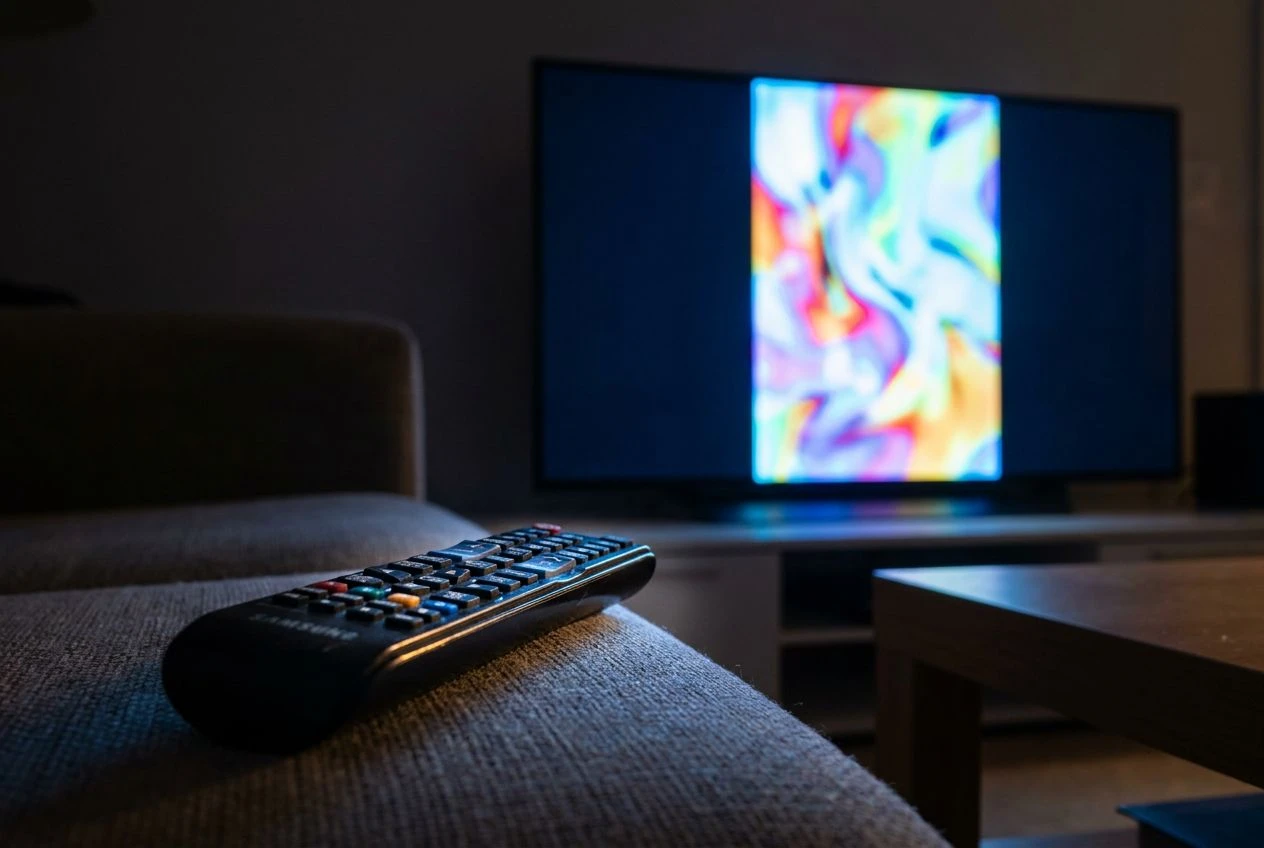
Shorts is built around a 9:16 vertical frame, composed for a screen held at arm’s length and navigated by swiping a touchscreen with a thumb. A 65-inch television creates immediate collisions: black bars fill the horizontal space on either side, the resolution wasn’t designed for large-scale display, and the navigation model requires a touchscreen that doesn’t exist in the living room.
YouTube’s answer was a dedicated remote-control interface. Viewers press a button to advance rather than swiping, sitting back on a couch rather than holding a phone upright in portrait mode. The dedicated player places comments and metadata alongside the vertical frame rather than overlaying them on the video. Unlike long-form content on YouTube, Shorts on TV don’t autoplay to the next video; the viewer has to actively advance. He described this design as “very leaned in,” meaning intentional and manual, and said the team is now thinking about how to shift the experience toward something more passive.
The design choice to require active navigation also has a measurement dimension. A viewer pressing a button to advance through Shorts is generating a deliberate engagement signal with each step, something passive ambient playback doesn’t produce. That distinction shapes the format’s current ad behavior on TV, and it’s also what lean-back autoplay would change once it ships.
Horizontal Rows and the Discovery Layer
The TV homepage doesn’t present a single vertical stream. YouTube shows Shorts in horizontal rows organized by category: comedy in one, sports in another. A viewer picks a topic before entering the Shorts player rather than landing in an undifferentiated feed. That structure matters for volume, since it gives a living-room viewer a route into Shorts that doesn’t require already knowing what they want to watch, which is how TV browse behavior typically works.
YouTube’s first major TV interface redesign in years, completed in December 2025, reorganized how the platform separates and presents different content formats. A separate change in late December 2025 reduced long-form video discovery slots on the home feed in favor of Shorts rows. The October 2024 extension of Shorts’ maximum duration from 60 seconds to three minutes also expanded the format’s range inside the TV browsing session: a viewer can move between a 20-second clip and a 3-minute sketch in the same horizontal row without switching contexts.
Why Viewers Keep Coming Back
When YouTube surveyed viewers about why they were watching Shorts on the TV, the social context of the living room came up consistently. The private experience of watching a 30-second clip on a phone changes when two or three people are in the same room, watching the same screen.
Viewers love watching them with their friends and family. It’s the best way to do that on the TV screen. It’s big. It’s beautiful.
He traced the behavior to the physical and social context of the TV screen. AdamW, whose sketch comedy channel built its following on mobile, noted in the same conversation that watching a comedy clip in a room with other people is a fundamentally different experience from watching alone on a phone.
Short-form content carries a practical advantage in the living room beyond the social one. Committing to a 90-minute documentary requires a real decision; if it disappoints, the viewer starts their search over. A Short that doesn’t land takes one button press to replace. AdamW described this as a discovery advantage: “With shorts, because they are short, I think like we can let people explore more, discover more.” He also noted that Shorts with a narrative structure, a beginning, middle, and end, consistently draw more viewership on YouTube than isolated gag clips, a pattern that maps onto how TV audiences watch even at short durations. YouTube’s viewer research characterized the TV Shorts experience as “appointment viewing” in the living room, grounding the phrase in the social context of the viewing session.
Thumbnails from 720p to 4K
In October 2025, YouTube raised the thumbnail upload limit from 2 megabytes to 50 megabytes and upgraded rendering from 720p to full 4K resolution. “A remnant, decade-old-plus remnant of YouTube starting on the web,” was how he described the old 2MB ceiling. Creators uploading thumbnails designed for TV display had been watching their images compressed and downscaled by the platform’s processing pipeline for years. A still frame that looked sharp in an editing application arrived on screen as a blurred JPEG artifact.
| Spec | Before October 2025 | After October 2025 |
|---|---|---|
| Max upload size | 2 MB | 50 MB |
| Rendering resolution | 720p | 4K |
Mobile thumbnail quality is a secondary factor: most mobile traffic arrives from feed scrolling, where, in his description, “you’re kind of just seeing it in your feed and probably like a majority of that traffic is just coming from scrolling.” The TV context runs differently. Viewers scan horizontal rows of thumbnails and pick content based on what they see. As Shorts appear in those rows with increasing frequency, the visual fidelity of the still frame directly affects whether a viewer clicks into a clip. He said the upgrade matters most for creators who approach short-form work as intentional editorial content; Shorts that are written and edited toward a specific brief tend to outperform repurposed long-form footage. The 4K upgrade applies initially to long-form content, with extension to Shorts thumbnails indicated.
AdamW described his orientation toward this shift in the episode: he wanted each Short’s thumbnail to look like a movie poster. “I write specifically for the time of how long it’ll be,” he said of his production approach. The 4K pipeline makes the visual ambition achievable on a television screen. The old 2MB limit made it unreachable regardless of how well the source image was composed.
A Second Screen Becomes a Second Revenue Layer
TV Companion and the Phone-in-Hand Problem
Third-party studies, Wilms said, show that roughly 9 out of 10 people watching TV have a phone in their hand at the same time. YouTube announced approximately one month before the June 5 episode a feature called TV Companion: when a viewer opens YouTube on their phone while the platform is running on the living-room TV, the feature detects the active session and surfaces the video currently playing on the larger screen. From there, the phone becomes an interface for reading comments, writing one, accessing the video description, or navigating to the creator’s channel, all without interrupting playback on the television.
Traditional broadcast can tell an advertiser how many people were in the room during a commercial break. YouTube’s version generates a signal that a specific viewer watched a specific clip long enough to pick up their phone and look for more. YouTube disclosed that conversions from CTV ads grew more than 200% year over year in Q1 2026. TV Companion, by linking the two screens in a single session, is designed to strengthen that signal further, turning the phone into the engagement layer the remote can’t be.
The Brandcast Advertising Stack
At its Brandcast 2026 advertiser event on May 13, YouTube announced a set of CTV-focused products that sit directly on top of the format’s living-room growth.
- Buy with Google Pay: two-click purchase completion directly on connected TV, currently in testing
- Custom Sponsorships: AI assembles video content packages matching advertiser briefs automatically
- Affiliate Partnerships Boost: brands amplify creator content that already tags their products
- Creator Shows slate: formal sponsorship opportunities tied to a first lineup of exclusive creator-led programming
The commercial context: eMarketer projects YouTube’s CTV ad revenues will reach $4.47 billion in 2026, roughly 12% of the total U.S. CTV advertising market, up from $4.01 billion in 2025. Alphabet reported total YouTube advertising revenue of $10.3 billion in Q3 2025, up 15% year over year. During Alphabet’s Q3 2025 earnings call on October 29, CEO Sundar Pichai stated that in the U.S., “Shorts now earn more revenue per watch hour than traditional in-stream on YouTube.” CTV placements typically command higher CPMs (cost per thousand impressions) than mobile ones, because the living-room context attracts brand advertisers who pay a premium similar to what traditional broadcast commanded. Shorts viewed on TV carry the same monetization framework as Shorts on a phone, but the CTV context now puts the format in competition for those higher-priced placements.
What the Product Team Is Building
He was direct about where the product is heading. His team is working toward a lean-back autoplay mode for Shorts on TV, a feature that would let the format run continuously in the background the way a conventional broadcast channel does, requiring no viewer input to keep going. Currently, that button press to advance is mandatory. The lean-back mode would remove it, turning Shorts into ambient television rather than an active browsing session.
He also described a direction toward creator tools that would help content adapt between vertical and landscape displays, and further expansion of the TV Companion second-screen capabilities. He described a pipeline of next-generation features for the TV experience, without specifying what they would be. The Brandcast 2026 trajectory YouTube has been building treats Shorts on TV as a primary content category in its living-room strategy. “We’re just getting started on Shorts,” he said.
He declined to give a product timeline but described lean-back autoplay as the team’s active priority. YouTube launched the TV player to make sure Shorts wasn’t broken on a television. Two billion monthly hours suggests it works fine.


TrendAI Appoints Richard Harrison as First Auckland-Based Global VP

Honor’s Robot Phone Launches August 12 as IPO Pressure Builds

The Snapdragon 8s Elite Leak That Foreshadowed Qualcomm’s Chip Split

Ookla’s Manila Study Favors Carrier Calls as Philippines’ 3G Deadline Nears

Vivo S2 Dummy Units Reveal a Downgraded Chipset and New Colours

Apple Delays Its AI Glasses to 2027 Over Privacy Fears

Bitcoin Steadies at $65,000 as Aave and Ondo Lead the Bounce

GTA 6 Trailer 3 Prediction Hinges on Take-Two’s Earnings Call

Meta’s Texas AI Data Center Bond Gets Pricier as Risk Rises

Google’s AI Watermarking Bet Pays Off as EU Delays Rules

Fable 5 and Mythos 5 Return as US Lifts Anthropic Export Controls

SpaceX’s Google Deal Turns a Rocket Company Into a Cloud Landlord

CD Projekt Red Co-CEO: Redemption Arc Isn’t Done, Witcher 4 in 2027

XPL Rallies 30% Ahead of Plasma One Card Tier Launch

DGO App Brings Rs 549 Mobile Pass for FIFA World Cup 2026 in Nepal

Oracle Cuts 21,000 Jobs in a Year, Cites AI in 10-K Filing

Moonshot AI Targets $30 Billion in China’s Fastest AI Funding Sprint

Google Search Profiles Build a Follow Graph Inside Discover

Microsoft Xbox Layoffs Start in July as Sharma Slams 3% Margin

Oppo’s ColorOS 17 Eligibility List Leaves A-Series Buyers Behind
-
 AI4 weeks ago
Fable 5 and Mythos 5 Return as US Lifts Anthropic Export Controls
-
 AI2 months ago
SpaceX’s Google Deal Turns a Rocket Company Into a Cloud Landlord
-
 GAMING1 month ago
CD Projekt Red Co-CEO: Redemption Arc Isn’t Done, Witcher 4 in 2027
-
 CRYPTO2 months ago
XPL Rallies 30% Ahead of Plasma One Card Tier Launch
-
 APPS2 months ago
DGO App Brings Rs 549 Mobile Pass for FIFA World Cup 2026 in Nepal
-
 AI1 month ago
Oracle Cuts 21,000 Jobs in a Year, Cites AI in 10-K Filing
-
 AI2 months ago
Moonshot AI Targets $30 Billion in China’s Fastest AI Funding Sprint
-
 NEWS2 months ago
Google Search Profiles Build a Follow Graph Inside Discover